Compare commits
4
Commits
| Author | SHA1 | Date | |
|---|---|---|---|
 maxiao1 |
c06fd64d75 | ||
|
maxiao1
|
2e28654bed | ||
|
maxiao1
|
3ccce90049 | ||
|
maxiao
|
909abb58f5 |
No files matched your search
@@ -1 +0,0 @@
|
||||
sgl-kernel/3rdparty/tensorrt_llm/*
|
||||
@@ -1,35 +0,0 @@
|
||||
FROM lmsysorg/sglang:dev
|
||||
|
||||
# Create non-root user with specified UID and GID
|
||||
# NOTE: Replace with your own UID and GID. This is a workaround from https://github.com/microsoft/vscode-remote-release/issues/49#issuecomment-489060908.
|
||||
ARG HOST_UID=1003
|
||||
ARG HOST_GID=1003
|
||||
RUN groupadd -g $HOST_GID devuser && \
|
||||
useradd -m -u $HOST_UID -g $HOST_GID -s /bin/zsh devuser
|
||||
|
||||
# Give devuser sudo access
|
||||
RUN apt-get update && apt-get install -y sudo && \
|
||||
echo "devuser ALL=(ALL) NOPASSWD:ALL" > /etc/sudoers.d/devuser && \
|
||||
rm -rf /var/lib/apt/lists/* && \
|
||||
apt-get clean
|
||||
|
||||
# Set up oh-my-zsh for devuser
|
||||
RUN cp -r /root/.oh-my-zsh /home/devuser/.oh-my-zsh && \
|
||||
cp /root/.zshrc /home/devuser/.zshrc && \
|
||||
cp /root/.vimrc /home/devuser/.vimrc && \
|
||||
cp /root/.tmux.conf /home/devuser/.tmux.conf && \
|
||||
sed -i 's|/root/.oh-my-zsh|/home/devuser/.oh-my-zsh|g' /home/devuser/.zshrc && \
|
||||
chown -R devuser:devuser /home/devuser/
|
||||
|
||||
# Set workspace directory and ownership
|
||||
WORKDIR /sgl-workspace/sglang
|
||||
RUN chown -R devuser:devuser /sgl-workspace
|
||||
|
||||
# Switch to devuser
|
||||
USER devuser
|
||||
|
||||
# Install uv
|
||||
RUN curl -LsSf https://astral.sh/uv/install.sh | sh
|
||||
|
||||
# Install rust
|
||||
RUN curl --proto '=https' --tlsv1.2 -sSf https://sh.rustup.rs | sh -s -- -y
|
||||
@@ -1,30 +0,0 @@
|
||||
{
|
||||
"name": "sglang",
|
||||
"build": {
|
||||
"dockerfile": "Dockerfile"
|
||||
},
|
||||
"remoteUser": "devuser",
|
||||
"customizations": {
|
||||
"vscode": {
|
||||
"extensions": [
|
||||
// Python development
|
||||
"ms-python.python",
|
||||
"charliermarsh.ruff",
|
||||
// Rust development
|
||||
"rust-lang.rust-analyzer",
|
||||
"tamasfe.even-better-toml"
|
||||
]
|
||||
}
|
||||
},
|
||||
"forwardPorts": [],
|
||||
"runArgs": [
|
||||
"--gpus",
|
||||
"all"
|
||||
],
|
||||
// The two lines below ensures that your local changes in the sglang
|
||||
// repo is automatically synced to the sglang pip package installed
|
||||
// in the dev docker container. You can remove / comment out these
|
||||
// two lines if you prefer to sync code changes manually.
|
||||
"workspaceMount": "source=${localWorkspaceFolder},target=/sgl-workspace/sglang,type=bind",
|
||||
"workspaceFolder": "/sgl-workspace/sglang"
|
||||
}
|
||||
@@ -1,25 +0,0 @@
|
||||
# https://editorconfig.org/
|
||||
|
||||
root = true
|
||||
|
||||
[*]
|
||||
charset = utf-8
|
||||
end_of_line = lf
|
||||
indent_style = space
|
||||
indent_size = 4
|
||||
trim_trailing_whitespace = true
|
||||
insert_final_newline = true
|
||||
|
||||
[*.{json,yaml,yml}]
|
||||
indent_size = 2
|
||||
|
||||
[*.md]
|
||||
indent_size = 2
|
||||
x-soft-wrap-text = true
|
||||
|
||||
[*.rst]
|
||||
indent_size = 4
|
||||
x-soft-wrap-text = true
|
||||
|
||||
[Makefile]
|
||||
indent_style = tab
|
||||
@@ -1,33 +0,0 @@
|
||||
.github @merrymercy @zhyncs
|
||||
/docker @zhyncs @HaiShaw @ByronHsu
|
||||
/docker/Dockerfile.npu @ping1jing2
|
||||
/python/pyproject.toml @merrymercy @zhyncs
|
||||
/python/sglang/* @merrymercy @Ying1123 @zhyncs @hnyls2002
|
||||
/python/sglang/srt/constrained @hnyls2002
|
||||
/python/sglang/srt/disaggregation @ByronHsu @hnyls2002
|
||||
/python/sglang/srt/disaggregation/mooncake @ShangmingCai
|
||||
/python/sglang/srt/disaggregation/ascend @ping1jing2
|
||||
/python/sglang/srt/distributed @yizhang2077 @merrymercy
|
||||
/python/sglang/srt/entrypoints @ispobock @CatherineSue @slin1237 @merrymercy @JustinTong0323
|
||||
/python/sglang/srt/eplb @fzyzcjy
|
||||
/python/sglang/srt/function_call @CatherineSue @JustinTong0323
|
||||
/python/sglang/srt/layers @merrymercy @Ying1123 @zhyncs @ispobock @HaiShaw @ch-wan @BBuf @kushanam @Edwardf0t1
|
||||
/python/sglang/srt/layers/quantization @ch-wan @BBuf @Edwardf0t1 @FlamingoPg
|
||||
/python/sglang/srt/layers/attention/ascend_backend.py @ping1jing2
|
||||
/python/sglang/srt/lora @Ying1123 @Fridge003 @lifuhuang
|
||||
/python/sglang/srt/managers @merrymercy @Ying1123 @hnyls2002 @xiezhq-hermann
|
||||
/python/sglang/srt/mem_cache @merrymercy @Ying1123 @hnyls2002 @xiezhq-hermann
|
||||
/python/sglang/srt/mem_cache/allocator_ascend.py @ping1jing2
|
||||
/python/sglang/srt/model_executor @merrymercy @Ying1123 @hnyls2002 @zhyncs @ispobock
|
||||
/python/sglang/srt/model_executor/npu_graph_runner.py @ping1jing2
|
||||
/python/sglang/srt/multimodal @mickqian @JustinTong0323
|
||||
/python/sglang/srt/speculative @Ying1123 @merrymercy @kssteven418
|
||||
/sgl-kernel @zhyncs @ispobock @BBuf @yizhang2077 @merrymercy @FlamingoPg @HaiShaw
|
||||
/sgl-router @slin1237 @ByronHsu @CatherineSue
|
||||
/sgl-router/src/protocols @CatherineSue @key4ng
|
||||
/sgl-router/src/proto @CatherineSue
|
||||
/sgl-router/src/routers/http/openai_router.rs @key4ng
|
||||
/sgl-router/src/data_connector @key4ng
|
||||
/sgl-router/src/mcp @key4ng
|
||||
/test/srt/test_modelopt* @Edwardf0t1
|
||||
/test/srt/ascend @ping1jing2
|
||||
@@ -1,38 +0,0 @@
|
||||
name: 🐞 Bug report
|
||||
description: Create a report to help us reproduce and fix the bug
|
||||
title: "[Bug] "
|
||||
labels: ['Bug']
|
||||
|
||||
body:
|
||||
- type: checkboxes
|
||||
attributes:
|
||||
label: Checklist
|
||||
options:
|
||||
- label: 1. I have searched related issues but cannot get the expected help.
|
||||
- label: 2. The bug has not been fixed in the latest version.
|
||||
- label: 3. Please note that if the bug-related issue you submitted lacks corresponding environment info and a minimal reproducible demo, it will be challenging for us to reproduce and resolve the issue, reducing the likelihood of receiving feedback.
|
||||
- label: 4. If the issue you raised is not a bug but a question, please raise a discussion at https://github.com/sgl-project/sglang/discussions/new/choose Otherwise, it will be closed.
|
||||
- label: 5. Please use English, otherwise it will be closed.
|
||||
- type: textarea
|
||||
attributes:
|
||||
label: Describe the bug
|
||||
description: A clear and concise description of what the bug is.
|
||||
validations:
|
||||
required: true
|
||||
- type: textarea
|
||||
attributes:
|
||||
label: Reproduction
|
||||
description: |
|
||||
What command or script did you run? Which **model** are you using?
|
||||
placeholder: |
|
||||
A placeholder for the command.
|
||||
validations:
|
||||
required: true
|
||||
- type: textarea
|
||||
attributes:
|
||||
label: Environment
|
||||
description: |
|
||||
Please provide necessary environment information here with `python3 -m sglang.check_env`. Otherwise the issue will be closed.
|
||||
placeholder: Environment here.
|
||||
validations:
|
||||
required: true
|
||||
@@ -1,23 +0,0 @@
|
||||
name: 🚀 Feature request
|
||||
description: Suggest an idea for this project
|
||||
title: "[Feature] "
|
||||
|
||||
body:
|
||||
- type: checkboxes
|
||||
attributes:
|
||||
label: Checklist
|
||||
options:
|
||||
- label: 1. If the issue you raised is not a feature but a question, please raise a discussion at https://github.com/sgl-project/sglang/discussions/new/choose Otherwise, it will be closed.
|
||||
- label: 2. Please use English, otherwise it will be closed.
|
||||
- type: textarea
|
||||
attributes:
|
||||
label: Motivation
|
||||
description: |
|
||||
A clear and concise description of the motivation of the feature.
|
||||
validations:
|
||||
required: true
|
||||
- type: textarea
|
||||
attributes:
|
||||
label: Related resources
|
||||
description: |
|
||||
If there is an official code release or third-party implementations, please also provide the information here, which would be very helpful.
|
||||
@@ -1,54 +0,0 @@
|
||||
# Area Reviewer
|
||||
|
||||
Here are some reviewers for common areas. You can ping them to review your code if you touch related parts.
|
||||
|
||||
## Hardware platforms
|
||||
- general @Alcanderian
|
||||
- AMD GPU @HaiShaw
|
||||
- Blackwell GPU @kushanam @trevor-m @zhyncs
|
||||
- CPU @mingfeima
|
||||
|
||||
## Kernel
|
||||
- general @zhyncs @ispobock @HandH1998 @BBuf @yizhang2077 @HaiShaw
|
||||
- triton attention backend @ispobock
|
||||
- aiter attention backend @HaiShaw @kkHuang-amd @valarLip
|
||||
- flash attention backend @hebiao064
|
||||
- flashinfer attention backend @Fridge003
|
||||
- moe kernel @BBuf @fzyzcjy @ch-wan @Alcanderian
|
||||
- quantization @FlamingoPg @HandH1998
|
||||
|
||||
## Scheduler and memory pool
|
||||
- general @merrymercy @Ying1123 @hnyls2002 @xiezhq-hermann
|
||||
- constrained decoding @hnyls2002
|
||||
- hierarchical cache @xiezhq-hermann @DarkSharpness
|
||||
- lora @Fridge003 @Ying1123 @lifuhuang
|
||||
- speculative decoding @merrymercy @Ying1123 @kssteven418 @Qiaolin-Yu
|
||||
- sliding window attention @hanming-lu
|
||||
|
||||
## Parallelism
|
||||
- expert parallelism @fzyzcjy @ch-wan
|
||||
- data parallelism attention @ch-wan
|
||||
- pipeline parallelism @Ying1123
|
||||
- tensor parallelism @merrymercy
|
||||
|
||||
## PD disaggregation
|
||||
- general @ByronHsu @ShangmingCai @hnyls2002
|
||||
- Mooncake backend @ShangmingCai
|
||||
|
||||
## Build and release
|
||||
- general @zhyncs @merrymercy
|
||||
|
||||
## API Server
|
||||
- general @CatherineSue @slin1237 @ispobock
|
||||
- function calling and reasoning parsing @CatherineSue
|
||||
- OpenAI API @CatherineSue @slin1237
|
||||
|
||||
## SGL-Router
|
||||
- general @slin1237 @ByronHsu
|
||||
|
||||
## Model
|
||||
- multimodal models @mickqian @JustinTong0323
|
||||
- other new models @zhaochenyang20
|
||||
|
||||
## Reinforcment learning
|
||||
- general @zhaochenyang20 @hebiao064 @fzyzcjy @zhuzilin
|
||||
@@ -1,24 +0,0 @@
|
||||
<!-- Thank you for your contribution! Please follow these guidelines to enhance your pull request. If anything is unclear, submit your PR and reach out to maintainers for assistance. Join our Slack community at https://slack.sglang.ai to discuss further. -->
|
||||
|
||||
## Motivation
|
||||
|
||||
<!-- Describe the purpose and goals of this pull request. -->
|
||||
|
||||
## Modifications
|
||||
|
||||
<!-- Detail the changes made in this pull request. -->
|
||||
|
||||
## Accuracy Tests
|
||||
|
||||
<!-- If this pull request affects model outputs (e.g., changes to the kernel or model forward code), provide accuracy test results. -->
|
||||
|
||||
## Benchmarking and Profiling
|
||||
|
||||
<!-- If this pull request impacts inference speed, provide benchmarking and profiling results. -->
|
||||
|
||||
## Checklist
|
||||
|
||||
- [ ] Format your code according to the [Format code with pre-commit](https://docs.sglang.ai/developer_guide/contribution_guide.html#format-code-with-pre-commit).
|
||||
- [ ] Add unit tests according to the [Run and add unit tests](https://docs.sglang.ai/developer_guide/contribution_guide.html#run-and-add-unit-tests).
|
||||
- [ ] Update documentation according to [Write documentations](https://docs.sglang.ai/developer_guide/contribution_guide.html#write-documentations).
|
||||
- [ ] Provide accuracy and speed benchmark results according to [Test the accuracy](https://docs.sglang.ai/developer_guide/contribution_guide.html#test-the-accuracy) and [Benchmark the speed](https://docs.sglang.ai/developer_guide/contribution_guide.html#benchmark-the-speed).
|
||||
@@ -1,46 +0,0 @@
|
||||
name: Bot Bump Kernel Version
|
||||
|
||||
on:
|
||||
workflow_dispatch:
|
||||
inputs:
|
||||
new_version:
|
||||
description: 'New sgl-kernel version (e.g., 0.3.12)'
|
||||
required: true
|
||||
type: string
|
||||
|
||||
permissions:
|
||||
contents: write
|
||||
pull-requests: write
|
||||
|
||||
jobs:
|
||||
bump-kernel-version:
|
||||
runs-on: ubuntu-latest
|
||||
steps:
|
||||
- name: Checkout code
|
||||
uses: actions/checkout@v4
|
||||
with:
|
||||
token: ${{ secrets.GITHUB_TOKEN }}
|
||||
|
||||
- name: Set up Python
|
||||
uses: actions/setup-python@v5
|
||||
with:
|
||||
python-version: '3.10'
|
||||
|
||||
- name: Configure Git and branch
|
||||
run: |
|
||||
git config user.name "sglang-bot"
|
||||
git config user.email "sglang-bot@users.noreply.github.com"
|
||||
RANDOM_SUFFIX=$(echo $RANDOM | md5sum | head -c 4)
|
||||
BRANCH_NAME="bot/bump-kernel-version-${{ github.event.inputs.new_version }}-${RANDOM_SUFFIX}"
|
||||
git checkout -b "$BRANCH_NAME"
|
||||
echo "BRANCH_NAME=$BRANCH_NAME" >> $GITHUB_ENV
|
||||
|
||||
- name: Run kernel version bump script
|
||||
run: |
|
||||
python scripts/release/bump_kernel_version.py "${{ github.event.inputs.new_version }}"
|
||||
|
||||
- name: Commit and create PR
|
||||
env:
|
||||
GH_TOKEN: ${{ secrets.GH_PAT_FOR_TAGGING }}
|
||||
run: |
|
||||
bash scripts/release/commit_and_pr.sh "sgl-kernel" "${{ github.event.inputs.new_version }}" "$BRANCH_NAME"
|
||||
@@ -1,46 +0,0 @@
|
||||
name: Bot Bump SGLang Version
|
||||
|
||||
on:
|
||||
workflow_dispatch:
|
||||
inputs:
|
||||
new_version:
|
||||
description: 'New SGLang version (e.g., 0.5.3 or 0.5.3rc0)'
|
||||
required: true
|
||||
type: string
|
||||
|
||||
permissions:
|
||||
contents: write
|
||||
pull-requests: write
|
||||
|
||||
jobs:
|
||||
bump-sglang-version:
|
||||
runs-on: ubuntu-latest
|
||||
steps:
|
||||
- name: Checkout code
|
||||
uses: actions/checkout@v4
|
||||
with:
|
||||
token: ${{ secrets.GITHUB_TOKEN }}
|
||||
|
||||
- name: Set up Python
|
||||
uses: actions/setup-python@v5
|
||||
with:
|
||||
python-version: '3.10'
|
||||
|
||||
- name: Configure Git and branch
|
||||
run: |
|
||||
git config user.name "sglang-bot"
|
||||
git config user.email "sglang-bot@users.noreply.github.com"
|
||||
RANDOM_SUFFIX=$(echo $RANDOM | md5sum | head -c 4)
|
||||
BRANCH_NAME="bot/bump-sglang-version-${{ github.event.inputs.new_version }}-${RANDOM_SUFFIX}"
|
||||
git checkout -b "$BRANCH_NAME"
|
||||
echo "BRANCH_NAME=$BRANCH_NAME" >> $GITHUB_ENV
|
||||
|
||||
- name: Run SGLang version bump script
|
||||
run: |
|
||||
python scripts/release/bump_sglang_version.py "${{ github.event.inputs.new_version }}"
|
||||
|
||||
- name: Commit and create PR
|
||||
env:
|
||||
GH_TOKEN: ${{ secrets.GH_PAT_FOR_TAGGING }}
|
||||
run: |
|
||||
bash scripts/release/commit_and_pr.sh "SGLang" "${{ github.event.inputs.new_version }}" "$BRANCH_NAME"
|
||||
@@ -1,45 +0,0 @@
|
||||
name: Cancel All Pending PR Test Runs
|
||||
|
||||
on:
|
||||
workflow_dispatch:
|
||||
inputs:
|
||||
workflows:
|
||||
description: 'Space-separated list of workflow filenames to cancel'
|
||||
required: true
|
||||
type: string
|
||||
default: 'pr-test.yml pr-test-xeon.yml'
|
||||
|
||||
permissions:
|
||||
actions: write # Needed to cancel runs
|
||||
contents: read # Needed to read repo info
|
||||
|
||||
jobs:
|
||||
cancel-pending:
|
||||
runs-on: ubuntu-latest
|
||||
steps:
|
||||
- name: Install GitHub CLI
|
||||
run: sudo apt-get install -y gh jq
|
||||
|
||||
- name: Cancel all pending/waiting runs for specified workflows
|
||||
env:
|
||||
GH_TOKEN: ${{ secrets.GITHUB_TOKEN }}
|
||||
REPO: ${{ github.repository }}
|
||||
run: |
|
||||
# Read the space-separated string from the input into a bash array
|
||||
WORKFLOW_FILES=(${{ github.event.inputs.workflows }})
|
||||
|
||||
echo "Targeting ${#WORKFLOW_FILES[@]} workflow(s): ${{ github.event.inputs.workflows }}"
|
||||
|
||||
for workflow_file in "${WORKFLOW_FILES[@]}"; do
|
||||
echo "--- Checking workflow: $workflow_file ---"
|
||||
gh run list \
|
||||
--repo "$REPO" \
|
||||
--workflow "$workflow_file" \
|
||||
--json databaseId,status \
|
||||
--limit 1000 \
|
||||
| jq -r '.[] | select(.status=="queued" or .status=="in_progress") | .databaseId' \
|
||||
| while read run_id; do
|
||||
echo "Cancelling run ID: $run_id for workflow: $workflow_file"
|
||||
gh run cancel "$run_id" --repo "$REPO"
|
||||
done
|
||||
done
|
||||
@@ -1,22 +0,0 @@
|
||||
name: Cancel PR Workflows on Merge
|
||||
|
||||
on:
|
||||
pull_request_target:
|
||||
types:
|
||||
- closed
|
||||
|
||||
permissions:
|
||||
actions: write
|
||||
|
||||
jobs:
|
||||
cancel:
|
||||
if: github.event.pull_request.merged == true
|
||||
runs-on: ubuntu-latest
|
||||
steps:
|
||||
- name: Cancel Previous Runs
|
||||
uses: styfle/cancel-workflow-action@0.12.1
|
||||
with:
|
||||
workflow_id: all
|
||||
access_token: ${{ secrets.GITHUB_TOKEN }}
|
||||
ignore_sha: true
|
||||
pr_number: ${{ github.event.pull_request.number }}
|
||||
@@ -1,65 +0,0 @@
|
||||
name: CI Monitor
|
||||
|
||||
on:
|
||||
schedule:
|
||||
- cron: '0 */12 * * *'
|
||||
workflow_dispatch:
|
||||
inputs:
|
||||
limit:
|
||||
description: 'Number of CI runs to analyze'
|
||||
required: false
|
||||
default: '1000'
|
||||
type: string
|
||||
|
||||
concurrency:
|
||||
group: ci-monitor-${{ github.ref }}
|
||||
cancel-in-progress: true
|
||||
|
||||
permissions:
|
||||
contents: write
|
||||
actions: read
|
||||
|
||||
jobs:
|
||||
ci-monitor:
|
||||
if: github.repository == 'sgl-project/sglang'|| github.event_name == 'pull_request'
|
||||
runs-on: ubuntu-latest
|
||||
steps:
|
||||
- name: Checkout code
|
||||
uses: actions/checkout@v4
|
||||
|
||||
- name: Set up Python
|
||||
uses: actions/setup-python@v5
|
||||
with:
|
||||
python-version: '3.9'
|
||||
|
||||
- name: Install dependencies
|
||||
run: |
|
||||
python -m pip install --upgrade pip
|
||||
pip install requests matplotlib pandas
|
||||
|
||||
- name: Run CI Analysis
|
||||
env:
|
||||
GITHUB_TOKEN: ${{ secrets.GH_PAT_FOR_NIGHTLY_CI }}
|
||||
PYTHONUNBUFFERED: 1
|
||||
PYTHONIOENCODING: utf-8
|
||||
run: |
|
||||
cd scripts/ci_monitor
|
||||
python ci_analyzer.py --token $GITHUB_TOKEN --limit ${{ inputs.limit || '1000' }} --output ci_analysis_$(date +%Y%m%d_%H%M%S).json
|
||||
|
||||
- name: Run Performance Analysis
|
||||
env:
|
||||
GITHUB_TOKEN: ${{ secrets.GH_PAT_FOR_NIGHTLY_CI }}
|
||||
PYTHONUNBUFFERED: 1
|
||||
PYTHONIOENCODING: utf-8
|
||||
run: |
|
||||
cd scripts/ci_monitor
|
||||
python ci_analyzer_perf.py --token $GITHUB_TOKEN --limit ${{ inputs.limit || '1000' }} --output-dir performance_tables_$(date +%Y%m%d_%H%M%S) --upload-to-github
|
||||
|
||||
- name: Upload Analysis Results
|
||||
uses: actions/upload-artifact@v4
|
||||
with:
|
||||
name: ci-analysis-results-${{ github.run_number }}
|
||||
path: |
|
||||
scripts/ci_monitor/ci_analysis_*.json
|
||||
scripts/ci_monitor/performance_tables_*
|
||||
retention-days: 30
|
||||
@@ -1,96 +0,0 @@
|
||||
name: Close Inactive Issues
|
||||
|
||||
on:
|
||||
schedule:
|
||||
- cron: '0 0 * * *'
|
||||
workflow_dispatch:
|
||||
|
||||
permissions:
|
||||
issues: write
|
||||
contents: read
|
||||
|
||||
jobs:
|
||||
close-inactive-issues:
|
||||
if: github.repository == 'sgl-project/sglang'
|
||||
runs-on: ubuntu-latest
|
||||
steps:
|
||||
- name: Check and close inactive issues
|
||||
uses: actions/github-script@v6
|
||||
with:
|
||||
github-token: ${{secrets.GITHUB_TOKEN}}
|
||||
script: |
|
||||
const sixtyDaysAgo = new Date(Date.now() - 60 * 24 * 60 * 60 * 1000);
|
||||
|
||||
const [owner, repo] = process.env.GITHUB_REPOSITORY.split('/');
|
||||
console.log(`Owner: ${owner}, Repo: ${repo}`);
|
||||
|
||||
async function fetchIssues(page = 1) {
|
||||
console.log(`Fetching issues for ${owner}/${repo}, page ${page}`);
|
||||
return await github.rest.issues.listForRepo({
|
||||
owner,
|
||||
repo,
|
||||
state: 'open',
|
||||
sort: 'updated',
|
||||
direction: 'asc',
|
||||
per_page: 100,
|
||||
page: page
|
||||
});
|
||||
}
|
||||
|
||||
async function processIssues() {
|
||||
console.log('Starting to process issues');
|
||||
console.log(`Repository: ${owner}/${repo}`);
|
||||
|
||||
let page = 1;
|
||||
let hasMoreIssues = true;
|
||||
while (hasMoreIssues) {
|
||||
try {
|
||||
const issues = await fetchIssues(page);
|
||||
console.log(`Fetched ${issues.data.length} issues on page ${page}`);
|
||||
|
||||
if (issues.data.length === 0) {
|
||||
hasMoreIssues = false;
|
||||
break;
|
||||
}
|
||||
|
||||
for (const issue of issues.data) {
|
||||
// Skip if the issue has 'good first issue' label
|
||||
if (issue.labels.some(label => label.name === 'good first issue')) {
|
||||
console.log(`Skipping issue #${issue.number} as it's marked as 'good first issue'`);
|
||||
continue;
|
||||
}
|
||||
if (new Date(issue.updated_at) < sixtyDaysAgo) {
|
||||
try {
|
||||
await github.rest.issues.update({
|
||||
owner,
|
||||
repo,
|
||||
issue_number: issue.number,
|
||||
state: 'closed',
|
||||
labels: [...issue.labels.map(l => l.name), 'inactive']
|
||||
});
|
||||
await github.rest.issues.createComment({
|
||||
owner,
|
||||
repo,
|
||||
issue_number: issue.number,
|
||||
body: 'This issue has been automatically closed due to inactivity. Please feel free to reopen it if needed.'
|
||||
});
|
||||
console.log(`Closed issue #${issue.number} due to inactivity.`);
|
||||
} catch (error) {
|
||||
console.error(`Failed to close issue #${issue.number}: ${error.message}`);
|
||||
}
|
||||
} else {
|
||||
console.log(`Issue #${issue.number} is still active. Stopping processing.`);
|
||||
hasMoreIssues = false;
|
||||
break;
|
||||
}
|
||||
}
|
||||
page += 1;
|
||||
} catch (error) {
|
||||
console.error(`Error fetching issues on page ${page}: ${error.message}`);
|
||||
hasMoreIssues = false;
|
||||
}
|
||||
}
|
||||
console.log('Finished processing issues');
|
||||
}
|
||||
|
||||
await processIssues();
|
||||
@@ -1,61 +0,0 @@
|
||||
name: Execute Notebooks
|
||||
|
||||
on:
|
||||
pull_request:
|
||||
branches: [ main ]
|
||||
paths:
|
||||
- "python/sglang/**"
|
||||
- "docs/**"
|
||||
types: [synchronize, labeled]
|
||||
workflow_dispatch:
|
||||
|
||||
|
||||
concurrency:
|
||||
group: execute-notebook-${{ github.ref }}
|
||||
cancel-in-progress: true
|
||||
|
||||
|
||||
jobs:
|
||||
run-all-notebooks:
|
||||
runs-on: 1-gpu-runner
|
||||
if: github.event_name != 'pull_request' || contains(github.event.pull_request.labels.*.name, 'run-ci')
|
||||
steps:
|
||||
- name: Checkout code
|
||||
uses: actions/checkout@v4
|
||||
|
||||
- name: Install dependencies
|
||||
run: |
|
||||
bash scripts/ci/ci_install_dependency.sh
|
||||
pip install -r docs/requirements.txt
|
||||
apt-get update && apt-get install -y pandoc parallel retry
|
||||
ln -sf "$(which python3)" /usr/bin/python
|
||||
|
||||
- name: Setup Jupyter Kernel
|
||||
run: |
|
||||
python -m ipykernel install --user --name python3 --display-name "Python 3"
|
||||
|
||||
- name: Execute notebooks
|
||||
timeout-minutes: 40
|
||||
run: |
|
||||
cd docs
|
||||
make clean
|
||||
make compile
|
||||
|
||||
|
||||
notebook-finish:
|
||||
needs: [
|
||||
run-all-notebooks
|
||||
]
|
||||
runs-on: ubuntu-latest
|
||||
steps:
|
||||
- name: Check all dependent job statuses
|
||||
run: |
|
||||
results=(${{ join(needs.*.result, ' ') }})
|
||||
for result in "${results[@]}"; do
|
||||
if [ "$result" = "failure" ] || [ "$result" = "cancelled" ]; then
|
||||
echo "Job failed with result: $result"
|
||||
exit 1
|
||||
fi
|
||||
done
|
||||
echo "All jobs completed successfully"
|
||||
exit 0
|
||||
@@ -1,36 +0,0 @@
|
||||
name: Label PR for CI
|
||||
|
||||
on:
|
||||
pull_request_target:
|
||||
types: [opened, reopened]
|
||||
|
||||
# This permission is still needed for the 'check-user-permission' action,
|
||||
# which uses the default GITHUB_TOKEN to verify the actor's permissions.
|
||||
permissions:
|
||||
pull-requests: read
|
||||
|
||||
jobs:
|
||||
labeler:
|
||||
runs-on: ubuntu-latest
|
||||
steps:
|
||||
- name: Check user permission
|
||||
id: checkAccess
|
||||
uses: actions-cool/check-user-permission@v2
|
||||
with:
|
||||
require: write
|
||||
username: ${{ github.triggering_actor }}
|
||||
env:
|
||||
GITHUB_TOKEN: ${{ secrets.GITHUB_TOKEN }}
|
||||
|
||||
- name: Add run-ci label
|
||||
if: steps.checkAccess.outputs.require-result == 'true'
|
||||
uses: actions/github-script@v7
|
||||
with:
|
||||
github-token: ${{ secrets.GH_PAT_FOR_TAGGING }}
|
||||
script: |
|
||||
github.rest.issues.addLabels({
|
||||
owner: context.repo.owner,
|
||||
repo: context.repo.repo,
|
||||
issue_number: context.issue.number,
|
||||
labels: ['run-ci']
|
||||
})
|
||||
@@ -1,34 +0,0 @@
|
||||
name: Lint
|
||||
|
||||
on:
|
||||
push:
|
||||
branches: [main]
|
||||
pull_request:
|
||||
branches: [main]
|
||||
|
||||
jobs:
|
||||
lint:
|
||||
runs-on: ubuntu-latest
|
||||
steps:
|
||||
- uses: actions/checkout@v4
|
||||
|
||||
- name: Set up Python
|
||||
uses: actions/setup-python@v4
|
||||
with:
|
||||
python-version: "3.10"
|
||||
|
||||
- name: Install pre-commit hook
|
||||
run: |
|
||||
python -m pip install pre-commit
|
||||
pre-commit install
|
||||
|
||||
- name: Run pre-commit checks
|
||||
run: SKIP=no-commit-to-branch pre-commit run --all-files --show-diff-on-failure
|
||||
|
||||
- name: Run sgl-kernel clang-format checks
|
||||
uses: DoozyX/clang-format-lint-action@v0.18.1
|
||||
with:
|
||||
source: sgl-kernel
|
||||
extensions: h,c,cpp,hpp,cu,cuh,cc
|
||||
clangFormatVersion: 18
|
||||
style: file
|
||||
@@ -1,146 +0,0 @@
|
||||
# Nightly release workflow for SGLang Router
|
||||
|
||||
name: Nightly Release SGLang Router to PyPI
|
||||
|
||||
on:
|
||||
schedule:
|
||||
# Run at 2 AM UTC every day
|
||||
- cron: '0 2 * * *'
|
||||
workflow_dispatch: # Allow manual trigger
|
||||
|
||||
jobs:
|
||||
build:
|
||||
name: Build on ${{ matrix.os }} (${{ matrix.target }})
|
||||
runs-on: ${{ matrix.os }}-latest
|
||||
strategy:
|
||||
fail-fast: false
|
||||
matrix:
|
||||
include:
|
||||
- os: ubuntu
|
||||
target: x86_64
|
||||
|
||||
steps:
|
||||
- uses: actions/checkout@v4
|
||||
with:
|
||||
path: sglang-repo
|
||||
|
||||
- name: Move sgl-router folder to root and delete sglang-repo
|
||||
run: |
|
||||
mv sglang-repo/sgl-router/* .
|
||||
rm -rf sglang-repo
|
||||
ls -alt
|
||||
|
||||
- name: Set up Python
|
||||
uses: actions/setup-python@v5
|
||||
with:
|
||||
python-version: "3.11"
|
||||
|
||||
- name: Modify version for nightly release
|
||||
run: |
|
||||
# Get current version from pyproject.toml
|
||||
CURRENT_VERSION=$(python -c "import tomllib; print(tomllib.load(open('pyproject.toml', 'rb'))['project']['version'])" 2>/dev/null || python -c "import tomli; print(tomli.load(open('pyproject.toml', 'rb'))['project']['version'])")
|
||||
# Create nightly version with date: e.g., 0.1.9.dev20250112
|
||||
NIGHTLY_VERSION="${CURRENT_VERSION}.dev$(date +%Y%m%d)"
|
||||
echo "Nightly version: $NIGHTLY_VERSION"
|
||||
|
||||
# Update pyproject.toml with nightly version (temporary, not committed)
|
||||
sed -i "s/version = \"${CURRENT_VERSION}\"/version = \"${NIGHTLY_VERSION}\"/" pyproject.toml
|
||||
|
||||
# Verify the change
|
||||
cat pyproject.toml | grep "^version"
|
||||
|
||||
- name: Install build dependencies
|
||||
run: |
|
||||
python -m pip install -U pip
|
||||
python -m pip install build twine auditwheel tomli
|
||||
|
||||
- name: Build package
|
||||
uses: pypa/cibuildwheel@v2.21.3
|
||||
env:
|
||||
CIBW_BUILD: "cp38-manylinux_x86_64 cp39-manylinux_x86_64 cp310-manylinux_x86_64 cp311-manylinux_x86_64 cp312-manylinux_x86_64"
|
||||
CIBW_BEFORE_ALL: |
|
||||
yum update -y && yum install -y openssl-devel wget unzip && \
|
||||
# Install latest protoc (v32.0) that supports proto3
|
||||
cd /tmp && \
|
||||
wget https://github.com/protocolbuffers/protobuf/releases/download/v32.0/protoc-32.0-linux-x86_64.zip && \
|
||||
unzip protoc-32.0-linux-x86_64.zip -d /usr/local && \
|
||||
rm protoc-32.0-linux-x86_64.zip && \
|
||||
# Install Rust
|
||||
curl --proto '=https' --tlsv1.2 -sSf https://sh.rustup.rs | sh -s -- -y
|
||||
CIBW_ENVIRONMENT: "PATH=$HOME/.cargo/bin:$PATH"
|
||||
|
||||
- name: List built packages
|
||||
run: ls -lh wheelhouse/
|
||||
|
||||
- name: Check packages
|
||||
run: twine check --strict wheelhouse/*
|
||||
|
||||
- uses: actions/upload-artifact@v4
|
||||
with:
|
||||
name: packages-${{ matrix.os }}-${{ matrix.target }}
|
||||
path: wheelhouse/
|
||||
|
||||
build-sdist:
|
||||
name: Build SDist
|
||||
runs-on: ubuntu-latest
|
||||
steps:
|
||||
- uses: actions/checkout@v4
|
||||
with:
|
||||
path: sglang-repo
|
||||
|
||||
- name: Move sgl-router folder to root, copy the license file, and delete sglang-repo
|
||||
run: |
|
||||
mv sglang-repo/sgl-router/* .
|
||||
mv sglang-repo/LICENSE .
|
||||
rm -rf sglang-repo
|
||||
ls -alt
|
||||
|
||||
- name: Set up Python
|
||||
uses: actions/setup-python@v5
|
||||
with:
|
||||
python-version: "3.11"
|
||||
|
||||
- name: Modify version for nightly release
|
||||
run: |
|
||||
# Get current version from pyproject.toml
|
||||
CURRENT_VERSION=$(python -c "import tomllib; print(tomllib.load(open('pyproject.toml', 'rb'))['project']['version'])" 2>/dev/null || python -c "import tomli; print(tomli.load(open('pyproject.toml', 'rb'))['project']['version'])")
|
||||
# Create nightly version with date: e.g., 0.1.9.dev20250112
|
||||
NIGHTLY_VERSION="${CURRENT_VERSION}.dev$(date +%Y%m%d)"
|
||||
echo "Nightly version: $NIGHTLY_VERSION"
|
||||
|
||||
# Update pyproject.toml with nightly version (temporary, not committed)
|
||||
sed -i "s/version = \"${CURRENT_VERSION}\"/version = \"${CURRENT_VERSION}\"/g" pyproject.toml
|
||||
sed -i "0,/version = \"${CURRENT_VERSION}\"/s//version = \"${NIGHTLY_VERSION}\"/" pyproject.toml
|
||||
|
||||
# Verify the change
|
||||
cat pyproject.toml | grep "^version"
|
||||
|
||||
- name: Build SDist
|
||||
run: |
|
||||
pip install build
|
||||
python -m pip install -U packaging tomli
|
||||
python -m build --sdist
|
||||
|
||||
- uses: actions/upload-artifact@v4
|
||||
with:
|
||||
name: sdist
|
||||
path: dist/*.tar.gz
|
||||
|
||||
upload:
|
||||
name: Upload to TestPyPI
|
||||
if: github.repository == 'sgl-project/sglang' # Ensure this job only runs for the sgl-project/sglang repository
|
||||
needs: [build, build-sdist]
|
||||
runs-on: ubuntu-latest
|
||||
steps:
|
||||
- uses: actions/download-artifact@v4
|
||||
with:
|
||||
path: dist
|
||||
merge-multiple: true
|
||||
|
||||
- name: Upload to TestPyPI
|
||||
env:
|
||||
TWINE_USERNAME: __token__
|
||||
TWINE_PASSWORD: ${{ secrets.TEST_PYPI_TOKEN_ROUTER }}
|
||||
run: |
|
||||
pip install twine
|
||||
twine upload --repository testpypi dist/* --verbose
|
||||
@@ -1,41 +0,0 @@
|
||||
name: Nightly Test (AMD)
|
||||
|
||||
on:
|
||||
schedule:
|
||||
- cron: '0 0 * * *'
|
||||
push:
|
||||
branches:
|
||||
- main
|
||||
paths:
|
||||
- "python/sglang/version.py"
|
||||
workflow_dispatch:
|
||||
|
||||
concurrency:
|
||||
group: nightly-test-amd-${{ github.ref }}
|
||||
cancel-in-progress: true
|
||||
|
||||
jobs:
|
||||
nightly-test:
|
||||
if: github.repository == 'sgl-project/sglang' || github.event_name == 'pull_request'
|
||||
strategy:
|
||||
matrix:
|
||||
runner: [linux-mi300-gpu-2, linux-mi325-gpu-2-nightly]
|
||||
runs-on: ${{matrix.runner}}
|
||||
steps:
|
||||
- name: Checkout code
|
||||
uses: actions/checkout@v4
|
||||
|
||||
- name: Setup docker
|
||||
run: |
|
||||
touch github_summary.md
|
||||
bash scripts/ci/amd_ci_start_container.sh
|
||||
env:
|
||||
GITHUB_WORKSPACE: ${{ github.workspace }}
|
||||
|
||||
- name: Install dependencies
|
||||
run: bash scripts/ci/amd_ci_install_dependency.sh
|
||||
|
||||
- name: Nightly Test
|
||||
run: |
|
||||
bash scripts/ci/amd_ci_exec.sh -e GITHUB_STEP_SUMMARY="/sglang-checkout/github_summary.md" python3 run_suite.py --suite nightly-amd --timeout-per-file 7200
|
||||
echo "$(<github_summary.md )" >> $GITHUB_STEP_SUMMARY
|
||||
@@ -1,123 +0,0 @@
|
||||
name: Nightly Test
|
||||
|
||||
on:
|
||||
schedule:
|
||||
- cron: '0 0 * * *'
|
||||
push:
|
||||
branches:
|
||||
- main
|
||||
paths:
|
||||
- "python/sglang/version.py"
|
||||
workflow_dispatch:
|
||||
|
||||
concurrency:
|
||||
group: nightly-test-${{ github.ref }}
|
||||
cancel-in-progress: true
|
||||
|
||||
jobs:
|
||||
nightly-test-eval-text-models:
|
||||
if: github.repository == 'sgl-project/sglang'
|
||||
runs-on: 2-gpu-runner
|
||||
steps:
|
||||
- name: Checkout code
|
||||
uses: actions/checkout@v4
|
||||
|
||||
- name: Install dependencies
|
||||
run: |
|
||||
bash scripts/ci/ci_install_dependency.sh
|
||||
|
||||
- name: Run eval test for text models
|
||||
timeout-minutes: 120
|
||||
run: |
|
||||
cd test/srt
|
||||
python3 test_nightly_text_models_gsm8k_eval.py
|
||||
|
||||
nightly-test-perf-text-models:
|
||||
if: github.repository == 'sgl-project/sglang'
|
||||
runs-on: 2-gpu-runner
|
||||
steps:
|
||||
- name: Checkout code
|
||||
uses: actions/checkout@v4
|
||||
|
||||
- name: Install dependencies
|
||||
run: |
|
||||
bash scripts/ci/ci_install_dependency.sh
|
||||
|
||||
- name: Run performance test for text models
|
||||
timeout-minutes: 180
|
||||
env:
|
||||
TRACE_BASE_URL: https://raw.githubusercontent.com/sglang-bot/sglang-ci-data/main/traces/${{ github.run_id }}
|
||||
PERFETTO_RELAY_URL: ${{ vars.PERFETTO_RELAY_URL }}
|
||||
run: |
|
||||
rm -rf test/srt/performance_profiles_text_models/
|
||||
python3 test/srt/test_nightly_text_models_perf.py
|
||||
|
||||
- name: Publish traces to storage repo
|
||||
env:
|
||||
GITHUB_TOKEN: ${{ secrets.GH_PAT_FOR_NIGHTLY_CI }}
|
||||
GITHUB_RUN_ID: ${{ github.run_id }}
|
||||
GITHUB_RUN_NUMBER: ${{ github.run_number }}
|
||||
run: |
|
||||
python3 scripts/ci/publish_traces.py
|
||||
|
||||
nightly-test-eval-vlms:
|
||||
if: github.repository == 'sgl-project/sglang'
|
||||
runs-on: 2-gpu-runner
|
||||
steps:
|
||||
- name: Checkout code
|
||||
uses: actions/checkout@v4
|
||||
|
||||
- name: Install dependencies
|
||||
run: |
|
||||
bash scripts/ci/ci_install_dependency.sh
|
||||
|
||||
- name: Run eval test for VLM models (fixed MMMU-100)
|
||||
timeout-minutes: 240
|
||||
run: |
|
||||
cd test/srt
|
||||
python3 test_nightly_vlms_mmmu_eval.py
|
||||
|
||||
nightly-test-perf-vlms:
|
||||
if: github.repository == 'sgl-project/sglang'
|
||||
runs-on: 2-gpu-runner
|
||||
steps:
|
||||
- name: Checkout code
|
||||
uses: actions/checkout@v4
|
||||
|
||||
- name: Install dependencies
|
||||
run: |
|
||||
bash scripts/ci/ci_install_dependency.sh
|
||||
|
||||
- name: Run perf test for VLM models (MMMU)
|
||||
timeout-minutes: 240
|
||||
env:
|
||||
TRACE_BASE_URL: https://raw.githubusercontent.com/sglang-bot/sglang-ci-data/main/traces/${{ github.run_id }}
|
||||
PERFETTO_RELAY_URL: ${{ vars.PERFETTO_RELAY_URL }}
|
||||
run: |
|
||||
rm -rf test/srt/performance_profiles_vlms/
|
||||
python3 test/srt/test_nightly_vlms_perf.py
|
||||
|
||||
- name: Publish traces to storage repo
|
||||
env:
|
||||
GITHUB_TOKEN: ${{ secrets.GH_PAT_FOR_NIGHTLY_CI }}
|
||||
GITHUB_RUN_ID: ${{ github.run_id }}
|
||||
GITHUB_RUN_NUMBER: ${{ github.run_number }}
|
||||
run: |
|
||||
python3 scripts/ci/publish_traces.py --vlm
|
||||
|
||||
nightly-test-1-gpu:
|
||||
if: github.repository == 'sgl-project/sglang'
|
||||
runs-on: 1-gpu-runner
|
||||
steps:
|
||||
- name: Checkout code
|
||||
uses: actions/checkout@v4
|
||||
|
||||
- name: Install dependencies
|
||||
run: |
|
||||
bash scripts/ci/ci_install_dependency.sh
|
||||
|
||||
- name: Run test
|
||||
timeout-minutes: 10
|
||||
run: |
|
||||
cd test/srt
|
||||
python3 run_suite.py --suite nightly-1-gpu
|
||||
@@ -1,28 +0,0 @@
|
||||
name: Open A PR to Copy Code From OSS
|
||||
|
||||
on:
|
||||
workflow_dispatch:
|
||||
# schedule:
|
||||
# - cron: '0 10 * * *'
|
||||
|
||||
permissions:
|
||||
contents: write
|
||||
|
||||
jobs:
|
||||
copy:
|
||||
runs-on: ubuntu-latest
|
||||
steps:
|
||||
- name: Checkout repository
|
||||
uses: actions/checkout@v4
|
||||
with:
|
||||
ref: 'main'
|
||||
|
||||
- name: Install GitHub CLI (if not present)
|
||||
run: |
|
||||
bash scripts/code_sync/install_github_cli.sh
|
||||
|
||||
- name: Copy from OSS code
|
||||
env:
|
||||
GH_TOKEN: ${{ secrets.PAT_FOR_CODE_SYNC_FROM_LIANMIN }}
|
||||
run: |
|
||||
python3 scripts/code_sync/copy_from_oss.py
|
||||
@@ -1,31 +0,0 @@
|
||||
name: Open A PR to Copy Diff To OSS
|
||||
|
||||
on:
|
||||
workflow_dispatch:
|
||||
inputs:
|
||||
commit_sha:
|
||||
description: 'The commit SHA to copy. Defaults to LAST to copy the latest commit.'
|
||||
required: false
|
||||
default: 'LAST'
|
||||
|
||||
permissions:
|
||||
contents: write
|
||||
|
||||
jobs:
|
||||
copy:
|
||||
runs-on: ubuntu-latest
|
||||
steps:
|
||||
- name: Checkout repository
|
||||
uses: actions/checkout@v4
|
||||
with:
|
||||
fetch-depth: 0
|
||||
|
||||
- name: Install GitHub CLI (if not present)
|
||||
run: |
|
||||
bash scripts/code_sync/install_github_cli.sh
|
||||
|
||||
- name: Copy to OSS code
|
||||
env:
|
||||
GH_TOKEN: ${{ secrets.PAT_FOR_CODE_SYNC_FROM_LIANMIN }}
|
||||
run: |
|
||||
python3 scripts/code_sync/copy_to_oss.py --commit ${{ github.event.inputs.commit_sha }}
|
||||
@@ -1,322 +0,0 @@
|
||||
name: PR Benchmark (SMG Components)
|
||||
|
||||
on:
|
||||
push:
|
||||
branches: [ main ]
|
||||
paths:
|
||||
- "sgl-router/**"
|
||||
pull_request:
|
||||
branches: [ main ]
|
||||
paths:
|
||||
- "sgl-router/**"
|
||||
types: [synchronize, labeled]
|
||||
workflow_dispatch:
|
||||
|
||||
concurrency:
|
||||
group: pr-benchmark-rust-${{ github.ref }}
|
||||
cancel-in-progress: true
|
||||
|
||||
env:
|
||||
RUSTC_WRAPPER: sccache
|
||||
SCCACHE_GHA_ENABLED: "true"
|
||||
|
||||
permissions:
|
||||
contents: read
|
||||
pull-requests: write
|
||||
issues: write
|
||||
|
||||
jobs:
|
||||
# Quick check job that always runs on PRs
|
||||
benchmark-compile-check:
|
||||
name: Benchmark Compilation Check
|
||||
runs-on: ubuntu-latest
|
||||
steps:
|
||||
- name: Checkout code
|
||||
uses: actions/checkout@v4
|
||||
|
||||
- name: Install dependencies
|
||||
run: |
|
||||
bash scripts/ci/ci_install_rust.sh
|
||||
|
||||
- name: Configure sccache
|
||||
uses: mozilla-actions/sccache-action@v0.0.9
|
||||
with:
|
||||
version: "v0.10.0"
|
||||
|
||||
- name: Rust cache
|
||||
uses: Swatinem/rust-cache@v2
|
||||
with:
|
||||
workspaces: sgl-router
|
||||
# Share cache across all benchmark jobs
|
||||
shared-key: "rust-cache"
|
||||
# Save cache even on failure
|
||||
save-if: true
|
||||
cache-all-crates: true
|
||||
cache-on-failure: true
|
||||
|
||||
- name: Check benchmarks compile
|
||||
run: |
|
||||
source "$HOME/.cargo/env"
|
||||
cd sgl-router/
|
||||
cargo check --benches
|
||||
|
||||
- name: Show sccache stats
|
||||
if: always()
|
||||
run: sccache --show-stats
|
||||
|
||||
# Full benchmark jobs that only run with label or on main branch
|
||||
benchmark-request-processing:
|
||||
name: Request Processing Benchmark
|
||||
if: |
|
||||
github.repository == 'sgl-project/sglang' &&
|
||||
(github.event_name == 'push' ||
|
||||
github.event_name == 'workflow_dispatch' ||
|
||||
(contains(github.event.pull_request.labels.*.name, 'router-benchmark') &&
|
||||
contains(github.event.pull_request.labels.*.name, 'run-ci')))
|
||||
runs-on: ubuntu-latest
|
||||
steps:
|
||||
- name: Checkout code
|
||||
uses: actions/checkout@v4
|
||||
with:
|
||||
# Fetch enough history for baseline comparison
|
||||
fetch-depth: 100
|
||||
|
||||
- name: Install dependencies
|
||||
run: |
|
||||
bash scripts/ci/ci_install_rust.sh
|
||||
|
||||
- name: Configure sccache
|
||||
uses: mozilla-actions/sccache-action@v0.0.9
|
||||
with:
|
||||
version: "v0.10.0"
|
||||
|
||||
- name: Rust cache
|
||||
uses: Swatinem/rust-cache@v2
|
||||
with:
|
||||
workspaces: sgl-router
|
||||
# Share cache across all benchmark jobs
|
||||
shared-key: "rust-cache"
|
||||
cache-all-crates: true
|
||||
cache-on-failure: true
|
||||
# Save cache even on failure
|
||||
save-if: true
|
||||
|
||||
- name: Run request processing benchmark
|
||||
timeout-minutes: 30
|
||||
run: |
|
||||
source "$HOME/.cargo/env"
|
||||
cd sgl-router/
|
||||
# Try to use sccache, but disable if it fails
|
||||
if command -v sccache &> /dev/null; then
|
||||
echo "Testing sccache availability..."
|
||||
# Try to start sccache and check if it works
|
||||
export RUSTC_WRAPPER=sccache
|
||||
export SCCACHE_GHA_ENABLED="true"
|
||||
if sccache --start-server 2>/dev/null && sccache --show-stats 2>/dev/null; then
|
||||
echo "sccache is working, using it for compilation"
|
||||
else
|
||||
echo "sccache failed to start, falling back to regular cargo"
|
||||
unset RUSTC_WRAPPER
|
||||
unset SCCACHE_GHA_ENABLED
|
||||
fi
|
||||
else
|
||||
echo "sccache not available, using regular cargo"
|
||||
fi
|
||||
# Run only the summary benchmark for quick validation in PRs
|
||||
cargo bench --bench request_processing -- benchmark_summary --exact
|
||||
|
||||
- name: Upload benchmark results
|
||||
if: always()
|
||||
uses: actions/upload-artifact@v4
|
||||
with:
|
||||
name: request-processing-results-${{ github.sha }}
|
||||
path: |
|
||||
sgl-router/target/criterion/benchmark_summary/
|
||||
retention-days: 30
|
||||
|
||||
- name: Show sccache stats
|
||||
if: always()
|
||||
run: sccache --show-stats
|
||||
|
||||
benchmark-tokenizer:
|
||||
name: Tokenizer Benchmark
|
||||
if: |
|
||||
github.repository == 'sgl-project/sglang' &&
|
||||
(github.event_name == 'push' ||
|
||||
github.event_name == 'workflow_dispatch' ||
|
||||
(contains(github.event.pull_request.labels.*.name, 'router-benchmark') &&
|
||||
contains(github.event.pull_request.labels.*.name, 'run-ci')))
|
||||
runs-on: ubuntu-latest
|
||||
steps:
|
||||
- name: Checkout code
|
||||
uses: actions/checkout@v4
|
||||
with:
|
||||
fetch-depth: 100
|
||||
|
||||
- name: Install dependencies
|
||||
run: |
|
||||
bash scripts/ci/ci_install_rust.sh
|
||||
|
||||
- name: Configure sccache
|
||||
uses: mozilla-actions/sccache-action@v0.0.9
|
||||
with:
|
||||
version: "v0.10.0"
|
||||
|
||||
- name: Rust cache
|
||||
uses: Swatinem/rust-cache@v2
|
||||
with:
|
||||
workspaces: sgl-router
|
||||
# Share cache across all benchmark jobs
|
||||
shared-key: "rust-cache"
|
||||
cache-all-crates: true
|
||||
cache-on-failure: true
|
||||
# Save cache even on failure
|
||||
save-if: true
|
||||
|
||||
- name: Run tokenizer benchmark
|
||||
timeout-minutes: 30
|
||||
run: |
|
||||
source "$HOME/.cargo/env"
|
||||
cd sgl-router/
|
||||
# Try to use sccache, but disable if it fails
|
||||
if command -v sccache &> /dev/null; then
|
||||
echo "Testing sccache availability..."
|
||||
# Try to start sccache and check if it works
|
||||
export RUSTC_WRAPPER=sccache
|
||||
export SCCACHE_GHA_ENABLED="true"
|
||||
if sccache --start-server 2>/dev/null && sccache --show-stats 2>/dev/null; then
|
||||
echo "sccache is working, using it for compilation"
|
||||
else
|
||||
echo "sccache failed to start, falling back to regular cargo"
|
||||
unset RUSTC_WRAPPER
|
||||
unset SCCACHE_GHA_ENABLED
|
||||
fi
|
||||
else
|
||||
echo "sccache not available, using regular cargo"
|
||||
fi
|
||||
cargo bench --bench tokenizer_benchmark
|
||||
|
||||
- name: Upload benchmark results
|
||||
if: always()
|
||||
uses: actions/upload-artifact@v4
|
||||
with:
|
||||
name: tokenizer-results-${{ github.sha }}
|
||||
path: |
|
||||
sgl-router/target/criterion/tokenizer*/
|
||||
retention-days: 30
|
||||
|
||||
benchmark-tool-parser:
|
||||
name: Tool Parser Benchmark
|
||||
if: |
|
||||
github.repository == 'sgl-project/sglang' &&
|
||||
(github.event_name == 'push' ||
|
||||
github.event_name == 'workflow_dispatch' ||
|
||||
(contains(github.event.pull_request.labels.*.name, 'router-benchmark') &&
|
||||
contains(github.event.pull_request.labels.*.name, 'run-ci')))
|
||||
runs-on: ubuntu-latest
|
||||
steps:
|
||||
- name: Checkout code
|
||||
uses: actions/checkout@v4
|
||||
with:
|
||||
fetch-depth: 100
|
||||
|
||||
- name: Install dependencies
|
||||
run: |
|
||||
bash scripts/ci/ci_install_rust.sh
|
||||
|
||||
- name: Configure sccache
|
||||
uses: mozilla-actions/sccache-action@v0.0.9
|
||||
with:
|
||||
version: "v0.10.0"
|
||||
|
||||
- name: Rust cache
|
||||
uses: Swatinem/rust-cache@v2
|
||||
with:
|
||||
workspaces: sgl-router
|
||||
# Share cache across all benchmark jobs
|
||||
shared-key: "rust-cache"
|
||||
cache-all-crates: true
|
||||
cache-on-failure: true
|
||||
# Save cache even on failure
|
||||
save-if: true
|
||||
|
||||
- name: Run tool parser benchmark
|
||||
timeout-minutes: 30
|
||||
run: |
|
||||
source "$HOME/.cargo/env"
|
||||
cd sgl-router/
|
||||
# Try to use sccache, but disable if it fails
|
||||
if command -v sccache &> /dev/null; then
|
||||
echo "Testing sccache availability..."
|
||||
# Try to start sccache and check if it works
|
||||
export RUSTC_WRAPPER=sccache
|
||||
export SCCACHE_GHA_ENABLED="true"
|
||||
if sccache --start-server 2>/dev/null && sccache --show-stats 2>/dev/null; then
|
||||
echo "sccache is working, using it for compilation"
|
||||
else
|
||||
echo "sccache failed to start, falling back to regular cargo"
|
||||
unset RUSTC_WRAPPER
|
||||
unset SCCACHE_GHA_ENABLED
|
||||
fi
|
||||
else
|
||||
echo "sccache not available, using regular cargo"
|
||||
fi
|
||||
cargo bench --bench tool_parser_benchmark
|
||||
|
||||
- name: Upload benchmark results
|
||||
if: always()
|
||||
uses: actions/upload-artifact@v4
|
||||
with:
|
||||
name: tool-parser-results-${{ github.sha }}
|
||||
path: |
|
||||
sgl-router/target/criterion/tool_parser*/
|
||||
retention-days: 30
|
||||
|
||||
- name: Show sccache stats
|
||||
if: always()
|
||||
run: sccache --show-stats
|
||||
|
||||
benchmark-summary:
|
||||
name: Benchmark Summary
|
||||
needs: [benchmark-request-processing, benchmark-tokenizer, benchmark-tool-parser]
|
||||
if: always() && (github.repository == 'sgl-project/sglang' || github.event_name == 'pull_request')
|
||||
runs-on: ubuntu-latest
|
||||
steps:
|
||||
- name: Download all benchmark results
|
||||
uses: actions/download-artifact@v4
|
||||
with:
|
||||
pattern: '*-results-${{ github.sha }}'
|
||||
path: benchmark-results
|
||||
|
||||
- name: Generate summary
|
||||
run: |
|
||||
echo "## Benchmark Results Summary" > summary.md
|
||||
echo "" >> summary.md
|
||||
echo "### Request Processing" >> summary.md
|
||||
if [ -d "benchmark-results/request-processing-results-${{ github.sha }}" ]; then
|
||||
echo "✅ Completed" >> summary.md
|
||||
else
|
||||
echo "❌ Failed or skipped" >> summary.md
|
||||
fi
|
||||
echo "" >> summary.md
|
||||
echo "### Tokenizer" >> summary.md
|
||||
if [ -d "benchmark-results/tokenizer-results-${{ github.sha }}" ]; then
|
||||
echo "✅ Completed" >> summary.md
|
||||
else
|
||||
echo "❌ Failed or skipped" >> summary.md
|
||||
fi
|
||||
echo "" >> summary.md
|
||||
echo "### Tool Parser" >> summary.md
|
||||
if [ -d "benchmark-results/tool-parser-results-${{ github.sha }}" ]; then
|
||||
echo "✅ Completed" >> summary.md
|
||||
else
|
||||
echo "❌ Failed or skipped" >> summary.md
|
||||
fi
|
||||
cat summary.md
|
||||
|
||||
- name: Upload summary
|
||||
uses: actions/upload-artifact@v4
|
||||
with:
|
||||
name: benchmark-summary-${{ github.sha }}
|
||||
path: summary.md
|
||||
retention-days: 30
|
||||
@@ -1,352 +0,0 @@
|
||||
name: PR Test (AMD)
|
||||
|
||||
on:
|
||||
push:
|
||||
branches: [ main ]
|
||||
paths:
|
||||
- "python/**"
|
||||
- "scripts/ci/**"
|
||||
- "test/**"
|
||||
- "sgl-kernel/**"
|
||||
- ".github/workflows/pr-test-amd.yml"
|
||||
pull_request:
|
||||
branches: [ main ]
|
||||
paths:
|
||||
- "python/**"
|
||||
- "scripts/ci/**"
|
||||
- "test/**"
|
||||
- "sgl-kernel/**"
|
||||
- ".github/workflows/pr-test-amd.yml"
|
||||
types: [synchronize, labeled]
|
||||
workflow_dispatch:
|
||||
|
||||
concurrency:
|
||||
group: pr-test-amd-${{ github.ref }}
|
||||
cancel-in-progress: true
|
||||
|
||||
jobs:
|
||||
accuracy-test-1-gpu-amd:
|
||||
if: github.event_name != 'pull_request' || contains(github.event.pull_request.labels.*.name, 'run-ci')
|
||||
strategy:
|
||||
fail-fast: false
|
||||
matrix:
|
||||
runner: [linux-mi300-gpu-1]
|
||||
runs-on: ${{matrix.runner}}
|
||||
steps:
|
||||
- name: Checkout code
|
||||
uses: actions/checkout@v4
|
||||
|
||||
- name: Ensure VRAM is clear
|
||||
run: bash scripts/ensure_vram_clear.sh rocm
|
||||
|
||||
- name: Start CI container
|
||||
run: bash scripts/ci/amd_ci_start_container.sh
|
||||
env:
|
||||
GITHUB_WORKSPACE: ${{ github.workspace }}
|
||||
|
||||
- name: Install dependencies
|
||||
run: bash scripts/ci/amd_ci_install_dependency.sh
|
||||
|
||||
- name: Evaluate Accuracy
|
||||
timeout-minutes: 30
|
||||
run: |
|
||||
bash scripts/ci/amd_ci_exec.sh -e SGLANG_USE_AITER=0 python3 test_eval_accuracy_large.py
|
||||
bash scripts/ci/amd_ci_exec.sh python3 test_eval_fp8_accuracy.py
|
||||
bash scripts/ci/amd_ci_exec.sh python3 models/test_qwen_models.py
|
||||
|
||||
accuracy-test-2-gpu-amd:
|
||||
if: github.event_name != 'pull_request' || contains(github.event.pull_request.labels.*.name, 'run-ci')
|
||||
strategy:
|
||||
fail-fast: false
|
||||
matrix:
|
||||
runner: [linux-mi300-gpu-2]
|
||||
runs-on: ${{matrix.runner}}
|
||||
steps:
|
||||
- name: Checkout code
|
||||
uses: actions/checkout@v4
|
||||
|
||||
- name: Ensure VRAM is clear
|
||||
run: bash scripts/ensure_vram_clear.sh rocm
|
||||
|
||||
- name: Start CI container
|
||||
run: bash scripts/ci/amd_ci_start_container.sh
|
||||
env:
|
||||
GITHUB_WORKSPACE: ${{ github.workspace }}
|
||||
|
||||
- name: Install dependencies
|
||||
run: bash scripts/ci/amd_ci_install_dependency.sh
|
||||
|
||||
- name: Evaluate accuracy (TP=2)
|
||||
timeout-minutes: 60
|
||||
run: |
|
||||
bash scripts/ci/amd_ci_exec.sh -e SGLANG_USE_AITER=0 python3 test_moe_eval_accuracy_large.py
|
||||
|
||||
mla-test-1-gpu-amd:
|
||||
if: github.event_name != 'pull_request' || contains(github.event.pull_request.labels.*.name, 'run-ci')
|
||||
strategy:
|
||||
fail-fast: false
|
||||
matrix:
|
||||
runner: [linux-mi300-gpu-1]
|
||||
runs-on: ${{matrix.runner}}
|
||||
steps:
|
||||
- name: Checkout code
|
||||
uses: actions/checkout@v4
|
||||
|
||||
- name: Ensure VRAM is clear
|
||||
run: bash scripts/ensure_vram_clear.sh rocm
|
||||
|
||||
- name: Start CI container
|
||||
run: bash scripts/ci/amd_ci_start_container.sh
|
||||
env:
|
||||
GITHUB_WORKSPACE: ${{ github.workspace }}
|
||||
|
||||
- name: Install dependencies
|
||||
run: bash scripts/ci/amd_ci_install_dependency.sh
|
||||
|
||||
- name: MLA TEST
|
||||
timeout-minutes: 30
|
||||
run: |
|
||||
bash scripts/ci/amd_ci_exec.sh python3 test_mla.py
|
||||
|
||||
performance-test-1-gpu-part-1-amd:
|
||||
if: github.event_name != 'pull_request' || contains(github.event.pull_request.labels.*.name, 'run-ci')
|
||||
strategy:
|
||||
fail-fast: false
|
||||
matrix:
|
||||
runner: [linux-mi300-gpu-1]
|
||||
runs-on: ${{matrix.runner}}
|
||||
steps:
|
||||
- name: Checkout code
|
||||
uses: actions/checkout@v4
|
||||
|
||||
- name: Ensure VRAM is clear
|
||||
run: bash scripts/ensure_vram_clear.sh rocm
|
||||
|
||||
- name: Start CI container
|
||||
run: bash scripts/ci/amd_ci_start_container.sh
|
||||
env:
|
||||
GITHUB_WORKSPACE: ${{ github.workspace }}
|
||||
|
||||
- name: Install dependencies
|
||||
run: bash scripts/ci/amd_ci_install_dependency.sh
|
||||
|
||||
- name: Benchmark single latency
|
||||
timeout-minutes: 20
|
||||
run: |
|
||||
bash scripts/ci/amd_ci_exec.sh python3 -m unittest test_bench_one_batch.TestBenchOneBatch.test_bs1_small
|
||||
bash scripts/ci/amd_ci_exec.sh python3 -m unittest test_bench_one_batch.TestBenchOneBatch.test_bs1_default
|
||||
|
||||
- name: Benchmark online latency
|
||||
timeout-minutes: 15
|
||||
run: |
|
||||
bash scripts/ci/amd_ci_exec.sh python3 -m unittest test_bench_serving.TestBenchServing.test_online_latency_default
|
||||
|
||||
- name: Benchmark offline throughput
|
||||
timeout-minutes: 15
|
||||
run: |
|
||||
bash scripts/ci/amd_ci_exec.sh python3 -m unittest test_bench_serving.TestBenchServing.test_offline_throughput_default
|
||||
|
||||
- name: Benchmark offline throughput (Non-streaming, small batch size)
|
||||
timeout-minutes: 15
|
||||
run: |
|
||||
bash scripts/ci/amd_ci_exec.sh python3 -m unittest test_bench_serving.TestBenchServing.test_offline_throughput_non_stream_small_batch_size
|
||||
|
||||
performance-test-1-gpu-part-2-amd:
|
||||
if: github.event_name != 'pull_request' || contains(github.event.pull_request.labels.*.name, 'run-ci')
|
||||
strategy:
|
||||
fail-fast: false
|
||||
matrix:
|
||||
runner: [linux-mi300-gpu-1]
|
||||
runs-on: ${{matrix.runner}}
|
||||
steps:
|
||||
- name: Checkout code
|
||||
uses: actions/checkout@v4
|
||||
|
||||
- name: Ensure VRAM is clear
|
||||
run: bash scripts/ensure_vram_clear.sh rocm
|
||||
|
||||
- name: Start CI container
|
||||
run: bash scripts/ci/amd_ci_start_container.sh
|
||||
env:
|
||||
GITHUB_WORKSPACE: ${{ github.workspace }}
|
||||
|
||||
- name: Install dependencies
|
||||
run: bash scripts/ci/amd_ci_install_dependency.sh
|
||||
|
||||
- name: Benchmark offline throughput (w/o RadixAttention)
|
||||
timeout-minutes: 15
|
||||
run: |
|
||||
bash scripts/ci/amd_ci_exec.sh python3 -m unittest test_bench_serving.TestBenchServing.test_offline_throughput_without_radix_cache
|
||||
|
||||
- name: Benchmark offline throughput (w/ Triton)
|
||||
timeout-minutes: 15
|
||||
run: |
|
||||
bash scripts/ci/amd_ci_exec.sh python3 -m unittest test_bench_serving.TestBenchServing.test_offline_throughput_with_triton_attention_backend
|
||||
|
||||
- name: Benchmark offline throughput (w/ FP8)
|
||||
timeout-minutes: 15
|
||||
run: |
|
||||
bash scripts/ci/amd_ci_exec.sh python3 -m unittest test_bench_serving.TestBenchServing.test_offline_throughput_default_fp8
|
||||
|
||||
bench-test-2-gpu-amd:
|
||||
if: github.event_name != 'pull_request' || contains(github.event.pull_request.labels.*.name, 'run-ci')
|
||||
strategy:
|
||||
fail-fast: false
|
||||
matrix:
|
||||
runner: [linux-mi300-gpu-2]
|
||||
runs-on: ${{matrix.runner}}
|
||||
steps:
|
||||
- name: Checkout code
|
||||
uses: actions/checkout@v4
|
||||
|
||||
- name: Ensure VRAM is clear
|
||||
run: bash scripts/ensure_vram_clear.sh rocm
|
||||
|
||||
- name: Start CI container
|
||||
run: bash scripts/ci/amd_ci_start_container.sh
|
||||
env:
|
||||
GITHUB_WORKSPACE: ${{ github.workspace }}
|
||||
|
||||
- name: Install dependencies
|
||||
run: bash scripts/ci/amd_ci_install_dependency.sh
|
||||
|
||||
- name: Benchmark dummy grok (TP=2)
|
||||
timeout-minutes: 30
|
||||
run: |
|
||||
bash scripts/ci/amd_ci_exec.sh python3 models/test_dummy_grok_models.py
|
||||
|
||||
- name: Benchmark single latency (TP=2)
|
||||
timeout-minutes: 25
|
||||
run: |
|
||||
bash scripts/ci/amd_ci_exec.sh python3 -m unittest test_bench_one_batch.TestBenchOneBatch.test_moe_tp2_bs1
|
||||
|
||||
- name: Benchmark single latency + torch.compile (TP=2)
|
||||
timeout-minutes: 25
|
||||
run: |
|
||||
bash scripts/ci/amd_ci_exec.sh python3 -m unittest test_bench_one_batch.TestBenchOneBatch.test_torch_compile_tp2_bs1
|
||||
|
||||
- name: Benchmark offline throughput (TP=2)
|
||||
timeout-minutes: 25
|
||||
run: |
|
||||
bash scripts/ci/amd_ci_exec.sh python3 -m unittest test_bench_serving.TestBenchServing.test_moe_offline_throughput_default
|
||||
|
||||
- name: Benchmark offline throughput (w/o RadixAttention) (TP=2)
|
||||
timeout-minutes: 25
|
||||
run: |
|
||||
bash scripts/ci/amd_ci_exec.sh python3 -m unittest test_bench_serving.TestBenchServing.test_moe_offline_throughput_without_radix_cache
|
||||
|
||||
unit-test-backend-1-gpu-amd:
|
||||
if: github.event_name != 'pull_request' || contains(github.event.pull_request.labels.*.name, 'run-ci')
|
||||
strategy:
|
||||
fail-fast: false
|
||||
matrix:
|
||||
runner: [linux-mi300-gpu-1]
|
||||
part: [0, 1, 2, 3, 4, 5, 6, 7, 8, 9, 10, 11]
|
||||
runs-on: ${{matrix.runner}}
|
||||
steps:
|
||||
- name: Checkout code
|
||||
uses: actions/checkout@v4
|
||||
|
||||
- name: Ensure VRAM is clear
|
||||
run: bash scripts/ensure_vram_clear.sh rocm
|
||||
|
||||
- name: Start CI container
|
||||
run: bash scripts/ci/amd_ci_start_container.sh
|
||||
env:
|
||||
GITHUB_WORKSPACE: ${{ github.workspace }}
|
||||
|
||||
- name: Install dependencies
|
||||
run: bash scripts/ci/amd_ci_install_dependency.sh
|
||||
|
||||
- name: Run test
|
||||
timeout-minutes: 30
|
||||
run: |
|
||||
bash scripts/ci/amd_ci_exec.sh python3 run_suite.py --suite per-commit-amd --auto-partition-id ${{ matrix.part }} --auto-partition-size 12
|
||||
|
||||
unit-test-backend-2-gpu-amd:
|
||||
if: github.event_name != 'pull_request' || contains(github.event.pull_request.labels.*.name, 'run-ci')
|
||||
strategy:
|
||||
fail-fast: false
|
||||
matrix:
|
||||
runner: [linux-mi300-gpu-2]
|
||||
runs-on: ${{matrix.runner}}
|
||||
steps:
|
||||
- name: Checkout code
|
||||
uses: actions/checkout@v4
|
||||
|
||||
- name: Ensure VRAM is clear
|
||||
run: bash scripts/ensure_vram_clear.sh rocm
|
||||
|
||||
- name: Start CI container
|
||||
run: bash scripts/ci/amd_ci_start_container.sh
|
||||
env:
|
||||
GITHUB_WORKSPACE: ${{ github.workspace }}
|
||||
|
||||
- name: Install dependencies
|
||||
run: bash scripts/ci/amd_ci_install_dependency.sh
|
||||
|
||||
- name: Run test
|
||||
timeout-minutes: 40
|
||||
run: |
|
||||
bash scripts/ci/amd_ci_exec.sh python3 run_suite.py --suite per-commit-2-gpu-amd
|
||||
|
||||
unit-test-backend-8-gpu-amd:
|
||||
if: github.event_name != 'pull_request' || contains(github.event.pull_request.labels.*.name, 'run-ci')
|
||||
strategy:
|
||||
fail-fast: false
|
||||
matrix:
|
||||
runner: [linux-mi300-gpu-8]
|
||||
part: [0, 1]
|
||||
runs-on: ${{matrix.runner}}
|
||||
steps:
|
||||
- name: Checkout code
|
||||
uses: actions/checkout@v4
|
||||
|
||||
- name: Ensure VRAM is clear
|
||||
run: bash scripts/ensure_vram_clear.sh rocm
|
||||
|
||||
- name: Start CI container
|
||||
run: bash scripts/ci/amd_ci_start_container.sh
|
||||
env:
|
||||
GITHUB_WORKSPACE: ${{ github.workspace }}
|
||||
|
||||
- name: Install dependencies
|
||||
run: bash scripts/ci/amd_ci_install_dependency.sh
|
||||
|
||||
- name: Run test
|
||||
timeout-minutes: 60
|
||||
run: |
|
||||
bash scripts/ci/amd_ci_exec.sh python3 run_suite.py --suite per-commit-8-gpu-amd --auto-partition-id ${{ matrix.part }} --auto-partition-size 2 --timeout-per-file 3600
|
||||
|
||||
unit-test-sgl-kernel-amd:
|
||||
if: github.event_name != 'pull_request' || contains(github.event.pull_request.labels.*.name, 'run-ci')
|
||||
strategy:
|
||||
fail-fast: false
|
||||
matrix:
|
||||
runner: [linux-mi300-gpu-1]
|
||||
runs-on: ${{matrix.runner}}
|
||||
steps:
|
||||
- name: Checkout code
|
||||
uses: actions/checkout@v4
|
||||
|
||||
- name: Ensure VRAM is clear
|
||||
run: bash scripts/ensure_vram_clear.sh rocm
|
||||
|
||||
- name: Start CI container
|
||||
run: bash scripts/ci/amd_ci_start_container.sh
|
||||
env:
|
||||
GITHUB_WORKSPACE: ${{ github.workspace }}
|
||||
|
||||
- name: Install dependencies
|
||||
run: |
|
||||
bash scripts/ci/amd_ci_install_dependency.sh
|
||||
|
||||
- name: Run test
|
||||
timeout-minutes: 14
|
||||
run: |
|
||||
docker exec -w /sglang-checkout/sgl-kernel/tests ci_sglang python3 -m pytest test_moe_align.py
|
||||
docker exec -w /sglang-checkout/sgl-kernel/tests ci_sglang python3 -m pytest test_moe_topk_softmax.py
|
||||
docker exec -w /sglang-checkout/sgl-kernel/tests/speculative ci_sglang python3 -m pytest test_eagle_utils.py
|
||||
docker exec -w /sglang-checkout/sgl-kernel/tests ci_sglang python3 -m pytest test_apply_token_bitmask_inplace.py
|
||||
docker exec -w /sglang-checkout/sgl-kernel/tests ci_sglang python3 -m pytest test_activation.py
|
||||
docker exec -w /sglang-checkout/sgl-kernel/tests ci_sglang python3 -m pytest test_kvcacheio.py
|
||||
@@ -1,180 +0,0 @@
|
||||
name: PR Test (Ascend NPU)
|
||||
|
||||
on:
|
||||
push:
|
||||
branches: [ main ]
|
||||
paths:
|
||||
- "python/**"
|
||||
- "scripts/ci/**"
|
||||
- "test/**"
|
||||
- ".github/workflows/pr-test-npu.yml"
|
||||
pull_request:
|
||||
branches: [ main ]
|
||||
paths:
|
||||
- "python/**"
|
||||
- "scripts/ci/**"
|
||||
- "test/**"
|
||||
- ".github/workflows/pr-test-npu.yml"
|
||||
types: [synchronize, labeled]
|
||||
workflow_dispatch:
|
||||
|
||||
concurrency:
|
||||
group: pr-test-npu-${{ github.ref }}
|
||||
cancel-in-progress: true
|
||||
|
||||
jobs:
|
||||
per-commit-1-ascend-npu:
|
||||
if: github.event_name != 'pull_request' || contains(github.event.pull_request.labels.*.name, 'run-ci')
|
||||
runs-on: linux-arm64-npu-1
|
||||
container:
|
||||
image: swr.cn-southwest-2.myhuaweicloud.com/base_image/ascend-ci/cann:8.2.rc1-910b-ubuntu22.04-py3.11
|
||||
steps:
|
||||
- name: Checkout code
|
||||
uses: actions/checkout@v4
|
||||
|
||||
- name: Install dependencies
|
||||
run: |
|
||||
# speed up by using infra cache services
|
||||
CACHING_URL="cache-service.nginx-pypi-cache.svc.cluster.local"
|
||||
sed -Ei "s@(ports|archive).ubuntu.com@${CACHING_URL}:8081@g" /etc/apt/sources.list
|
||||
pip config set global.index-url http://${CACHING_URL}/pypi/simple
|
||||
pip config set global.extra-index-url "https://pypi.tuna.tsinghua.edu.cn/simple https://mirrors.aliyun.com/pypi/simple/"
|
||||
pip config set global.trusted-host "${CACHING_URL} pypi.tuna.tsinghua.edu.cn mirrors.aliyun.com"
|
||||
|
||||
bash scripts/ci/npu_ci_install_dependency.sh 910b
|
||||
# copy required file from our daily cache
|
||||
cp ~/.cache/modelscope/hub/datasets/otavia/ShareGPT_Vicuna_unfiltered/ShareGPT_V3_unfiltered_cleaned_split.json /tmp
|
||||
# copy download through proxy
|
||||
curl -o /tmp/test.jsonl -L https://gh-proxy.test.osinfra.cn/https://raw.githubusercontent.com/openai/grade-school-math/master/grade_school_math/data/test.jsonl
|
||||
|
||||
- name: Run test
|
||||
timeout-minutes: 60
|
||||
env:
|
||||
SGLANG_USE_MODELSCOPE: true
|
||||
SGLANG_IS_IN_CI: true
|
||||
HF_ENDPOINT: https://hf-mirror.com
|
||||
TORCH_EXTENSIONS_DIR: /tmp/torch_extensions
|
||||
PYTORCH_NPU_ALLOC_CONF: "expandable_segments:True"
|
||||
STREAMS_PER_DEVICE: 32
|
||||
run: |
|
||||
export PATH="/usr/local/Ascend/8.3.RC1/compiler/bishengir/bin:${PATH}"
|
||||
cd test/srt
|
||||
python3 run_suite.py --suite per-commit-1-ascend-npu
|
||||
|
||||
per-commit-2-ascend-npu:
|
||||
if: github.event_name != 'pull_request' || contains(github.event.pull_request.labels.*.name, 'run-ci')
|
||||
runs-on: linux-arm64-npu-2
|
||||
strategy:
|
||||
fail-fast: false
|
||||
matrix:
|
||||
part: [0, 1, 2]
|
||||
container:
|
||||
image: swr.cn-southwest-2.myhuaweicloud.com/base_image/ascend-ci/cann:8.2.rc1-910b-ubuntu22.04-py3.11
|
||||
steps:
|
||||
- name: Checkout code
|
||||
uses: actions/checkout@v4
|
||||
|
||||
- name: Install dependencies
|
||||
run: |
|
||||
# speed up by using infra cache services
|
||||
CACHING_URL="cache-service.nginx-pypi-cache.svc.cluster.local"
|
||||
sed -Ei "s@(ports|archive).ubuntu.com@${CACHING_URL}:8081@g" /etc/apt/sources.list
|
||||
pip config set global.index-url http://${CACHING_URL}/pypi/simple
|
||||
pip config set global.extra-index-url "https://pypi.tuna.tsinghua.edu.cn/simple https://mirrors.aliyun.com/pypi/simple/"
|
||||
pip config set global.trusted-host "${CACHING_URL} pypi.tuna.tsinghua.edu.cn mirrors.aliyun.com"
|
||||
|
||||
bash scripts/ci/npu_ci_install_dependency.sh 910b
|
||||
# copy required file from our daily cache
|
||||
cp ~/.cache/modelscope/hub/datasets/otavia/ShareGPT_Vicuna_unfiltered/ShareGPT_V3_unfiltered_cleaned_split.json /tmp
|
||||
# copy download through proxy
|
||||
curl -o /tmp/test.jsonl -L https://gh-proxy.test.osinfra.cn/https://raw.githubusercontent.com/openai/grade-school-math/master/grade_school_math/data/test.jsonl
|
||||
|
||||
- name: Run test
|
||||
timeout-minutes: 60
|
||||
env:
|
||||
SGLANG_USE_MODELSCOPE: true
|
||||
SGLANG_IS_IN_CI: true
|
||||
HF_ENDPOINT: https://hf-mirror.com
|
||||
TORCH_EXTENSIONS_DIR: /tmp/torch_extensions
|
||||
PYTORCH_NPU_ALLOC_CONF: "expandable_segments:True"
|
||||
STREAMS_PER_DEVICE: 32
|
||||
run: |
|
||||
export PATH="/usr/local/Ascend/8.3.RC1/compiler/bishengir/bin:${PATH}"
|
||||
cd test/srt
|
||||
python3 run_suite.py --suite per-commit-2-ascend-npu --auto-partition-id ${{ matrix.part }} --auto-partition-size 3
|
||||
|
||||
per-commit-4-ascend-npu:
|
||||
if: github.event_name != 'pull_request' || contains(github.event.pull_request.labels.*.name, 'run-ci')
|
||||
runs-on: linux-arm64-npu-4
|
||||
container:
|
||||
image: swr.cn-southwest-2.myhuaweicloud.com/base_image/ascend-ci/cann:8.2.rc1-910b-ubuntu22.04-py3.11
|
||||
steps:
|
||||
- name: Checkout code
|
||||
uses: actions/checkout@v4
|
||||
|
||||
- name: Install dependencies
|
||||
run: |
|
||||
# speed up by using infra cache services
|
||||
CACHING_URL="cache-service.nginx-pypi-cache.svc.cluster.local"
|
||||
sed -Ei "s@(ports|archive).ubuntu.com@${CACHING_URL}:8081@g" /etc/apt/sources.list
|
||||
pip config set global.index-url http://${CACHING_URL}/pypi/simple
|
||||
pip config set global.extra-index-url "https://pypi.tuna.tsinghua.edu.cn/simple https://mirrors.aliyun.com/pypi/simple/"
|
||||
pip config set global.trusted-host "${CACHING_URL} pypi.tuna.tsinghua.edu.cn mirrors.aliyun.com"
|
||||
|
||||
bash scripts/ci/npu_ci_install_dependency.sh 910b
|
||||
# copy required file from our daily cache
|
||||
cp ~/.cache/modelscope/hub/datasets/otavia/ShareGPT_Vicuna_unfiltered/ShareGPT_V3_unfiltered_cleaned_split.json /tmp
|
||||
# copy download through proxy
|
||||
curl -o /tmp/test.jsonl -L https://gh-proxy.test.osinfra.cn/https://raw.githubusercontent.com/openai/grade-school-math/master/grade_school_math/data/test.jsonl
|
||||
|
||||
- name: Run test
|
||||
timeout-minutes: 60
|
||||
env:
|
||||
SGLANG_USE_MODELSCOPE: true
|
||||
SGLANG_IS_IN_CI: true
|
||||
HF_ENDPOINT: https://hf-mirror.com
|
||||
TORCH_EXTENSIONS_DIR: /tmp/torch_extensions
|
||||
PYTORCH_NPU_ALLOC_CONF: "expandable_segments:True"
|
||||
STREAMS_PER_DEVICE: 32
|
||||
run: |
|
||||
export PATH="/usr/local/Ascend/8.3.RC1/compiler/bishengir/bin:${PATH}"
|
||||
cd test/srt
|
||||
python3 run_suite.py --suite per-commit-4-ascend-npu --timeout-per-file 3600
|
||||
|
||||
per-commit-16-ascend-a3:
|
||||
if: github.event_name != 'pull_request' || contains(github.event.pull_request.labels.*.name, 'run-ci')
|
||||
runs-on: linux-aarch64-a3-16
|
||||
container:
|
||||
image: swr.cn-southwest-2.myhuaweicloud.com/base_image/ascend-ci/cann:8.2.rc1-a3-ubuntu22.04-py3.11
|
||||
steps:
|
||||
- name: Checkout code
|
||||
uses: actions/checkout@v4
|
||||
|
||||
- name: Install dependencies
|
||||
run: |
|
||||
# speed up by using infra cache services
|
||||
CACHING_URL="cache-service.nginx-pypi-cache.svc.cluster.local"
|
||||
sed -Ei "s@(ports|archive).ubuntu.com@${CACHING_URL}:8081@g" /etc/apt/sources.list
|
||||
pip config set global.index-url http://${CACHING_URL}/pypi/simple
|
||||
pip config set global.extra-index-url "https://pypi.tuna.tsinghua.edu.cn/simple https://mirrors.aliyun.com/pypi/simple/"
|
||||
pip config set global.trusted-host "${CACHING_URL} pypi.tuna.tsinghua.edu.cn mirrors.aliyun.com"
|
||||
|
||||
bash scripts/ci/npu_ci_install_dependency.sh a3
|
||||
# copy required file from our daily cache
|
||||
cp ~/.cache/modelscope/hub/datasets/otavia/ShareGPT_Vicuna_unfiltered/ShareGPT_V3_unfiltered_cleaned_split.json /tmp
|
||||
# copy download through proxy
|
||||
curl -o /tmp/test.jsonl -L https://gh-proxy.test.osinfra.cn/https://raw.githubusercontent.com/openai/grade-school-math/master/grade_school_math/data/test.jsonl
|
||||
|
||||
- name: Run test
|
||||
timeout-minutes: 60
|
||||
env:
|
||||
SGLANG_USE_MODELSCOPE: true
|
||||
SGLANG_IS_IN_CI: true
|
||||
HF_ENDPOINT: https://hf-mirror.com
|
||||
TORCH_EXTENSIONS_DIR: /tmp/torch_extensions
|
||||
PYTORCH_NPU_ALLOC_CONF: "expandable_segments:True"
|
||||
STREAMS_PER_DEVICE: 32
|
||||
run: |
|
||||
export PATH="/usr/local/Ascend/8.3.RC1/compiler/bishengir/bin:${PATH}"
|
||||
cd test/srt
|
||||
python3 run_suite.py --suite per-commit-16-ascend-a3 --timeout-per-file 3600
|
||||
@@ -1,601 +0,0 @@
|
||||
name: PR Benchmark (SMG PD Router)
|
||||
|
||||
on:
|
||||
push:
|
||||
branches: [ main ]
|
||||
paths:
|
||||
- 'python/sglang/srt/disaggregation/**'
|
||||
- 'scripts/ci/ci_start_disaggregation_servers.sh'
|
||||
- 'sgl-router/**'
|
||||
pull_request:
|
||||
branches: [ main ]
|
||||
paths:
|
||||
- 'python/sglang/srt/disaggregation/**'
|
||||
- 'scripts/ci/ci_start_disaggregation_servers.sh'
|
||||
- 'sgl-router/**'
|
||||
types: [synchronize, labeled]
|
||||
workflow_dispatch:
|
||||
|
||||
concurrency:
|
||||
group: test-disaggregation-${{ github.ref }}
|
||||
cancel-in-progress: true
|
||||
|
||||
permissions:
|
||||
contents: read
|
||||
pull-requests: write
|
||||
issues: write
|
||||
|
||||
jobs:
|
||||
test-disaggregation:
|
||||
if: github.event_name != 'pull_request' || (contains(github.event.pull_request.labels.*.name, 'run-ci') && contains(github.event.pull_request.labels.*.name, 'router-benchmark'))
|
||||
runs-on: [8-gpu-h200-oracle]
|
||||
timeout-minutes: 45
|
||||
|
||||
steps:
|
||||
- name: Checkout code
|
||||
uses: actions/checkout@v4
|
||||
with:
|
||||
fetch-depth: 10
|
||||
|
||||
- name: Setup Python
|
||||
uses: actions/setup-python@v4
|
||||
with:
|
||||
python-version: '3.12'
|
||||
|
||||
- name: Setup Rust
|
||||
run: |
|
||||
bash scripts/ci/ci_install_rust.sh
|
||||
|
||||
- name: Cache Rust dependencies
|
||||
uses: actions/cache@v4
|
||||
with:
|
||||
path: |
|
||||
~/.cargo/bin/
|
||||
~/.cargo/registry/index/
|
||||
~/.cargo/registry/cache/
|
||||
~/.cargo/git/db/
|
||||
sgl-router/target/
|
||||
key: ${{ runner.os }}-cargo-${{ hashFiles('sgl-router/Cargo.lock') }}
|
||||
restore-keys: |
|
||||
${{ runner.os }}-cargo-
|
||||
|
||||
- name: Cache pip dependencies
|
||||
uses: actions/cache@v4
|
||||
with:
|
||||
path: ~/.cache/pip
|
||||
key: ${{ runner.os }}-pip-${{ hashFiles('python/pyproject.toml') }}
|
||||
restore-keys: |
|
||||
${{ runner.os }}-pip-
|
||||
|
||||
- name: Validate environment
|
||||
run: |
|
||||
echo "=== System Validation ==="
|
||||
nvidia-smi
|
||||
echo "GPU count: $(nvidia-smi -L | wc -l)"
|
||||
if [ $(nvidia-smi -L | wc -l) -lt 8 ]; then
|
||||
echo "Error: This test requires at least 8 GPUs"
|
||||
exit 1
|
||||
fi
|
||||
|
||||
echo "=== GPU Process Check ==="
|
||||
# Fail fast if any GPU compute processes are active
|
||||
if command -v nvidia-smi >/dev/null 2>&1; then
|
||||
# Try to query compute apps first (preferred and concise)
|
||||
gpu_procs=$(nvidia-smi --query-compute-apps=pid,process_name,gpu_uuid --format=csv,noheader 2>/dev/null | sed '/^$/d' || true)
|
||||
|
||||
# Fallback to detailed PIDS report if the query returns nothing but there might still be processes
|
||||
if [ -z "$gpu_procs" ]; then
|
||||
gpu_procs=$(nvidia-smi -q -d PIDS 2>/dev/null | awk '/Processes/{flag=1;next}/^$/{flag=0}flag' | sed '/^\s*Processes:/d' | sed '/^\s*$/d' || true)
|
||||
fi
|
||||
|
||||
if [ -n "$gpu_procs" ]; then
|
||||
echo "Error: Found active GPU processes using the device(s):"
|
||||
echo "$gpu_procs"
|
||||
exit 1
|
||||
else
|
||||
echo "No active GPU compute processes detected."
|
||||
fi
|
||||
else
|
||||
echo "Error: nvidia-smi not found; skipping GPU process check."
|
||||
exit 1
|
||||
fi
|
||||
|
||||
echo "=== RDMA Validation ==="
|
||||
if ! command -v ibv_devices >/dev/null 2>&1; then
|
||||
echo "Error: InfiniBand tools not found"
|
||||
exit 1
|
||||
fi
|
||||
|
||||
# Check for active IB devices
|
||||
found_active_device=false
|
||||
for device in mlx5_{0..11}; do
|
||||
if ibv_devinfo $device >/dev/null 2>&1; then
|
||||
state=$(ibv_devinfo $device | grep "state:" | head -1 | awk '{print $2}')
|
||||
if [[ "$state" == "PORT_ACTIVE" ]]; then
|
||||
echo "✓ Found active device: $device"
|
||||
found_active_device=true
|
||||
break
|
||||
fi
|
||||
fi
|
||||
done
|
||||
|
||||
if [ "$found_active_device" = false ]; then
|
||||
echo "Error: No active IB devices found"
|
||||
echo "Available devices:"
|
||||
ibv_devices || true
|
||||
exit 1
|
||||
fi
|
||||
|
||||
echo "=== Model Validation ==="
|
||||
if [ ! -d "/raid/models/meta-llama/Llama-3.1-8B-Instruct" ]; then
|
||||
echo "Error: Model not found"
|
||||
ls -la /raid/models/ || echo "No models directory"
|
||||
exit 1
|
||||
fi
|
||||
echo "✓ Model found"
|
||||
|
||||
- name: Install SGLang dependencies
|
||||
run: |
|
||||
echo "Installing SGLang with all extras..."
|
||||
python3 -m pip --no-cache-dir install --upgrade pip
|
||||
python3 -m pip --no-cache-dir install torch==2.8.0 torchvision torchaudio --index-url https://download.pytorch.org/whl/test/cu128
|
||||
python3 -m pip --no-cache-dir install -e "python[all]" --break-system-packages
|
||||
python3 -m pip --no-cache-dir install mooncake-transfer-engine==0.3.6.post1
|
||||
python3 -m pip --no-cache-dir install --user --force-reinstall genai-bench==0.0.2
|
||||
|
||||
- name: Build and install sgl-router
|
||||
run: |
|
||||
source "$HOME/.cargo/env"
|
||||
echo "Building sgl-router..."
|
||||
cd sgl-router
|
||||
cargo build && python3 -m build && pip install --force-reinstall dist/*.whl
|
||||
|
||||
- name: Start disaggregation servers
|
||||
id: start_servers
|
||||
run: |
|
||||
echo "Starting disaggregation servers..."
|
||||
READY_FILE=".disagg_ready"
|
||||
rm -f "$READY_FILE"
|
||||
DISAGG_READY_FILE="$READY_FILE" bash scripts/ci/ci_start_disaggregation_servers.sh &
|
||||
SERVER_PID=$!
|
||||
echo "server_pid=$SERVER_PID" >> $GITHUB_OUTPUT
|
||||
|
||||
# Wait until script signals readiness (8/8 healthy) or timeout
|
||||
TIMEOUT=300
|
||||
ELAPSED=0
|
||||
while [ $ELAPSED -lt $TIMEOUT ]; do
|
||||
if [ -f "$READY_FILE" ]; then
|
||||
echo "✓ All disaggregation servers are healthy (signal detected)"
|
||||
break
|
||||
fi
|
||||
if ! ps -p $SERVER_PID > /dev/null; then
|
||||
echo "Error: server bootstrap script exited prematurely"
|
||||
exit 1
|
||||
fi
|
||||
sleep 5
|
||||
ELAPSED=$((ELAPSED + 5))
|
||||
done
|
||||
if [ $ELAPSED -ge $TIMEOUT ]; then
|
||||
echo "❌ Timeout waiting for disaggregation servers to be healthy"
|
||||
exit 1
|
||||
fi
|
||||
|
||||
echo "✓ Servers started (PID: $SERVER_PID)"
|
||||
|
||||
|
||||
- name: Test all policies sequentially
|
||||
timeout-minutes: 30
|
||||
run: |
|
||||
POLICIES=("random" "round_robin" "cache_aware" "power_of_two")
|
||||
BASE_URL="http://127.0.0.9:8000"
|
||||
|
||||
# Free commonly used ports for router and metrics
|
||||
echo "Freeing ports 29000 (metrics) and 8000 (API), if in use..."
|
||||
fuser -k -n tcp 29000 2>/dev/null || true
|
||||
fuser -k -n tcp 8000 2>/dev/null || true
|
||||
sleep 1
|
||||
|
||||
for policy in "${POLICIES[@]}"; do
|
||||
echo ""
|
||||
echo "=================================================="
|
||||
echo "Testing policy: $policy"
|
||||
echo "=================================================="
|
||||
|
||||
# Free ports before starting router
|
||||
fuser -k -n tcp 29000 2>/dev/null || true
|
||||
fuser -k -n tcp 8000 2>/dev/null || true
|
||||
|
||||
# Start router with the current policy
|
||||
echo "Starting router with policy: $policy..."
|
||||
RUST_BACKTRACE=1 python3 -m sglang_router.launch_router \
|
||||
--pd-disaggregation \
|
||||
--policy "$policy" \
|
||||
--prefill http://127.0.0.1:30001 9001 \
|
||||
--prefill http://127.0.0.2:30002 9002 \
|
||||
--prefill http://127.0.0.3:30003 9003 \
|
||||
--prefill http://127.0.0.4:30004 9004 \
|
||||
--decode http://127.0.0.5:30005 \
|
||||
--decode http://127.0.0.6:30006 \
|
||||
--decode http://127.0.0.7:30007 \
|
||||
--decode http://127.0.0.8:30008 \
|
||||
--host 127.0.0.9 \
|
||||
--log-level warn \
|
||||
--port 8000 &
|
||||
ROUTER_PID=$!
|
||||
|
||||
# Wait for router to become healthy
|
||||
echo "Waiting for router to become healthy..."
|
||||
TIMEOUT=60
|
||||
ELAPSED=0
|
||||
while [ $ELAPSED -lt $TIMEOUT ]; do
|
||||
if curl --connect-timeout 5 --silent http://127.0.0.9:8000 > /dev/null 2>&1; then
|
||||
echo "✓ Router is reachable"
|
||||
break
|
||||
fi
|
||||
if ! ps -p $ROUTER_PID > /dev/null; then
|
||||
echo "Error: Router process died"
|
||||
exit 1
|
||||
fi
|
||||
sleep 5
|
||||
ELAPSED=$((ELAPSED + 5))
|
||||
done
|
||||
|
||||
if [ $ELAPSED -ge $TIMEOUT ]; then
|
||||
echo "Error: Router health check timeout"
|
||||
kill $ROUTER_PID 2>/dev/null || true
|
||||
exit 1
|
||||
fi
|
||||
|
||||
# Test API functionality
|
||||
echo "Testing API completions for $policy..."
|
||||
response=$(curl -s -X POST "$BASE_URL/v1/chat/completions" \
|
||||
-H "Content-Type: application/json" \
|
||||
-H "Authorization: Bearer test-token" \
|
||||
-d '{
|
||||
"model": "/raid/models/meta-llama/Llama-3.1-8B-Instruct",
|
||||
"messages": [
|
||||
{"role": "user", "content": "Write a Python function to calculate fibonacci numbers recursively"}
|
||||
],
|
||||
"stream": false,
|
||||
"max_completion_tokens": 100
|
||||
}')
|
||||
|
||||
if echo "$response" | jq -e '.choices[0].message.content' > /dev/null 2>&1; then
|
||||
echo "✓ API test passed for $policy"
|
||||
else
|
||||
echo "✗ API test failed for $policy: $response"
|
||||
kill $ROUTER_PID 2>/dev/null || true
|
||||
exit 1
|
||||
fi
|
||||
|
||||
# Test streaming
|
||||
echo "Testing streaming API for $policy..."
|
||||
stream_response=$(timeout 30 curl -s -X POST "$BASE_URL/v1/chat/completions" \
|
||||
-H "Content-Type: application/json" \
|
||||
-H "Authorization: Bearer test-token" \
|
||||
-d '{
|
||||
"model": "/raid/models/meta-llama/Llama-3.1-8B-Instruct",
|
||||
"messages": [
|
||||
{"role": "user", "content": "Count from 1 to 5"}
|
||||
],
|
||||
"stream": true,
|
||||
"max_completion_tokens": 50
|
||||
}')
|
||||
|
||||
if echo "$stream_response" | grep -q "data:"; then
|
||||
echo "✓ Streaming API test passed for $policy"
|
||||
else
|
||||
echo "✗ Streaming API test failed for $policy"
|
||||
kill $ROUTER_PID 2>/dev/null || true
|
||||
exit 1
|
||||
fi
|
||||
|
||||
# Run genai-bench benchmark
|
||||
echo "Running genai-bench for $policy..."
|
||||
genai-bench benchmark \
|
||||
--api-backend openai \
|
||||
--api-base "http://127.0.0.9:8000" \
|
||||
--api-key "dummy-token" \
|
||||
--api-model-name "/raid/models/meta-llama/Llama-3.1-8B-Instruct" \
|
||||
--model-tokenizer /raid/models/meta-llama/Llama-3.1-8B-Instruct \
|
||||
--task text-to-text \
|
||||
--num-concurrency 64 \
|
||||
--traffic-scenario "D(8000,2000)" \
|
||||
--max-requests-per-run 1000 \
|
||||
--max-time-per-run 5 \
|
||||
--experiment-folder-name "benchmark_${policy}" \
|
||||
--experiment-base-dir "."
|
||||
|
||||
# Find the actual experiment folder
|
||||
actual_folder=$(find . -maxdepth 1 -name "benchmark_${policy}" -type d | head -1)
|
||||
|
||||
if [ -n "$actual_folder" ]; then
|
||||
# Extract metrics from the Excel summary or JSON files
|
||||
summary_file="$actual_folder"/*_summary.xlsx
|
||||
json_files=$(find "$actual_folder" -name "*.json" | grep -v experiment_metadata)
|
||||
|
||||
echo "Genai-bench results saved in: $actual_folder"
|
||||
|
||||
# Extract mean values and validate performance thresholds
|
||||
echo "📊 Extracting performance metrics for $policy..."
|
||||
|
||||
# Find JSON files excluding experiment metadata
|
||||
json_files=$(find "$actual_folder" -name "*.json" | grep -v experiment_metadata)
|
||||
|
||||
if [ -n "$json_files" ]; then
|
||||
# Extract metrics using jq and validate against loose thresholds
|
||||
for json_file in $json_files; do
|
||||
echo "Processing: $(basename "$json_file")"
|
||||
|
||||
# Extract mean values for performance validation
|
||||
ttft_mean=$(jq -r '.aggregated_metrics.stats.ttft.mean' "$json_file")
|
||||
e2e_latency_mean=$(jq -r '.aggregated_metrics.stats.e2e_latency.mean' "$json_file")
|
||||
input_throughput_mean=$(jq -r '.aggregated_metrics.stats.input_throughput.mean' "$json_file")
|
||||
output_throughput_mean=$(jq -r '.aggregated_metrics.stats.output_throughput.mean' "$json_file")
|
||||
|
||||
echo " TTFT mean: ${ttft_mean}s"
|
||||
echo " E2E Latency mean: ${e2e_latency_mean}s"
|
||||
echo " Input Throughput mean: ${input_throughput_mean} tokens/s"
|
||||
echo " Output Throughput mean: ${output_throughput_mean} tokens/s"
|
||||
|
||||
# Set mean thresholds (allowing for reasonable variance)
|
||||
# These can be adjusted based on your performance requirements
|
||||
ttft_threshold=4.7 # Max 4.7 seconds for mean TTFT
|
||||
e2e_latency_threshold=35.0 # Max 35.0 seconds for mean E2E latency
|
||||
input_throughput_threshold=10000 # Min 02000 tokens/s for mean input throughput
|
||||
output_throughput_threshold=68 # Min 68 tokens/s for mean output throughput
|
||||
|
||||
|
||||
# Validate mean thresholds
|
||||
validation_passed=true
|
||||
|
||||
if (( $(echo "$ttft_mean > $ttft_threshold" | bc -l) )); then
|
||||
echo "❌ TTFT validation failed: $ttft_mean > $ttft_threshold"
|
||||
validation_passed=false
|
||||
fi
|
||||
|
||||
if (( $(echo "$e2e_latency_mean > $e2e_latency_threshold" | bc -l) )); then
|
||||
echo "❌ E2E Latency validation failed: $e2e_latency_mean > $e2e_latency_threshold"
|
||||
validation_passed=false
|
||||
fi
|
||||
|
||||
if (( $(echo "$input_throughput_mean < $input_throughput_threshold" | bc -l) )); then
|
||||
echo "❌ Input Throughput validation failed: $input_throughput_mean < $input_throughput_threshold"
|
||||
validation_passed=false
|
||||
fi
|
||||
|
||||
if (( $(echo "$output_throughput_mean < $output_throughput_threshold" | bc -l) )); then
|
||||
echo "❌ Output Throughput validation failed: $output_throughput_mean < $output_throughput_threshold"
|
||||
validation_passed=false
|
||||
fi
|
||||
|
||||
if [ "$validation_passed" = true ]; then
|
||||
echo "✅ Performance validation passed for $policy"
|
||||
else
|
||||
echo "❌ Performance validation failed for $policy"
|
||||
kill $ROUTER_PID 2>/dev/null || true
|
||||
exit 1
|
||||
fi
|
||||
done
|
||||
|
||||
echo "✓ Genai-bench completed successfully for $policy"
|
||||
echo "📊 Detailed metrics and plots available in: $actual_folder"
|
||||
else
|
||||
echo "✗ Benchmark failed for $policy: No JSON results found"
|
||||
kill $ROUTER_PID 2>/dev/null || true
|
||||
exit 1
|
||||
fi
|
||||
else
|
||||
echo "✗ Benchmark failed for $policy: Experiment folder not found"
|
||||
kill $ROUTER_PID 2>/dev/null || true
|
||||
exit 1
|
||||
fi
|
||||
|
||||
# Stop router before testing next policy
|
||||
echo "Stopping router for $policy..."
|
||||
# First try graceful shutdown
|
||||
kill $ROUTER_PID 2>/dev/null || true
|
||||
|
||||
# Wait up to 5 seconds for graceful shutdown
|
||||
for i in {1..5}; do
|
||||
if ! ps -p $ROUTER_PID > /dev/null 2>&1; then
|
||||
echo "Router stopped gracefully"
|
||||
break
|
||||
fi
|
||||
sleep 1
|
||||
done
|
||||
|
||||
# Force kill if still running
|
||||
if ps -p $ROUTER_PID > /dev/null 2>&1; then
|
||||
echo "Force killing router..."
|
||||
kill -9 $ROUTER_PID 2>/dev/null || true
|
||||
fi
|
||||
|
||||
# Short delay to ensure port is released
|
||||
sleep 2
|
||||
|
||||
echo "✓ Completed testing for $policy"
|
||||
done
|
||||
|
||||
echo ""
|
||||
echo "✅ All policies tested successfully!"
|
||||
|
||||
|
||||
- name: Upload benchmark results
|
||||
if: success()
|
||||
uses: actions/upload-artifact@v4
|
||||
with:
|
||||
name: genai-bench-results-all-policies
|
||||
path: benchmark_**/
|
||||
|
||||
- name: Cleanup servers
|
||||
if: always()
|
||||
run: |
|
||||
if [ -n "${{ steps.start_servers.outputs.server_pid }}" ]; then
|
||||
pkill -P ${{ steps.start_servers.outputs.server_pid }} || true
|
||||
kill ${{ steps.start_servers.outputs.server_pid }} || true
|
||||
fi
|
||||
pkill -f "sglang.launch_server" || true
|
||||
sleep 5
|
||||
remaining=$(ps aux | grep -c "sglang.launch_server" || echo "0")
|
||||
echo "Cleanup completed. Remaining processes: $remaining"
|
||||
|
||||
summarize-benchmarks:
|
||||
needs: test-disaggregation
|
||||
runs-on: ubuntu-latest
|
||||
if: success()
|
||||
|
||||
steps:
|
||||
- name: Install jq
|
||||
run: sudo apt-get update && sudo apt-get install -y jq bc
|
||||
|
||||
- name: Download benchmark results
|
||||
uses: actions/download-artifact@v4
|
||||
with:
|
||||
name: genai-bench-results-all-policies
|
||||
|
||||
- name: List downloaded contents
|
||||
run: |
|
||||
echo "Contents after download:"
|
||||
ls -la
|
||||
find . -name "benchmark_*" -type d
|
||||
echo "JSON files found:"
|
||||
find . -name "*.json" | head -10
|
||||
|
||||
- name: Create benchmark summary
|
||||
run: |
|
||||
echo "=== DEBUG: Creating benchmark summary ==="
|
||||
echo "Available benchmark directories:"
|
||||
find . -name "benchmark_*" -type d
|
||||
echo "=========================================="
|
||||
|
||||
echo "## PD Router Genai-Bench Results Summary" >> $GITHUB_STEP_SUMMARY
|
||||
echo "" >> $GITHUB_STEP_SUMMARY
|
||||
echo "🚀 **Benchmarked with genai-bench for comprehensive LLM serving performance evaluation**" >> $GITHUB_STEP_SUMMARY
|
||||
echo "" >> $GITHUB_STEP_SUMMARY
|
||||
echo "| Policy | Status | TTFT (s) | E2E Latency (s) | Input Throughput (tok/s) | Output Throughput (tok/s) |" >> $GITHUB_STEP_SUMMARY
|
||||
echo "|--------|--------|----------|-----------------|--------------------------|---------------------------|" >> $GITHUB_STEP_SUMMARY
|
||||
|
||||
# First, complete the table with all policies
|
||||
for policy in random round_robin cache_aware power_of_two; do
|
||||
# Find genai-bench result folders for this policy (handle zip extraction structure)
|
||||
result_folder=$(find . -maxdepth 2 -name "benchmark_${policy}" -type d | head -1)
|
||||
if [ -z "$result_folder" ]; then
|
||||
# Try alternative patterns in case of different extraction structure
|
||||
result_folder=$(find . -maxdepth 3 -path "*benchmark_${policy}*" -type d | head -1)
|
||||
fi
|
||||
|
||||
echo "DEBUG: Policy ${policy} -> Found folder: ${result_folder:-'NOT FOUND'}"
|
||||
|
||||
if [ -n "$result_folder" ] && [ -d "$result_folder" ]; then
|
||||
# Find JSON file with metrics
|
||||
json_file=$(find "$result_folder" -name "*.json" -not -name "experiment_metadata.json" | head -1)
|
||||
|
||||
if [ -n "$json_file" ] && [ -f "$json_file" ]; then
|
||||
# Extract performance metrics
|
||||
ttft_mean=$(jq -r '.aggregated_metrics.stats.ttft.mean // "N/A"' "$json_file" 2>/dev/null || echo "N/A")
|
||||
e2e_latency_mean=$(jq -r '.aggregated_metrics.stats.e2e_latency.mean // "N/A"' "$json_file" 2>/dev/null || echo "N/A")
|
||||
input_throughput_mean=$(jq -r '.aggregated_metrics.stats.input_throughput.mean // "N/A"' "$json_file" 2>/dev/null || echo "N/A")
|
||||
output_throughput_mean=$(jq -r '.aggregated_metrics.stats.output_throughput.mean // "N/A"' "$json_file" 2>/dev/null || echo "N/A")
|
||||
|
||||
# Format numbers for display (2 decimal places)
|
||||
if [ "$ttft_mean" != "N/A" ] && [ "$ttft_mean" != "null" ]; then
|
||||
ttft_display=$(printf "%.2f" "$ttft_mean" 2>/dev/null || echo "$ttft_mean")
|
||||
else
|
||||
ttft_display="N/A"
|
||||
fi
|
||||
|
||||
if [ "$e2e_latency_mean" != "N/A" ] && [ "$e2e_latency_mean" != "null" ]; then
|
||||
e2e_display=$(printf "%.2f" "$e2e_latency_mean" 2>/dev/null || echo "$e2e_latency_mean")
|
||||
else
|
||||
e2e_display="N/A"
|
||||
fi
|
||||
|
||||
if [ "$input_throughput_mean" != "N/A" ] && [ "$input_throughput_mean" != "null" ]; then
|
||||
input_display=$(printf "%.0f" "$input_throughput_mean" 2>/dev/null || echo "$input_throughput_mean")
|
||||
else
|
||||
input_display="N/A"
|
||||
fi
|
||||
|
||||
if [ "$output_throughput_mean" != "N/A" ] && [ "$output_throughput_mean" != "null" ]; then
|
||||
output_display=$(printf "%.0f" "$output_throughput_mean" 2>/dev/null || echo "$output_throughput_mean")
|
||||
else
|
||||
output_display="N/A"
|
||||
fi
|
||||
|
||||
echo "| ${policy} | ✅ Success | $ttft_display | $e2e_display | $input_display | $output_display |" >> $GITHUB_STEP_SUMMARY
|
||||
else
|
||||
echo "| ${policy} | ❌ No Data | N/A | N/A | N/A | N/A |" >> $GITHUB_STEP_SUMMARY
|
||||
fi
|
||||
else
|
||||
echo "| ${policy} | ❌ Failed | N/A | N/A | N/A | N/A |" >> $GITHUB_STEP_SUMMARY
|
||||
fi
|
||||
done
|
||||
|
||||
# Add performance validation summary
|
||||
echo "" >> $GITHUB_STEP_SUMMARY
|
||||
echo "## 📊 Performance Validation" >> $GITHUB_STEP_SUMMARY
|
||||
echo "" >> $GITHUB_STEP_SUMMARY
|
||||
echo "**Thresholds:** TTFT ≤ 2.0s | E2E Latency ≤ 8.0s | Input Throughput ≥ 10,000 tok/s | Output Throughput ≥ 100 tok/s" >> $GITHUB_STEP_SUMMARY
|
||||
echo "" >> $GITHUB_STEP_SUMMARY
|
||||
|
||||
validation_summary=""
|
||||
for policy in random round_robin cache_aware power_of_two; do
|
||||
# Use same robust path finding as above
|
||||
result_folder=$(find . -maxdepth 2 -name "benchmark_${policy}" -type d | head -1)
|
||||
if [ -z "$result_folder" ]; then
|
||||
result_folder=$(find . -maxdepth 3 -path "*benchmark_${policy}*" -type d | head -1)
|
||||
fi
|
||||
|
||||
if [ -n "$result_folder" ] && [ -d "$result_folder" ]; then
|
||||
json_file=$(find "$result_folder" -name "*.json" -not -name "experiment_metadata.json" | head -1)
|
||||
if [ -n "$json_file" ] && [ -f "$json_file" ]; then
|
||||
# Extract metrics for validation
|
||||
ttft=$(jq -r '.aggregated_metrics.stats.ttft.mean // "N/A"' "$json_file" 2>/dev/null || echo "N/A")
|
||||
e2e_latency=$(jq -r '.aggregated_metrics.stats.e2e_latency.mean // "N/A"' "$json_file" 2>/dev/null || echo "N/A")
|
||||
input_throughput=$(jq -r '.aggregated_metrics.stats.input_throughput.mean // "N/A"' "$json_file" 2>/dev/null || echo "N/A")
|
||||
output_throughput=$(jq -r '.aggregated_metrics.stats.output_throughput.mean // "N/A"' "$json_file" 2>/dev/null || echo "N/A")
|
||||
|
||||
# Check thresholds (using same values as in main workflow)
|
||||
validation_status="✅"
|
||||
if [ "$ttft" != "N/A" ] && [ "$ttft" != "null" ]; then
|
||||
if (( $(echo "$ttft > 4.7" | bc -l 2>/dev/null || echo "0") )); then
|
||||
validation_status="❌"
|
||||
fi
|
||||
fi
|
||||
if [ "$e2e_latency" != "N/A" ] && [ "$e2e_latency" != "null" ]; then
|
||||
if (( $(echo "$e2e_latency > 35.0" | bc -l 2>/dev/null || echo "0") )); then
|
||||
validation_status="❌"
|
||||
fi
|
||||
fi
|
||||
if [ "$input_throughput" != "N/A" ] && [ "$input_throughput" != "null" ]; then
|
||||
if (( $(echo "$input_throughput < 10000" | bc -l 2>/dev/null || echo "0") )); then
|
||||
validation_status="❌"
|
||||
fi
|
||||
fi
|
||||
if [ "$output_throughput" != "N/A" ] && [ "$output_throughput" != "null" ]; then
|
||||
if (( $(echo "$output_throughput < 68" | bc -l 2>/dev/null || echo "0") )); then
|
||||
validation_status="❌"
|
||||
fi
|
||||
fi
|
||||
|
||||
validation_summary="${validation_summary}- **${policy}**: $validation_status\n"
|
||||
else
|
||||
validation_summary="${validation_summary}- **${policy}**: ❌ No data\n"
|
||||
fi
|
||||
else
|
||||
validation_summary="${validation_summary}- **${policy}**: ❌ Failed\n"
|
||||
fi
|
||||
done
|
||||
|
||||
echo -e "$validation_summary" >> $GITHUB_STEP_SUMMARY
|
||||
|
||||
echo "" >> $GITHUB_STEP_SUMMARY
|
||||
echo "## 📊 Genai-Bench Features Used" >> $GITHUB_STEP_SUMMARY
|
||||
echo "- **Token-level Performance**: TTFT, TPOT, End-to-End latency" >> $GITHUB_STEP_SUMMARY
|
||||
echo "- **Throughput Analysis**: Input/Output/Total token throughput" >> $GITHUB_STEP_SUMMARY
|
||||
echo "- **Statistical Analysis**: Percentiles, mean, std dev for all metrics" >> $GITHUB_STEP_SUMMARY
|
||||
echo "- **Visual Reports**: Automated plots and Excel summaries" >> $GITHUB_STEP_SUMMARY
|
||||
echo "- **SGLang Backend**: Native integration with SGLang serving" >> $GITHUB_STEP_SUMMARY
|
||||
echo "" >> $GITHUB_STEP_SUMMARY
|
||||
echo "✅ All policies tested successfully with genai-bench!" >> $GITHUB_STEP_SUMMARY
|
||||
@@ -1,299 +0,0 @@
|
||||
name: PR Test (SMG)
|
||||
|
||||
on:
|
||||
push:
|
||||
branches: [ main ]
|
||||
paths:
|
||||
- "sgl-router/**"
|
||||
pull_request:
|
||||
branches: [ main ]
|
||||
paths:
|
||||
- "sgl-router/**"
|
||||
types: [synchronize, labeled]
|
||||
workflow_dispatch:
|
||||
|
||||
concurrency:
|
||||
group: pr-test-rust-${{ github.ref }}
|
||||
cancel-in-progress: true
|
||||
|
||||
env:
|
||||
RUSTC_WRAPPER: sccache
|
||||
SCCACHE_GHA_ENABLED: "true"
|
||||
|
||||
jobs:
|
||||
unit-test-rust:
|
||||
if: github.event_name != 'pull_request' || contains(github.event.pull_request.labels.*.name, 'run-ci')
|
||||
runs-on: ubuntu-latest
|
||||
steps:
|
||||
- name: Checkout code
|
||||
uses: actions/checkout@v4
|
||||
|
||||
- name: Install dependencies
|
||||
run: |
|
||||
bash scripts/ci/ci_install_rust.sh
|
||||
|
||||
- name: Configure sccache
|
||||
uses: mozilla-actions/sccache-action@v0.0.9
|
||||
with:
|
||||
version: "v0.10.0"
|
||||
|
||||
- name: Rust cache
|
||||
uses: Swatinem/rust-cache@v2
|
||||
with:
|
||||
workspaces: sgl-router
|
||||
cache-all-crates: true
|
||||
cache-on-failure: true
|
||||
|
||||
- name: Run lint
|
||||
run: |
|
||||
source "$HOME/.cargo/env"
|
||||
cd sgl-router/
|
||||
cargo clippy --all-targets --all-features -- -D warnings
|
||||
|
||||
- name: Run fmt
|
||||
run: |
|
||||
source "$HOME/.cargo/env"
|
||||
cd sgl-router/
|
||||
rustup component add --toolchain nightly-x86_64-unknown-linux-gnu rustfmt
|
||||
rustup toolchain install nightly --profile minimal
|
||||
cargo +nightly fmt -- --check
|
||||
|
||||
- name: Run Rust tests
|
||||
timeout-minutes: 20
|
||||
run: |
|
||||
source "$HOME/.cargo/env"
|
||||
cd sgl-router/
|
||||
cargo test
|
||||
|
||||
- name: Check benchmark compilation
|
||||
run: |
|
||||
source "$HOME/.cargo/env"
|
||||
cd sgl-router/
|
||||
cargo check --benches
|
||||
|
||||
- name: Quick benchmark sanity check
|
||||
timeout-minutes: 15
|
||||
run: |
|
||||
source "$HOME/.cargo/env"
|
||||
cd sgl-router/
|
||||
# Run quick benchmarks to ensure they work using Python script
|
||||
python3 scripts/run_benchmarks.py --quick
|
||||
|
||||
- name: Show sccache stats
|
||||
if: always()
|
||||
run: sccache --show-stats
|
||||
|
||||
pytest-rust:
|
||||
if: github.event_name != 'pull_request' || contains(github.event.pull_request.labels.*.name, 'run-ci')
|
||||
runs-on: 4-gpu-a10
|
||||
timeout-minutes: 32
|
||||
steps:
|
||||
- name: Checkout code
|
||||
uses: actions/checkout@v4
|
||||
|
||||
- name: Install rust dependencies
|
||||
run: |
|
||||
bash scripts/ci/ci_install_rust.sh
|
||||
|
||||
- name: Configure sccache
|
||||
uses: mozilla-actions/sccache-action@v0.0.9
|
||||
with:
|
||||
version: "v0.10.0"
|
||||
|
||||
- name: Rust cache
|
||||
uses: Swatinem/rust-cache@v2
|
||||
with:
|
||||
workspaces: sgl-router
|
||||
cache-all-crates: true
|
||||
cache-on-failure: true
|
||||
|
||||
- name: Install SGLang dependencies
|
||||
run: |
|
||||
sudo --preserve-env=PATH bash scripts/ci/ci_install_dependency.sh
|
||||
|
||||
- name: Build python binding
|
||||
run: |
|
||||
source "$HOME/.cargo/env"
|
||||
export RUSTC_WRAPPER=sccache
|
||||
cd sgl-router
|
||||
pip install setuptools-rust wheel build
|
||||
python3 -m build
|
||||
pip install --force-reinstall dist/*.whl
|
||||
|
||||
|
||||
- name: Run Python unit tests
|
||||
run: |
|
||||
cd sgl-router
|
||||
source "$HOME/.cargo/env"
|
||||
pip install pytest pytest-cov pytest-xdist
|
||||
pytest -q py_test/unit --cov=sglang_router --cov-report=term-missing --cov-fail-under=80
|
||||
|
||||
- name: Run Python integration tests
|
||||
run: |
|
||||
cd sgl-router
|
||||
source "$HOME/.cargo/env"
|
||||
# Integration tests use FastAPI/uvicorn for mock workers
|
||||
pip install fastapi uvicorn orjson
|
||||
pytest -q -m integration
|
||||
|
||||
- name: Run Python E2E tests
|
||||
run: |
|
||||
bash scripts/killall_sglang.sh "nuk_gpus"
|
||||
cd sgl-router
|
||||
python3 -m pip --no-cache-dir install --upgrade --ignore-installed blinker
|
||||
python3 -m pip --no-cache-dir install --upgrade --break-system-packages genai-bench==0.0.2
|
||||
pytest -m e2e -s -vv -o log_cli=true --log-cli-level=INFO
|
||||
|
||||
- name: Upload benchmark results
|
||||
if: success()
|
||||
uses: actions/upload-artifact@v4
|
||||
with:
|
||||
name: genai-bench-results-all-policies
|
||||
path: sgl-router/benchmark_**/
|
||||
|
||||
pytest-rust-2:
|
||||
if: github.event_name != 'pull_request' || contains(github.event.pull_request.labels.*.name, 'run-ci')
|
||||
runs-on: 4-gpu-a10
|
||||
timeout-minutes: 16
|
||||
steps:
|
||||
- name: Checkout code
|
||||
uses: actions/checkout@v4
|
||||
|
||||
- name: Install rust dependencies
|
||||
run: |
|
||||
bash scripts/ci/ci_install_rust.sh
|
||||
|
||||
- name: Configure sccache
|
||||
uses: mozilla-actions/sccache-action@v0.0.9
|
||||
with:
|
||||
version: "v0.10.0"
|
||||
|
||||
- name: Rust cache
|
||||
uses: Swatinem/rust-cache@v2
|
||||
with:
|
||||
workspaces: sgl-router
|
||||
cache-all-crates: true
|
||||
cache-on-failure: true
|
||||
|
||||
- name: Install SGLang dependencies
|
||||
run: |
|
||||
sudo --preserve-env=PATH bash scripts/ci/ci_install_dependency.sh
|
||||
|
||||
- name: Build python binding
|
||||
run: |
|
||||
source "$HOME/.cargo/env"
|
||||
export RUSTC_WRAPPER=sccache
|
||||
cd sgl-router
|
||||
pip install setuptools-rust wheel build
|
||||
python3 -m build
|
||||
pip install --force-reinstall dist/*.whl
|
||||
|
||||
- name: Run Python E2E response API tests
|
||||
run: |
|
||||
bash scripts/killall_sglang.sh "nuk_gpus"
|
||||
cd sgl-router
|
||||
SHOW_ROUTER_LOGS=1 pytest py_test/e2e_response_api -s -vv -o log_cli=true --log-cli-level=INFO
|
||||
|
||||
- name: Run Python E2E gRPC tests
|
||||
run: |
|
||||
bash scripts/killall_sglang.sh "nuk_gpus"
|
||||
cd sgl-router
|
||||
SHOW_ROUTER_LOGS=1 ROUTER_LOCAL_MODEL_PATH="/home/ubuntu/models" pytest py_test/e2e_grpc -s -vv -o log_cli=true --log-cli-level=INFO
|
||||
|
||||
|
||||
finish:
|
||||
needs: [unit-test-rust, pytest-rust, pytest-rust-2]
|
||||
runs-on: ubuntu-latest
|
||||
steps:
|
||||
- name: Finish
|
||||
run: echo "This is an empty step to ensure that all jobs are completed."
|
||||
|
||||
summarize-benchmarks:
|
||||
needs: pytest-rust
|
||||
runs-on: ubuntu-latest
|
||||
if: success()
|
||||
|
||||
steps:
|
||||
- name: Install jq
|
||||
run: sudo apt-get update && sudo apt-get install -y jq bc
|
||||
|
||||
- name: Download benchmark results
|
||||
uses: actions/download-artifact@v4
|
||||
with:
|
||||
name: genai-bench-results-all-policies
|
||||
|
||||
- name: List downloaded contents
|
||||
run: |
|
||||
echo "Contents after download:"
|
||||
ls -la
|
||||
find . -name "benchmark_*" -type d
|
||||
echo "JSON files found:"
|
||||
find . -name "*.json" | head -10
|
||||
|
||||
- name: Create benchmark summary
|
||||
run: |
|
||||
echo "=== DEBUG: Creating benchmark summary ==="
|
||||
echo "Available benchmark directories:"
|
||||
find . -name "benchmark_*" -type d || true
|
||||
echo "=========================================="
|
||||
|
||||
echo "## Router E2E Genai-Bench Results Summary" >> $GITHUB_STEP_SUMMARY
|
||||
echo "" >> $GITHUB_STEP_SUMMARY
|
||||
echo "Results captured from E2E tests for two scenarios: regular router (2 workers, dp=2) and PD router (2 prefill + 2 decode)." >> $GITHUB_STEP_SUMMARY
|
||||
echo "" >> $GITHUB_STEP_SUMMARY
|
||||
echo "| Scenario | Status | TTFT (s) | E2E Latency (s) | Input Throughput (tok/s) | Output Throughput (tok/s) |" >> $GITHUB_STEP_SUMMARY
|
||||
echo "|----------|--------|----------|-----------------|--------------------------|---------------------------|" >> $GITHUB_STEP_SUMMARY
|
||||
|
||||
scenarios=$'Regular (dp=2, round_robin)|benchmark_round_robin_regular\nPD (2 prefill + 2 decode, round_robin)|benchmark_round_robin_pd'
|
||||
|
||||
echo "$scenarios" | sed 's/^\s*//' | while IFS='|' read -r label pattern; do
|
||||
[ -z "$label" ] && continue
|
||||
# Find the result folder (handle different extraction layouts)
|
||||
result_folder=$(find . -maxdepth 3 \( -name "$pattern" -o -path "*${pattern}*" \) -type d | head -1)
|
||||
|
||||
if [ -n "$result_folder" ] && [ -d "$result_folder" ]; then
|
||||
json_file=$(find "$result_folder" -name "*.json" -not -name "experiment_metadata.json" | head -1)
|
||||
|
||||
if [ -n "$json_file" ] && [ -f "$json_file" ]; then
|
||||
ttft_mean=$(jq -r '.aggregated_metrics.stats.ttft.mean' "$json_file")
|
||||
e2e_latency_mean=$(jq -r '.aggregated_metrics.stats.e2e_latency.mean' "$json_file")
|
||||
input_throughput_mean=$(jq -r '.aggregated_metrics.stats.input_throughput.mean' "$json_file")
|
||||
output_throughput_mean=$(jq -r '.aggregated_metrics.stats.output_throughput.mean' "$json_file")
|
||||
|
||||
ttft_display=$(printf "%.2f" "$ttft_mean" 2>/dev/null || echo "$ttft_mean")
|
||||
e2e_display=$(printf "%.2f" "$e2e_latency_mean" 2>/dev/null || echo "$e2e_latency_mean")
|
||||
input_display=$(printf "%.0f" "$input_throughput_mean" 2>/dev/null || echo "$input_throughput_mean")
|
||||
output_display=$(printf "%.0f" "$output_throughput_mean" 2>/dev/null || echo "$output_throughput_mean")
|
||||
|
||||
echo "| ${label} | ✅ Success | $ttft_display | $e2e_display | $input_display | $output_display |" >> $GITHUB_STEP_SUMMARY
|
||||
|
||||
# Optional GPU utilization table if monitor output exists
|
||||
gpu_json="$result_folder/gpu_utilization.json"
|
||||
if [ -f "$gpu_json" ]; then
|
||||
overall_mean=$(jq -r '.overall.mean // 0' "$gpu_json")
|
||||
printf "\n#### GPU Utilization — %s\n\n" "$label" >> $GITHUB_STEP_SUMMARY
|
||||
printf "Overall mean: %.2f%%\n\n" "$overall_mean" >> $GITHUB_STEP_SUMMARY
|
||||
echo "| GPU | Mean (%) | p5 | p10 | p25 | p50 | p75 | p90 | p95 |" >> $GITHUB_STEP_SUMMARY
|
||||
echo "|-----|----------|----|-----|-----|-----|-----|-----|-----|" >> $GITHUB_STEP_SUMMARY
|
||||
jq -r '
|
||||
.per_gpu
|
||||
| to_entries[]
|
||||
| [ .key,
|
||||
(.value.mean // 0),
|
||||
(.value.p5 // 0),
|
||||
(.value.p10 // 0),
|
||||
(.value.p25 // 0),
|
||||
(.value.p50 // 0),
|
||||
(.value.p75 // 0),
|
||||
(.value.p90 // 0),
|
||||
(.value.p95 // 0)
|
||||
]
|
||||
| @tsv' "$gpu_json" \
|
||||
| while IFS=$'\t' read -r gpu m p5 p10 p25 p50 p75 p90 p95; do
|
||||
printf "| %s | %.2f | %.2f | %.2f | %.2f | %.2f | %.2f | %.2f | %.2f |\n" "$gpu" "$m" "$p5" "$p10" "$p25" "$p50" "$p75" "$p90" "$p95" >> $GITHUB_STEP_SUMMARY
|
||||
done
|
||||
echo "" >> $GITHUB_STEP_SUMMARY
|
||||
fi
|
||||
fi
|
||||
fi
|
||||
done
|
||||
@@ -1,84 +0,0 @@
|
||||
name: PR Test (Xeon)
|
||||
|
||||
on:
|
||||
push:
|
||||
branches: [ main ]
|
||||
paths:
|
||||
- "python/**"
|
||||
- "scripts/ci/**"
|
||||
- "test/**"
|
||||
- "sgl-kernel/**"
|
||||
- ".github/workflows/pr-test-xeon.yml"
|
||||
pull_request:
|
||||
branches: [ main ]
|
||||
paths:
|
||||
- "python/**"
|
||||
- "scripts/ci/**"
|
||||
- "test/**"
|
||||
- "sgl-kernel/**"
|
||||
- ".github/workflows/pr-test-xeon.yml"
|
||||
types: [synchronize, labeled]
|
||||
workflow_dispatch:
|
||||
|
||||
concurrency:
|
||||
group: pr-test-xeon-${{ github.ref }}
|
||||
cancel-in-progress: false
|
||||
|
||||
jobs:
|
||||
build-test:
|
||||
if: github.event_name != 'pull_request' || contains(github.event.pull_request.labels.*.name, 'run-ci')
|
||||
runs-on: xeon-gnr
|
||||
env:
|
||||
HF_HOME: /home/sdp/.cache/huggingface
|
||||
strategy:
|
||||
matrix:
|
||||
build_type: ['all']
|
||||
steps:
|
||||
- name: Checkout repository
|
||||
uses: actions/checkout@v4
|
||||
|
||||
- name: Build and Push
|
||||
run: |
|
||||
version=$(cat python/sglang/version.py | cut -d'"' -f2)
|
||||
tag=v${version}-xeon
|
||||
PR_REPO=${{ github.event.pull_request.head.repo.clone_url }}
|
||||
PR_HEAD_REF=${{ github.head_ref }}
|
||||
|
||||
docker build \
|
||||
${PR_REPO:+--build-arg SGLANG_REPO=$PR_REPO} \
|
||||
${PR_HEAD_REF:+--build-arg VER_SGLANG=$PR_HEAD_REF} \
|
||||
. -f docker/Dockerfile.xeon -t sglang_xeon --no-cache
|
||||
|
||||
- name: Run container
|
||||
run: |
|
||||
docker run -dt \
|
||||
-v ${{ github.workspace }}:/sglang-checkout/ --ipc=host \
|
||||
-v ${HF_HOME}:/root/.cache/huggingface \
|
||||
--name ci_sglang_xeon \
|
||||
sglang_xeon
|
||||
|
||||
- name: Check AMX support
|
||||
id: check_amx
|
||||
timeout-minutes: 5
|
||||
run: |
|
||||
docker exec -w /sglang-checkout/ ci_sglang_xeon \
|
||||
bash -c "python3 -c 'import torch; import sgl_kernel; assert torch._C._cpu._is_amx_tile_supported(); assert hasattr(torch.ops.sgl_kernel, \"convert_weight_packed\"); '"
|
||||
|
||||
- name: Run unit tests
|
||||
timeout-minutes: 36
|
||||
run: |
|
||||
docker exec -w /sglang-checkout/ ci_sglang_xeon \
|
||||
bash -c "cd ./test/srt && python3 run_suite.py --suite per-commit-cpu --timeout-per-file 1500"
|
||||
|
||||
- name: Change permission
|
||||
timeout-minutes: 2
|
||||
run: |
|
||||
docker exec -u root ci_sglang_xeon bash -c "
|
||||
rm -rf /tmp/ci-home &&
|
||||
chown -R $(id -u):$(id -g) /sglang-checkout/ 2>/dev/null || true
|
||||
"
|
||||
|
||||
- name: Cleanup container
|
||||
if: always()
|
||||
run: |
|
||||
docker rm -f ci_sglang_xeon || true
|
||||
@@ -1,99 +0,0 @@
|
||||
name: PR Test (XPU)
|
||||
|
||||
on:
|
||||
push:
|
||||
branches: [ main ]
|
||||
paths:
|
||||
- "python/**"
|
||||
- "scripts/ci/**"
|
||||
- "test/**"
|
||||
- "sgl-kernel/**"
|
||||
- ".github/workflows/pr-test-xpu.yml"
|
||||
pull_request:
|
||||
branches: [ main ]
|
||||
paths:
|
||||
- "python/**"
|
||||
- "scripts/ci/**"
|
||||
- "test/**"
|
||||
- "sgl-kernel/**"
|
||||
- ".github/workflows/pr-test-xpu.yml"
|
||||
types: [synchronize, labeled]
|
||||
workflow_dispatch:
|
||||
|
||||
concurrency:
|
||||
group: pr-test-xpu-${{ github.ref }}
|
||||
cancel-in-progress: true
|
||||
|
||||
jobs:
|
||||
build-and-test:
|
||||
if: github.event_name != 'pull_request' || contains(github.event.pull_request.labels.*.name, 'run-ci')
|
||||
runs-on: intel-bmg
|
||||
env:
|
||||
HF_HOME: /home/sdp/.cache/huggingface
|
||||
steps:
|
||||
- name: Checkout code
|
||||
uses: actions/checkout@v4
|
||||
with:
|
||||
fetch-depth: 0
|
||||
|
||||
- name: Set up Docker Buildx
|
||||
uses: docker/setup-buildx-action@v3
|
||||
|
||||
- name: Build Docker image
|
||||
run: |
|
||||
PR_REPO=${{ github.event.pull_request.head.repo.clone_url }}
|
||||
PR_HEAD_REF=${{ github.head_ref }}
|
||||
docker build \
|
||||
${PR_REPO:+--build-arg SG_LANG_REPO=$PR_REPO} \
|
||||
${PR_HEAD_REF:+--build-arg SG_LANG_BRANCH=$PR_HEAD_REF} \
|
||||
--no-cache --progress=plain -f docker/Dockerfile.xpu -t xpu_sglang_main:bmg .
|
||||
|
||||
- name: Run container
|
||||
id: start_container
|
||||
run: |
|
||||
container_id=$(docker run -dt \
|
||||
--group-add 992 \
|
||||
--group-add $(getent group video | cut -d: -f3) \
|
||||
-v ${HF_HOME}:/root/.cache/huggingface \
|
||||
--device /dev/dri \
|
||||
-e HF_TOKEN="$(cat ~/huggingface_token.txt)" \
|
||||
xpu_sglang_main:bmg)
|
||||
echo "Started container: $container_id"
|
||||
echo "container_id=$container_id" >> "$GITHUB_OUTPUT"
|
||||
|
||||
- name: Install Dependency
|
||||
timeout-minutes: 20
|
||||
run: |
|
||||
cid="${{ steps.start_container.outputs.container_id }}"
|
||||
docker exec "$cid" /home/sdp/miniforge3/envs/py3.10/bin/python3 -m pip install --upgrade pip
|
||||
docker exec "$cid" /home/sdp/miniforge3/envs/py3.10/bin/python3 -m pip install pytest expecttest ray huggingface_hub
|
||||
docker exec "$cid" /home/sdp/miniforge3/envs/py3.10/bin/python3 -m pip uninstall -y flashinfer-python
|
||||
docker exec "$cid" /bin/bash -c '/home/sdp/miniforge3/envs/py3.10/bin/huggingface-cli login --token ${HF_TOKEN} '
|
||||
docker exec -u root "$cid" /bin/bash -c "ln -sf /home/sdp/miniforge3/envs/py3.10/bin/python3 /usr/bin/python3"
|
||||
|
||||
- name: Run E2E Bfloat16 tests
|
||||
timeout-minutes: 20
|
||||
run: |
|
||||
cid="${{ steps.start_container.outputs.container_id }}"
|
||||
docker exec -w /home/sdp/sglang/ "$cid" \
|
||||
bash -c "LD_LIBRARY_PATH=/home/sdp/miniforge3/envs/py3.10/lib:$LD_LIBRARY_PATH && cd ./test/srt && python3 run_suite.py --suite per-commit-xpu"
|
||||
|
||||
- name: Cleanup container
|
||||
if: always()
|
||||
run: |
|
||||
cid="${{ steps.start_container.outputs.container_id }}"
|
||||
docker rm -f "$cid" || true
|
||||
|
||||
finish:
|
||||
if: always()
|
||||
needs: [build-and-test]
|
||||
runs-on: ubuntu-latest
|
||||
steps:
|
||||
- name: Check job status
|
||||
run: |
|
||||
if [ "${{ needs.build-and-test.result }}" != "success" ]; then
|
||||
echo "Job failed with result: ${{ needs.build-and-test.result }}"
|
||||
exit 1
|
||||
fi
|
||||
echo "All jobs completed successfully"
|
||||
exit 0
|
||||
@@ -1,840 +0,0 @@
|
||||
name: PR Test
|
||||
|
||||
on:
|
||||
push:
|
||||
branches: [main]
|
||||
pull_request:
|
||||
branches: [main]
|
||||
types: [synchronize, labeled]
|
||||
workflow_dispatch:
|
||||
inputs:
|
||||
version:
|
||||
description: "FlashInfer version"
|
||||
required: true
|
||||
type: choice
|
||||
default: "release"
|
||||
options:
|
||||
- "release"
|
||||
- "nightly"
|
||||
|
||||
concurrency:
|
||||
group: pr-test-${{ github.ref }}
|
||||
cancel-in-progress: true
|
||||
|
||||
jobs:
|
||||
# =============================================== check changes ====================================================
|
||||
check-changes:
|
||||
runs-on: ubuntu-latest
|
||||
outputs:
|
||||
main_package: ${{ steps.filter.outputs.main_package }}
|
||||
sgl_kernel: ${{ steps.filter.outputs.sgl_kernel }}
|
||||
steps:
|
||||
- name: Checkout code
|
||||
uses: actions/checkout@v4
|
||||
|
||||
- name: Fail if the PR does not have the 'run-ci' label
|
||||
if: github.event_name == 'pull_request' && !contains(github.event.pull_request.labels.*.name, 'run-ci')
|
||||
run: |
|
||||
echo "This pull request does not have the 'run-ci' label. Failing the workflow."
|
||||
exit 1
|
||||
|
||||
- name: Fail if the PR is a draft
|
||||
if: github.event_name == 'pull_request' && github.event.pull_request.draft == true
|
||||
run: |
|
||||
echo "This pull request is a draft. Failing the workflow."
|
||||
exit 1
|
||||
|
||||
- name: Detect file changes
|
||||
id: filter
|
||||
uses: dorny/paths-filter@v3
|
||||
with:
|
||||
filters: |
|
||||
main_package:
|
||||
- "python/**"
|
||||
- "scripts/ci/**"
|
||||
- "test/**"
|
||||
- ".github/workflows/pr-test.yml"
|
||||
sgl_kernel:
|
||||
- "sgl-kernel/**"
|
||||
|
||||
# =============================================== sgl-kernel ====================================================
|
||||
|
||||
sgl-kernel-build-wheels:
|
||||
needs: [check-changes]
|
||||
if: needs.check-changes.outputs.sgl_kernel == 'true'
|
||||
runs-on: x64-kernel-build-node
|
||||
strategy:
|
||||
matrix:
|
||||
include:
|
||||
- python-version: "3.10"
|
||||
cuda-version: "12.9"
|
||||
- python-version: "3.10"
|
||||
cuda-version: "13.0"
|
||||
name: Build Wheel
|
||||
steps:
|
||||
- name: Cleanup
|
||||
run: |
|
||||
sudo rm -rf $GITHUB_WORKSPACE/* || true
|
||||
|
||||
- uses: actions/checkout@v4
|
||||
with:
|
||||
submodules: "recursive"
|
||||
|
||||
- name: Set up Python ${{ matrix.python-version }}
|
||||
uses: actions/setup-python@v5
|
||||
with:
|
||||
python-version: ${{ matrix.python-version }}
|
||||
|
||||
- name: Build wheel for Python ${{ matrix.python-version }} and CUDA ${{ matrix.cuda-version }}
|
||||
run: |
|
||||
cd sgl-kernel
|
||||
./build.sh "${{ matrix.python-version }}" "${{ matrix.cuda-version }}"
|
||||
|
||||
- name: Upload artifacts
|
||||
uses: actions/upload-artifact@v4
|
||||
with:
|
||||
name: wheel-python${{ matrix.python-version }}-cuda${{ matrix.cuda-version }}
|
||||
path: sgl-kernel/dist/*
|
||||
|
||||
sgl-kernel-unit-test:
|
||||
needs: [check-changes, sgl-kernel-build-wheels]
|
||||
if: needs.check-changes.outputs.sgl_kernel == 'true'
|
||||
runs-on: 1-gpu-runner
|
||||
steps:
|
||||
- uses: actions/checkout@v4
|
||||
|
||||
- name: Cleanup
|
||||
run: |
|
||||
ls -alh sgl-kernel/dist || true
|
||||
rm -rf sgl-kernel/dist/* || true
|
||||
|
||||
- name: Download artifacts
|
||||
uses: actions/download-artifact@v4
|
||||
with:
|
||||
path: sgl-kernel/dist/
|
||||
merge-multiple: true
|
||||
pattern: wheel-python3.10-cuda12.9
|
||||
|
||||
- name: Install dependencies
|
||||
run: |
|
||||
CUSTOM_BUILD_SGL_KERNEL=${{needs.check-changes.outputs.sgl_kernel}} bash scripts/ci/ci_install_dependency.sh
|
||||
|
||||
- name: Run test
|
||||
timeout-minutes: 30
|
||||
run: |
|
||||
cd sgl-kernel
|
||||
pytest tests/
|
||||
|
||||
sgl-kernel-mla-test:
|
||||
needs: [check-changes, sgl-kernel-build-wheels]
|
||||
if: needs.check-changes.outputs.sgl_kernel == 'true'
|
||||
runs-on: 1-gpu-runner
|
||||
steps:
|
||||
- uses: actions/checkout@v4
|
||||
|
||||
- name: Cleanup
|
||||
run: |
|
||||
ls -alh sgl-kernel/dist || true
|
||||
rm -rf sgl-kernel/dist/* || true
|
||||
|
||||
- name: Download artifacts
|
||||
uses: actions/download-artifact@v4
|
||||
with:
|
||||
path: sgl-kernel/dist/
|
||||
merge-multiple: true
|
||||
pattern: wheel-python3.10-cuda12.9
|
||||
|
||||
- name: Install dependencies
|
||||
run: |
|
||||
CUSTOM_BUILD_SGL_KERNEL=${{needs.check-changes.outputs.sgl_kernel}} bash scripts/ci/ci_install_dependency.sh
|
||||
|
||||
- name: Run test
|
||||
timeout-minutes: 30
|
||||
run: |
|
||||
cd test/srt
|
||||
python3 test_mla_deepseek_v3.py
|
||||
|
||||
sgl-kernel-benchmark-test:
|
||||
needs: [check-changes, sgl-kernel-build-wheels]
|
||||
if: needs.check-changes.outputs.sgl_kernel == 'true'
|
||||
runs-on: 1-gpu-runner
|
||||
env:
|
||||
HF_TOKEN: ${{ secrets.HF_TOKEN }}
|
||||
CI: true
|
||||
steps:
|
||||
- uses: actions/checkout@v4
|
||||
|
||||
- name: Cleanup
|
||||
run: |
|
||||
ls -alh sgl-kernel/dist || true
|
||||
rm -rf sgl-kernel/dist/* || true
|
||||
|
||||
- name: Download artifacts
|
||||
uses: actions/download-artifact@v4
|
||||
with:
|
||||
path: sgl-kernel/dist/
|
||||
merge-multiple: true
|
||||
pattern: wheel-python3.10-cuda12.9
|
||||
|
||||
- name: Install dependencies
|
||||
run: |
|
||||
CUSTOM_BUILD_SGL_KERNEL=${{needs.check-changes.outputs.sgl_kernel}} bash scripts/ci/ci_install_dependency.sh
|
||||
|
||||
- name: Run benchmark tests
|
||||
timeout-minutes: 45
|
||||
run: |
|
||||
cd sgl-kernel/benchmark
|
||||
echo "Running sgl-kernel benchmark tests in CI mode..."
|
||||
|
||||
echo "CI environment variable: $CI"
|
||||
echo "GITHUB_ACTIONS environment variable: $GITHUB_ACTIONS"
|
||||
|
||||
for bench_file in bench_*.py; do
|
||||
echo "Testing $bench_file..."
|
||||
timeout 60 python3 "$bench_file" || echo "Warning: $bench_file timed out or failed, continuing..."
|
||||
echo "Completed $bench_file"
|
||||
echo "---"
|
||||
done
|
||||
|
||||
echo "All benchmark tests completed!"
|
||||
|
||||
# Adding a single CUDA13 smoke test to verify that the kernel builds and runs
|
||||
# TODO: Add back this test when it can pass on CI
|
||||
# cuda13-kernel-smoke-test:
|
||||
# needs: [check-changes, sgl-kernel-build-wheels]
|
||||
# if: needs.check-changes.outputs.sgl_kernel == 'true'
|
||||
# runs-on: x64-cu13-kernel-tests
|
||||
# steps:
|
||||
# - uses: actions/checkout@v4
|
||||
|
||||
# - name: Cleanup
|
||||
# run: |
|
||||
# ls -alh sgl-kernel/dist || true
|
||||
# rm -rf sgl-kernel/dist/* || true
|
||||
|
||||
# - name: Download CUDA 13.0 artifacts
|
||||
# uses: actions/download-artifact@v4
|
||||
# with:
|
||||
# path: sgl-kernel/dist/
|
||||
# merge-multiple: true
|
||||
# pattern: wheel-python3.10-cuda13.0
|
||||
|
||||
# - name: Install dependencies
|
||||
# run: |
|
||||
# CUSTOM_BUILD_SGL_KERNEL=${{needs.check-changes.outputs.sgl_kernel}} bash scripts/ci/ci_install_dependency.sh
|
||||
|
||||
# - name: Run kernel unit tests
|
||||
# timeout-minutes: 30
|
||||
# run: |
|
||||
# cd sgl-kernel
|
||||
# pytest tests/
|
||||
|
||||
# =============================================== primary ====================================================
|
||||
|
||||
unit-test-frontend:
|
||||
needs: [check-changes, sgl-kernel-build-wheels]
|
||||
if: always() && !failure() && !cancelled() &&
|
||||
((needs.check-changes.outputs.main_package == 'true') || (needs.check-changes.outputs.sgl_kernel == 'true'))
|
||||
runs-on: 1-gpu-runner
|
||||
steps:
|
||||
- name: Checkout code
|
||||
uses: actions/checkout@v4
|
||||
|
||||
- name: Download artifacts
|
||||
if: needs.check-changes.outputs.sgl_kernel == 'true'
|
||||
uses: actions/download-artifact@v4
|
||||
with:
|
||||
path: sgl-kernel/dist/
|
||||
merge-multiple: true
|
||||
pattern: wheel-python3.10-cuda12.9
|
||||
|
||||
- name: Install dependencies
|
||||
run: |
|
||||
CUSTOM_BUILD_SGL_KERNEL=${{needs.check-changes.outputs.sgl_kernel}} bash scripts/ci/ci_install_dependency.sh
|
||||
|
||||
- name: Run test
|
||||
timeout-minutes: 10
|
||||
run: |
|
||||
cd test/lang
|
||||
python3 run_suite.py --suite per-commit
|
||||
|
||||
unit-test-backend-1-gpu:
|
||||
needs: [check-changes, unit-test-frontend, sgl-kernel-build-wheels]
|
||||
if: always() && !failure() && !cancelled() &&
|
||||
((needs.check-changes.outputs.main_package == 'true') || (needs.check-changes.outputs.sgl_kernel == 'true'))
|
||||
runs-on: 1-gpu-runner
|
||||
strategy:
|
||||
fail-fast: false
|
||||
matrix:
|
||||
part: [0, 1, 2, 3, 4, 5, 6, 7, 8, 9, 10]
|
||||
steps:
|
||||
- name: Checkout code
|
||||
uses: actions/checkout@v4
|
||||
|
||||
- name: Download artifacts
|
||||
if: needs.check-changes.outputs.sgl_kernel == 'true'
|
||||
uses: actions/download-artifact@v4
|
||||
with:
|
||||
path: sgl-kernel/dist/
|
||||
merge-multiple: true
|
||||
pattern: wheel-python3.10-cuda12.9
|
||||
|
||||
- name: Install dependencies
|
||||
run: |
|
||||
CUSTOM_BUILD_SGL_KERNEL=${{needs.check-changes.outputs.sgl_kernel}} bash scripts/ci/ci_install_dependency.sh
|
||||
|
||||
- name: Run test
|
||||
timeout-minutes: 30
|
||||
run: |
|
||||
cd test/srt
|
||||
python3 run_suite.py --suite per-commit-1-gpu --auto-partition-id ${{ matrix.part }} --auto-partition-size 11
|
||||
|
||||
unit-test-backend-2-gpu:
|
||||
needs: [check-changes, sgl-kernel-build-wheels]
|
||||
if: always() && !failure() && !cancelled() &&
|
||||
((needs.check-changes.outputs.main_package == 'true') || (needs.check-changes.outputs.sgl_kernel == 'true'))
|
||||
runs-on: 2-gpu-runner
|
||||
strategy:
|
||||
fail-fast: false
|
||||
matrix:
|
||||
part: [0, 1]
|
||||
steps:
|
||||
- name: Checkout code
|
||||
uses: actions/checkout@v4
|
||||
|
||||
- name: Download artifacts
|
||||
if: needs.check-changes.outputs.sgl_kernel == 'true'
|
||||
uses: actions/download-artifact@v4
|
||||
with:
|
||||
path: sgl-kernel/dist/
|
||||
merge-multiple: true
|
||||
pattern: wheel-python3.10-cuda12.9
|
||||
|
||||
- name: Install dependencies
|
||||
run: |
|
||||
CUSTOM_BUILD_SGL_KERNEL=${{needs.check-changes.outputs.sgl_kernel}} bash scripts/ci/ci_install_dependency.sh
|
||||
|
||||
- name: Run test
|
||||
timeout-minutes: 30
|
||||
run: |
|
||||
cd test/srt
|
||||
python3 run_suite.py --suite per-commit-2-gpu --auto-partition-id ${{ matrix.part }} --auto-partition-size 2
|
||||
|
||||
unit-test-backend-4-gpu:
|
||||
needs: [check-changes, unit-test-backend-2-gpu, sgl-kernel-build-wheels]
|
||||
if: always() && !failure() && !cancelled() &&
|
||||
((needs.check-changes.outputs.main_package == 'true') || (needs.check-changes.outputs.sgl_kernel == 'true'))
|
||||
runs-on: 4-gpu-h100
|
||||
strategy:
|
||||
fail-fast: false
|
||||
matrix:
|
||||
part: [0, 1]
|
||||
steps:
|
||||
- name: Checkout code
|
||||
uses: actions/checkout@v4
|
||||
|
||||
- name: Download artifacts
|
||||
if: needs.check-changes.outputs.sgl_kernel == 'true'
|
||||
uses: actions/download-artifact@v4
|
||||
with:
|
||||
path: sgl-kernel/dist/
|
||||
merge-multiple: true
|
||||
pattern: wheel-python3.10-cuda12.9
|
||||
|
||||
- name: Install dependencies
|
||||
run: |
|
||||
CUSTOM_BUILD_SGL_KERNEL=${{needs.check-changes.outputs.sgl_kernel}} bash scripts/ci/ci_install_dependency.sh
|
||||
|
||||
- name: Run test
|
||||
timeout-minutes: 20
|
||||
run: |
|
||||
cd test/srt
|
||||
python3 run_suite.py --suite per-commit-4-gpu --auto-partition-id ${{ matrix.part }} --auto-partition-size 2
|
||||
|
||||
unit-test-backend-8-gpu-h200:
|
||||
needs: [check-changes, unit-test-backend-2-gpu, sgl-kernel-build-wheels]
|
||||
if: always() && !failure() && !cancelled() &&
|
||||
((needs.check-changes.outputs.main_package == 'true') || (needs.check-changes.outputs.sgl_kernel == 'true'))
|
||||
runs-on: 8-gpu-h200
|
||||
strategy:
|
||||
fail-fast: false
|
||||
matrix:
|
||||
part: [0, 1]
|
||||
steps:
|
||||
- name: Checkout code
|
||||
uses: actions/checkout@v4
|
||||
|
||||
- name: Download artifacts
|
||||
if: needs.check-changes.outputs.sgl_kernel == 'true'
|
||||
uses: actions/download-artifact@v4
|
||||
with:
|
||||
path: sgl-kernel/dist/
|
||||
merge-multiple: true
|
||||
pattern: wheel-python3.10-cuda12.9
|
||||
|
||||
- name: Install dependencies
|
||||
run: |
|
||||
CUSTOM_BUILD_SGL_KERNEL=${{needs.check-changes.outputs.sgl_kernel}} bash scripts/ci/ci_install_dependency.sh
|
||||
|
||||
- name: Run test
|
||||
timeout-minutes: 20
|
||||
run: |
|
||||
cd test/srt
|
||||
python3 run_suite.py --suite per-commit-8-gpu-h200 --auto-partition-id ${{ matrix.part }} --auto-partition-size 2
|
||||
|
||||
unit-test-backend-8-gpu-h20:
|
||||
needs: [check-changes, unit-test-backend-2-gpu, sgl-kernel-build-wheels]
|
||||
if: always() && !failure() && !cancelled() &&
|
||||
((needs.check-changes.outputs.main_package == 'true') || (needs.check-changes.outputs.sgl_kernel == 'true'))
|
||||
runs-on: 8-gpu-h20
|
||||
env:
|
||||
SGLANG_CI_RDMA_ALL_DEVICES: "mlx5_1,mlx5_2,mlx5_3,mlx5_4"
|
||||
strategy:
|
||||
fail-fast: false
|
||||
matrix:
|
||||
part: [0, 1]
|
||||
steps:
|
||||
- name: Checkout code
|
||||
uses: actions/checkout@v4
|
||||
|
||||
- name: Download artifacts
|
||||
if: needs.check-changes.outputs.sgl_kernel == 'true'
|
||||
uses: actions/download-artifact@v4
|
||||
with:
|
||||
path: sgl-kernel/dist/
|
||||
merge-multiple: true
|
||||
pattern: wheel-python3.10-cuda12.9
|
||||
|
||||
- name: Install dependencies
|
||||
run: |
|
||||
CUSTOM_BUILD_SGL_KERNEL=${{needs.check-changes.outputs.sgl_kernel}} bash scripts/ci/ci_install_dependency.sh
|
||||
|
||||
- name: Run test
|
||||
timeout-minutes: 20
|
||||
run: |
|
||||
cd test/srt
|
||||
python3 run_suite.py --suite per-commit-8-gpu-h20 --auto-partition-id ${{ matrix.part }} --auto-partition-size 2
|
||||
|
||||
performance-test-1-gpu-part-1:
|
||||
needs: [check-changes, sgl-kernel-build-wheels]
|
||||
if: always() && !failure() && !cancelled() &&
|
||||
((needs.check-changes.outputs.main_package == 'true') || (needs.check-changes.outputs.sgl_kernel == 'true'))
|
||||
runs-on: 1-gpu-runner
|
||||
steps:
|
||||
- name: Checkout code
|
||||
uses: actions/checkout@v4
|
||||
|
||||
- name: Download artifacts
|
||||
if: needs.check-changes.outputs.sgl_kernel == 'true'
|
||||
uses: actions/download-artifact@v4
|
||||
with:
|
||||
path: sgl-kernel/dist/
|
||||
merge-multiple: true
|
||||
pattern: wheel-python3.10-cuda12.9
|
||||
|
||||
- name: Install dependencies
|
||||
run: |
|
||||
CUSTOM_BUILD_SGL_KERNEL=${{needs.check-changes.outputs.sgl_kernel}} bash scripts/ci/ci_install_dependency.sh
|
||||
|
||||
- name: Benchmark single latency
|
||||
timeout-minutes: 10
|
||||
run: |
|
||||
cd test/srt
|
||||
python3 -m unittest test_bench_one_batch.TestBenchOneBatch.test_bs1_small
|
||||
python3 -m unittest test_bench_one_batch.TestBenchOneBatch.test_bs1_default
|
||||
|
||||
- name: Benchmark online latency
|
||||
timeout-minutes: 10
|
||||
run: |
|
||||
cd test/srt
|
||||
python3 -m unittest test_bench_serving.TestBenchServing.test_online_latency_default
|
||||
|
||||
- name: Benchmark offline throughput
|
||||
timeout-minutes: 10
|
||||
run: |
|
||||
cd test/srt
|
||||
python3 -m unittest test_bench_serving.TestBenchServing.test_offline_throughput_default
|
||||
|
||||
- name: Benchmark offline throughput (Non-streaming, small batch size)
|
||||
timeout-minutes: 10
|
||||
run: |
|
||||
cd test/srt
|
||||
python3 -m unittest test_bench_serving.TestBenchServing.test_offline_throughput_non_stream_small_batch_size
|
||||
|
||||
- name: Benchmark online latency (EAGLE)
|
||||
timeout-minutes: 10
|
||||
run: |
|
||||
cd test/srt
|
||||
python3 -m unittest test_bench_serving.TestBenchServing.test_online_latency_eagle
|
||||
|
||||
- name: Benchmark online latency (LoRA)
|
||||
timeout-minutes: 10
|
||||
run: |
|
||||
cd test/srt
|
||||
python3 -m unittest test_bench_serving.TestBenchServing.test_lora_online_latency
|
||||
python3 -m unittest test_bench_serving.TestBenchServing.test_lora_online_latency_with_concurrent_adapter_updates
|
||||
|
||||
performance-test-1-gpu-part-2:
|
||||
needs: [check-changes, sgl-kernel-build-wheels]
|
||||
if: always() && !failure() && !cancelled() &&
|
||||
((needs.check-changes.outputs.main_package == 'true') || (needs.check-changes.outputs.sgl_kernel == 'true'))
|
||||
runs-on: 1-gpu-runner
|
||||
steps:
|
||||
- name: Checkout code
|
||||
uses: actions/checkout@v4
|
||||
|
||||
- name: Download artifacts
|
||||
if: needs.check-changes.outputs.sgl_kernel == 'true'
|
||||
uses: actions/download-artifact@v4
|
||||
with:
|
||||
path: sgl-kernel/dist/
|
||||
merge-multiple: true
|
||||
pattern: wheel-python3.10-cuda12.9
|
||||
|
||||
- name: Install dependencies
|
||||
run: |
|
||||
CUSTOM_BUILD_SGL_KERNEL=${{needs.check-changes.outputs.sgl_kernel}} bash scripts/ci/ci_install_dependency.sh
|
||||
|
||||
- name: Benchmark offline throughput (w/o RadixAttention)
|
||||
timeout-minutes: 10
|
||||
run: |
|
||||
cd test/srt
|
||||
python3 -m unittest test_bench_serving.TestBenchServing.test_offline_throughput_without_radix_cache
|
||||
|
||||
- name: Benchmark offline throughput (w/ Triton)
|
||||
timeout-minutes: 10
|
||||
run: |
|
||||
cd test/srt
|
||||
python3 -m unittest test_bench_serving.TestBenchServing.test_offline_throughput_with_triton_attention_backend
|
||||
|
||||
- name: Benchmark offline throughput (w/ FP8)
|
||||
timeout-minutes: 10
|
||||
run: |
|
||||
cd test/srt
|
||||
python3 -m unittest test_bench_serving.TestBenchServing.test_offline_throughput_default_fp8
|
||||
|
||||
- name: Benchmark VLM offline throughput
|
||||
timeout-minutes: 10
|
||||
run: |
|
||||
cd test/srt
|
||||
python3 -m unittest test_bench_serving.TestBenchServing.test_vlm_offline_throughput
|
||||
|
||||
- name: Benchmark VLM online latency
|
||||
timeout-minutes: 10
|
||||
run: |
|
||||
cd test/srt
|
||||
python3 -m unittest test_bench_serving.TestBenchServing.test_vlm_online_latency
|
||||
|
||||
performance-test-1-gpu-part-3:
|
||||
needs: [check-changes, sgl-kernel-build-wheels]
|
||||
if: always() && !failure() && !cancelled() &&
|
||||
((needs.check-changes.outputs.main_package == 'true') || (needs.check-changes.outputs.sgl_kernel == 'true'))
|
||||
runs-on: 1-gpu-runner
|
||||
steps:
|
||||
- name: Checkout code
|
||||
uses: actions/checkout@v4
|
||||
|
||||
- name: Download artifacts
|
||||
if: needs.check-changes.outputs.sgl_kernel == 'true'
|
||||
uses: actions/download-artifact@v4
|
||||
with:
|
||||
path: sgl-kernel/dist/
|
||||
merge-multiple: true
|
||||
pattern: wheel-python3.10-cuda12.9
|
||||
|
||||
- name: Install dependencies
|
||||
run: |
|
||||
CUSTOM_BUILD_SGL_KERNEL=${{needs.check-changes.outputs.sgl_kernel}} bash scripts/ci/ci_install_dependency.sh
|
||||
|
||||
- name: Benchmark Scores online latency and throughput
|
||||
timeout-minutes: 10
|
||||
run: |
|
||||
cd test/srt
|
||||
python3 -m unittest test_bench_serving.TestBenchServing.test_score_api_latency_throughput
|
||||
|
||||
- name: Benchmark Scores online latency and throughput (batch size scaling)
|
||||
timeout-minutes: 10
|
||||
run: |
|
||||
cd test/srt
|
||||
python3 -m unittest test_bench_serving.TestBenchServing.test_score_api_batch_scaling
|
||||
|
||||
performance-test-2-gpu:
|
||||
needs: [check-changes, unit-test-backend-2-gpu, sgl-kernel-build-wheels]
|
||||
if: always() && !failure() && !cancelled() &&
|
||||
((needs.check-changes.outputs.main_package == 'true') || (needs.check-changes.outputs.sgl_kernel == 'true'))
|
||||
runs-on: 2-gpu-runner
|
||||
steps:
|
||||
- name: Checkout code
|
||||
uses: actions/checkout@v4
|
||||
|
||||
- name: Download artifacts
|
||||
if: needs.check-changes.outputs.sgl_kernel == 'true'
|
||||
uses: actions/download-artifact@v4
|
||||
with:
|
||||
path: sgl-kernel/dist/
|
||||
merge-multiple: true
|
||||
pattern: wheel-python3.10-cuda12.9
|
||||
|
||||
- name: Install dependencies
|
||||
run: |
|
||||
CUSTOM_BUILD_SGL_KERNEL=${{needs.check-changes.outputs.sgl_kernel}} bash scripts/ci/ci_install_dependency.sh
|
||||
|
||||
- name: Benchmark single latency (TP=2)
|
||||
timeout-minutes: 10
|
||||
run: |
|
||||
cd test/srt
|
||||
python3 -m unittest test_bench_one_batch.TestBenchOneBatch.test_moe_tp2_bs1
|
||||
|
||||
- name: Benchmark single latency + torch.compile (TP=2)
|
||||
timeout-minutes: 10
|
||||
run: |
|
||||
cd test/srt
|
||||
python3 -m unittest test_bench_one_batch.TestBenchOneBatch.test_torch_compile_tp2_bs1
|
||||
|
||||
- name: Benchmark offline throughput (TP=2)
|
||||
timeout-minutes: 10
|
||||
run: |
|
||||
cd test/srt
|
||||
python3 -m unittest test_bench_serving.TestBenchServing.test_moe_offline_throughput_default
|
||||
|
||||
- name: Benchmark offline throughput (w/o RadixAttention) (TP=2)
|
||||
timeout-minutes: 10
|
||||
run: |
|
||||
cd test/srt
|
||||
python3 -m unittest test_bench_serving.TestBenchServing.test_moe_offline_throughput_without_radix_cache
|
||||
|
||||
- name: Benchmark offline PP decode throughput (PP=2)
|
||||
timeout-minutes: 10
|
||||
run: |
|
||||
cd test/srt
|
||||
python3 -m unittest test_bench_serving.TestBenchServing.test_pp_offline_throughput_default_decode
|
||||
|
||||
- name: Benchmark offline PP prefill throughput (PP=2)
|
||||
timeout-minutes: 10
|
||||
run: |
|
||||
cd test/srt
|
||||
python3 -m unittest test_bench_serving.TestBenchServing.test_pp_long_context_prefill
|
||||
|
||||
accuracy-test-1-gpu:
|
||||
needs: [check-changes, sgl-kernel-build-wheels]
|
||||
if: always() && !failure() && !cancelled() &&
|
||||
((needs.check-changes.outputs.main_package == 'true') || (needs.check-changes.outputs.sgl_kernel == 'true'))
|
||||
runs-on: 1-gpu-runner
|
||||
steps:
|
||||
- name: Checkout code
|
||||
uses: actions/checkout@v4
|
||||
|
||||
- name: Download artifacts
|
||||
if: needs.check-changes.outputs.sgl_kernel == 'true'
|
||||
uses: actions/download-artifact@v4
|
||||
with:
|
||||
path: sgl-kernel/dist/
|
||||
merge-multiple: true
|
||||
pattern: wheel-python3.10-cuda12.9
|
||||
|
||||
- name: Install dependencies
|
||||
run: |
|
||||
CUSTOM_BUILD_SGL_KERNEL=${{needs.check-changes.outputs.sgl_kernel}} bash scripts/ci/ci_install_dependency.sh
|
||||
git clone https://github.com/merrymercy/human-eval.git
|
||||
cd human-eval
|
||||
pip install -e .
|
||||
|
||||
- name: Evaluate accuracy
|
||||
timeout-minutes: 20
|
||||
run: |
|
||||
cd test/srt
|
||||
python3 test_eval_accuracy_large.py
|
||||
|
||||
accuracy-test-2-gpu:
|
||||
needs: [check-changes, accuracy-test-1-gpu, sgl-kernel-build-wheels]
|
||||
if: always() && !failure() && !cancelled() &&
|
||||
((needs.check-changes.outputs.main_package == 'true') || (needs.check-changes.outputs.sgl_kernel == 'true'))
|
||||
runs-on: 2-gpu-runner
|
||||
steps:
|
||||
- name: Checkout code
|
||||
uses: actions/checkout@v4
|
||||
|
||||
- name: Download artifacts
|
||||
if: needs.check-changes.outputs.sgl_kernel == 'true'
|
||||
uses: actions/download-artifact@v4
|
||||
with:
|
||||
path: sgl-kernel/dist/
|
||||
merge-multiple: true
|
||||
pattern: wheel-python3.10-cuda12.9
|
||||
|
||||
- name: Install dependencies
|
||||
run: |
|
||||
CUSTOM_BUILD_SGL_KERNEL=${{needs.check-changes.outputs.sgl_kernel}} bash scripts/ci/ci_install_dependency.sh
|
||||
git clone https://github.com/merrymercy/human-eval.git
|
||||
cd human-eval
|
||||
pip install -e .
|
||||
|
||||
- name: Evaluate accuracy (TP=2)
|
||||
timeout-minutes: 20
|
||||
run: |
|
||||
cd test/srt
|
||||
python3 test_moe_eval_accuracy_large.py
|
||||
|
||||
unit-test-deepep-4-gpu:
|
||||
needs: [check-changes, unit-test-backend-2-gpu, sgl-kernel-build-wheels]
|
||||
if: always() && !failure() && !cancelled() &&
|
||||
((needs.check-changes.outputs.main_package == 'true') || (needs.check-changes.outputs.sgl_kernel == 'true'))
|
||||
runs-on: 4-gpu-h100
|
||||
steps:
|
||||
- name: Checkout code
|
||||
uses: actions/checkout@v4
|
||||
|
||||
- name: Download artifacts
|
||||
if: needs.check-changes.outputs.sgl_kernel == 'true'
|
||||
uses: actions/download-artifact@v4
|
||||
with:
|
||||
path: sgl-kernel/dist/
|
||||
merge-multiple: true
|
||||
pattern: wheel-python3.10-cuda12.9
|
||||
|
||||
- name: Install dependencies
|
||||
run: |
|
||||
CUSTOM_BUILD_SGL_KERNEL=${{needs.check-changes.outputs.sgl_kernel}} bash scripts/ci/ci_install_deepep.sh
|
||||
|
||||
- name: Run test
|
||||
timeout-minutes: 20
|
||||
run: |
|
||||
cd test/srt
|
||||
python3 run_suite.py --suite per-commit-4-gpu-deepep
|
||||
|
||||
unit-test-deepep-8-gpu:
|
||||
needs: [check-changes, unit-test-backend-2-gpu, sgl-kernel-build-wheels]
|
||||
if: always() && !failure() && !cancelled() &&
|
||||
((needs.check-changes.outputs.main_package == 'true') || (needs.check-changes.outputs.sgl_kernel == 'true'))
|
||||
runs-on: 8-gpu-h200
|
||||
steps:
|
||||
- name: Checkout code
|
||||
uses: actions/checkout@v4
|
||||
|
||||
- name: Download artifacts
|
||||
if: needs.check-changes.outputs.sgl_kernel == 'true'
|
||||
uses: actions/download-artifact@v4
|
||||
with:
|
||||
path: sgl-kernel/dist/
|
||||
merge-multiple: true
|
||||
pattern: wheel-python3.10-cuda12.9
|
||||
|
||||
- name: Install dependencies
|
||||
run: |
|
||||
CUSTOM_BUILD_SGL_KERNEL=${{needs.check-changes.outputs.sgl_kernel}} bash scripts/ci/ci_install_deepep.sh
|
||||
|
||||
- name: Run test
|
||||
timeout-minutes: 20
|
||||
run: |
|
||||
cd test/srt
|
||||
python3 run_suite.py --suite per-commit-8-gpu-h200-deepep
|
||||
|
||||
unit-test-backend-8-gpu-deepseek-v32:
|
||||
needs: [check-changes, unit-test-backend-2-gpu, sgl-kernel-build-wheels]
|
||||
if: always() && !failure() && !cancelled() &&
|
||||
((needs.check-changes.outputs.main_package == 'true') || (needs.check-changes.outputs.sgl_kernel == 'true'))
|
||||
runs-on: 8-gpu-h200
|
||||
steps:
|
||||
- name: Checkout code
|
||||
uses: actions/checkout@v4
|
||||
|
||||
- name: Download artifacts
|
||||
if: needs.check-changes.outputs.sgl_kernel == 'true'
|
||||
uses: actions/download-artifact@v4
|
||||
with:
|
||||
path: sgl-kernel/dist/
|
||||
merge-multiple: true
|
||||
pattern: wheel-python3.10-cuda12.9
|
||||
|
||||
- name: Install dependencies
|
||||
run: |
|
||||
CUSTOM_BUILD_SGL_KERNEL=${{needs.check-changes.outputs.sgl_kernel}} RUN_DEEPSEEK_V32=1 bash scripts/ci/ci_install_dependency.sh
|
||||
|
||||
- name: Run test
|
||||
timeout-minutes: 20
|
||||
run: |
|
||||
cd test/srt
|
||||
python3 run_suite.py --suite per-commit-8-gpu-h200-deepseek-v32
|
||||
|
||||
unit-test-backend-4-gpu-b200:
|
||||
needs: [check-changes, unit-test-backend-2-gpu, sgl-kernel-build-wheels]
|
||||
if: always() && !failure() && !cancelled() &&
|
||||
((needs.check-changes.outputs.main_package == 'true') || (needs.check-changes.outputs.sgl_kernel == 'true'))
|
||||
runs-on: 4-gpu-b200
|
||||
strategy:
|
||||
fail-fast: false
|
||||
steps:
|
||||
- name: Checkout code
|
||||
uses: actions/checkout@v4
|
||||
|
||||
- name: Download artifacts
|
||||
if: needs.check-changes.outputs.sgl_kernel == 'true'
|
||||
uses: actions/download-artifact@v4
|
||||
with:
|
||||
path: sgl-kernel/dist/
|
||||
merge-multiple: true
|
||||
pattern: wheel-python3.10-cuda12.9
|
||||
|
||||
- name: Install dependencies
|
||||
run: |
|
||||
CUSTOM_BUILD_SGL_KERNEL=${{needs.check-changes.outputs.sgl_kernel}} IS_BLACKWELL=1 bash scripts/ci/ci_install_dependency.sh
|
||||
|
||||
- name: Run test
|
||||
timeout-minutes: 45
|
||||
run: |
|
||||
cd test/srt
|
||||
python3 run_suite.py --suite per-commit-4-gpu-b200 --auto-partition-id 0 --auto-partition-size 1 --timeout-per-file 3600
|
||||
|
||||
pr-test-finish:
|
||||
needs:
|
||||
[
|
||||
check-changes,
|
||||
|
||||
sgl-kernel-build-wheels,
|
||||
sgl-kernel-unit-test,
|
||||
sgl-kernel-mla-test,
|
||||
sgl-kernel-benchmark-test,
|
||||
|
||||
unit-test-frontend,
|
||||
unit-test-backend-1-gpu,
|
||||
unit-test-backend-2-gpu,
|
||||
unit-test-backend-4-gpu,
|
||||
unit-test-backend-8-gpu-h200,
|
||||
performance-test-1-gpu-part-1,
|
||||
performance-test-1-gpu-part-2,
|
||||
performance-test-1-gpu-part-3,
|
||||
performance-test-2-gpu,
|
||||
accuracy-test-1-gpu,
|
||||
accuracy-test-2-gpu,
|
||||
unit-test-deepep-4-gpu,
|
||||
unit-test-deepep-8-gpu,
|
||||
unit-test-backend-4-gpu-b200,
|
||||
]
|
||||
if: always()
|
||||
runs-on: ubuntu-latest
|
||||
steps:
|
||||
- name: Check all dependent job statuses
|
||||
run: |
|
||||
# Convert the 'needs' context to a JSON string
|
||||
json_needs='${{ toJson(needs) }}'
|
||||
|
||||
# Get a list of all job names from the JSON keys
|
||||
job_names=$(echo "$json_needs" | jq -r 'keys_unsorted[]')
|
||||
|
||||
for job in $job_names; do
|
||||
# For each job, extract its result
|
||||
result=$(echo "$json_needs" | jq -r --arg j "$job" '.[$j].result')
|
||||
|
||||
# Print the job name and its result
|
||||
echo "$job: $result"
|
||||
|
||||
# Check for failure or cancellation and exit if found
|
||||
if [[ "$result" == "failure" || "$result" == "cancelled" ]]; then
|
||||
echo "The above jobs failed."
|
||||
exit 1
|
||||
fi
|
||||
done
|
||||
|
||||
# If the loop completes, all jobs were successful
|
||||
echo "All jobs completed successfully"
|
||||
exit 0
|
||||
@@ -1,137 +0,0 @@
|
||||
name: Release Docker Images Nightly (AMD)
|
||||
on:
|
||||
workflow_dispatch:
|
||||
schedule:
|
||||
- cron: '0 13 * * *'
|
||||
|
||||
concurrency:
|
||||
# A PR number if a pull request and otherwise the commit hash. This cancels
|
||||
# queued and in-progress runs for the same PR (presubmit) or commit
|
||||
# (postsubmit). The workflow name is prepended to avoid conflicts between
|
||||
# different workflows.
|
||||
group: ${{ github.workflow }}-${{ github.event.number || github.sha }}
|
||||
cancel-in-progress: true
|
||||
|
||||
jobs:
|
||||
publish:
|
||||
if: github.repository == 'sgl-project/sglang'
|
||||
runs-on: amd-docker-scale
|
||||
environment: 'prod'
|
||||
strategy:
|
||||
matrix:
|
||||
gpu_arch: ['gfx942', 'gfx942-rocm700', 'gfx950']
|
||||
build_type: ['all', 'srt']
|
||||
steps:
|
||||
- name: Checkout repository
|
||||
uses: actions/checkout@v4
|
||||
|
||||
- name: "Set Date"
|
||||
run: |
|
||||
echo "DATE=$(date +%Y%m%d)" >> $GITHUB_ENV
|
||||
|
||||
- name: Login to Docker Hub
|
||||
uses: docker/login-action@v2
|
||||
with:
|
||||
username: ${{ secrets.DOCKERHUB_AMD_USERNAME }}
|
||||
password: ${{ secrets.DOCKERHUB_AMD_TOKEN }}
|
||||
|
||||
- name: Build and Push
|
||||
run: |
|
||||
version=$(cat python/sglang/version.py | cut -d'"' -f2)
|
||||
|
||||
if [ "${{ matrix.gpu_arch }}" = "gfx942" ]; then
|
||||
rocm_tag="rocm630-mi30x"
|
||||
elif [ "${{ matrix.gpu_arch }}" = "gfx942-rocm700" ]; then
|
||||
rocm_tag="rocm700-mi30x"
|
||||
elif [ "${{ matrix.gpu_arch }}" = "gfx950" ]; then
|
||||
rocm_tag="rocm700-mi35x"
|
||||
else
|
||||
echo "Unsupported gfx arch"
|
||||
exit 1
|
||||
fi
|
||||
|
||||
tag=v${version}-${rocm_tag}
|
||||
|
||||
if [ "${{ matrix.build_type }}" = "all" ]; then
|
||||
tag_suffix=""
|
||||
elif [ "${{ matrix.build_type }}" = "srt" ]; then
|
||||
tag_suffix="-srt"
|
||||
else
|
||||
echo "Unsupported build type"
|
||||
exit 1
|
||||
fi
|
||||
|
||||
docker build . -f docker/Dockerfile.rocm --build-arg BUILD_TYPE=${{ matrix.build_type }} --build-arg GPU_ARCH=${{ matrix.gpu_arch }} -t rocm/sgl-dev:${tag}-${{ env.DATE }}${tag_suffix} --no-cache
|
||||
docker push rocm/sgl-dev:${tag}-${{ env.DATE }}${tag_suffix}
|
||||
|
||||
cache:
|
||||
if: github.repository == 'sgl-project/sglang'
|
||||
runs-on: linux-mi300-gpu-1
|
||||
environment: 'prod'
|
||||
needs: publish
|
||||
strategy:
|
||||
matrix:
|
||||
gpu_arch: ['gfx942', 'gfx942-rocm700']
|
||||
build_type: ['all']
|
||||
steps:
|
||||
- name: Checkout repository
|
||||
uses: actions/checkout@v4
|
||||
|
||||
- name: "Set Date"
|
||||
run: |
|
||||
echo "DATE=$(date +%Y%m%d)" >> $GITHUB_ENV
|
||||
|
||||
- name: Login to Docker Hub
|
||||
uses: docker/login-action@v2
|
||||
with:
|
||||
username: ${{ secrets.DOCKERHUB_AMD_USERNAME }}
|
||||
password: ${{ secrets.DOCKERHUB_AMD_TOKEN }}
|
||||
|
||||
- name: Pull and Save Docker Image to Cache
|
||||
run: |
|
||||
set -euxo pipefail
|
||||
|
||||
version=$(cat python/sglang/version.py | cut -d'"' -f2)
|
||||
|
||||
if [ "${{ matrix.gpu_arch }}" = "gfx942" ]; then
|
||||
rocm_tag="rocm630-mi30x"
|
||||
elif [ "${{ matrix.gpu_arch }}" = "gfx942-rocm700" ]; then
|
||||
rocm_tag="rocm700-mi30x"
|
||||
else
|
||||
echo "Unsupported gfx arch"
|
||||
exit 1
|
||||
fi
|
||||
|
||||
tag=v${version}-${rocm_tag}
|
||||
|
||||
if [ "${{ matrix.build_type }}" = "all" ]; then
|
||||
tag_suffix=""
|
||||
else
|
||||
echo "Unsupported build type"
|
||||
exit 1
|
||||
fi
|
||||
|
||||
image="rocm/sgl-dev:${tag}-${{ env.DATE }}${tag_suffix}"
|
||||
|
||||
# Determine target cache file name based on ROCm variant
|
||||
if [[ "${rocm_tag}" == rocm630* ]]; then
|
||||
final_path="/home/runner/sgl-data/docker/image.tar"
|
||||
elif [[ "${rocm_tag}" == rocm700* ]]; then
|
||||
final_path="/home/runner/sgl-data/docker/image-700.tar"
|
||||
else
|
||||
echo "Unexpected ROCm tag: ${rocm_tag}"
|
||||
exit 1
|
||||
fi
|
||||
|
||||
tmp_path="${final_path}.tmp"
|
||||
|
||||
echo "Pulling image: ${image}"
|
||||
docker pull "${image}"
|
||||
|
||||
echo "Saving to temp file: ${tmp_path}"
|
||||
docker save "${image}" -o "${tmp_path}"
|
||||
|
||||
echo "Moving to final path: ${final_path}"
|
||||
mv -f "${tmp_path}" "${final_path}"
|
||||
|
||||
echo "Cache populated successfully at ${final_path}"
|
||||
@@ -1,56 +0,0 @@
|
||||
name: Release Docker Images (AMD)
|
||||
on:
|
||||
push:
|
||||
branches:
|
||||
- main
|
||||
paths:
|
||||
- "python/sglang/version.py"
|
||||
workflow_dispatch:
|
||||
|
||||
jobs:
|
||||
publish:
|
||||
if: github.repository == 'sgl-project/sglang'
|
||||
runs-on: amd-docker-scale
|
||||
environment: 'prod'
|
||||
strategy:
|
||||
matrix:
|
||||
gpu_arch: ['gfx942', 'gfx942-rocm700', 'gfx950']
|
||||
build_type: ['all', 'srt']
|
||||
steps:
|
||||
- name: Checkout repository
|
||||
uses: actions/checkout@v4
|
||||
|
||||
- name: Login to Docker Hub
|
||||
uses: docker/login-action@v2
|
||||
with:
|
||||
username: ${{ secrets.DOCKERHUB_USERNAME }}
|
||||
password: ${{ secrets.DOCKERHUB_TOKEN }}
|
||||
|
||||
- name: Build and Push
|
||||
run: |
|
||||
version=$(cat python/sglang/version.py | cut -d'"' -f2)
|
||||
|
||||
if [ "${{ matrix.gpu_arch }}" = "gfx942" ]; then
|
||||
rocm_tag="rocm630-mi30x"
|
||||
elif [ "${{ matrix.gpu_arch }}" = "gfx942-rocm700" ]; then
|
||||
rocm_tag="rocm700-mi30x"
|
||||
elif [ "${{ matrix.gpu_arch }}" = "gfx950" ]; then
|
||||
rocm_tag="rocm700-mi35x"
|
||||
else
|
||||
echo "Unsupported gfx arch"
|
||||
exit 1
|
||||
fi
|
||||
|
||||
tag=v${version}-${rocm_tag}
|
||||
|
||||
if [ "${{ matrix.build_type }}" = "all" ]; then
|
||||
tag_suffix=""
|
||||
elif [ "${{ matrix.build_type }}" = "srt" ]; then
|
||||
tag_suffix="-srt"
|
||||
else
|
||||
echo "Unsupported build type"
|
||||
exit 1
|
||||
fi
|
||||
|
||||
docker build . -f docker/Dockerfile.rocm --build-arg BUILD_TYPE=${{ matrix.build_type }} --build-arg GPU_ARCH=${{ matrix.gpu_arch }} -t lmsysorg/sglang:${tag}${tag_suffix} --no-cache
|
||||
docker push lmsysorg/sglang:${tag}${tag_suffix}
|
||||
@@ -1,110 +0,0 @@
|
||||
name: Build and Push Development Docker Images
|
||||
|
||||
on:
|
||||
workflow_dispatch:
|
||||
schedule:
|
||||
- cron: "0 0 * * *"
|
||||
|
||||
jobs:
|
||||
build-dev:
|
||||
if: ${{ github.repository == 'sgl-project/sglang' }}
|
||||
runs-on: ${{ matrix.runner }}
|
||||
strategy:
|
||||
matrix:
|
||||
include:
|
||||
- runner: x64-docker-build-node
|
||||
platform: linux/amd64
|
||||
build_type: all
|
||||
grace_blackwell: 0
|
||||
tag: dev-x86
|
||||
version: 12.9.1
|
||||
- runner: arm-docker-build-node
|
||||
platform: linux/arm64
|
||||
build_type: all
|
||||
grace_blackwell: 1
|
||||
tag: dev-arm64
|
||||
version: 12.9.1
|
||||
steps:
|
||||
- name: Delete huge unnecessary tools folder
|
||||
run: rm -rf /opt/hostedtoolcache
|
||||
|
||||
- name: Checkout repository
|
||||
uses: actions/checkout@v4
|
||||
|
||||
- name: Free disk space
|
||||
uses: jlumbroso/free-disk-space@main
|
||||
with:
|
||||
tool-cache: true
|
||||
docker-images: true
|
||||
android: true
|
||||
dotnet: true
|
||||
haskell: true
|
||||
large-packages: true
|
||||
swap-storage: true
|
||||
|
||||
- name: Set up Docker Buildx
|
||||
uses: docker/setup-buildx-action@v3
|
||||
|
||||
- name: Login to Docker Hub
|
||||
uses: docker/login-action@v2
|
||||
with:
|
||||
username: ${{ secrets.DOCKERHUB_USERNAME }}
|
||||
password: ${{ secrets.DOCKERHUB_TOKEN }}
|
||||
|
||||
- name: Build and Push Dev Image
|
||||
run: |
|
||||
docker buildx build --platform ${{ matrix.platform }} --push -f docker/Dockerfile --build-arg CUDA_VERSION=${{ matrix.version }} --build-arg BUILD_TYPE=${{ matrix.build_type }} --build-arg GRACE_BLACKWELL=${{ matrix.grace_blackwell }} --build-arg CMAKE_BUILD_PARALLEL_LEVEL=$(nproc) -t lmsysorg/sglang:${{ matrix.tag }} --no-cache .
|
||||
|
||||
create-manifests:
|
||||
runs-on: ubuntu-22.04
|
||||
needs: [build-dev]
|
||||
if: ${{ github.repository == 'sgl-project/sglang' }}
|
||||
strategy:
|
||||
matrix:
|
||||
variant:
|
||||
- tag: dev
|
||||
x86_tag: dev-x86
|
||||
arm64_tag: dev-arm64
|
||||
steps:
|
||||
- uses: docker/setup-buildx-action@v3
|
||||
|
||||
- uses: docker/login-action@v2
|
||||
with:
|
||||
username: ${{ secrets.DOCKERHUB_USERNAME }}
|
||||
password: ${{ secrets.DOCKERHUB_TOKEN }}
|
||||
- run: |
|
||||
SHORT_SHA="${{ github.sha }}"
|
||||
docker buildx imagetools create \
|
||||
-t lmsysorg/sglang:${{ matrix.variant.tag }} \
|
||||
-t lmsysorg/sglang:nightly-${{ matrix.variant.tag }}-$(date +%Y%m%d)-${SHORT_SHA:0:8} \
|
||||
lmsysorg/sglang:${{ matrix.variant.x86_tag }} \
|
||||
lmsysorg/sglang:${{ matrix.variant.arm64_tag }}
|
||||
|
||||
- name: Cleanup Old Nightly Builds
|
||||
run: |
|
||||
# Get JWT token for Docker Hub API
|
||||
TOKEN=$(curl -s -H "Content-Type: application/json" -X POST -d '{"username": "${{ secrets.DOCKERHUB_USERNAME }}", "password": "${{ secrets.DOCKERHUB_TOKEN }}"}' https://hub.docker.com/v2/users/login/ | jq -r .token)
|
||||
|
||||
# Get all tags for the repository
|
||||
TAGS_RESPONSE=$(curl -s -H "Authorization: JWT $TOKEN" "https://hub.docker.com/v2/repositories/lmsysorg/sglang/tags/?page_size=100")
|
||||
|
||||
# Extract tags that match our pattern and sort by last_updated timestamp (most recent first)
|
||||
TAGS=$(echo "$TAGS_RESPONSE" | jq -r '.results[] | select(.name | startswith("nightly-${{ matrix.variant.tag }}-")) | "\(.last_updated)|\(.name)"' | sort -r | cut -d'|' -f2)
|
||||
|
||||
# Count total tags and keep only the 14 most recent
|
||||
TAG_COUNT=$(echo "$TAGS" | wc -l)
|
||||
if [ "$TAG_COUNT" -gt 14 ]; then
|
||||
echo "Found $TAG_COUNT nightly builds, keeping only the 14 most recent"
|
||||
TAGS_TO_DELETE=$(echo "$TAGS" | tail -n +15)
|
||||
echo "Tags to delete: $TAGS_TO_DELETE"
|
||||
|
||||
# Delete old tags
|
||||
for tag in $TAGS_TO_DELETE; do
|
||||
echo "Deleting tag: $tag"
|
||||
curl -X DELETE \
|
||||
-H "Authorization: JWT $TOKEN" \
|
||||
"https://hub.docker.com/v2/repositories/lmsysorg/sglang/tags/$tag/"
|
||||
done
|
||||
else
|
||||
echo "Only $TAG_COUNT nightly builds found, no cleanup needed"
|
||||
fi
|
||||
@@ -1,78 +0,0 @@
|
||||
name: Release Docker Images Nightly (Ascend NPU)
|
||||
on:
|
||||
pull_request:
|
||||
branches:
|
||||
- main
|
||||
paths:
|
||||
- ".github/workflows/release-docker-npu-nightly.yml"
|
||||
- "docker/Dockerfile.npu"
|
||||
workflow_dispatch:
|
||||
schedule:
|
||||
- cron: "0 0 * * *"
|
||||
|
||||
concurrency:
|
||||
group: ${{ github.workflow }}-${{ github.sha }}
|
||||
cancel-in-progress: true
|
||||
|
||||
jobs:
|
||||
build:
|
||||
runs-on: ubuntu-22.04-arm
|
||||
strategy:
|
||||
matrix:
|
||||
cann_version: ["8.2.rc1"]
|
||||
device_type: ["910b", "a3"]
|
||||
steps:
|
||||
- name: Checkout repository
|
||||
uses: actions/checkout@v4
|
||||
|
||||
- name: Free up disk space
|
||||
uses: jlumbroso/free-disk-space@54081f138730dfa15788a46383842cd2f914a1be # v1.3.1
|
||||
with:
|
||||
tool-cache: true
|
||||
docker-images: false
|
||||
|
||||
- name: Setup Docker buildx
|
||||
uses: docker/setup-buildx-action@v3
|
||||
|
||||
- name: Docker meta
|
||||
id: meta
|
||||
uses: docker/metadata-action@v5
|
||||
with:
|
||||
images: |
|
||||
lmsysorg/sglang
|
||||
# push with schedule event
|
||||
# push with workflow_dispatch event
|
||||
tags: |
|
||||
type=ref,event=pr
|
||||
type=ref,event=branch
|
||||
type=schedule,pattern=main
|
||||
flavor: |
|
||||
latest=false
|
||||
suffix=-cann${{ matrix.cann_version }}-${{ matrix.device_type }},onlatest=true
|
||||
# Login against a Docker registry except on PR
|
||||
# https://github.com/docker/login-action
|
||||
- name: Log into docker hub
|
||||
uses: docker/login-action@v3
|
||||
if: ${{ github.repository == 'sgl-project/sglang' && github.event_name != 'pull_request' }}
|
||||
with:
|
||||
username: ${{ secrets.DOCKERHUB_USERNAME }}
|
||||
password: ${{ secrets.DOCKERHUB_TOKEN }}
|
||||
|
||||
# Build and push Docker image with Buildx (don't push on PR)
|
||||
# https://github.com/docker/build-push-action
|
||||
- name: Build and push Docker image
|
||||
id: build-and-push
|
||||
uses: docker/build-push-action@v6
|
||||
with:
|
||||
context: docker
|
||||
file: docker/Dockerfile.npu
|
||||
# TODO: need add x86 platforms support when memfabric is ready
|
||||
platforms: linux/arm64
|
||||
labels: ${{ steps.meta.outputs.labels }}
|
||||
tags: ${{ steps.meta.outputs.tags }}
|
||||
push: ${{ github.repository == 'sgl-project/sglang' && github.event_name != 'pull_request' }}
|
||||
provenance: false
|
||||
build-args: |
|
||||
SGLANG_KERNEL_NPU_TAG=20250926
|
||||
CANN_VERSION=${{ matrix.cann_version }}
|
||||
DEVICE_TYPE=${{ matrix.device_type }}
|
||||
@@ -1,74 +0,0 @@
|
||||
name: Release Docker Images (Ascend NPU)
|
||||
on:
|
||||
push:
|
||||
tags:
|
||||
- "*" # Trigger on all tags and filterred by pep440 later
|
||||
workflow_dispatch:
|
||||
pull_request:
|
||||
branches:
|
||||
- main
|
||||
paths:
|
||||
- ".github/workflows/release-docker-npu.yml"
|
||||
- "docker/Dockerfile.npu"
|
||||
|
||||
jobs:
|
||||
build:
|
||||
runs-on: ubuntu-22.04-arm
|
||||
strategy:
|
||||
matrix:
|
||||
cann_version: ["8.2.rc1"]
|
||||
device_type: ["910b", "a3"]
|
||||
steps:
|
||||
- name: Checkout repository
|
||||
uses: actions/checkout@v4
|
||||
|
||||
- name: Free up disk space
|
||||
uses: jlumbroso/free-disk-space@54081f138730dfa15788a46383842cd2f914a1be # v1.3.1
|
||||
with:
|
||||
tool-cache: true
|
||||
docker-images: false
|
||||
|
||||
# push with tag
|
||||
- name: Docker meta
|
||||
id: meta
|
||||
uses: docker/metadata-action@v5
|
||||
with:
|
||||
images: |
|
||||
lmsysorg/sglang
|
||||
tags: |
|
||||
type=ref,event=pr
|
||||
type=ref,event=tag,suffix=-cann${{ matrix.cann_version }}-${{ matrix.device_type }}
|
||||
flavor: |
|
||||
latest=false
|
||||
|
||||
# Login against a Docker registry except on PR
|
||||
# https://github.com/docker/login-action
|
||||
- name: Login to Docker Hub
|
||||
uses: docker/login-action@v2
|
||||
if: ${{ github.repository == 'sgl-project/sglang' && github.event_name != 'pull_request' }}
|
||||
with:
|
||||
username: ${{ secrets.DOCKERHUB_USERNAME }}
|
||||
password: ${{ secrets.DOCKERHUB_TOKEN }}
|
||||
|
||||
- name: Get version
|
||||
id: get_version
|
||||
run: |
|
||||
version=$(cat python/sglang/version.py | cut -d'"' -f2)
|
||||
echo "TAG=lmsysorg/sglang:v$version-cann${{ matrix.cann_version }}-${{ matrix.device_type }}" >> $GITHUB_OUTPUT
|
||||
|
||||
- name: Build and push Docker image
|
||||
id: build-and-push
|
||||
uses: docker/build-push-action@v6
|
||||
with:
|
||||
context: docker
|
||||
file: docker/Dockerfile.npu
|
||||
# TODO: need add x86 platforms support when memfabric is ready
|
||||
platforms: linux/arm64
|
||||
labels: ${{ steps.meta.outputs.labels }}
|
||||
tags: ${{ steps.meta.outputs.tags || steps.get_version.outputs.TAG }}
|
||||
push: ${{ github.repository == 'sgl-project/sglang' && github.event_name != 'pull_request' }}
|
||||
provenance: false
|
||||
build-args: |
|
||||
SGLANG_KERNEL_NPU_TAG=20250926
|
||||
CANN_VERSION=${{ matrix.cann_version }}
|
||||
DEVICE_TYPE=${{ matrix.device_type }}
|
||||
@@ -1,30 +0,0 @@
|
||||
name: Release SGLang Router Docker Image
|
||||
on:
|
||||
push:
|
||||
branches:
|
||||
- main
|
||||
paths:
|
||||
- "sgl-router/py_src/sglang_router/version.py"
|
||||
workflow_dispatch:
|
||||
|
||||
jobs:
|
||||
publish:
|
||||
if: github.repository == 'sgl-project/sglang'
|
||||
runs-on: ubuntu-24.04
|
||||
steps:
|
||||
- name: Checkout repository
|
||||
uses: actions/checkout@v4
|
||||
|
||||
- name: Login to Docker Hub
|
||||
uses: docker/login-action@v2
|
||||
with:
|
||||
username: ${{ secrets.DOCKERHUB_USERNAME }}
|
||||
password: ${{ secrets.DOCKERHUB_TOKEN }}
|
||||
|
||||
- name: Build and Push
|
||||
run: |
|
||||
version=$(cat sgl-router/py_src/sglang_router/version.py | cut -d'"' -f2)
|
||||
tag=v${version}
|
||||
|
||||
docker build . -f docker/Dockerfile.router -t lmsysorg/sglang-router:${tag} --no-cache
|
||||
docker push lmsysorg/sglang-router:${tag}
|
||||
@@ -1,35 +0,0 @@
|
||||
name: Release Docker Xeon Images
|
||||
on:
|
||||
push:
|
||||
branches:
|
||||
- main
|
||||
paths:
|
||||
- "python/sglang/version.py"
|
||||
workflow_dispatch:
|
||||
|
||||
jobs:
|
||||
publish:
|
||||
if: github.repository == 'sgl-project/sglang'
|
||||
runs-on: ubuntu-24.04
|
||||
environment: 'prod'
|
||||
strategy:
|
||||
matrix:
|
||||
build_type: ['all']
|
||||
steps:
|
||||
|
||||
- name: Checkout repository
|
||||
uses: actions/checkout@v4
|
||||
|
||||
- name: Login to Docker Hub
|
||||
uses: docker/login-action@v2
|
||||
with:
|
||||
username: ${{ secrets.DOCKERHUB_USERNAME }}
|
||||
password: ${{ secrets.DOCKERHUB_TOKEN }}
|
||||
|
||||
- name: Build and Push
|
||||
run: |
|
||||
version=$(cat python/sglang/version.py | cut -d'"' -f2)
|
||||
tag=v${version}-xeon
|
||||
|
||||
docker build . -f docker/Dockerfile.xeon -t lmsysorg/sglang:${tag} --no-cache
|
||||
docker push lmsysorg/sglang:${tag}
|
||||
@@ -1,138 +0,0 @@
|
||||
name: Release Docker Images
|
||||
on:
|
||||
push:
|
||||
branches:
|
||||
- main
|
||||
paths:
|
||||
- "python/sglang/version.py"
|
||||
workflow_dispatch:
|
||||
|
||||
jobs:
|
||||
publish-x86:
|
||||
if: github.repository == 'sgl-project/sglang'
|
||||
environment: "prod"
|
||||
strategy:
|
||||
matrix:
|
||||
variant:
|
||||
- cuda_version: "12.9.1"
|
||||
build_type: "all"
|
||||
grace_blackwell: 0
|
||||
runs-on: x64-docker-build-node
|
||||
steps:
|
||||
- name: Delete huge unnecessary tools folder
|
||||
run: rm -rf /opt/hostedtoolcache
|
||||
|
||||
- name: Checkout repository
|
||||
uses: actions/checkout@v4
|
||||
|
||||
- name: Free disk space
|
||||
uses: jlumbroso/free-disk-space@main
|
||||
with:
|
||||
tool-cache: false
|
||||
docker-images: false
|
||||
android: true
|
||||
dotnet: true
|
||||
haskell: true
|
||||
large-packages: true
|
||||
swap-storage: false
|
||||
|
||||
- name: Set up Docker Buildx
|
||||
uses: docker/setup-buildx-action@v3
|
||||
|
||||
- name: Login to Docker Hub
|
||||
uses: docker/login-action@v2
|
||||
with:
|
||||
username: ${{ secrets.DOCKERHUB_USERNAME }}
|
||||
password: ${{ secrets.DOCKERHUB_TOKEN }}
|
||||
|
||||
- name: Build and Push AMD64
|
||||
run: |
|
||||
version=$(cat python/sglang/version.py | cut -d'"' -f2)
|
||||
tag=v${version}-cu129-amd64
|
||||
|
||||
docker buildx build \
|
||||
--platform linux/amd64 \
|
||||
--push \
|
||||
-f docker/Dockerfile \
|
||||
--build-arg CUDA_VERSION=${{ matrix.variant.cuda_version }} \
|
||||
--build-arg BUILD_TYPE=${{ matrix.variant.build_type }} \
|
||||
--build-arg GRACE_BLACKWELL=${{ matrix.variant.grace_blackwell }} \
|
||||
-t lmsysorg/sglang:${tag} \
|
||||
--no-cache \
|
||||
.
|
||||
|
||||
publish-arm64:
|
||||
if: github.repository == 'sgl-project/sglang'
|
||||
environment: "prod"
|
||||
strategy:
|
||||
matrix:
|
||||
variant:
|
||||
- cuda_version: "12.9.1"
|
||||
build_type: "all"
|
||||
grace_blackwell: 1
|
||||
runs-on: arm-docker-build-node
|
||||
steps:
|
||||
- name: Delete huge unnecessary tools folder
|
||||
run: rm -rf /opt/hostedtoolcache
|
||||
|
||||
- name: Checkout repository
|
||||
uses: actions/checkout@v4
|
||||
|
||||
- name: Set up Docker Buildx
|
||||
uses: docker/setup-buildx-action@v3
|
||||
|
||||
- name: Login to Docker Hub
|
||||
uses: docker/login-action@v2
|
||||
with:
|
||||
username: ${{ secrets.DOCKERHUB_USERNAME }}
|
||||
password: ${{ secrets.DOCKERHUB_TOKEN }}
|
||||
|
||||
- name: Build and Push ARM64
|
||||
run: |
|
||||
version=$(cat python/sglang/version.py | cut -d'"' -f2)
|
||||
tag=v${version}-cu129-arm64
|
||||
|
||||
docker buildx build \
|
||||
--platform linux/arm64 \
|
||||
--push \
|
||||
-f docker/Dockerfile \
|
||||
--build-arg CUDA_VERSION=${{ matrix.variant.cuda_version }} \
|
||||
--build-arg BUILD_TYPE=${{ matrix.variant.build_type }} \
|
||||
--build-arg GRACE_BLACKWELL=${{ matrix.variant.grace_blackwell }} \
|
||||
-t lmsysorg/sglang:${tag} \
|
||||
--no-cache \
|
||||
.
|
||||
|
||||
create-manifests:
|
||||
runs-on: ubuntu-22.04
|
||||
needs: [publish-x86, publish-arm64]
|
||||
if: github.repository == 'sgl-project/sglang'
|
||||
environment: "prod"
|
||||
steps:
|
||||
- name: Checkout repository
|
||||
uses: actions/checkout@v4
|
||||
|
||||
- name: Set up Docker Buildx
|
||||
uses: docker/setup-buildx-action@v3
|
||||
|
||||
- name: Login to Docker Hub
|
||||
uses: docker/login-action@v2
|
||||
with:
|
||||
username: ${{ secrets.DOCKERHUB_USERNAME }}
|
||||
password: ${{ secrets.DOCKERHUB_TOKEN }}
|
||||
|
||||
- name: Create multi-arch manifests
|
||||
run: |
|
||||
version=$(cat python/sglang/version.py | cut -d'"' -f2)
|
||||
|
||||
# Create versioned manifest
|
||||
docker buildx imagetools create \
|
||||
-t lmsysorg/sglang:v${version} \
|
||||
lmsysorg/sglang:v${version}-cu129-amd64 \
|
||||
lmsysorg/sglang:v${version}-cu129-arm64
|
||||
|
||||
# Create latest manifest
|
||||
docker buildx imagetools create \
|
||||
-t lmsysorg/sglang:latest \
|
||||
lmsysorg/sglang:v${version}-cu129-amd64 \
|
||||
lmsysorg/sglang:v${version}-cu129-arm64
|
||||
@@ -1,65 +0,0 @@
|
||||
name: Release Documentation
|
||||
|
||||
on:
|
||||
push:
|
||||
branches:
|
||||
- main
|
||||
paths:
|
||||
- "docs/**"
|
||||
- "python/sglang/version.py"
|
||||
- "python/sglang/**"
|
||||
workflow_dispatch:
|
||||
|
||||
concurrency:
|
||||
group: release-docs-${{ github.ref }}
|
||||
cancel-in-progress: true
|
||||
|
||||
jobs:
|
||||
execute-and-deploy:
|
||||
runs-on: 1-gpu-runner
|
||||
if: github.repository == 'sgl-project/sglang'
|
||||
steps:
|
||||
- name: Checkout code
|
||||
uses: actions/checkout@v4
|
||||
|
||||
- name: Install dependencies
|
||||
run: |
|
||||
bash scripts/ci/ci_install_dependency.sh
|
||||
pip install -r docs/requirements.txt
|
||||
apt-get update && apt-get install -y pandoc parallel retry
|
||||
ln -sf "$(which python3)" /usr/bin/python
|
||||
|
||||
- name: Setup Jupyter Kernel
|
||||
run: |
|
||||
python -m ipykernel install --user --name python3 --display-name "Python 3"
|
||||
|
||||
- name: Execute notebooks
|
||||
timeout-minutes: 40
|
||||
run: |
|
||||
cd docs
|
||||
make clean
|
||||
make compile
|
||||
|
||||
- name: Push HTML to sgl-project.github.io
|
||||
timeout-minutes: 30
|
||||
env:
|
||||
GITHUB_TOKEN: ${{ secrets.GH_PAT_FOR_DOCUMENTATION }}
|
||||
run: |
|
||||
cd docs
|
||||
make html
|
||||
python3 wrap_run_llm.py
|
||||
|
||||
cd _build/html
|
||||
|
||||
git clone https://$GITHUB_TOKEN@github.com/sgl-project/sgl-project.github.io.git ../sgl-project.github.io --depth 1
|
||||
find ../sgl-project.github.io/ -mindepth 1 -not -path "../sgl-project.github.io/.git*" -not -name CNAME -not -name ".jekyll" -not -name ".nojekyll" -delete
|
||||
cp -r * ../sgl-project.github.io
|
||||
cp ../../README.md ../sgl-project.github.io/README.md
|
||||
cd ../sgl-project.github.io
|
||||
git config user.name "sglang-bot"
|
||||
git config user.email "sglangbot@gmail.com"
|
||||
git add .
|
||||
git commit -m "Update $(date +'%Y-%m-%d %H:%M:%S')"
|
||||
git push https://$GITHUB_TOKEN@github.com/sgl-project/sgl-project.github.io.git main
|
||||
cd ..
|
||||
rm -rf sgl-project.github.io
|
||||
@@ -1,35 +0,0 @@
|
||||
name: Release Fake Tag
|
||||
on:
|
||||
push:
|
||||
branches:
|
||||
- main
|
||||
paths:
|
||||
- "python/sglang/version.py"
|
||||
workflow_dispatch:
|
||||
|
||||
permissions:
|
||||
contents: write
|
||||
|
||||
jobs:
|
||||
publish:
|
||||
if: github.repository == 'sgl-project/sglang'
|
||||
runs-on: ubuntu-latest
|
||||
environment: 'prod'
|
||||
steps:
|
||||
- name: Checkout repository
|
||||
uses: actions/checkout@v4
|
||||
|
||||
- name: Get version
|
||||
id: get_version
|
||||
run: |
|
||||
version=$(cat python/sglang/version.py | cut -d'"' -f2)
|
||||
echo "TAG=v$version" >> $GITHUB_OUTPUT
|
||||
|
||||
- name: Create and push fake tag
|
||||
env:
|
||||
GITHUB_TOKEN: ${{ secrets.REPO_TOKEN }}
|
||||
run: |
|
||||
git config user.name zhyncs
|
||||
git config user.email me@zhyncs.com
|
||||
git checkout -b ${{ steps.get_version.outputs.TAG }}
|
||||
git push --set-upstream origin ${{ steps.get_version.outputs.TAG }}
|
||||
@@ -1,119 +0,0 @@
|
||||
# Reference: https://github.com/openai/tiktoken/blob/63527649963def8c759b0f91f2eb69a40934e468/.github/workflows/build_wheels.yml#L1
|
||||
|
||||
name: Release SGLang Router to PyPI
|
||||
|
||||
on:
|
||||
push:
|
||||
branches:
|
||||
- main
|
||||
paths:
|
||||
- sgl-router/pyproject.toml
|
||||
workflow_dispatch:
|
||||
|
||||
jobs:
|
||||
build:
|
||||
name: Build on ${{ matrix.os }} (${{ matrix.target }})
|
||||
runs-on: ${{ matrix.os }}-latest
|
||||
strategy:
|
||||
fail-fast: false
|
||||
matrix:
|
||||
include:
|
||||
- os: ubuntu
|
||||
target: x86_64
|
||||
|
||||
steps:
|
||||
- uses: actions/checkout@v4
|
||||
with:
|
||||
path: sglang-repo
|
||||
|
||||
- name: Move sgl-router folder to root and delete sglang-repo
|
||||
run: |
|
||||
mv sglang-repo/sgl-router/* .
|
||||
rm -rf sglang-repo
|
||||
ls -alt
|
||||
|
||||
- name: Set up Python
|
||||
uses: actions/setup-python@v5
|
||||
with:
|
||||
python-version: "3.11"
|
||||
|
||||
- name: Install build dependencies
|
||||
run: |
|
||||
python -m pip install -U pip
|
||||
python -m pip install build twine auditwheel
|
||||
|
||||
- name: Build package
|
||||
uses: pypa/cibuildwheel@v2.21.3
|
||||
env:
|
||||
CIBW_BUILD: "cp38-manylinux_x86_64 cp39-manylinux_x86_64 cp310-manylinux_x86_64 cp311-manylinux_x86_64 cp312-manylinux_x86_64"
|
||||
CIBW_BEFORE_ALL: |
|
||||
yum update -y && yum install -y openssl-devel wget unzip && \
|
||||
# Install latest protoc (v32.0) that supports proto3
|
||||
cd /tmp && \
|
||||
wget https://github.com/protocolbuffers/protobuf/releases/download/v32.0/protoc-32.0-linux-x86_64.zip && \
|
||||
unzip protoc-32.0-linux-x86_64.zip -d /usr/local && \
|
||||
rm protoc-32.0-linux-x86_64.zip && \
|
||||
# Install Rust
|
||||
curl --proto '=https' --tlsv1.2 -sSf https://sh.rustup.rs | sh -s -- -y
|
||||
CIBW_ENVIRONMENT: "PATH=$HOME/.cargo/bin:$PATH"
|
||||
|
||||
- name: List built packages
|
||||
run: ls -lh wheelhouse/
|
||||
|
||||
- name: Check packages
|
||||
run: twine check --strict wheelhouse/*
|
||||
|
||||
- uses: actions/upload-artifact@v4
|
||||
with:
|
||||
name: packages-${{ matrix.os }}-${{ matrix.target }}
|
||||
path: wheelhouse/
|
||||
|
||||
build-sdist:
|
||||
name: Build SDist
|
||||
runs-on: ubuntu-latest
|
||||
steps:
|
||||
- uses: actions/checkout@v4
|
||||
with:
|
||||
path: sglang-repo
|
||||
|
||||
- name: Move sgl-router folder to root, copy the license file, and delete sglang-repo
|
||||
run: |
|
||||
mv sglang-repo/sgl-router/* .
|
||||
mv sglang-repo/LICENSE .
|
||||
rm -rf sglang-repo
|
||||
ls -alt
|
||||
|
||||
- name: Set up Python
|
||||
uses: actions/setup-python@v5
|
||||
with:
|
||||
python-version: "3.11"
|
||||
|
||||
- name: Build SDist
|
||||
run: |
|
||||
pip install build
|
||||
python -m pip install -U packaging
|
||||
python -m build --sdist
|
||||
|
||||
- uses: actions/upload-artifact@v4
|
||||
with:
|
||||
name: sdist
|
||||
path: dist/*.tar.gz
|
||||
|
||||
upload:
|
||||
name: Upload to PyPI
|
||||
if: github.repository == 'sgl-project/sglang' # Ensure this job only runs for the sgl-project/sglang repository
|
||||
needs: [build, build-sdist]
|
||||
runs-on: ubuntu-latest
|
||||
steps:
|
||||
- uses: actions/download-artifact@v4
|
||||
with:
|
||||
path: dist
|
||||
merge-multiple: true
|
||||
|
||||
- name: Upload to PyPI
|
||||
env:
|
||||
TWINE_USERNAME: __token__
|
||||
TWINE_PASSWORD: ${{ secrets.PYPI_TOKEN_ROUTER }}
|
||||
run: |
|
||||
pip install twine
|
||||
twine upload dist/* --verbose
|
||||
@@ -1,31 +0,0 @@
|
||||
name: Release PyPI
|
||||
on:
|
||||
push:
|
||||
branches:
|
||||
- main
|
||||
paths:
|
||||
- "python/sglang/version.py"
|
||||
workflow_dispatch:
|
||||
|
||||
jobs:
|
||||
publish:
|
||||
if: github.repository == 'sgl-project/sglang'
|
||||
runs-on: ubuntu-latest
|
||||
environment: "prod"
|
||||
steps:
|
||||
- name: Set up Python
|
||||
uses: actions/setup-python@v4
|
||||
with:
|
||||
python-version: "3.10"
|
||||
|
||||
- name: Checkout repository
|
||||
uses: actions/checkout@v4
|
||||
|
||||
- name: Upload to pypi
|
||||
run: |
|
||||
cd python
|
||||
cp ../README.md ../LICENSE .
|
||||
pip install build
|
||||
python3 -m build
|
||||
pip install twine
|
||||
python3 -m twine upload dist/* -u __token__ -p ${{ secrets.PYPI_TOKEN }}
|
||||
@@ -1,191 +0,0 @@
|
||||
name: Release SGLang Kernels
|
||||
|
||||
on:
|
||||
push:
|
||||
branches:
|
||||
- main
|
||||
paths:
|
||||
- sgl-kernel/python/sgl_kernel/version.py
|
||||
workflow_dispatch:
|
||||
inputs:
|
||||
tag_name:
|
||||
type: string
|
||||
required: false
|
||||
|
||||
concurrency:
|
||||
group: release-sglang-kernels-${{ github.ref }}
|
||||
cancel-in-progress: true
|
||||
|
||||
jobs:
|
||||
build-cu129-matrix:
|
||||
if: github.repository == 'sgl-project/sglang'
|
||||
strategy:
|
||||
matrix:
|
||||
python-version: ["3.10"]
|
||||
cuda-version: ["12.9"]
|
||||
include:
|
||||
- arch: x86_64
|
||||
runner: x64-kernel-build-node
|
||||
- arch: aarch64
|
||||
runner: arm-kernel-build-node
|
||||
runs-on: ${{ matrix.runner }}
|
||||
steps:
|
||||
- uses: actions/checkout@v4
|
||||
with:
|
||||
submodules: "recursive"
|
||||
|
||||
- name: Set up Python ${{ matrix.python-version }}
|
||||
uses: actions/setup-python@v5
|
||||
with:
|
||||
python-version: ${{ matrix.python-version }}
|
||||
|
||||
- name: Build wheels
|
||||
run: |
|
||||
cd sgl-kernel
|
||||
chmod +x ./build.sh
|
||||
./build.sh "${{ matrix.python-version }}" "${{ matrix.cuda-version }}" ${{ matrix.arch == 'aarch64' && 'aarch64' || '' }}
|
||||
|
||||
- name: Upload to PyPI
|
||||
working-directory: sgl-kernel
|
||||
run: |
|
||||
pip install twine
|
||||
python3 -m twine upload --skip-existing dist/* -u __token__ -p ${{ secrets.PYPI_TOKEN }}
|
||||
|
||||
- name: Upload artifacts
|
||||
uses: actions/upload-artifact@v4
|
||||
with:
|
||||
name: wheel-python${{ matrix.python-version }}-cuda${{ matrix.cuda-version }}${{ matrix.arch == 'aarch64' && '-aarch64' || '' }}
|
||||
path: sgl-kernel/dist/*
|
||||
|
||||
release-cu129:
|
||||
needs: build-cu129-matrix
|
||||
runs-on: ubuntu-latest
|
||||
steps:
|
||||
- uses: actions/checkout@v4
|
||||
|
||||
- name: Download artifacts
|
||||
uses: actions/download-artifact@v4
|
||||
with:
|
||||
path: sgl-kernel/dist/
|
||||
merge-multiple: true
|
||||
pattern: wheel-*
|
||||
|
||||
- name: Set tag name
|
||||
id: set_tag_name
|
||||
run: |
|
||||
if [ -z "${{ inputs.tag_name }}" ]; then
|
||||
TAG_NAME="v$(cat sgl-kernel/python/sgl_kernel/version.py | cut -d'"' -f2)"
|
||||
echo "tag_name=$TAG_NAME" >> $GITHUB_OUTPUT
|
||||
else
|
||||
echo "tag_name=${{ inputs.tag_name }}" >> $GITHUB_OUTPUT
|
||||
fi
|
||||
|
||||
- name: Release
|
||||
uses: softprops/action-gh-release@v2
|
||||
with:
|
||||
tag_name: ${{ steps.set_tag_name.outputs.tag_name }}
|
||||
repository: sgl-project/whl
|
||||
token: ${{ secrets.WHL_TOKEN }}
|
||||
files: |
|
||||
sgl-kernel/dist/*
|
||||
|
||||
- name: Clone wheel index
|
||||
run: git clone https://oauth2:${WHL_TOKEN}@github.com/sgl-project/whl.git sgl-whl
|
||||
env:
|
||||
WHL_TOKEN: ${{ secrets.WHL_TOKEN }}
|
||||
|
||||
- name: Update wheel index
|
||||
run: python3 scripts/update_kernel_whl_index.py --cuda 129
|
||||
|
||||
- name: Push wheel index
|
||||
run: |
|
||||
cd sgl-whl
|
||||
git config --local user.name "sglang-bot"
|
||||
git config --local user.email "sglangbot@gmail.com"
|
||||
git add -A
|
||||
git commit -m "update whl index"
|
||||
git push
|
||||
|
||||
# for now we do not release CUDA 13.0 wheels to pypi
|
||||
build-cu130-matrix:
|
||||
if: github.repository == 'sgl-project/sglang'
|
||||
strategy:
|
||||
matrix:
|
||||
python-version: ["3.10"]
|
||||
cuda-version: ["13.0"]
|
||||
include:
|
||||
- arch: x86_64
|
||||
runner: x64-kernel-build-node
|
||||
- arch: aarch64
|
||||
runner: arm-kernel-build-node
|
||||
runs-on: ${{ matrix.runner }}
|
||||
steps:
|
||||
- uses: actions/checkout@v4
|
||||
with:
|
||||
submodules: "recursive"
|
||||
|
||||
- name: Set up Python ${{ matrix.python-version }}
|
||||
uses: actions/setup-python@v5
|
||||
with:
|
||||
python-version: ${{ matrix.python-version }}
|
||||
|
||||
- name: Build wheels
|
||||
run: |
|
||||
cd sgl-kernel
|
||||
chmod +x ./build.sh
|
||||
./build.sh "${{ matrix.python-version }}" "${{ matrix.cuda-version }}" ${{ matrix.arch == 'aarch64' && 'aarch64' || '' }}
|
||||
|
||||
- name: Upload artifacts
|
||||
uses: actions/upload-artifact@v4
|
||||
with:
|
||||
name: wheel-python${{ matrix.python-version }}-cuda${{ matrix.cuda-version }}${{ matrix.arch == 'aarch64' && '-aarch64' || '' }}
|
||||
path: sgl-kernel/dist/*
|
||||
|
||||
release-cu130:
|
||||
needs: build-cu130-matrix
|
||||
runs-on: ubuntu-latest
|
||||
steps:
|
||||
- uses: actions/checkout@v4
|
||||
|
||||
- name: Download artifacts
|
||||
uses: actions/download-artifact@v4
|
||||
with:
|
||||
path: sgl-kernel/dist/
|
||||
merge-multiple: true
|
||||
pattern: wheel-*
|
||||
|
||||
- name: Set tag name
|
||||
id: set_tag_name
|
||||
run: |
|
||||
if [ -z "${{ inputs.tag_name }}" ]; then
|
||||
TAG_NAME="v$(cat sgl-kernel/python/sgl_kernel/version.py | cut -d'"' -f2)"
|
||||
echo "tag_name=$TAG_NAME" >> $GITHUB_OUTPUT
|
||||
else
|
||||
echo "tag_name=${{ inputs.tag_name }}" >> $GITHUB_OUTPUT
|
||||
fi
|
||||
|
||||
- name: Release
|
||||
uses: softprops/action-gh-release@v2
|
||||
with:
|
||||
tag_name: ${{ steps.set_tag_name.outputs.tag_name }}
|
||||
repository: sgl-project/whl
|
||||
token: ${{ secrets.WHL_TOKEN }}
|
||||
files: |
|
||||
sgl-kernel/dist/*
|
||||
|
||||
- name: Clone wheel index
|
||||
run: git clone https://oauth2:${WHL_TOKEN}@github.com/sgl-project/whl.git sgl-whl
|
||||
env:
|
||||
WHL_TOKEN: ${{ secrets.WHL_TOKEN }}
|
||||
|
||||
- name: Update wheel index
|
||||
run: python3 scripts/update_kernel_whl_index.py --cuda 130
|
||||
|
||||
- name: Push wheel index
|
||||
run: |
|
||||
cd sgl-whl
|
||||
git config --local user.name "sglang-bot"
|
||||
git config --local user.email "sglangbot@gmail.com"
|
||||
git add -A
|
||||
git commit -m "update whl index"
|
||||
git push
|
||||
@@ -1,42 +0,0 @@
|
||||
name: VLLM Dependency Test
|
||||
|
||||
on:
|
||||
push:
|
||||
branches: [ main ]
|
||||
paths:
|
||||
- "python/**"
|
||||
- "scripts/ci/**"
|
||||
- "test/**"
|
||||
- ".github/workflows/vllm-dependency-test.yml"
|
||||
pull_request:
|
||||
branches: [ main ]
|
||||
paths:
|
||||
- "python/**"
|
||||
- "scripts/ci/**"
|
||||
- "test/**"
|
||||
- ".github/workflows/vllm-dependency-test.yml"
|
||||
types: [synchronize, labeled]
|
||||
workflow_dispatch:
|
||||
|
||||
concurrency:
|
||||
group: vllm-dependency-test-${{ github.ref }}
|
||||
cancel-in-progress: true
|
||||
|
||||
jobs:
|
||||
vllm-dependency-test:
|
||||
if: github.event_name != 'pull_request' || contains(github.event.pull_request.labels.*.name, 'run-ci')
|
||||
runs-on: 1-gpu-runner
|
||||
steps:
|
||||
- name: Checkout code
|
||||
uses: actions/checkout@v4
|
||||
|
||||
- name: Install dependencies
|
||||
run: |
|
||||
bash scripts/ci/ci_install_dependency.sh
|
||||
pip install "bitsandbytes>=0.44.0"
|
||||
|
||||
- name: Run vLLM dependency tests
|
||||
timeout-minutes: 30
|
||||
run: |
|
||||
cd test/srt
|
||||
python3 run_suite.py --suite vllm_dependency_test
|
||||
-240
@@ -1,240 +0,0 @@
|
||||
# Byte-compiled / optimized / DLL files
|
||||
__pycache__/
|
||||
*.py[cod]
|
||||
*$py.class
|
||||
|
||||
# C extensions
|
||||
*.so
|
||||
|
||||
# Distribution / packaging
|
||||
.Python
|
||||
build/
|
||||
develop-eggs/
|
||||
dist/
|
||||
downloads/
|
||||
eggs/
|
||||
.eggs/
|
||||
lib/
|
||||
lib64/
|
||||
parts/
|
||||
sdist/
|
||||
var/
|
||||
wheels/
|
||||
share/python-wheels/
|
||||
*.egg-info/
|
||||
.installed.cfg
|
||||
*.egg
|
||||
MANIFEST
|
||||
|
||||
# PyInstaller
|
||||
# Usually these files are written by a python script from a template
|
||||
# before PyInstaller builds the exe, so as to inject date/other infos into it.
|
||||
*.manifest
|
||||
*.spec
|
||||
|
||||
# Installer logs
|
||||
pip-log.txt
|
||||
pip-delete-this-directory.txt
|
||||
|
||||
# Unit test / coverage reports
|
||||
htmlcov/
|
||||
.tox/
|
||||
.nox/
|
||||
.coverage
|
||||
.coverage.*
|
||||
.cache
|
||||
nosetests.xml
|
||||
coverage.xml
|
||||
*.cover
|
||||
*.py,cover
|
||||
.hypothesis/
|
||||
|
||||
# Tokenizer cache for tests
|
||||
.tokenizer_cache/
|
||||
.pytest_cache/
|
||||
cover/
|
||||
|
||||
# Translations
|
||||
*.mo
|
||||
*.pot
|
||||
|
||||
# Django stuff:
|
||||
*.log
|
||||
local_settings.py
|
||||
db.sqlite3
|
||||
db.sqlite3-journal
|
||||
|
||||
# Flask stuff:
|
||||
instance/
|
||||
.webassets-cache
|
||||
|
||||
# Scrapy stuff:
|
||||
.scrapy
|
||||
|
||||
# Sphinx documentation
|
||||
docs/_build/
|
||||
|
||||
# PyBuilder
|
||||
.pybuilder/
|
||||
target/
|
||||
|
||||
# Jupyter Notebook
|
||||
.ipynb_checkpoints
|
||||
|
||||
# IPython
|
||||
profile_default/
|
||||
ipython_config.py
|
||||
|
||||
# pyenv
|
||||
# For a library or package, you might want to ignore these files since the code is
|
||||
# intended to run in multiple environments; otherwise, check them in:
|
||||
# .python-version
|
||||
|
||||
# pipenv
|
||||
# According to pypa/pipenv#598, it is recommended to include Pipfile.lock in version control.
|
||||
# However, in case of collaboration, if having platform-specific dependencies or dependencies
|
||||
# having no cross-platform support, pipenv may install dependencies that don't work, or not
|
||||
# install all needed dependencies.
|
||||
#Pipfile.lock
|
||||
|
||||
# poetry
|
||||
# Similar to Pipfile.lock, it is generally recommended to include poetry.lock in version control.
|
||||
# This is especially recommended for binary packages to ensure reproducibility, and is more
|
||||
# commonly ignored for libraries.
|
||||
# https://python-poetry.org/docs/basic-usage/#commit-your-poetrylock-file-to-version-control
|
||||
#poetry.lock
|
||||
|
||||
# pdm
|
||||
# Similar to Pipfile.lock, it is generally recommended to include pdm.lock in version control.
|
||||
#pdm.lock
|
||||
# pdm stores project-wide configurations in .pdm.toml, but it is recommended to not include it
|
||||
# in version control.
|
||||
# https://pdm.fming.dev/#use-with-ide
|
||||
.pdm.toml
|
||||
|
||||
# PEP 582; used by e.g. github.com/David-OConnor/pyflow and github.com/pdm-project/pdm
|
||||
__pypackages__/
|
||||
|
||||
# Celery stuff
|
||||
celerybeat-schedule
|
||||
celerybeat.pid
|
||||
|
||||
# SageMath parsed files
|
||||
*.sage.py
|
||||
|
||||
# Environments
|
||||
.env
|
||||
.venv
|
||||
env/
|
||||
venv/
|
||||
ENV/
|
||||
env.bak/
|
||||
venv.bak/
|
||||
|
||||
# Spyder project settings
|
||||
.spyderproject
|
||||
.spyproject
|
||||
|
||||
# Rope project settings
|
||||
.ropeproject
|
||||
|
||||
# mkdocs documentation
|
||||
/site
|
||||
|
||||
# mypy
|
||||
.mypy_cache/
|
||||
.dmypy.json
|
||||
dmypy.json
|
||||
|
||||
# Pyre type checker
|
||||
.pyre/
|
||||
|
||||
# pytype static type analyzer
|
||||
.pytype/
|
||||
|
||||
# Cython debug symbols
|
||||
cython_debug/
|
||||
|
||||
# PyCharm
|
||||
# JetBrains specific template is maintained in a separate JetBrains.gitignore that can
|
||||
# be found at https://github.com/github/gitignore/blob/main/Global/JetBrains.gitignore
|
||||
# and can be added to the global gitignore or merged into this file. For a more nuclear
|
||||
# option (not recommended) you can uncomment the following to ignore the entire idea folder.
|
||||
.idea/
|
||||
|
||||
# MacOS
|
||||
.DS_Store
|
||||
|
||||
# Vim
|
||||
*.swp
|
||||
|
||||
# Documentation
|
||||
docs/_build
|
||||
|
||||
# SGL
|
||||
benchmark/mmlu/data
|
||||
benchmark/mmlu/data.tar
|
||||
benchmark/llava_bench/images
|
||||
benchmark/llava_bench/mme_pack
|
||||
*.jsonl
|
||||
tmp*.txt
|
||||
|
||||
# Plots
|
||||
*.png
|
||||
*.pdf
|
||||
|
||||
# personnal
|
||||
work_dirs/
|
||||
*.csv
|
||||
|
||||
!logo.png
|
||||
|
||||
# Prerequisites
|
||||
*.d
|
||||
|
||||
# Compiled Object files
|
||||
*.slo
|
||||
*.lo
|
||||
*.o
|
||||
*.obj
|
||||
|
||||
# Precompiled Headers
|
||||
*.gch
|
||||
*.pch
|
||||
|
||||
# Compiled Dynamic libraries
|
||||
*.so
|
||||
*.dylib
|
||||
*.dll
|
||||
|
||||
# Fortran module files
|
||||
*.mod
|
||||
*.smod
|
||||
|
||||
# Compiled Static libraries
|
||||
*.lai
|
||||
*.la
|
||||
*.a
|
||||
*.lib
|
||||
|
||||
# Executables
|
||||
*.exe
|
||||
*.out
|
||||
*.app
|
||||
|
||||
compile_commands.json
|
||||
|
||||
*.iml
|
||||
|
||||
# VSCode
|
||||
.vscode
|
||||
|
||||
1
|
||||
|
||||
# Autoenv
|
||||
.env.leave
|
||||
|
||||
# Rust lib
|
||||
Cargo.lock
|
||||
|
||||
lmms-eval
|
||||
@@ -1,3 +0,0 @@
|
||||
[settings]
|
||||
profile=black
|
||||
known_first_party=sglang
|
||||
@@ -1,67 +0,0 @@
|
||||
default_stages: [pre-commit, pre-push, manual]
|
||||
|
||||
repos:
|
||||
- repo: https://github.com/pre-commit/pre-commit-hooks
|
||||
rev: v5.0.0
|
||||
hooks:
|
||||
- id: check-symlinks
|
||||
- id: destroyed-symlinks
|
||||
- id: trailing-whitespace
|
||||
- id: end-of-file-fixer
|
||||
- id: check-yaml
|
||||
args: [--allow-multiple-documents]
|
||||
- id: check-toml
|
||||
- id: check-ast
|
||||
- id: check-added-large-files
|
||||
- id: check-merge-conflict
|
||||
- id: check-shebang-scripts-are-executable
|
||||
- id: detect-private-key
|
||||
- id: debug-statements
|
||||
- id: no-commit-to-branch
|
||||
- repo: https://github.com/PyCQA/isort
|
||||
rev: 5.13.2
|
||||
hooks:
|
||||
- id: isort
|
||||
exclude: '^python/sglang/srt/grpc/.*_pb2\.py$|^python/sglang/srt/grpc/.*_pb2_grpc\.py$|^python/sglang/srt/grpc/.*_pb2\.pyi$|^python/sglang/srt/grpc/.*_pb2_grpc\.pyi$'
|
||||
- repo: https://github.com/astral-sh/ruff-pre-commit
|
||||
rev: v0.11.7
|
||||
hooks:
|
||||
- id: ruff
|
||||
args:
|
||||
- --select=F401,F821
|
||||
- --fix
|
||||
files: ^(benchmark/|docs/|examples/|python/sglang/|sgl-router/py_*)
|
||||
exclude: __init__\.py$|\.ipynb$|^python/sglang/srt/grpc/.*_pb2\.py$|^python/sglang/srt/grpc/.*_pb2_grpc\.py$|^python/sglang/srt/grpc/.*_pb2\.pyi$|^python/sglang/srt/grpc/.*_pb2_grpc\.pyi$
|
||||
- repo: https://github.com/psf/black
|
||||
rev: 24.10.0
|
||||
hooks:
|
||||
- id: black-jupyter
|
||||
exclude: '^python/sglang/srt/grpc/.*_pb2\.py$|^python/sglang/srt/grpc/.*_pb2_grpc\.py$|^python/sglang/srt/grpc/.*_pb2\.pyi$|^python/sglang/srt/grpc/.*_pb2_grpc\.pyi$'
|
||||
- repo: https://github.com/codespell-project/codespell
|
||||
rev: v2.4.1
|
||||
hooks:
|
||||
- id: codespell
|
||||
additional_dependencies: ['tomli']
|
||||
args: ['--toml', 'python/pyproject.toml', '-L', 'cann,thi,makro,wil,rouge,PRIS']
|
||||
exclude: |
|
||||
(?x)^(
|
||||
test/srt/test_reasoning_parser\.py|
|
||||
docs/advanced_features/vlm_query\.ipynb|
|
||||
python/sglang/srt/grpc/.*_pb2\.py|
|
||||
python/sglang/srt/grpc/.*_pb2_grpc\.py|
|
||||
python/sglang/srt/grpc/.*_pb2\.pyi|
|
||||
python/sglang/srt/grpc/.*_pb2_grpc\.pyi
|
||||
)$
|
||||
- repo: https://github.com/pre-commit/mirrors-clang-format
|
||||
rev: v18.1.8
|
||||
hooks:
|
||||
- id: clang-format
|
||||
types_or: [c++, cuda]
|
||||
args: [--style=file, --verbose]
|
||||
- repo: https://github.com/kynan/nbstripout
|
||||
rev: 0.8.1
|
||||
hooks:
|
||||
- id: nbstripout
|
||||
args:
|
||||
- '--keep-output'
|
||||
- '--extra-keys=metadata.kernelspec metadata.language_info.version'
|
||||
@@ -1,128 +0,0 @@
|
||||
# Contributor Covenant Code of Conduct
|
||||
|
||||
## Our Pledge
|
||||
|
||||
We as members, contributors, and leaders pledge to make participation in our
|
||||
community a harassment-free experience for everyone, regardless of age, body
|
||||
size, visible or invisible disability, ethnicity, sex characteristics, gender
|
||||
identity and expression, level of experience, education, socio-economic status,
|
||||
nationality, personal appearance, race, religion, or sexual identity
|
||||
and orientation.
|
||||
|
||||
We pledge to act and interact in ways that contribute to an open, welcoming,
|
||||
diverse, inclusive, and healthy community.
|
||||
|
||||
## Our Standards
|
||||
|
||||
Examples of behavior that contributes to a positive environment for our
|
||||
community include:
|
||||
|
||||
* Demonstrating empathy and kindness toward other people
|
||||
* Being respectful of differing opinions, viewpoints, and experiences
|
||||
* Giving and gracefully accepting constructive feedback
|
||||
* Accepting responsibility and apologizing to those affected by our mistakes,
|
||||
and learning from the experience
|
||||
* Focusing on what is best not just for us as individuals, but for the
|
||||
overall community
|
||||
|
||||
Examples of unacceptable behavior include:
|
||||
|
||||
* The use of sexualized language or imagery, and sexual attention or
|
||||
advances of any kind
|
||||
* Trolling, insulting or derogatory comments, and personal or political attacks
|
||||
* Public or private harassment
|
||||
* Publishing others' private information, such as a physical or email
|
||||
address, without their explicit permission
|
||||
* Other conduct which could reasonably be considered inappropriate in a
|
||||
professional setting
|
||||
|
||||
## Enforcement Responsibilities
|
||||
|
||||
Community leaders are responsible for clarifying and enforcing our standards of
|
||||
acceptable behavior and will take appropriate and fair corrective action in
|
||||
response to any behavior that they deem inappropriate, threatening, offensive,
|
||||
or harmful.
|
||||
|
||||
Community leaders have the right and responsibility to remove, edit, or reject
|
||||
comments, commits, code, wiki edits, issues, and other contributions that are
|
||||
not aligned to this Code of Conduct, and will communicate reasons for moderation
|
||||
decisions when appropriate.
|
||||
|
||||
## Scope
|
||||
|
||||
This Code of Conduct applies within all community spaces, and also applies when
|
||||
an individual is officially representing the community in public spaces.
|
||||
Examples of representing our community include using an official e-mail address,
|
||||
posting via an official social media account, or acting as an appointed
|
||||
representative at an online or offline event.
|
||||
|
||||
## Enforcement
|
||||
|
||||
Instances of abusive, harassing, or otherwise unacceptable behavior may be
|
||||
reported to the community leaders responsible for enforcement at
|
||||
.
|
||||
All complaints will be reviewed and investigated promptly and fairly.
|
||||
|
||||
All community leaders are obligated to respect the privacy and security of the
|
||||
reporter of any incident.
|
||||
|
||||
## Enforcement Guidelines
|
||||
|
||||
Community leaders will follow these Community Impact Guidelines in determining
|
||||
the consequences for any action they deem in violation of this Code of Conduct:
|
||||
|
||||
### 1. Correction
|
||||
|
||||
**Community Impact**: Use of inappropriate language or other behavior deemed
|
||||
unprofessional or unwelcome in the community.
|
||||
|
||||
**Consequence**: A private, written warning from community leaders, providing
|
||||
clarity around the nature of the violation and an explanation of why the
|
||||
behavior was inappropriate. A public apology may be requested.
|
||||
|
||||
### 2. Warning
|
||||
|
||||
**Community Impact**: A violation through a single incident or series
|
||||
of actions.
|
||||
|
||||
**Consequence**: A warning with consequences for continued behavior. No
|
||||
interaction with the people involved, including unsolicited interaction with
|
||||
those enforcing the Code of Conduct, for a specified period of time. This
|
||||
includes avoiding interactions in community spaces as well as external channels
|
||||
like social media. Violating these terms may lead to a temporary or
|
||||
permanent ban.
|
||||
|
||||
### 3. Temporary Ban
|
||||
|
||||
**Community Impact**: A serious violation of community standards, including
|
||||
sustained inappropriate behavior.
|
||||
|
||||
**Consequence**: A temporary ban from any sort of interaction or public
|
||||
communication with the community for a specified period of time. No public or
|
||||
private interaction with the people involved, including unsolicited interaction
|
||||
with those enforcing the Code of Conduct, is allowed during this period.
|
||||
Violating these terms may lead to a permanent ban.
|
||||
|
||||
### 4. Permanent Ban
|
||||
|
||||
**Community Impact**: Demonstrating a pattern of violation of community
|
||||
standards, including sustained inappropriate behavior, harassment of an
|
||||
individual, or aggression toward or disparagement of classes of individuals.
|
||||
|
||||
**Consequence**: A permanent ban from any sort of public interaction within
|
||||
the community.
|
||||
|
||||
## Attribution
|
||||
|
||||
This Code of Conduct is adapted from the [Contributor Covenant][homepage],
|
||||
version 2.0, available at
|
||||
https://www.contributor-covenant.org/version/2/0/code_of_conduct.html.
|
||||
|
||||
Community Impact Guidelines were inspired by [Mozilla's code of conduct
|
||||
enforcement ladder](https://github.com/mozilla/diversity).
|
||||
|
||||
[homepage]: https://www.contributor-covenant.org
|
||||
|
||||
For answers to common questions about this code of conduct, see the FAQ at
|
||||
https://www.contributor-covenant.org/faq. Translations are available at
|
||||
https://www.contributor-covenant.org/translations.
|
||||
@@ -18,14 +18,11 @@ format: check-deps ## Format modified Python files using isort and black
|
||||
|
||||
FILES_TO_UPDATE = docker/Dockerfile.rocm \
|
||||
python/pyproject.toml \
|
||||
python/pyproject_other.toml \
|
||||
python/sglang/version.py \
|
||||
docs/developer_guide/setup_github_runner.md \
|
||||
docs/get_started/install.md \
|
||||
docs/platforms/amd_gpu.md \
|
||||
docs/platforms/ascend_npu.md \
|
||||
docs/platforms/cpu_server.md \
|
||||
docs/platforms/xpu.md \
|
||||
benchmark/deepseek_v3/README.md
|
||||
|
||||
update: ## Update version numbers across project files. Usage: make update <new_version>
|
||||
|
||||
@@ -1,82 +1,74 @@
|
||||
<div align="center" id="sglangtop">
|
||||
<img src="https://raw.githubusercontent.com/sgl-project/sglang/main/assets/logo.png" alt="logo" width="400" margin="10px"></img>
|
||||
# <div align="center"><strong>sglang</strong></div>
|
||||
|
||||
[](https://pypi.org/project/sglang)
|
||||

|
||||
[](https://github.com/sgl-project/sglang/tree/main/LICENSE)
|
||||
[](https://github.com/sgl-project/sglang/issues)
|
||||
[](https://github.com/sgl-project/sglang/issues)
|
||||
[](https://deepwiki.com/sgl-project/sglang)
|
||||
## 简介
|
||||
|
||||
</div>
|
||||
sglang 是一个用于大语言模型(LLM)与多模态视觉语言模型(VLM)的高效推理与服务框架。通过前后端协同设计,提供更高吞吐与更可控的调用体验。
|
||||
|
||||
--------------------------------------------------------------------------------
|
||||
## 安装
|
||||
|
||||
| [**Blog**](https://lmsys.org/blog/2025-05-05-large-scale-ep/)
|
||||
| [**Documentation**](https://docs.sglang.ai/)
|
||||
| [**Join Slack**](https://slack.sglang.ai/)
|
||||
| [**Join Bi-Weekly Development Meeting**](https://meeting.sglang.ai/)
|
||||
| [**Roadmap**](https://github.com/sgl-project/sglang/issues/7736)
|
||||
| [**Slides**](https://github.com/sgl-project/sgl-learning-materials?tab=readme-ov-file#slides) |
|
||||
> 组件支持组合安装;下表给出一个经过验证的环境组合示例,可按需替换为你本机/集群的镜像与版本。
|
||||
|
||||
## News
|
||||
- [2025/09] 🔥 Deploying DeepSeek on GB200 NVL72 with PD and Large Scale EP (Part II): 3.8x Prefill, 4.8x Decode Throughput ([blog](https://lmsys.org/blog/2025-09-25-gb200-part-2/)).
|
||||
- [2025/09] 🔥 SGLang Day 0 Support for DeepSeek-V3.2 with Sparse Attention ([blog](https://lmsys.org/blog/2025-09-29-deepseek-V32/)).
|
||||
- [2025/08] 🔔 SGLang x AMD SF Meetup on 8/22: Hands-on GPU workshop, tech talks by AMD/xAI/SGLang, and networking ([Roadmap](https://github.com/sgl-project/sgl-learning-materials/blob/main/slides/amd_meetup_sglang_roadmap.pdf), [Large-scale EP](https://github.com/sgl-project/sgl-learning-materials/blob/main/slides/amd_meetup_sglang_ep.pdf), [Highlights](https://github.com/sgl-project/sgl-learning-materials/blob/main/slides/amd_meetup_highlights.pdf), [AITER/MoRI](https://github.com/sgl-project/sgl-learning-materials/blob/main/slides/amd_meetup_aiter_mori.pdf), [Wave](https://github.com/sgl-project/sgl-learning-materials/blob/main/slides/amd_meetup_wave.pdf)).
|
||||
- [2025/08] SGLang provides day-0 support for OpenAI gpt-oss model ([instructions](https://github.com/sgl-project/sglang/issues/8833))
|
||||
- [2025/05] Deploying DeepSeek with PD Disaggregation and Large-scale Expert Parallelism on 96 H100 GPUs ([blog](https://lmsys.org/blog/2025-05-05-large-scale-ep/)).
|
||||
- [2025/03] SGLang Joins PyTorch Ecosystem: Efficient LLM Serving Engine ([PyTorch blog](https://pytorch.org/blog/sglang-joins-pytorch/))
|
||||
- [2024/12] v0.4 Release: Zero-Overhead Batch Scheduler, Cache-Aware Load Balancer, Faster Structured Outputs ([blog](https://lmsys.org/blog/2024-12-04-sglang-v0-4/)).
|
||||
| Python版本 | DTK版本 | 基础镜像(示例) | 推荐安装方式 |
|
||||
| ---------- | -------------- | ------------------------------------------------------------------------------------------------------------------------- | ------------------ |
|
||||
| 3.10 | 25.04.1 及以上 | `image.sourcefind.cn:5000/dcu/admin/base/vllm:0.9.2-ubuntu22.04-dtk25.04.1-rc5-rocblas101839-0811-das1.6-py3.10-20250812-beta` | 使用镜像 + 源码安装 |
|
||||
|
||||
<details>
|
||||
<summary>More</summary>
|
||||
### 1、使用镜像环境准备
|
||||
|
||||
- [2025/06] SGLang, the high-performance serving infrastructure powering trillions of tokens daily, has been awarded the third batch of the Open Source AI Grant by a16z ([a16z blog](https://a16z.com/advancing-open-source-ai-through-benchmarks-and-bold-experimentation/)).
|
||||
- [2025/06] Deploying DeepSeek on GB200 NVL72 with PD and Large Scale EP (Part I): 2.7x Higher Decoding Throughput ([blog](https://lmsys.org/blog/2025-06-16-gb200-part-1/)).
|
||||
- [2025/03] Supercharge DeepSeek-R1 Inference on AMD Instinct MI300X ([AMD blog](https://rocm.blogs.amd.com/artificial-intelligence/DeepSeekR1-Part2/README.html))
|
||||
- [2025/02] Unlock DeepSeek-R1 Inference Performance on AMD Instinct™ MI300X GPU ([AMD blog](https://rocm.blogs.amd.com/artificial-intelligence/DeepSeekR1_Perf/README.html))
|
||||
- [2025/01] SGLang provides day one support for DeepSeek V3/R1 models on NVIDIA and AMD GPUs with DeepSeek-specific optimizations. ([instructions](https://github.com/sgl-project/sglang/tree/main/benchmark/deepseek_v3), [AMD blog](https://www.amd.com/en/developer/resources/technical-articles/amd-instinct-gpus-power-deepseek-v3-revolutionizing-ai-development-with-sglang.html), [10+ other companies](https://x.com/lmsysorg/status/1887262321636221412))
|
||||
- [2024/10] The First SGLang Online Meetup ([slides](https://github.com/sgl-project/sgl-learning-materials?tab=readme-ov-file#the-first-sglang-online-meetup)).
|
||||
- [2024/09] v0.3 Release: 7x Faster DeepSeek MLA, 1.5x Faster torch.compile, Multi-Image/Video LLaVA-OneVision ([blog](https://lmsys.org/blog/2024-09-04-sglang-v0-3/)).
|
||||
- [2024/07] v0.2 Release: Faster Llama3 Serving with SGLang Runtime (vs. TensorRT-LLM, vLLM) ([blog](https://lmsys.org/blog/2024-07-25-sglang-llama3/)).
|
||||
- [2024/02] SGLang enables **3x faster JSON decoding** with compressed finite state machine ([blog](https://lmsys.org/blog/2024-02-05-compressed-fsm/)).
|
||||
- [2024/01] SGLang provides up to **5x faster inference** with RadixAttention ([blog](https://lmsys.org/blog/2024-01-17-sglang/)).
|
||||
- [2024/01] SGLang powers the serving of the official **LLaVA v1.6** release demo ([usage](https://github.com/haotian-liu/LLaVA?tab=readme-ov-file#demo)).
|
||||
#### 拉取并启动 Docker
|
||||
|
||||
</details>
|
||||
```bash
|
||||
# 拉取镜像
|
||||
docker pull image.sourcefind.cn:5000/dcu/admin/base/vllm:0.9.2-ubuntu22.04-dtk25.04.1-rc5-rocblas101839-0811-das1.6-py3.10-20250812-beta
|
||||
|
||||
## About
|
||||
SGLang is a high-performance serving framework for large language models and vision-language models.
|
||||
It is designed to deliver low-latency and high-throughput inference across a wide range of setups, from a single GPU to large distributed clusters.
|
||||
Its core features include:
|
||||
# 启动容器(将 <Image ID> 替换为上面拉取镜像的 ID;路径按需修改)
|
||||
docker run -it --name sglang-dev \
|
||||
--shm-size=1024G \
|
||||
-v /opt/hyhal:/opt/hyhal:ro \
|
||||
--device=/dev/kfd \
|
||||
--device=/dev/dri/ \
|
||||
--cap-add=SYS_PTRACE \
|
||||
<Image ID> /bin/bash
|
||||
```
|
||||
|
||||
- **Fast Backend Runtime**: Provides efficient serving with RadixAttention for prefix caching, a zero-overhead CPU scheduler, prefill-decode disaggregation, speculative decoding, continuous batching, paged attention, tensor/pipeline/expert/data parallelism, structured outputs, chunked prefill, quantization (FP4/FP8/INT4/AWQ/GPTQ), and multi-LoRA batching.
|
||||
- **Extensive Model Support**: Supports a wide range of generative models (Llama, Qwen, DeepSeek, Kimi, GLM, GPT, Gemma, Mistral, etc.), embedding models (e5-mistral, gte, mcdse), and reward models (Skywork), with easy extensibility for integrating new models. Compatible with most Hugging Face models and OpenAI APIs.
|
||||
- **Extensive Hardware Support**: Runs on NVIDIA GPUs (GB200/B300/H100/A100/Spark), AMD GPUs (MI355/MI300), Intel Xeon CPUs, Google TPUs, Ascend NPUs, and more.
|
||||
- **Flexible Frontend Language**: Offers an intuitive interface for programming LLM applications, supporting chained generation calls, advanced prompting, control flow, multi-modal inputs, parallelism, and external interactions.
|
||||
- **Active Community**: SGLang is open-source and supported by a vibrant community with widespread industry adoption, powering over 300,000 GPUs worldwide.
|
||||
> 注意:
|
||||
> 1) `-v /opt/hyhal:/opt/hyhal` 不能少;
|
||||
> 2) 若 `pip install` 较慢,可添加镜像源:`-i https://pypi.tuna.tsinghua.edu.cn/simple/`。
|
||||
|
||||
## Getting Started
|
||||
- [Install SGLang](https://docs.sglang.ai/get_started/install.html)
|
||||
- [Quick Start](https://docs.sglang.ai/basic_usage/send_request.html)
|
||||
- [Backend Tutorial](https://docs.sglang.ai/basic_usage/openai_api_completions.html)
|
||||
- [Frontend Tutorial](https://docs.sglang.ai/references/frontend/frontend_tutorial.html)
|
||||
- [Contribution Guide](https://docs.sglang.ai/developer_guide/contribution_guide.html)
|
||||
### 2、源码准备
|
||||
|
||||
## Benchmark and Performance
|
||||
Learn more in the release blogs: [v0.2 blog](https://lmsys.org/blog/2024-07-25-sglang-llama3/), [v0.3 blog](https://lmsys.org/blog/2024-09-04-sglang-v0-3/), [v0.4 blog](https://lmsys.org/blog/2024-12-04-sglang-v0-4/), [Large-scale expert parallelism](https://lmsys.org/blog/2025-05-05-large-scale-ep/).
|
||||
```bash
|
||||
# 克隆代码仓库(容器内执行)
|
||||
git clone https://developer.sourcefind.cn/codes/OpenDAS/sglang
|
||||
cd sglang
|
||||
```
|
||||
|
||||
## Roadmap
|
||||
[Development Roadmap (2025 H2)](https://github.com/sgl-project/sglang/issues/7736)
|
||||
### 3、编译与安装
|
||||
|
||||
## Adoption and Sponsorship
|
||||
SGLang has been deployed at large scale, generating trillions of tokens in production each day. It is trusted and adopted by a wide range of leading enterprises and institutions, including xAI, AMD, NVIDIA, Intel, LinkedIn, Cursor, Oracle Cloud, Google Cloud, Microsoft Azure, AWS, Atlas Cloud, Voltage Park, Nebius, DataCrunch, Novita, InnoMatrix, MIT, UCLA, the University of Washington, Stanford, UC Berkeley, Tsinghua University, Jam & Tea Studios, Baseten, and other major technology organizations across North America and Asia. As an open-source LLM inference engine, SGLang has become the de facto industry standard, with deployments running on over 300,000 GPUs worldwide.
|
||||
SGLang is currently hosted under the non-profit open-source organization [LMSYS](https://lmsys.org/about/).
|
||||
#### 3.1 编译 `sgl-kernel`
|
||||
|
||||
<img src="https://raw.githubusercontent.com/sgl-project/sgl-learning-materials/refs/heads/main/slides/adoption.png" alt="logo" width="800" margin="10px"></img>
|
||||
```bash
|
||||
cd sgl-kernel
|
||||
python setup_hip.py install
|
||||
```
|
||||
|
||||
## Contact Us
|
||||
For enterprises interested in adopting or deploying SGLang at scale, including technical consulting, sponsorship opportunities, or partnership inquiries, please contact us at contact@sglang.ai.
|
||||
#### 3.2 安装 sglang Python 依赖
|
||||
|
||||
## Acknowledgment
|
||||
We learned the design and reused code from the following projects: [Guidance](https://github.com/guidance-ai/guidance), [vLLM](https://github.com/vllm-project/vllm), [LightLLM](https://github.com/ModelTC/lightllm), [FlashInfer](https://github.com/flashinfer-ai/flashinfer), [Outlines](https://github.com/outlines-dev/outlines), and [LMQL](https://github.com/eth-sri/lmql).
|
||||
```bash
|
||||
cd ..
|
||||
pip install -e "python[all_hip]"
|
||||
```
|
||||
|
||||
## 注意事项
|
||||
|
||||
- **挂载依赖**:确保在 `docker run` 时挂载 `/opt/hyhal:/opt/hyhal`,否则运行期可能缺少必需依赖。
|
||||
- **加速下载**:国内网络环境建议为 `pip` 添加清华源:`-i https://pypi.tuna.tsinghua.edu.cn/simple/`。
|
||||
- **设备访问**:容器需添加 `--device=/dev/kfd --device=/dev/dri/` 以启用 DCU/ROCm 设备访问。
|
||||
|
||||
## Known Issue
|
||||
|
||||
- 无
|
||||
|
||||
## 参考资料
|
||||
|
||||
- 仓库地址:`https://developer.sourcefind.cn/codes/OpenDAS/sglang`
|
||||
- [README_ORIGIN](https://developer.sourcefind.cn/codes/OpenDAS/sglang/-/blob/v0.5.2rc1/README_ORIGIN.md)
|
||||
@@ -0,0 +1,78 @@
|
||||
<div align="center" id="sglangtop">
|
||||
<img src="https://raw.githubusercontent.com/sgl-project/sglang/main/assets/logo.png" alt="logo" width="400" margin="10px"></img>
|
||||
|
||||
[](https://pypi.org/project/sglang)
|
||||

|
||||
[](https://github.com/sgl-project/sglang/tree/main/LICENSE)
|
||||
[](https://github.com/sgl-project/sglang/issues)
|
||||
[](https://github.com/sgl-project/sglang/issues)
|
||||
[](https://deepwiki.com/sgl-project/sglang)
|
||||
|
||||
</div>
|
||||
|
||||
--------------------------------------------------------------------------------
|
||||
|
||||
| [**Blog**](https://lmsys.org/blog/2025-05-05-large-scale-ep/)
|
||||
| [**Documentation**](https://docs.sglang.ai/)
|
||||
| [**Join Slack**](https://slack.sglang.ai/)
|
||||
| [**Join Bi-Weekly Development Meeting**](https://meeting.sglang.ai/)
|
||||
| [**Roadmap**](https://github.com/sgl-project/sglang/issues/7736)
|
||||
| [**Slides**](https://github.com/sgl-project/sgl-learning-materials?tab=readme-ov-file#slides) |
|
||||
|
||||
## News
|
||||
- [2025/08] 🔔 SGLang x AMD SF Meetup on 8/22: Hands-on GPU workshop, tech talks by AMD/xAI/SGLang, and networking ([Roadmap](https://github.com/sgl-project/sgl-learning-materials/blob/main/slides/amd_meetup_sglang_roadmap.pdf), [Large-scale EP](https://github.com/sgl-project/sgl-learning-materials/blob/main/slides/amd_meetup_sglang_ep.pdf), [Highlights](https://github.com/sgl-project/sgl-learning-materials/blob/main/slides/amd_meetup_highlights.pdf), [AITER/MoRI](https://github.com/sgl-project/sgl-learning-materials/blob/main/slides/amd_meetup_aiter_mori.pdf), [Wave](https://github.com/sgl-project/sgl-learning-materials/blob/main/slides/amd_meetup_wave.pdf)).
|
||||
- [2025/08] 🔥 SGLang provides day-0 support for OpenAI gpt-oss model ([instructions](https://github.com/sgl-project/sglang/issues/8833))
|
||||
- [2025/06] 🔥 SGLang, the high-performance serving infrastructure powering trillions of tokens daily, has been awarded the third batch of the Open Source AI Grant by a16z ([a16z blog](https://a16z.com/advancing-open-source-ai-through-benchmarks-and-bold-experimentation/)).
|
||||
- [2025/06] 🔥 Deploying DeepSeek on GB200 NVL72 with PD and Large Scale EP (Part I): 2.7x Higher Decoding Throughput ([blog](https://lmsys.org/blog/2025-06-16-gb200-part-1/)).
|
||||
- [2025/05] 🔥 Deploying DeepSeek with PD Disaggregation and Large-scale Expert Parallelism on 96 H100 GPUs ([blog](https://lmsys.org/blog/2025-05-05-large-scale-ep/)).
|
||||
- [2025/03] Supercharge DeepSeek-R1 Inference on AMD Instinct MI300X ([AMD blog](https://rocm.blogs.amd.com/artificial-intelligence/DeepSeekR1-Part2/README.html))
|
||||
- [2025/03] SGLang Joins PyTorch Ecosystem: Efficient LLM Serving Engine ([PyTorch blog](https://pytorch.org/blog/sglang-joins-pytorch/))
|
||||
- [2024/12] v0.4 Release: Zero-Overhead Batch Scheduler, Cache-Aware Load Balancer, Faster Structured Outputs ([blog](https://lmsys.org/blog/2024-12-04-sglang-v0-4/)).
|
||||
|
||||
<details>
|
||||
<summary>More</summary>
|
||||
|
||||
- [2025/02] Unlock DeepSeek-R1 Inference Performance on AMD Instinct™ MI300X GPU ([AMD blog](https://rocm.blogs.amd.com/artificial-intelligence/DeepSeekR1_Perf/README.html))
|
||||
- [2025/01] SGLang provides day one support for DeepSeek V3/R1 models on NVIDIA and AMD GPUs with DeepSeek-specific optimizations. ([instructions](https://github.com/sgl-project/sglang/tree/main/benchmark/deepseek_v3), [AMD blog](https://www.amd.com/en/developer/resources/technical-articles/amd-instinct-gpus-power-deepseek-v3-revolutionizing-ai-development-with-sglang.html), [10+ other companies](https://x.com/lmsysorg/status/1887262321636221412))
|
||||
- [2024/10] The First SGLang Online Meetup ([slides](https://github.com/sgl-project/sgl-learning-materials?tab=readme-ov-file#the-first-sglang-online-meetup)).
|
||||
- [2024/09] v0.3 Release: 7x Faster DeepSeek MLA, 1.5x Faster torch.compile, Multi-Image/Video LLaVA-OneVision ([blog](https://lmsys.org/blog/2024-09-04-sglang-v0-3/)).
|
||||
- [2024/07] v0.2 Release: Faster Llama3 Serving with SGLang Runtime (vs. TensorRT-LLM, vLLM) ([blog](https://lmsys.org/blog/2024-07-25-sglang-llama3/)).
|
||||
- [2024/02] SGLang enables **3x faster JSON decoding** with compressed finite state machine ([blog](https://lmsys.org/blog/2024-02-05-compressed-fsm/)).
|
||||
- [2024/01] SGLang provides up to **5x faster inference** with RadixAttention ([blog](https://lmsys.org/blog/2024-01-17-sglang/)).
|
||||
- [2024/01] SGLang powers the serving of the official **LLaVA v1.6** release demo ([usage](https://github.com/haotian-liu/LLaVA?tab=readme-ov-file#demo)).
|
||||
|
||||
</details>
|
||||
|
||||
## About
|
||||
SGLang is a fast serving framework for large language models and vision language models.
|
||||
It makes your interaction with models faster and more controllable by co-designing the backend runtime and frontend language.
|
||||
The core features include:
|
||||
|
||||
- **Fast Backend Runtime**: Provides efficient serving with RadixAttention for prefix caching, zero-overhead CPU scheduler, prefill-decode disaggregation, speculative decoding, continuous batching, paged attention, tensor/pipeline/expert/data parallelism, structured outputs, chunked prefill, quantization (FP4/FP8/INT4/AWQ/GPTQ), and multi-lora batching.
|
||||
- **Flexible Frontend Language**: Offers an intuitive interface for programming LLM applications, including chained generation calls, advanced prompting, control flow, multi-modal inputs, parallelism, and external interactions.
|
||||
- **Extensive Model Support**: Supports a wide range of generative models (Llama, Qwen, DeepSeek, Kimi, GPT, Gemma, Mistral, etc.), embedding models (e5-mistral, gte, mcdse) and reward models (Skywork), with easy extensibility for integrating new models.
|
||||
- **Active Community**: SGLang is open-source and backed by an active community with wide industry adoption.
|
||||
|
||||
## Getting Started
|
||||
- [Install SGLang](https://docs.sglang.ai/get_started/install.html)
|
||||
- [Quick Start](https://docs.sglang.ai/basic_usage/send_request.html)
|
||||
- [Backend Tutorial](https://docs.sglang.ai/basic_usage/openai_api_completions.html)
|
||||
- [Frontend Tutorial](https://docs.sglang.ai/references/frontend/frontend_tutorial.html)
|
||||
- [Contribution Guide](https://docs.sglang.ai/developer_guide/contribution_guide.html)
|
||||
|
||||
## Benchmark and Performance
|
||||
Learn more in the release blogs: [v0.2 blog](https://lmsys.org/blog/2024-07-25-sglang-llama3/), [v0.3 blog](https://lmsys.org/blog/2024-09-04-sglang-v0-3/), [v0.4 blog](https://lmsys.org/blog/2024-12-04-sglang-v0-4/), [Large-scale expert parallelism](https://lmsys.org/blog/2025-05-05-large-scale-ep/).
|
||||
|
||||
## Roadmap
|
||||
[Development Roadmap (2025 H2)](https://github.com/sgl-project/sglang/issues/7736)
|
||||
|
||||
## Adoption and Sponsorship
|
||||
SGLang has been deployed at large scale, generating trillions of tokens in production each day. It is trusted and adopted by a wide range of leading enterprises and institutions, including xAI, AMD, NVIDIA, Intel, LinkedIn, Cursor, Oracle Cloud, Google Cloud, Microsoft Azure, AWS, Atlas Cloud, Voltage Park, Nebius, DataCrunch, Novita, InnoMatrix, MIT, UCLA, the University of Washington, Stanford, UC Berkeley, Tsinghua University, Jam & Tea Studios, Baseten, and other major technology organizations across North America and Asia. As an open-source LLM inference engine, SGLang has become the de facto industry standard, with deployments running on over 1,000,000 GPUs worldwide.
|
||||
|
||||
<img src="https://raw.githubusercontent.com/sgl-project/sgl-learning-materials/refs/heads/main/slides/adoption.png" alt="logo" width="800" margin="10px"></img>
|
||||
|
||||
## Contact Us
|
||||
For enterprises interested in adopting or deploying SGLang at scale, including technical consulting, sponsorship opportunities, or partnership inquiries, please contact us at contact@sglang.ai.
|
||||
|
||||
## Acknowledgment
|
||||
We learned the design and reused code from the following projects: [Guidance](https://github.com/guidance-ai/guidance), [vLLM](https://github.com/vllm-project/vllm), [LightLLM](https://github.com/ModelTC/lightllm), [FlashInfer](https://github.com/flashinfer-ai/flashinfer), [Outlines](https://github.com/outlines-dev/outlines), and [LMQL](https://github.com/eth-sri/lmql).
|
||||
@@ -8,7 +8,7 @@ import time
|
||||
import numpy as np
|
||||
from datasets import load_dataset
|
||||
|
||||
from sglang.lang.api import set_default_backend
|
||||
from sglang.api import set_default_backend
|
||||
from sglang.test.test_utils import (
|
||||
add_common_sglang_args_and_parse,
|
||||
select_sglang_backend,
|
||||
@@ -58,7 +58,7 @@ def main(args):
|
||||
dataset = load_dataset(data_path, name=subject)
|
||||
dev_lines_temp = dataset["dev"]
|
||||
val_lines_temp = dataset["val"]
|
||||
few_shot_examples = get_few_shot_examples(dev_lines_temp)
|
||||
few_shot_examples = get_few_shot_examples(dev_lines_temp, subject)
|
||||
examples += f"{few_shot_examples}"
|
||||
for val_line in val_lines_temp:
|
||||
arguments.append(
|
||||
@@ -132,7 +132,7 @@ def main(args):
|
||||
|
||||
if __name__ == "__main__":
|
||||
parser = argparse.ArgumentParser()
|
||||
parser.add_argument("--data-path", type=str, default="ceval/ceval-exam")
|
||||
parser.add_argument("--data-path", type=str, default="ceval-exam")
|
||||
parser.add_argument("--num-questions", type=int, default=None)
|
||||
args = add_common_sglang_args_and_parse(parser)
|
||||
main(args)
|
||||
@@ -33,7 +33,7 @@ Add [performance optimization options](#performance-optimization-options) as nee
|
||||
|
||||
```bash
|
||||
# Installation
|
||||
pip install "sglang[all]>=0.5.4"
|
||||
pip install "sglang[all]>=0.5.2rc1"
|
||||
|
||||
# Launch
|
||||
python3 -m sglang.launch_server --model deepseek-ai/DeepSeek-V3 --tp 8 --trust-remote-code
|
||||
|
||||
@@ -132,8 +132,8 @@ python3 -m sglang.launch_server --model openai/gpt-oss-120b --speculative-algori
|
||||
# On Blackwell:
|
||||
# - Chain decoding (topk = 1) is supported on TRTLLM-MHA backend. Tree decoding (topk > 1) is in progress, stay tuned!
|
||||
# - Both tree decoding (topk > 1) and chain decoding (topk = 1) are supported on the Triton backend.
|
||||
python3 -m sglang.launch_server --model openai/gpt-oss-120b --speculative-algo EAGLE3 --speculative-draft-model-path lmsys/EAGLE3-gpt-oss-120b-bf16 --speculative-num-steps 3 --speculative-eagle-topk 1 --speculative-num-draft-tokens 4 --tp 4
|
||||
python3 -m sglang.launch_server --model openai/gpt-oss-120b --speculative-algo EAGLE3 --speculative-draft-model-path lmsys/EAGLE3-gpt-oss-120b-bf16 --speculative-num-steps 5 --speculative-eagle-topk 4 --speculative-num-draft-tokens 8 --attention-backend triton --tp 4
|
||||
python3 -m sglang.launch_server --model openai/gpt-oss-120b --speculative-algo EAGLE3 --speculative-draft lmsys/EAGLE3-gpt-oss-120b-bf16 --speculative-num-steps 3 --speculative-eagle-topk 1 --speculative-num-draft-tokens 4 --tp 4
|
||||
python3 -m sglang.launch_server --model openai/gpt-oss-120b --speculative-algo EAGLE3 --speculative-draft lmsys/EAGLE3-gpt-oss-120b-bf16 --speculative-num-steps 5 --speculative-eagle-topk 4 --speculative-num-draft-tokens 8 --attention-backend triton --tp 4
|
||||
```
|
||||
|
||||
Benchmark Command
|
||||
|
||||
@@ -7,7 +7,7 @@ from typing import List
|
||||
import torch
|
||||
from tqdm import tqdm
|
||||
|
||||
from sglang.srt.mem_cache.storage.hf3fs.hf3fs_usrbio_client import Hf3fsUsrBioClient
|
||||
from sglang.srt.mem_cache.storage.hf3fs.client_hf3fs import Hf3fsClient
|
||||
|
||||
|
||||
def print_stats(x: List[int]):
|
||||
@@ -29,7 +29,7 @@ def test():
|
||||
file_size = 1 << 40
|
||||
bytes_per_page = 16 << 20
|
||||
entries = 32
|
||||
file_ops = Hf3fsUsrBioClient(file_path, file_size, bytes_per_page, entries)
|
||||
file_ops = Hf3fsClient(file_path, file_size, bytes_per_page, entries)
|
||||
|
||||
print("test batch_read / batch_write")
|
||||
num_pages = 128
|
||||
@@ -74,7 +74,7 @@ def bench():
|
||||
numel = bytes_per_page // dtype.itemsize
|
||||
|
||||
file_ops = [
|
||||
Hf3fsUsrBioClient(file_path, file_size, bytes_per_page, entries)
|
||||
Hf3fsClient(file_path, file_size, bytes_per_page, entries)
|
||||
for _ in range(numjobs)
|
||||
]
|
||||
|
||||
|
||||
@@ -65,7 +65,6 @@ class ContextWorkloadGenerator(WorkloadGenerator):
|
||||
|
||||
self.max_parallel = args.max_parallel
|
||||
self.logfile = args.log_file
|
||||
self.enable_round_barrier = False
|
||||
|
||||
def response_handler(self):
|
||||
while True:
|
||||
|
||||
@@ -105,16 +105,12 @@ def parse_args():
|
||||
action="store_true",
|
||||
help="If set, disable automatically testing with a range of request rates.",
|
||||
)
|
||||
|
||||
parser.add_argument(
|
||||
"--disable-random-sample",
|
||||
action="store_true",
|
||||
help="If set, disable random sampling of requests from the ShareGPT dataset.",
|
||||
)
|
||||
parser.add_argument(
|
||||
"--enable-round-barrier",
|
||||
action="store_true",
|
||||
help="If set, only send i-th turn requests after all (i-1)-th turn requests finished.",
|
||||
)
|
||||
parser.add_argument(
|
||||
"--sub-question-input-length",
|
||||
type=int,
|
||||
@@ -134,12 +130,6 @@ def parse_args():
|
||||
help="Tag of a certain run in the log file",
|
||||
)
|
||||
parser.add_argument("--seed", type=int, default=1, help="The random seed.")
|
||||
parser.add_argument(
|
||||
"--lora-path",
|
||||
type=str,
|
||||
default="",
|
||||
help="String of LoRA path. Currently we only support benchmarking on a single LoRA adaptor.",
|
||||
)
|
||||
return parser.parse_args()
|
||||
|
||||
|
||||
@@ -215,7 +205,7 @@ async def async_request_sglang_generate(
|
||||
return output
|
||||
|
||||
|
||||
def gen_payload(prompt, output_len, lora_path=""):
|
||||
def gen_payload(prompt, output_len):
|
||||
payload = {
|
||||
"text": prompt,
|
||||
"sampling_params": {
|
||||
@@ -225,7 +215,7 @@ def gen_payload(prompt, output_len, lora_path=""):
|
||||
},
|
||||
"stream": True,
|
||||
"stream_options": {"include_usage": True},
|
||||
"lora_path": lora_path,
|
||||
"lora_path": "",
|
||||
"return_logprob": False,
|
||||
"logprob_start_len": -1,
|
||||
}
|
||||
@@ -313,12 +303,7 @@ class WorkloadGenerator:
|
||||
)
|
||||
|
||||
init_requests = [
|
||||
(
|
||||
i,
|
||||
gen_payload(
|
||||
self.candidate_inputs[i], args.output_length, args.lora_path
|
||||
),
|
||||
)
|
||||
(i, gen_payload(self.candidate_inputs[i], args.output_length))
|
||||
for i in range(args.num_clients)
|
||||
]
|
||||
self.client_records = {
|
||||
@@ -339,19 +324,6 @@ class WorkloadGenerator:
|
||||
"cached_tokens": [],
|
||||
"generated_len": [],
|
||||
}
|
||||
self.enable_round_barrier = args.enable_round_barrier
|
||||
if self.enable_round_barrier:
|
||||
# Add round-specific metrics while preserving the original structure
|
||||
for i in range(args.num_rounds):
|
||||
self.performance_metrics[f"round_{i}"] = {
|
||||
"ttft": [],
|
||||
"latency": [],
|
||||
"prompt_len": [],
|
||||
"cached_tokens": [],
|
||||
"generated_len": [],
|
||||
}
|
||||
self.num_clients = args.num_clients
|
||||
|
||||
self.num_rounds = args.num_rounds
|
||||
self.max_parallel = args.max_parallel
|
||||
self.output_length = args.output_length
|
||||
@@ -400,7 +372,6 @@ class WorkloadGenerator:
|
||||
loop.close()
|
||||
|
||||
def response_handler(self):
|
||||
next_round_reqs = []
|
||||
while True:
|
||||
try:
|
||||
client_id, response = self.response_queue.get(
|
||||
@@ -409,29 +380,12 @@ class WorkloadGenerator:
|
||||
if not response.success:
|
||||
raise ValueError(f"Request failed with error: {response.error}")
|
||||
self.client_records[client_id]["history"] += response.generated_text
|
||||
current_round = self.client_records[client_id]["round"]
|
||||
self.client_records[client_id]["round"] += 1
|
||||
self.performance_metrics["ttft"].append(response.ttft)
|
||||
self.performance_metrics["latency"].append(response.latency)
|
||||
self.performance_metrics["prompt_len"].append(response.prompt_len)
|
||||
self.performance_metrics["cached_tokens"].append(response.cached_tokens)
|
||||
self.performance_metrics["generated_len"].append(response.generated_len)
|
||||
if self.enable_round_barrier:
|
||||
self.performance_metrics[f"round_{current_round}"]["ttft"].append(
|
||||
response.ttft
|
||||
)
|
||||
self.performance_metrics[f"round_{current_round}"][
|
||||
"latency"
|
||||
].append(response.latency)
|
||||
self.performance_metrics[f"round_{current_round}"][
|
||||
"prompt_len"
|
||||
].append(response.prompt_len)
|
||||
self.performance_metrics[f"round_{current_round}"][
|
||||
"cached_tokens"
|
||||
].append(response.cached_tokens)
|
||||
self.performance_metrics[f"round_{current_round}"][
|
||||
"generated_len"
|
||||
].append(response.generated_len)
|
||||
self.completed_requests += 1
|
||||
|
||||
if self.client_records[client_id]["round"] < self.num_rounds:
|
||||
@@ -439,22 +393,15 @@ class WorkloadGenerator:
|
||||
self.client_records[client_id][
|
||||
"history"
|
||||
] += self.sub_question_inputs.pop().prompt
|
||||
new_req = (
|
||||
client_id,
|
||||
gen_payload(
|
||||
self.client_records[client_id]["history"],
|
||||
self.output_length,
|
||||
args.lora_path,
|
||||
),
|
||||
self.ready_queue.append(
|
||||
(
|
||||
client_id,
|
||||
gen_payload(
|
||||
self.client_records[client_id]["history"],
|
||||
self.output_length,
|
||||
),
|
||||
)
|
||||
)
|
||||
if self.enable_round_barrier:
|
||||
next_round_reqs.append(new_req)
|
||||
if len(next_round_reqs) == self.num_clients:
|
||||
for req in next_round_reqs:
|
||||
self.ready_queue.append(req)
|
||||
next_round_reqs = []
|
||||
else:
|
||||
self.ready_queue.append(new_req)
|
||||
except queue.Empty:
|
||||
if self.pbar.n == self.pbar.total:
|
||||
break
|
||||
@@ -479,18 +426,6 @@ class WorkloadGenerator:
|
||||
"summary": {
|
||||
"total_requests": len(self.performance_metrics["ttft"]),
|
||||
"request_rate": self.request_rate,
|
||||
"average_prompt_len": (
|
||||
sum(self.performance_metrics["prompt_len"])
|
||||
/ len(self.performance_metrics["prompt_len"])
|
||||
if self.performance_metrics["prompt_len"]
|
||||
else 0.0
|
||||
),
|
||||
"average_output_len": (
|
||||
sum(self.performance_metrics["generated_len"])
|
||||
/ len(self.performance_metrics["generated_len"])
|
||||
if self.performance_metrics["generated_len"]
|
||||
else 0.0
|
||||
),
|
||||
"average_ttft": sum(self.performance_metrics["ttft"])
|
||||
/ len(self.performance_metrics["ttft"]),
|
||||
"p90_ttft": sorted(self.performance_metrics["ttft"])[
|
||||
@@ -522,36 +457,11 @@ class WorkloadGenerator:
|
||||
),
|
||||
},
|
||||
}
|
||||
if self.enable_round_barrier:
|
||||
performance_data["round"] = {}
|
||||
for round_num in range(args.num_rounds):
|
||||
round_key = f"round_{round_num}"
|
||||
round_metrics = self.performance_metrics[round_key]
|
||||
performance_data["round"][round_key] = {
|
||||
"average_ttft": (
|
||||
sum(round_metrics["ttft"]) / len(round_metrics["ttft"])
|
||||
if round_metrics["ttft"]
|
||||
else 0
|
||||
),
|
||||
"cache_hit_rate": (
|
||||
0
|
||||
if sum(round_metrics["prompt_len"]) == 0
|
||||
else sum(round_metrics["cached_tokens"])
|
||||
/ sum(round_metrics["prompt_len"])
|
||||
),
|
||||
"request_count": len(round_metrics["ttft"]),
|
||||
}
|
||||
print("All requests completed")
|
||||
print("Performance metrics summary:")
|
||||
print(
|
||||
f" Total requests: {performance_data['summary']['total_requests']} at {performance_data['summary']['request_rate']} requests per second"
|
||||
)
|
||||
print(
|
||||
f" Average Prompt Length: {performance_data['summary']['average_prompt_len']:.2f} tokens"
|
||||
)
|
||||
print(
|
||||
f" Average Output Length: {performance_data['summary']['average_output_len']:.2f} tokens"
|
||||
)
|
||||
print(f" Average TTFT: {performance_data['summary']['average_ttft']:.2f}")
|
||||
print(f" P90 TTFT: {performance_data['summary']['p90_ttft']:.2f}")
|
||||
print(f" Median TTFT: {performance_data['summary']['median_ttft']:.2f}")
|
||||
@@ -570,26 +480,6 @@ class WorkloadGenerator:
|
||||
f" Request Throughput: {performance_data['summary']['throughput']:.2f} requests per second"
|
||||
)
|
||||
print(f" Cache Hit Rate: {performance_data['summary']['cache_hit_rate']:.6f}")
|
||||
|
||||
if self.enable_round_barrier:
|
||||
# Print round-basedsummary
|
||||
print("Per-round metrics:")
|
||||
if "round" in performance_data:
|
||||
for round_num in range(self.num_rounds):
|
||||
round_key = f"round_{round_num}"
|
||||
if round_key in performance_data["round"]:
|
||||
round_data = performance_data["round"][round_key]
|
||||
avg_ttft = round_data["average_ttft"]
|
||||
cache_hit_rate = round_data["cache_hit_rate"]
|
||||
request_count = round_data["request_count"]
|
||||
print(
|
||||
f" Round {round_num}: Average TTFT = {avg_ttft:.2f}s, "
|
||||
f"Cache Hit Rate = {cache_hit_rate:.6f} "
|
||||
f"({request_count} requests)"
|
||||
)
|
||||
else:
|
||||
print(f" Round {round_num}: No requests completed")
|
||||
|
||||
return performance_data
|
||||
|
||||
|
||||
|
||||
@@ -8,7 +8,7 @@ from datasets import load_dataset
|
||||
|
||||
import sglang as sgl
|
||||
from sglang.global_config import global_config
|
||||
from sglang.srt.utils.hf_transformers_utils import get_tokenizer
|
||||
from sglang.srt.hf_transformers_utils import get_tokenizer
|
||||
from sglang.test.test_utils import (
|
||||
add_common_sglang_args_and_parse,
|
||||
select_sglang_backend,
|
||||
|
||||
@@ -1,234 +0,0 @@
|
||||
"""For Now, SYMM_MEM is only supported on TP8 case
|
||||
|
||||
export WORLD_SIZE=1
|
||||
export RANK=0
|
||||
export MASTER_ADDR=127.0.0.1
|
||||
export MASTER_PORT=12345
|
||||
|
||||
torchrun --nproc_per_node gpu \
|
||||
--nnodes $WORLD_SIZE \
|
||||
--node_rank $RANK \
|
||||
--master_addr $MASTER_ADDR \
|
||||
--master_port $MASTER_PORT ./benchmark/kernels/all_reduce/benchmark_symm_mem.py
|
||||
"""
|
||||
|
||||
import os
|
||||
from contextlib import nullcontext
|
||||
from typing import List
|
||||
|
||||
import torch
|
||||
import torch.distributed as dist
|
||||
from torch.distributed import ProcessGroup
|
||||
|
||||
from sglang.srt.distributed import init_distributed_environment
|
||||
from sglang.srt.distributed.device_communicators.pynccl import PyNcclCommunicator
|
||||
from sglang.srt.distributed.device_communicators.symm_mem import SymmMemCommunicator
|
||||
from sglang.srt.distributed.parallel_state import (
|
||||
get_tensor_model_parallel_group,
|
||||
graph_capture,
|
||||
initialize_model_parallel,
|
||||
set_symm_mem_all_reduce,
|
||||
)
|
||||
|
||||
# CI environment detection
|
||||
IS_CI = (
|
||||
os.getenv("CI", "false").lower() == "true"
|
||||
or os.getenv("GITHUB_ACTIONS", "false").lower() == "true"
|
||||
)
|
||||
|
||||
|
||||
def torch_allreduce(torch_input: torch.Tensor, group: ProcessGroup) -> torch.Tensor:
|
||||
dist.all_reduce(torch_input, group=group)
|
||||
return torch_input
|
||||
|
||||
|
||||
def symm_mem_allreduce(
|
||||
symm_mem_input: torch.Tensor, symm_mem_comm: SymmMemCommunicator
|
||||
) -> torch.Tensor:
|
||||
return symm_mem_comm.all_reduce(symm_mem_input)
|
||||
|
||||
|
||||
def pynccl_allreduce(
|
||||
pynccl_input: torch.Tensor, pynccl_comm: PyNcclCommunicator
|
||||
) -> torch.Tensor:
|
||||
pynccl_comm.all_reduce(pynccl_input)
|
||||
return pynccl_input
|
||||
|
||||
|
||||
def _bench_graph_time(func, inp_randn, warmup_loop=2, graph_loop=10, test_loop=10):
|
||||
graph_input = inp_randn.clone()
|
||||
with graph_capture() as graph_capture_context:
|
||||
graph = torch.cuda.CUDAGraph()
|
||||
with torch.cuda.graph(graph, stream=graph_capture_context.stream):
|
||||
for _ in range(graph_loop):
|
||||
graph_out = func(graph_input)
|
||||
|
||||
graph.replay()
|
||||
func_output = graph_out.clone()
|
||||
|
||||
for _ in range(warmup_loop):
|
||||
graph.replay()
|
||||
torch.cuda.synchronize()
|
||||
|
||||
start_event = torch.cuda.Event(enable_timing=True)
|
||||
end_event = torch.cuda.Event(enable_timing=True)
|
||||
|
||||
latencies: List[float] = []
|
||||
for _ in range(test_loop):
|
||||
torch.cuda.synchronize()
|
||||
dist.barrier()
|
||||
start_event.record()
|
||||
graph.replay()
|
||||
end_event.record()
|
||||
end_event.synchronize()
|
||||
latencies.append(start_event.elapsed_time(end_event))
|
||||
func_cost_us = sum(latencies) / len(latencies) / graph_loop * 1000
|
||||
graph.reset()
|
||||
return func_output, func_cost_us
|
||||
|
||||
|
||||
def _bench_eager_time(func, inp_randn, warmup_loop=2, test_loop=10):
|
||||
eager_input = inp_randn.clone()
|
||||
eager_output = func(eager_input)
|
||||
func_output = eager_output.clone()
|
||||
|
||||
for _ in range(warmup_loop):
|
||||
func(eager_input)
|
||||
torch.cuda.synchronize()
|
||||
|
||||
start_event = torch.cuda.Event(enable_timing=True)
|
||||
end_event = torch.cuda.Event(enable_timing=True)
|
||||
torch.cuda.synchronize()
|
||||
start_event.record()
|
||||
for _ in range(test_loop):
|
||||
func(eager_input)
|
||||
end_event.record()
|
||||
torch.cuda.synchronize()
|
||||
func_cost_us = start_event.elapsed_time(end_event) / test_loop * 1000
|
||||
|
||||
return func_output, func_cost_us
|
||||
|
||||
|
||||
def get_torch_prof_ctx(do_prof: bool):
|
||||
ctx = (
|
||||
torch.profiler.profile(
|
||||
activities=[
|
||||
torch.profiler.ProfilerActivity.CPU,
|
||||
torch.profiler.ProfilerActivity.CUDA,
|
||||
],
|
||||
record_shapes=True,
|
||||
with_stack=True,
|
||||
)
|
||||
if do_prof
|
||||
else nullcontext()
|
||||
)
|
||||
return ctx
|
||||
|
||||
|
||||
def human_readable_size(size, decimal_places=1):
|
||||
for unit in ["B", "KiB", "MiB", "GiB", "TiB", "PiB"]:
|
||||
if size < 1024.0 or unit == "PiB":
|
||||
break
|
||||
size /= 1024.0
|
||||
return f"{size:.{decimal_places}f} {unit}"
|
||||
|
||||
|
||||
try:
|
||||
from tabulate import tabulate
|
||||
except ImportError:
|
||||
print("tabulate not installed, skipping table printing")
|
||||
tabulate = None
|
||||
|
||||
|
||||
def print_markdown_table(data):
|
||||
if tabulate is not None:
|
||||
print(tabulate(data, headers="keys", tablefmt="github"))
|
||||
return
|
||||
headers = data[0].keys()
|
||||
header_row = "| " + " | ".join(headers) + " |"
|
||||
separator = "| " + " | ".join(["---"] * len(headers)) + " |"
|
||||
rows = []
|
||||
for item in data:
|
||||
row = "| " + " | ".join(str(item[key]) for key in headers) + " |"
|
||||
rows.append(row)
|
||||
markdown_table = "\n".join([header_row, separator] + rows)
|
||||
print(markdown_table)
|
||||
|
||||
|
||||
if __name__ == "__main__":
|
||||
import logging
|
||||
|
||||
logging.basicConfig(
|
||||
level=logging.INFO,
|
||||
format="%(asctime)s - %(levelname)s - %(message)s",
|
||||
datefmt="%Y-%m-%d %H:%M:%S",
|
||||
force=True,
|
||||
)
|
||||
if not dist.is_initialized():
|
||||
dist.init_process_group(backend="nccl")
|
||||
world, world_size = dist.group.WORLD, dist.get_world_size()
|
||||
rank = dist.get_rank()
|
||||
torch.cuda.set_device(rank % 8)
|
||||
device = torch.cuda.current_device()
|
||||
set_symm_mem_all_reduce(True)
|
||||
init_distributed_environment(
|
||||
world_size=world_size,
|
||||
rank=rank,
|
||||
local_rank=rank % 8,
|
||||
)
|
||||
initialize_model_parallel(tensor_model_parallel_size=world_size)
|
||||
group = get_tensor_model_parallel_group().device_group
|
||||
cpu_group = get_tensor_model_parallel_group().cpu_group
|
||||
pynccl_comm = get_tensor_model_parallel_group().pynccl_comm
|
||||
symm_mem_comm = get_tensor_model_parallel_group().symm_mem_comm
|
||||
dist.barrier()
|
||||
profile = False
|
||||
dtype = torch.bfloat16
|
||||
ctx = get_torch_prof_ctx(profile)
|
||||
result = []
|
||||
|
||||
with ctx:
|
||||
if IS_CI:
|
||||
i_range = range(10, 11)
|
||||
else:
|
||||
i_range = range(10, 20)
|
||||
for i in i_range:
|
||||
sz = 2**i
|
||||
if sz * dtype.itemsize > 2**24:
|
||||
break
|
||||
inp_randn = torch.randint(1, 16, (sz,), dtype=dtype, device=device)
|
||||
|
||||
memory = torch.empty_like(inp_randn)
|
||||
memory_out = torch.empty_like(memory)
|
||||
torch_eager_output, torch_eager_time = _bench_eager_time(
|
||||
lambda inp: torch_allreduce(inp, group), inp_randn
|
||||
)
|
||||
symm_mem_eager_output, symm_mem_eager_time = _bench_eager_time(
|
||||
lambda inp: symm_mem_allreduce(inp, symm_mem_comm), inp_randn
|
||||
)
|
||||
symm_mem_graph_output, symm_mem_graph_time = _bench_graph_time(
|
||||
lambda inp: symm_mem_allreduce(inp, symm_mem_comm), inp_randn
|
||||
)
|
||||
# since pynccl is inplace op, this return result is not correct if graph loop > 1
|
||||
_, pynccl_graph_time = _bench_graph_time(
|
||||
lambda inp: pynccl_allreduce(inp, pynccl_comm), inp_randn
|
||||
)
|
||||
torch.testing.assert_close(torch_eager_output, symm_mem_graph_output)
|
||||
torch.testing.assert_close(torch_eager_output, symm_mem_eager_output)
|
||||
result.append(
|
||||
{
|
||||
"msg_size": human_readable_size(inp_randn.nbytes),
|
||||
"torch eager time": torch_eager_time,
|
||||
"symm mem eager time": symm_mem_eager_time,
|
||||
"symm mem graph time": symm_mem_graph_time,
|
||||
"pynccl graph time": pynccl_graph_time,
|
||||
}
|
||||
)
|
||||
if rank == 0:
|
||||
print(f"sz={sz}, dtype={dtype}: correctness check PASS!")
|
||||
if rank == 0:
|
||||
print_markdown_table(result)
|
||||
if profile:
|
||||
prof_dir = f"prof/symm_mem"
|
||||
os.makedirs(prof_dir, exist_ok=True)
|
||||
ctx.export_chrome_trace(f"{prof_dir}/trace_rank{dist.get_rank()}.json.gz")
|
||||
@@ -381,8 +381,8 @@ def test_main(
|
||||
|
||||
# Tune combine performance
|
||||
best_time, best_results = 1e10, None
|
||||
for nvl_chunk_size in range(1, 8, 1):
|
||||
for rdma_chunk_size in range(12 if num_nodes == 2 else 8, 33, 4):
|
||||
for nvl_chunk_size in range(1, 5, 1):
|
||||
for rdma_chunk_size in range(8, 33, 4):
|
||||
config_kwargs = {
|
||||
"num_sms": num_sms,
|
||||
"num_max_nvl_chunked_send_tokens": nvl_chunk_size,
|
||||
|
||||
@@ -5,8 +5,7 @@ import tilelang
|
||||
import tilelang.language as T
|
||||
import torch
|
||||
import triton
|
||||
from deep_gemm import ceil_div
|
||||
from deep_gemm.utils.layout import get_mn_major_tma_aligned_tensor
|
||||
from deep_gemm import ceil_div, get_col_major_tma_aligned_tensor
|
||||
from vllm.model_executor.layers.quantization.utils.fp8_utils import (
|
||||
w8a8_block_fp8_matmul as vllm_w8a8_block_fp8_matmul,
|
||||
)
|
||||
@@ -132,7 +131,7 @@ def fp8_gemm_deepgemm(
|
||||
out = torch.empty((m, n), device="cuda", dtype=torch.bfloat16)
|
||||
|
||||
# Run DeepGEMM kernel
|
||||
deep_gemm.fp8_gemm_nt((x_fp8, x_scale), (y_fp8, y_scale), out)
|
||||
deep_gemm.gemm_fp8_fp8_bf16_nt((x_fp8, x_scale), (y_fp8, y_scale), out)
|
||||
return out
|
||||
|
||||
|
||||
@@ -180,7 +179,7 @@ def calculate_diff(m: int, n: int, k: int):
|
||||
|
||||
x_fp8, x_scale = per_token_cast_to_fp8(x.clone())
|
||||
y_fp8, y_scale = per_block_cast_to_fp8(y.clone())
|
||||
x_scale_col_major = get_mn_major_tma_aligned_tensor(x_scale.clone())
|
||||
x_scale_col_major = get_col_major_tma_aligned_tensor(x_scale.clone())
|
||||
|
||||
out_deepgemm = fp8_gemm_deepgemm(
|
||||
x_fp8.clone(),
|
||||
@@ -301,7 +300,7 @@ def get_benchmark(tp_size):
|
||||
# Preprocess data before benchmarking
|
||||
x_fp8, x_scale = per_token_cast_to_fp8(x)
|
||||
y_fp8, y_scale = per_block_cast_to_fp8(y)
|
||||
x_scale_col_major = get_mn_major_tma_aligned_tensor(x_scale.clone())
|
||||
x_scale_col_major = get_col_major_tma_aligned_tensor(x_scale.clone())
|
||||
|
||||
quantiles = [0.5, 0.2, 0.8]
|
||||
|
||||
|
||||
@@ -4,8 +4,7 @@ import deep_gemm
|
||||
import torch
|
||||
import triton
|
||||
import triton.language as tl
|
||||
from deep_gemm import calc_diff
|
||||
from deep_gemm.utils.layout import get_mn_major_tma_aligned_tensor
|
||||
from deep_gemm import calc_diff, get_col_major_tma_aligned_tensor
|
||||
|
||||
# Import shared functionality from the regular GEMM benchmark
|
||||
from sglang.benchmark.kernels.deepseek.benchmark_deepgemm_fp8_gemm import (
|
||||
@@ -72,9 +71,9 @@ def construct_grouped_and_flat_fp8(
|
||||
# Transpose earlier for testing
|
||||
x_fp8_grouped = (
|
||||
x_fp8_grouped[0],
|
||||
get_mn_major_tma_aligned_tensor(x_fp8_grouped[1]),
|
||||
get_col_major_tma_aligned_tensor(x_fp8_grouped[1]),
|
||||
)
|
||||
x_fp8_flat = (x_fp8_flat[0], get_mn_major_tma_aligned_tensor(x_fp8_flat[1]))
|
||||
x_fp8_flat = (x_fp8_flat[0], get_col_major_tma_aligned_tensor(x_fp8_flat[1]))
|
||||
|
||||
return x_fp8_grouped, y_fp8_grouped, x_fp8_flat, y_fp8_flat, out, ref_out
|
||||
|
||||
@@ -241,7 +240,7 @@ def fp8_gemm_group_triton(a_tuple, b_tuple, c, num_groups):
|
||||
|
||||
|
||||
def fp8_gemm_group_deepgemm(x_fp8_grouped, y_fp8_grouped, out, m_indices):
|
||||
deep_gemm.m_grouped_fp8_gemm_nt_contiguous(
|
||||
deep_gemm.m_grouped_gemm_fp8_fp8_bf16_nt_contiguous(
|
||||
x_fp8_grouped,
|
||||
y_fp8_grouped,
|
||||
out,
|
||||
|
||||
@@ -1,198 +0,0 @@
|
||||
import torch
|
||||
import triton
|
||||
import triton.language as tl
|
||||
from sgl_kernel import concat_mla_k as concat_mla_k_cuda
|
||||
|
||||
DEVICE = triton.runtime.driver.active.get_active_torch_device()
|
||||
|
||||
num_local_heads = 128
|
||||
qk_nope_head_dim = 128
|
||||
qk_rope_head_dim = 64
|
||||
|
||||
|
||||
def create_data(num_tokens):
|
||||
k_nope_container = torch.randn(
|
||||
(num_tokens, num_local_heads, qk_nope_head_dim + 128),
|
||||
dtype=torch.bfloat16,
|
||||
device="cuda",
|
||||
)
|
||||
k_nope = k_nope_container[:, :, :qk_nope_head_dim]
|
||||
|
||||
k_rope_container = torch.randn(
|
||||
(num_tokens, 1, 128 + qk_rope_head_dim), dtype=torch.bfloat16, device="cuda"
|
||||
)
|
||||
k_rope = k_rope_container[:, :, -qk_rope_head_dim:]
|
||||
|
||||
k = torch.empty(
|
||||
(num_tokens, num_local_heads, qk_nope_head_dim + qk_rope_head_dim),
|
||||
dtype=torch.bfloat16,
|
||||
device="cuda",
|
||||
)
|
||||
return dict(k=k, k_nope=k_nope, k_rope=k_rope)
|
||||
|
||||
|
||||
def fn_torch(k, k_nope, k_rope):
|
||||
k[..., :qk_nope_head_dim] = k_nope
|
||||
k[..., qk_nope_head_dim:] = k_rope
|
||||
|
||||
|
||||
def fn_hack_non_strided(k, k_nope, k_rope):
|
||||
k_flatten_view = k.flatten()
|
||||
k_flatten_view[: k_nope.numel()] = k_nope.flatten()
|
||||
|
||||
k2 = k_flatten_view[k_nope.numel() :].view(k_rope.numel(), -1)
|
||||
k2 = k_rope.flatten()[:, None]
|
||||
|
||||
|
||||
@torch.compile(dynamic=True)
|
||||
def fn_torch_compiled(k, k_nope, k_rope):
|
||||
return fn_torch(k, k_nope, k_rope)
|
||||
|
||||
|
||||
def fn_cuda(k, k_nope, k_rope):
|
||||
concat_mla_k_cuda(k, k_nope, k_rope)
|
||||
|
||||
|
||||
@triton.jit
|
||||
def fn_triton_kernel(
|
||||
k_ptr,
|
||||
k_nope_ptr,
|
||||
k_rope_ptr,
|
||||
num_tokens,
|
||||
QK_NOPE_HEAD_DIM: tl.constexpr,
|
||||
QK_ROPE_HEAD_DIM: tl.constexpr,
|
||||
NUM_LOCAL_HEADS: tl.constexpr,
|
||||
K_NOPE_STRIDE_0: tl.constexpr,
|
||||
K_NOPE_STRIDE_1: tl.constexpr,
|
||||
K_STRIDE_0: tl.constexpr,
|
||||
K_STRIDE_1: tl.constexpr,
|
||||
K_ROPE_STRIDE_0: tl.constexpr,
|
||||
BLOCK_ROWS: tl.constexpr,
|
||||
):
|
||||
pid = tl.program_id(axis=0)
|
||||
|
||||
token_id = pid * BLOCK_ROWS + tl.arange(0, BLOCK_ROWS)
|
||||
token_mask = token_id < num_tokens
|
||||
|
||||
head_id = tl.arange(0, NUM_LOCAL_HEADS)
|
||||
|
||||
# nope
|
||||
nope_sub_id = tl.arange(0, QK_NOPE_HEAD_DIM)
|
||||
offs_nope = (
|
||||
token_id[:, None, None] * K_NOPE_STRIDE_0
|
||||
+ head_id[None, :, None] * K_NOPE_STRIDE_1
|
||||
+ nope_sub_id[None, None, :]
|
||||
)
|
||||
offs_k = (
|
||||
token_id[:, None, None] * K_STRIDE_0
|
||||
+ head_id[None, :, None] * K_STRIDE_1
|
||||
+ nope_sub_id[None, None, :]
|
||||
)
|
||||
vals_nope = tl.load(k_nope_ptr + offs_nope, mask=token_mask[:, None, None])
|
||||
tl.store(k_ptr + offs_k, vals_nope, mask=token_mask[:, None, None])
|
||||
|
||||
# rope
|
||||
rope_sub_id = tl.arange(0, QK_ROPE_HEAD_DIM)
|
||||
offs_rope = token_id[:, None, None] * K_ROPE_STRIDE_0 + rope_sub_id[None, None, :]
|
||||
offs_k = (
|
||||
token_id[:, None, None] * K_STRIDE_0
|
||||
+ head_id[None, :, None] * K_STRIDE_1
|
||||
+ rope_sub_id[None, None, :]
|
||||
+ QK_NOPE_HEAD_DIM
|
||||
)
|
||||
vals_rope = tl.load(k_rope_ptr + offs_rope, mask=token_mask[:, None, None])
|
||||
tl.store(k_ptr + offs_k, vals_rope, mask=token_mask[:, None, None])
|
||||
|
||||
|
||||
def fn_triton(k, k_nope, k_rope):
|
||||
assert k.device == DEVICE and k_nope.device == DEVICE and k_rope.device == DEVICE
|
||||
num_tokens, _, _ = k.shape
|
||||
grid = lambda meta: (triton.cdiv(num_tokens, meta["BLOCK_ROWS"]),)
|
||||
fn_triton_kernel[grid](
|
||||
k,
|
||||
k_nope,
|
||||
k_rope,
|
||||
num_tokens,
|
||||
QK_NOPE_HEAD_DIM=qk_nope_head_dim,
|
||||
QK_ROPE_HEAD_DIM=qk_rope_head_dim,
|
||||
NUM_LOCAL_HEADS=num_local_heads,
|
||||
K_NOPE_STRIDE_0=k_nope.stride(0),
|
||||
K_NOPE_STRIDE_1=k_nope.stride(1),
|
||||
K_STRIDE_0=k.stride(0),
|
||||
K_STRIDE_1=k.stride(1),
|
||||
K_ROPE_STRIDE_0=k_rope.stride(0),
|
||||
BLOCK_ROWS=16,
|
||||
)
|
||||
|
||||
|
||||
def execute_and_get_output(f, data):
|
||||
data["k"].zero_()
|
||||
f(**data)
|
||||
assert data["k"].sum().item() != 0
|
||||
return data["k"].clone()
|
||||
|
||||
|
||||
torch.manual_seed(0)
|
||||
data = create_data(num_tokens=32768)
|
||||
output_ref = execute_and_get_output(fn_torch, data)
|
||||
output_exp = execute_and_get_output(fn_cuda, data)
|
||||
# print(output_ref)
|
||||
# print(output_exp)
|
||||
if not torch.all(output_ref == output_exp):
|
||||
abs_delta = torch.abs(output_ref - output_exp)
|
||||
raise AssertionError(
|
||||
f"{output_ref=} {output_exp=} "
|
||||
f"{abs_delta=} "
|
||||
f"{torch.argwhere(abs_delta != 0.0)=} "
|
||||
)
|
||||
|
||||
|
||||
@triton.testing.perf_report(
|
||||
triton.testing.Benchmark(
|
||||
x_names=["num_tokens"], # Argument names to use as an x-axis for the plot.
|
||||
x_vals=[
|
||||
2048,
|
||||
4096,
|
||||
8192,
|
||||
16384,
|
||||
32768,
|
||||
], # Different possible values for `x_name`.
|
||||
x_log=False, # x axis is logarithmic.
|
||||
line_arg="provider", # Argument name whose value corresponds to a different line in the plot.
|
||||
line_vals=[
|
||||
"torch",
|
||||
"torch_compiled",
|
||||
"triton",
|
||||
"hack_non_strided",
|
||||
"cuda",
|
||||
], # Possible values for `line_arg`.
|
||||
line_names=[
|
||||
"torch",
|
||||
"torch_compiled",
|
||||
"triton",
|
||||
"hack_non_strided",
|
||||
"cuda",
|
||||
], # Label name for the lines.
|
||||
plot_name="vector-add-performance", # Name for the plot. Used also as a file name for saving the plot.
|
||||
args={}, # Values for function arguments not in `x_names` and `y_name`.
|
||||
)
|
||||
)
|
||||
def benchmark(num_tokens, provider):
|
||||
data = create_data(num_tokens=num_tokens)
|
||||
quantiles = [0.5, 0.2, 0.8]
|
||||
fn = {
|
||||
"torch": fn_torch,
|
||||
"torch_compiled": fn_torch_compiled,
|
||||
"triton": fn_triton,
|
||||
"hack_non_strided": fn_hack_non_strided,
|
||||
"cuda": fn_cuda,
|
||||
}[provider]
|
||||
ms, min_ms, max_ms = triton.testing.do_bench(
|
||||
lambda: fn(**data), quantiles=quantiles
|
||||
)
|
||||
return ms, min_ms, max_ms
|
||||
|
||||
|
||||
torch.cuda.cudart().cudaProfilerStart()
|
||||
benchmark.run(print_data=True, show_plots=True)
|
||||
torch.cuda.cudart().cudaProfilerStop()
|
||||
@@ -0,0 +1,29 @@
|
||||
## Benchmark FBGEMM Grouped GEMM
|
||||
|
||||
Benchmark FBGEMM Grouped GEMM in both Triton and CUDA version and SGLang Triton Grouped GEMM, it will be used to compare the bandwidth of different implementations.
|
||||
|
||||
### Requirements
|
||||
|
||||
```shell
|
||||
pip install fbgemm-gpu-genai
|
||||
```
|
||||
|
||||
### Usage
|
||||
|
||||
```bash
|
||||
python3 benchmark/fbgemm/benchmark_fbgemm_grouped_gemm.py --model Qwen/Qwen2-57B-A14B-Instruct --tp-size 4 --use-fp8-w8a8
|
||||
```
|
||||
|
||||
For example, in H200, the Qwen2-57B-A14B-Instruct TP4 fp8w8a8 grouped gemm bandwidth result is as follows:
|
||||
|
||||
```shell
|
||||
grouped-gemm-performance:
|
||||
batch_size FBGEMM Triton Grouped GEMM FP8 FBGEMM CUTLASS F8F8BF16 Rowwise SGLang Grouped GEMM FP8
|
||||
0 256.0 3704.841339 3042.626402 2254.725030
|
||||
1 512.0 3691.426346 3029.065684 2269.504543
|
||||
2 1024.0 3653.938629 2258.471467 2358.319020
|
||||
3 2048.0 3596.644313 2271.611904 2476.895397
|
||||
4 4096.0 3468.496435 2231.283986 2179.473910
|
||||
```
|
||||
|
||||
The theoretical peak bandwidth of H200 is 4.8 TB/s. Taking batch_size 256 as an example, the bandwidth of FBGEMM Triton Grouped GEMM FP8 is 3704.841339 GB/s, the bandwidth of FBGEMM CUTLASS F8F8BF16 Rowwise is 3042.626402 GB/s, and the bandwidth of SGLang Grouped GEMM FP8 is 2254.725030 GB/s. Therefore, FBGEMM Triton Grouped GEMM FP8 achieves 77.9% of H200's theoretical peak bandwidth, FBGEMM CUTLASS F8F8BF16 Rowwise achieves 63.4% of H200's theoretical peak bandwidth, and SGLang Grouped GEMM FP8 achieves 46.9% of H200's theoretical peak bandwidth.
|
||||
@@ -0,0 +1,516 @@
|
||||
# python3 benchmark/fbgemm/benchmark_fbgemm_grouped_gemm.py --model Qwen/Qwen2-57B-A14B-Instruct --tp-size 4 --use-fp8-w8a8
|
||||
import argparse
|
||||
|
||||
import torch
|
||||
import triton
|
||||
from fbgemm_gpu.experimental.gemm.triton_gemm.fp8_gemm import (
|
||||
quantize_fp8_row,
|
||||
triton_quantize_fp8_row,
|
||||
)
|
||||
from fbgemm_gpu.experimental.gemm.triton_gemm.grouped_gemm import (
|
||||
grouped_gemm as fbgemm_grouped_gemm,
|
||||
)
|
||||
from fbgemm_gpu.experimental.gemm.triton_gemm.grouped_gemm import (
|
||||
grouped_gemm_fp8_rowwise as fbgemm_grouped_gemm_fp8_rowwise,
|
||||
)
|
||||
from transformers import AutoConfig
|
||||
|
||||
from sglang.srt.layers.moe.ep_moe.kernels import (
|
||||
grouped_gemm_triton as sglang_grouped_gemm,
|
||||
)
|
||||
|
||||
|
||||
def get_model_config(model_name: str, tp_size: int):
|
||||
config = AutoConfig.from_pretrained(model_name, trust_remote_code=True)
|
||||
|
||||
if config.architectures[0] == "DbrxForCausalLM":
|
||||
num_groups = config.ffn_config.moe_num_experts
|
||||
intermediate_size = config.ffn_config.ffn_hidden_size
|
||||
elif config.architectures[0] == "JambaForCausalLM":
|
||||
num_groups = config.num_experts
|
||||
intermediate_size = config.intermediate_size
|
||||
elif config.architectures[0] == "Qwen2MoeForCausalLM":
|
||||
num_groups = config.num_experts
|
||||
intermediate_size = config.moe_intermediate_size
|
||||
elif config.architectures[0] == "Qwen3MoeForCausalLM":
|
||||
num_groups = config.num_experts
|
||||
intermediate_size = config.moe_intermediate_size
|
||||
elif config.architectures[0] in [
|
||||
"DeepseekV2ForCausalLM",
|
||||
"DeepseekV3ForCausalLM",
|
||||
]:
|
||||
num_groups = config.n_routed_experts
|
||||
intermediate_size = config.moe_intermediate_size
|
||||
elif config.architectures[0] == "Llama4ForConditionalGeneration":
|
||||
num_groups = config.text_config.num_local_experts
|
||||
intermediate_size = config.text_config.intermediate_size
|
||||
elif config.architectures[0] in [
|
||||
"Grok1ForCausalLM",
|
||||
"Grok1ImgGen",
|
||||
"Grok1AForCausalLM",
|
||||
]:
|
||||
num_groups = config.num_local_experts
|
||||
intermediate_size = config.moe_intermediate_size
|
||||
else:
|
||||
num_groups = config.num_local_experts
|
||||
intermediate_size = config.intermediate_size
|
||||
|
||||
shape_configs = {
|
||||
"num_groups": num_groups,
|
||||
"hidden_size": config.hidden_size,
|
||||
"intermediate_size": intermediate_size,
|
||||
"dtype": config.torch_dtype,
|
||||
}
|
||||
print(f"{shape_configs=}")
|
||||
return shape_configs
|
||||
|
||||
|
||||
def create_test_data(batch_size, num_groups, hidden_size, intermediate_size):
|
||||
torch.manual_seed(42)
|
||||
|
||||
tokens_per_group = batch_size // num_groups
|
||||
m_sizes = torch.full(
|
||||
(num_groups,), tokens_per_group, dtype=torch.int32, device="cuda"
|
||||
)
|
||||
|
||||
x = torch.randn(batch_size, hidden_size, dtype=torch.bfloat16, device="cuda")
|
||||
|
||||
base_weights = torch.randn(
|
||||
num_groups, intermediate_size, hidden_size, dtype=torch.bfloat16, device="cuda"
|
||||
)
|
||||
|
||||
w_fbgemm = base_weights.reshape(num_groups * intermediate_size, hidden_size)
|
||||
w_sglang = base_weights
|
||||
|
||||
c_fbgemm = torch.empty(
|
||||
batch_size, intermediate_size, dtype=torch.bfloat16, device="cuda"
|
||||
)
|
||||
c_sglang = torch.empty(
|
||||
batch_size, intermediate_size, dtype=torch.bfloat16, device="cuda"
|
||||
)
|
||||
|
||||
seg_indptr = torch.zeros(num_groups + 1, dtype=torch.int32, device="cuda")
|
||||
for i in range(1, num_groups + 1):
|
||||
seg_indptr[i] = seg_indptr[i - 1] + tokens_per_group
|
||||
|
||||
weight_indices = torch.arange(num_groups, dtype=torch.int32, device="cuda")
|
||||
|
||||
return (
|
||||
x,
|
||||
w_fbgemm,
|
||||
w_sglang,
|
||||
c_fbgemm,
|
||||
c_sglang,
|
||||
m_sizes,
|
||||
seg_indptr,
|
||||
weight_indices,
|
||||
)
|
||||
|
||||
|
||||
def create_fp8_test_data(
|
||||
batch_size, num_groups, hidden_size, intermediate_size, backend="triton"
|
||||
):
|
||||
"""
|
||||
Create test data for FP8 grouped GEMM operations.
|
||||
|
||||
Args:
|
||||
batch_size: Total batch size
|
||||
num_groups: Number of groups
|
||||
hidden_size: Hidden dimension size
|
||||
intermediate_size: Intermediate dimension size
|
||||
backend: "triton" for Triton GEMM, "cutlass" for CUTLASS GEMM
|
||||
|
||||
Returns:
|
||||
For triton: (x_fp8, w_fp8, m_sizes, x_scale, w_scale)
|
||||
For cutlass: (x, wq, w_scale, m_sizes)
|
||||
"""
|
||||
torch.manual_seed(42)
|
||||
|
||||
tokens_per_group = batch_size // num_groups
|
||||
|
||||
# Create weight matrices for each group
|
||||
w_list = []
|
||||
for _ in range(num_groups):
|
||||
w = torch.randn(
|
||||
intermediate_size, hidden_size, dtype=torch.float16, device="cuda"
|
||||
)
|
||||
w_list.append(w)
|
||||
|
||||
# Quantize weights using quantize_fp8_row for each group
|
||||
wq_list, w_scale_list = zip(*[quantize_fp8_row(w) for w in w_list])
|
||||
|
||||
if backend == "triton":
|
||||
# Triton format: concatenated weights
|
||||
w_fp8 = torch.concat(wq_list, dim=0).contiguous()
|
||||
w_scale = torch.concat(w_scale_list, dim=0).contiguous()
|
||||
|
||||
# Create m_sizes as int32 for triton
|
||||
m_sizes = torch.full(
|
||||
(num_groups,), tokens_per_group, dtype=torch.int32, device="cuda"
|
||||
)
|
||||
|
||||
# Create and quantize input
|
||||
x_fp16 = torch.randn(
|
||||
batch_size, hidden_size, dtype=torch.float16, device="cuda"
|
||||
)
|
||||
x_fp8, x_scale = triton_quantize_fp8_row(x_fp16)
|
||||
x_scale = x_scale.view(batch_size, -1)
|
||||
|
||||
return x_fp8, w_fp8, m_sizes, x_scale, w_scale
|
||||
|
||||
elif backend == "cutlass":
|
||||
# CUTLASS format: stacked weights
|
||||
wq = torch.stack(wq_list, dim=0).contiguous()
|
||||
w_scale = torch.stack(w_scale_list, dim=0).contiguous()
|
||||
|
||||
# Create m_sizes as int64 for cutlass
|
||||
m_values = [tokens_per_group] * num_groups
|
||||
m_sizes = torch.tensor(m_values).to(dtype=torch.int64, device="cuda")
|
||||
|
||||
# Create input data - separate for each group then concat
|
||||
x_list = []
|
||||
for _ in range(num_groups):
|
||||
x = torch.randn(
|
||||
tokens_per_group, hidden_size, dtype=torch.float16, device="cuda"
|
||||
)
|
||||
x_list.append(x)
|
||||
|
||||
# Concatenate inputs into single tensor
|
||||
x = torch.concat(x_list, dim=0).contiguous()
|
||||
|
||||
return x, wq, w_scale, m_sizes
|
||||
|
||||
else:
|
||||
raise ValueError(f"Unsupported backend: {backend}")
|
||||
|
||||
|
||||
def calculate_memory_bandwidth(m_sizes, hidden_size, intermediate_size, dtype):
|
||||
"""
|
||||
Calculate memory bandwidth based on accessed expert weights.
|
||||
|
||||
Args:
|
||||
m_sizes: Tensor containing batch sizes for each group
|
||||
hidden_size: Hidden dimension size
|
||||
intermediate_size: Intermediate dimension size
|
||||
dtype: Data type of weights
|
||||
|
||||
Returns:
|
||||
Memory size in bytes for accessed expert weights
|
||||
"""
|
||||
# Count non-zero groups (active experts)
|
||||
if hasattr(m_sizes, "cpu"):
|
||||
active_experts = torch.count_nonzero(m_sizes).item()
|
||||
else:
|
||||
active_experts = sum(1 for m in m_sizes if m > 0)
|
||||
|
||||
# Calculate bytes per element based on dtype
|
||||
if dtype in [torch.float16, torch.bfloat16]:
|
||||
bytes_per_element = 2
|
||||
elif dtype in [torch.float8_e4m3fn, torch.float8_e5m2]:
|
||||
bytes_per_element = 1
|
||||
elif dtype == torch.float32:
|
||||
bytes_per_element = 4
|
||||
else:
|
||||
# Default to 2 bytes for unknown dtypes
|
||||
bytes_per_element = 2
|
||||
|
||||
# Memory per expert weight matrix
|
||||
memory_per_expert = hidden_size * intermediate_size * bytes_per_element
|
||||
|
||||
# Total memory for active experts
|
||||
total_memory_bytes = active_experts * memory_per_expert
|
||||
|
||||
return total_memory_bytes
|
||||
|
||||
|
||||
def get_benchmark_config(use_fp8_w8a8=False):
|
||||
if use_fp8_w8a8:
|
||||
return {
|
||||
"line_vals": [
|
||||
"fbgemm_triton_grouped_gemm_fp8",
|
||||
"fbgemm_cutlass_f8f8bf16_rowwise",
|
||||
"sglang_grouped_gemm",
|
||||
],
|
||||
"line_names": [
|
||||
"FBGEMM Triton Grouped GEMM FP8",
|
||||
"FBGEMM CUTLASS F8F8BF16 Rowwise",
|
||||
"SGLang Grouped GEMM FP8",
|
||||
],
|
||||
"styles": [("blue", "-"), ("orange", "-"), ("red", "-")],
|
||||
}
|
||||
else:
|
||||
return {
|
||||
"line_vals": ["fbgemm_triton_grouped_gemm", "sglang_grouped_gemm"],
|
||||
"line_names": [
|
||||
"FBGEMM Triton Grouped GEMM BF16",
|
||||
"SGLang Grouped GEMM BF16",
|
||||
],
|
||||
"styles": [("blue", "-"), ("green", "-")],
|
||||
}
|
||||
|
||||
|
||||
def run_benchmark(
|
||||
model_config, use_fp8_w8a8=False, save_path="./benchmark_grouped_gemm/"
|
||||
):
|
||||
config = get_benchmark_config(use_fp8_w8a8)
|
||||
|
||||
benchmark_config = triton.testing.Benchmark(
|
||||
x_names=["batch_size"],
|
||||
x_vals=[256, 512, 1024, 2048, 4096],
|
||||
line_arg="provider",
|
||||
line_vals=config["line_vals"],
|
||||
line_names=config["line_names"],
|
||||
styles=config["styles"],
|
||||
ylabel="Bandwidth (GB/s)",
|
||||
plot_name="grouped-gemm-performance",
|
||||
args={},
|
||||
)
|
||||
|
||||
@triton.testing.perf_report(benchmark_config)
|
||||
def dynamic_benchmark(batch_size, provider, model_config, use_fp8_w8a8=False):
|
||||
print(f"Benchmarking {provider} with batch_size={batch_size}")
|
||||
torch.cuda.manual_seed_all(0)
|
||||
|
||||
num_groups = model_config["num_groups"]
|
||||
hidden_size = model_config["hidden_size"]
|
||||
intermediate_size = model_config["intermediate_size"]
|
||||
|
||||
if provider == "fbgemm_triton_grouped_gemm_fp8":
|
||||
try:
|
||||
test_data = create_fp8_test_data(
|
||||
batch_size,
|
||||
num_groups,
|
||||
hidden_size,
|
||||
intermediate_size,
|
||||
backend="triton",
|
||||
)
|
||||
x_fp8, w_fp8, m_sizes, x_scale, w_scale = test_data
|
||||
|
||||
# Calculate memory bandwidth
|
||||
memory_bytes = calculate_memory_bandwidth(
|
||||
m_sizes, hidden_size, intermediate_size, torch.float8_e4m3fn
|
||||
)
|
||||
|
||||
def run_func():
|
||||
return fbgemm_grouped_gemm_fp8_rowwise(
|
||||
x_fp8, w_fp8, m_sizes, x_scale, w_scale, use_fast_accum=True
|
||||
)
|
||||
|
||||
except Exception as e:
|
||||
print(f"FP8 not supported, skipping: {e}")
|
||||
return float("inf"), float("inf"), float("inf")
|
||||
|
||||
elif provider == "fbgemm_cutlass_f8f8bf16_rowwise":
|
||||
try:
|
||||
test_data = create_fp8_test_data(
|
||||
batch_size,
|
||||
num_groups,
|
||||
hidden_size,
|
||||
intermediate_size,
|
||||
backend="cutlass",
|
||||
)
|
||||
x, wq, w_scale, m_sizes = test_data
|
||||
|
||||
# Calculate memory bandwidth
|
||||
memory_bytes = calculate_memory_bandwidth(
|
||||
m_sizes, hidden_size, intermediate_size, torch.float8_e4m3fn
|
||||
)
|
||||
|
||||
# Quantize input using triton_quantize_fp8_row
|
||||
xq, x_scale = triton_quantize_fp8_row(x)
|
||||
x_scale = x_scale.view(batch_size, -1)
|
||||
|
||||
def run_func():
|
||||
return torch.ops.fbgemm.f8f8bf16_rowwise_grouped_stacked(
|
||||
xq, wq, x_scale, w_scale, m_sizes
|
||||
)
|
||||
|
||||
except Exception as e:
|
||||
print(
|
||||
f"CUTLASS f8f8bf16_rowwise_grouped_stacked not supported, "
|
||||
f"skipping: {e}"
|
||||
)
|
||||
return float("inf"), float("inf"), float("inf")
|
||||
else:
|
||||
test_data = create_test_data(
|
||||
batch_size, num_groups, hidden_size, intermediate_size
|
||||
)
|
||||
(
|
||||
x,
|
||||
w_fbgemm,
|
||||
w_sglang,
|
||||
c_fbgemm,
|
||||
c_sglang,
|
||||
m_sizes,
|
||||
seg_indptr,
|
||||
weight_indices,
|
||||
) = test_data
|
||||
|
||||
# Calculate memory bandwidth for BF16 operations
|
||||
memory_bytes = calculate_memory_bandwidth(
|
||||
m_sizes, hidden_size, intermediate_size, torch.bfloat16
|
||||
)
|
||||
|
||||
if provider == "fbgemm_triton_grouped_gemm":
|
||||
|
||||
def run_func():
|
||||
return fbgemm_grouped_gemm(
|
||||
x, w_fbgemm, m_sizes, use_fast_accum=True
|
||||
)
|
||||
|
||||
else:
|
||||
|
||||
def run_func():
|
||||
return sglang_grouped_gemm(
|
||||
x,
|
||||
w_sglang,
|
||||
c_sglang,
|
||||
num_groups,
|
||||
weight_column_major=True,
|
||||
seg_indptr=seg_indptr,
|
||||
weight_indices=weight_indices,
|
||||
c_dtype=c_sglang.dtype,
|
||||
)
|
||||
|
||||
for _ in range(10):
|
||||
try:
|
||||
run_func()
|
||||
except Exception as e:
|
||||
print(f"Error during warmup for {provider}: {e}")
|
||||
return float("inf"), float("inf"), float("inf")
|
||||
|
||||
torch.cuda.synchronize()
|
||||
|
||||
try:
|
||||
quantiles = [0.5, 0.2, 0.8]
|
||||
ms, min_ms, max_ms = triton.testing.do_bench(run_func, quantiles=quantiles)
|
||||
|
||||
# Convert time (ms) to bandwidth (GB/s)
|
||||
# Bandwidth = Memory (bytes) / Time (seconds)
|
||||
# Convert ms to seconds and bytes to GB (1e9)
|
||||
gb_per_s = (memory_bytes / 1e9) / (ms / 1000)
|
||||
# min bandwidth = max time, max bandwidth = min time
|
||||
min_gb_per_s = (memory_bytes / 1e9) / (max_ms / 1000)
|
||||
max_gb_per_s = (memory_bytes / 1e9) / (min_ms / 1000)
|
||||
|
||||
return gb_per_s, min_gb_per_s, max_gb_per_s
|
||||
except Exception as e:
|
||||
print(f"Error during benchmarking for {provider}: {e}")
|
||||
return 0.0, 0.0, 0.0
|
||||
|
||||
dynamic_benchmark.run(
|
||||
show_plots=True,
|
||||
print_data=True,
|
||||
save_path=save_path,
|
||||
model_config=model_config,
|
||||
use_fp8_w8a8=use_fp8_w8a8,
|
||||
)
|
||||
|
||||
|
||||
def verify_correctness(model_config):
|
||||
print("Verifying correctness...")
|
||||
batch_size = 128
|
||||
num_groups = model_config["num_groups"]
|
||||
hidden_size = model_config["hidden_size"]
|
||||
intermediate_size = model_config["intermediate_size"]
|
||||
|
||||
test_data = create_test_data(batch_size, num_groups, hidden_size, intermediate_size)
|
||||
(
|
||||
x,
|
||||
w_fbgemm,
|
||||
w_sglang,
|
||||
c_fbgemm,
|
||||
c_sglang,
|
||||
m_sizes,
|
||||
seg_indptr,
|
||||
weight_indices,
|
||||
) = test_data
|
||||
|
||||
result_fbgemm = fbgemm_grouped_gemm(x, w_fbgemm, m_sizes, use_fast_accum=True)
|
||||
|
||||
result_sglang = sglang_grouped_gemm(
|
||||
x,
|
||||
w_sglang,
|
||||
c_sglang,
|
||||
num_groups,
|
||||
weight_column_major=True,
|
||||
seg_indptr=seg_indptr,
|
||||
weight_indices=weight_indices,
|
||||
c_dtype=c_sglang.dtype,
|
||||
)
|
||||
|
||||
if torch.allclose(result_fbgemm, result_sglang, rtol=1e-3, atol=1e-3):
|
||||
print("✓ BF16 Correctness verification passed!")
|
||||
else:
|
||||
max_diff = torch.max(torch.abs(result_fbgemm - result_sglang))
|
||||
print(f"✗ BF16 Correctness verification failed! Max diff: {max_diff}")
|
||||
return False
|
||||
|
||||
return True
|
||||
|
||||
|
||||
def main():
|
||||
parser = argparse.ArgumentParser(
|
||||
description="Benchmark FBGEMM vs SGLang Grouped GEMM"
|
||||
)
|
||||
parser.add_argument(
|
||||
"--model",
|
||||
type=str,
|
||||
default="mistralai/Mixtral-8x7B-Instruct-v0.1",
|
||||
help="Model name to get configuration from",
|
||||
)
|
||||
parser.add_argument(
|
||||
"--tp-size", type=int, default=1, help="Tensor parallelism size"
|
||||
)
|
||||
parser.add_argument(
|
||||
"--use-fp8-w8a8", action="store_true", help="Enable FP8 W8A8 benchmark"
|
||||
)
|
||||
parser.add_argument(
|
||||
"--save-path",
|
||||
type=str,
|
||||
default="./benchmark_grouped_gemm/",
|
||||
help="Path to save benchmark results",
|
||||
)
|
||||
parser.add_argument(
|
||||
"--verify-correctness",
|
||||
action="store_true",
|
||||
help="Verify correctness before benchmarking",
|
||||
)
|
||||
|
||||
args = parser.parse_args()
|
||||
|
||||
try:
|
||||
model_config = get_model_config(args.model, args.tp_size)
|
||||
except Exception as e:
|
||||
print(f"Failed to get model config: {e}")
|
||||
print("Using default configuration...")
|
||||
model_config = {
|
||||
"num_groups": 8,
|
||||
"hidden_size": 4096,
|
||||
"intermediate_size": 14336,
|
||||
"dtype": torch.bfloat16,
|
||||
}
|
||||
|
||||
print("Running benchmark with:")
|
||||
print(f" num_groups: {model_config['num_groups']}")
|
||||
print(f" hidden_size: {model_config['hidden_size']}")
|
||||
print(f" intermediate_size: {model_config['intermediate_size']}")
|
||||
print(f" use_fp8_w8a8: {args.use_fp8_w8a8}")
|
||||
|
||||
if args.verify_correctness:
|
||||
if not verify_correctness(model_config):
|
||||
print("Correctness verification failed. Exiting...")
|
||||
return
|
||||
|
||||
try:
|
||||
run_benchmark(
|
||||
model_config=model_config,
|
||||
use_fp8_w8a8=args.use_fp8_w8a8,
|
||||
save_path=args.save_path,
|
||||
)
|
||||
except Exception as e:
|
||||
print(f"Benchmark failed: {e}")
|
||||
|
||||
|
||||
if __name__ == "__main__":
|
||||
main()
|
||||
+42
-94
@@ -1,18 +1,10 @@
|
||||
import os
|
||||
|
||||
import torch
|
||||
import triton
|
||||
import triton.language as tl
|
||||
from sgl_kernel import moe_sum_reduce as moe_sum_reduce_cuda
|
||||
from triton.testing import do_bench
|
||||
|
||||
# CI environment detection
|
||||
IS_CI = (
|
||||
os.getenv("CI", "false").lower() == "true"
|
||||
or os.getenv("GITHUB_ACTIONS", "false").lower() == "true"
|
||||
)
|
||||
|
||||
|
||||
# _moe_sum_reduce_kernel kernel modified from https://github.com/ModelTC/lightllm/blob/main/lightllm/common/fused_moe/moe_sum_reduce.py
|
||||
@triton.jit
|
||||
def _moe_sum_reduce_kernel(
|
||||
input_ptr,
|
||||
@@ -37,35 +29,32 @@ def _moe_sum_reduce_kernel(
|
||||
token_block_id = tl.program_id(0)
|
||||
dim_block_id = tl.program_id(1)
|
||||
|
||||
offs_token = token_block_id * BLOCK_M + tl.arange(0, BLOCK_M)
|
||||
offs_dim = dim_block_id * BLOCK_DIM + tl.arange(0, BLOCK_DIM)
|
||||
token_start = token_block_id * BLOCK_M
|
||||
token_end = min((token_block_id + 1) * BLOCK_M, token_num)
|
||||
|
||||
mask_token = offs_token < token_num
|
||||
mask_dim = offs_dim < hidden_dim
|
||||
dim_start = dim_block_id * BLOCK_DIM
|
||||
dim_end = min((dim_block_id + 1) * BLOCK_DIM, hidden_dim)
|
||||
|
||||
base_ptrs = input_ptr + offs_token[:, None] * input_stride_0 + offs_dim[None, :]
|
||||
offs_dim = dim_start + tl.arange(0, BLOCK_DIM)
|
||||
|
||||
accumulator = tl.zeros((BLOCK_M, BLOCK_DIM), dtype=tl.float32)
|
||||
for i in tl.range(0, topk_num, num_stages=NUM_STAGE):
|
||||
tile = tl.load(
|
||||
base_ptrs + i * input_stride_1,
|
||||
mask=mask_token[:, None] & mask_dim[None, :],
|
||||
other=0.0,
|
||||
for token_index in range(token_start, token_end):
|
||||
accumulator = tl.zeros((BLOCK_DIM,), dtype=tl.float32)
|
||||
input_t_ptr = input_ptr + token_index * input_stride_0 + offs_dim
|
||||
for i in tl.range(0, topk_num, num_stages=NUM_STAGE):
|
||||
tmp = tl.load(
|
||||
input_t_ptr + i * input_stride_1, mask=offs_dim < dim_end, other=0.0
|
||||
)
|
||||
accumulator += tmp
|
||||
accumulator = accumulator * routed_scaling_factor
|
||||
store_t_ptr = output_ptr + token_index * output_stride_0 + offs_dim
|
||||
tl.store(
|
||||
store_t_ptr,
|
||||
accumulator.to(input_ptr.dtype.element_ty),
|
||||
mask=offs_dim < dim_end,
|
||||
)
|
||||
accumulator += tile.to(tl.float32)
|
||||
accumulator *= routed_scaling_factor
|
||||
|
||||
# -------- Write back --------
|
||||
store_ptrs = output_ptr + offs_token[:, None] * output_stride_0 + offs_dim[None, :]
|
||||
tl.store(
|
||||
store_ptrs,
|
||||
accumulator.to(input_ptr.dtype.element_ty),
|
||||
mask=mask_token[:, None] & mask_dim[None, :],
|
||||
)
|
||||
|
||||
|
||||
# _moe_sum_reduce_kernel kernel modified from https://github.com/ModelTC/lightllm/blob/main/lightllm/common/fused_moe/moe_sum_reduce.py
|
||||
def moe_sum_reduce_triton(
|
||||
def moe_sum_reduce(
|
||||
input: torch.Tensor, output: torch.Tensor, routed_scaling_factor: float
|
||||
):
|
||||
assert input.is_contiguous()
|
||||
@@ -77,7 +66,7 @@ def moe_sum_reduce_triton(
|
||||
BLOCK_M = 1
|
||||
BLOCK_DIM = 2048
|
||||
NUM_STAGE = 1
|
||||
num_warps = 16
|
||||
num_warps = 8
|
||||
|
||||
grid = (
|
||||
triton.cdiv(token_num, BLOCK_M),
|
||||
@@ -117,7 +106,7 @@ def compute_sum_scaled_compiled(
|
||||
return out
|
||||
|
||||
|
||||
def get_benchmark(dtype=torch.bfloat16):
|
||||
def get_benchmark():
|
||||
num_tokens_range = [2**i for i in range(0, 13)]
|
||||
|
||||
@triton.testing.perf_report(
|
||||
@@ -125,11 +114,11 @@ def get_benchmark(dtype=torch.bfloat16):
|
||||
x_names=["num_tokens"],
|
||||
x_vals=num_tokens_range,
|
||||
line_arg="version",
|
||||
line_vals=["baseline", "compiled", "triton", "cuda"],
|
||||
line_names=["Original", "TorchCompile", "TritonKernel", "CudaKernel"],
|
||||
styles=[("blue", "-"), ("green", "-"), ("red", "-"), ("yellow", "-")],
|
||||
line_vals=["baseline", "compiled", "triton"],
|
||||
line_names=["Original", "TorchCompile", "TritonKernel"],
|
||||
styles=[("blue", "-"), ("green", "-"), ("red", "-")],
|
||||
ylabel="us",
|
||||
plot_name=f"sum_scaled_performance_{str(dtype).split('.')[-1]}",
|
||||
plot_name="sum_scaled_performance",
|
||||
args={},
|
||||
)
|
||||
)
|
||||
@@ -148,10 +137,8 @@ def get_benchmark(dtype=torch.bfloat16):
|
||||
compute_sum_scaled_baseline(x, out, scaling_factor)
|
||||
elif version == "compiled":
|
||||
compute_sum_scaled_compiled(x, out, scaling_factor)
|
||||
elif version == "triton":
|
||||
moe_sum_reduce_triton(x, out, scaling_factor)
|
||||
else:
|
||||
moe_sum_reduce_cuda(x, out, scaling_factor)
|
||||
moe_sum_reduce(x, out, scaling_factor)
|
||||
|
||||
# Benchmark
|
||||
quantiles = [0.5, 0.2, 0.8]
|
||||
@@ -165,15 +152,9 @@ def get_benchmark(dtype=torch.bfloat16):
|
||||
lambda: compute_sum_scaled_compiled(x, out, scaling_factor),
|
||||
quantiles=quantiles,
|
||||
)
|
||||
elif version == "triton":
|
||||
ms, min_ms, max_ms = do_bench(
|
||||
lambda: moe_sum_reduce_triton(x, out, scaling_factor),
|
||||
quantiles=quantiles,
|
||||
)
|
||||
else:
|
||||
ms, min_ms, max_ms = do_bench(
|
||||
lambda: moe_sum_reduce_cuda(x, out, scaling_factor),
|
||||
quantiles=quantiles,
|
||||
lambda: moe_sum_reduce(x, out, scaling_factor), quantiles=quantiles
|
||||
)
|
||||
|
||||
return 1000 * ms, 1000 * max_ms, 1000 * min_ms
|
||||
@@ -181,8 +162,8 @@ def get_benchmark(dtype=torch.bfloat16):
|
||||
return benchmark
|
||||
|
||||
|
||||
def verify_correctness(num_tokens=1024, dtype=torch.bfloat16):
|
||||
x = torch.randn(num_tokens, 9, 4096, device="cuda", dtype=dtype)
|
||||
def verify_correctness(num_tokens=1024):
|
||||
x = torch.randn(num_tokens, 9, 4096, device="cuda", dtype=torch.bfloat16)
|
||||
scaling_factor = 0.3
|
||||
|
||||
out_baseline = torch.empty_like(x[:, 0])
|
||||
@@ -191,60 +172,27 @@ def verify_correctness(num_tokens=1024, dtype=torch.bfloat16):
|
||||
out_compiled = torch.empty_like(out_baseline)
|
||||
compute_sum_scaled_compiled(x, out_compiled, scaling_factor)
|
||||
|
||||
out_cuda = torch.empty_like(out_baseline)
|
||||
moe_sum_reduce_cuda(x, out_cuda, scaling_factor)
|
||||
out_triton = torch.empty_like(out_baseline)
|
||||
moe_sum_reduce(x, out_triton, scaling_factor)
|
||||
|
||||
triton_skipped = dtype == torch.float64
|
||||
if not triton_skipped:
|
||||
out_triton = torch.empty_like(out_baseline)
|
||||
moe_sum_reduce_triton(x, out_triton, scaling_factor)
|
||||
|
||||
if dtype == torch.float64:
|
||||
atol, rtol = 1e-12, 1e-12
|
||||
elif dtype == torch.float32:
|
||||
atol, rtol = 1e-6, 1e-6
|
||||
else: # bfloat16 / float16
|
||||
atol, rtol = 1e-2, 1e-2
|
||||
|
||||
ok_compiled = torch.allclose(out_baseline, out_compiled, atol=atol, rtol=rtol)
|
||||
ok_cuda = torch.allclose(out_baseline, out_cuda, atol=atol, rtol=rtol)
|
||||
ok_triton = (
|
||||
True
|
||||
if triton_skipped
|
||||
else torch.allclose(out_baseline, out_triton, atol=atol, rtol=rtol)
|
||||
)
|
||||
|
||||
if ok_compiled and ok_triton and ok_cuda:
|
||||
msg = "✅ All implementations match"
|
||||
if triton_skipped:
|
||||
msg += " (Triton skipped for float64)"
|
||||
print(msg)
|
||||
if torch.allclose(
|
||||
out_baseline, out_compiled, atol=1e-2, rtol=1e-2
|
||||
) and torch.allclose(out_baseline, out_triton, atol=1e-2, rtol=1e-2):
|
||||
print("✅ All implementations match")
|
||||
else:
|
||||
print("❌ Implementations differ")
|
||||
print(
|
||||
f"Baseline vs Compiled: {(out_baseline - out_compiled).abs().max().item()}"
|
||||
)
|
||||
if not triton_skipped:
|
||||
print(
|
||||
f"Baseline vs Triton: {(out_baseline - out_triton).abs().max().item()}"
|
||||
)
|
||||
print(f"Baseline vs Cuda: {(out_baseline - out_cuda).abs().max().item()}")
|
||||
print(f"Baseline vs Triton: {(out_baseline - out_triton).abs().max().item()}")
|
||||
|
||||
|
||||
if __name__ == "__main__":
|
||||
print("Running correctness verification for bfloat16...")
|
||||
verify_correctness(dtype=torch.bfloat16)
|
||||
print("Running correctness verification...")
|
||||
verify_correctness()
|
||||
|
||||
# CI environment uses simplified parameters
|
||||
if not IS_CI:
|
||||
print("Running correctness verification for float64...")
|
||||
verify_correctness(dtype=torch.float64)
|
||||
|
||||
print("Running correctness verification for float64...")
|
||||
verify_correctness(dtype=torch.float64)
|
||||
|
||||
print("\nRunning performance benchmark for bfloat16...")
|
||||
benchmark = get_benchmark(dtype=torch.bfloat16)
|
||||
print("\nRunning performance benchmark...")
|
||||
benchmark = get_benchmark()
|
||||
benchmark.run(
|
||||
print_data=True,
|
||||
# save_path="./configs/benchmark_ops/sum_scaled/"
|
||||
@@ -13,8 +13,8 @@ from ray.experimental.tqdm_ray import tqdm
|
||||
from transformers import AutoConfig
|
||||
|
||||
from sglang.srt.layers.moe.fused_moe_triton import override_config
|
||||
from sglang.srt.layers.moe.fused_moe_triton.fused_moe import fused_moe
|
||||
from sglang.srt.layers.moe.fused_moe_triton.fused_moe_triton_config import (
|
||||
from sglang.srt.layers.moe.fused_moe_triton.fused_moe import (
|
||||
fused_moe,
|
||||
get_config_dtype_str,
|
||||
get_config_file_name,
|
||||
get_default_config,
|
||||
@@ -47,7 +47,6 @@ def benchmark_config(
|
||||
use_fp8_w8a8: bool,
|
||||
use_int8_w8a8: bool,
|
||||
use_int8_w8a16: bool,
|
||||
per_channel_quant: bool,
|
||||
block_shape: List[int] = None,
|
||||
num_iters: int = 100,
|
||||
) -> float:
|
||||
@@ -153,7 +152,6 @@ def benchmark_config(
|
||||
w2_scale=w2_scale,
|
||||
a1_scale=a1_scale,
|
||||
a2_scale=a2_scale,
|
||||
per_channel_quant=per_channel_quant,
|
||||
block_shape=block_shape,
|
||||
)
|
||||
|
||||
@@ -263,7 +261,6 @@ class BenchmarkWorker:
|
||||
use_fp8_w8a8: bool,
|
||||
use_int8_w8a8: bool,
|
||||
use_int8_w8a16: bool,
|
||||
per_channel_quant: bool,
|
||||
block_shape: List[int],
|
||||
) -> Tuple[Dict[str, int], float]:
|
||||
torch.cuda.manual_seed_all(0)
|
||||
@@ -275,12 +272,7 @@ class BenchmarkWorker:
|
||||
block_n = block_shape[0] if block_shape else 0
|
||||
block_k = block_shape[1] if block_shape else 0
|
||||
op_config = get_moe_configs(
|
||||
num_experts,
|
||||
shard_intermediate_size // 2,
|
||||
dtype_str,
|
||||
block_n,
|
||||
block_k,
|
||||
per_channel_quant,
|
||||
num_experts, shard_intermediate_size // 2, dtype_str, block_n, block_k
|
||||
)
|
||||
if op_config is None:
|
||||
config = get_default_config(
|
||||
@@ -307,7 +299,6 @@ class BenchmarkWorker:
|
||||
use_fp8_w8a8,
|
||||
use_int8_w8a8,
|
||||
use_int8_w8a16,
|
||||
per_channel_quant,
|
||||
block_shape,
|
||||
)
|
||||
return config, kernel_time
|
||||
@@ -323,7 +314,6 @@ class BenchmarkWorker:
|
||||
use_fp8_w8a8: bool,
|
||||
use_int8_w8a8: bool,
|
||||
use_int8_w8a16: bool,
|
||||
per_channel_quant: bool,
|
||||
block_shape: List[int],
|
||||
search_space: List[Dict[str, int]],
|
||||
) -> Dict[str, int]:
|
||||
@@ -343,7 +333,6 @@ class BenchmarkWorker:
|
||||
use_fp8_w8a8,
|
||||
use_int8_w8a8,
|
||||
use_int8_w8a16,
|
||||
per_channel_quant,
|
||||
block_shape,
|
||||
num_iters=10,
|
||||
)
|
||||
@@ -384,7 +373,6 @@ def save_configs(
|
||||
use_fp8_w8a8: bool,
|
||||
use_int8_w8a8: bool,
|
||||
use_int8_w8a16: bool,
|
||||
per_channel_quant: bool,
|
||||
block_shape: List[int],
|
||||
) -> None:
|
||||
dtype_str = get_config_dtype_str(
|
||||
@@ -401,7 +389,6 @@ def save_configs(
|
||||
shard_intermediate_size // 2,
|
||||
dtype_str,
|
||||
block_shape,
|
||||
per_channel_quant,
|
||||
)
|
||||
|
||||
print(f"Writing best config to {filename}...")
|
||||
@@ -424,11 +411,7 @@ def main(args: argparse.Namespace):
|
||||
topk = config.num_experts_per_tok
|
||||
intermediate_size = config.intermediate_size
|
||||
shard_intermediate_size = 2 * intermediate_size // args.tp_size
|
||||
elif config.architectures[0] in [
|
||||
"Qwen2MoeForCausalLM",
|
||||
"Qwen3MoeForCausalLM",
|
||||
"Qwen3NextForCausalLM",
|
||||
]:
|
||||
elif config.architectures[0] in ["Qwen2MoeForCausalLM", "Qwen3MoeForCausalLM"]:
|
||||
E = config.num_experts
|
||||
topk = config.num_experts_per_tok
|
||||
intermediate_size = config.moe_intermediate_size
|
||||
@@ -458,15 +441,6 @@ def main(args: argparse.Namespace):
|
||||
topk = config.num_experts_per_tok
|
||||
intermediate_size = config.moe_intermediate_size
|
||||
shard_intermediate_size = 2 * intermediate_size // args.tp_size
|
||||
elif config.architectures[0] in [
|
||||
"BailingMoEForCausalLM",
|
||||
"BailingMoeForCausalLM",
|
||||
"BailingMoeV2ForCausalLM",
|
||||
]:
|
||||
E = config.num_experts
|
||||
topk = config.num_experts_per_tok
|
||||
intermediate_size = config.moe_intermediate_size
|
||||
shard_intermediate_size = 2 * intermediate_size // args.tp_size
|
||||
elif config.architectures[0] in ["Glm4MoeForCausalLM"]:
|
||||
E = config.n_routed_experts
|
||||
topk = config.num_experts_per_tok
|
||||
@@ -484,7 +458,6 @@ def main(args: argparse.Namespace):
|
||||
use_fp8_w8a8 = args.dtype == "fp8_w8a8"
|
||||
use_int8_w8a8 = args.dtype == "int8_w8a8"
|
||||
use_int8_w8a16 = args.dtype == "int8_w8a16"
|
||||
per_channel_quant = args.per_channel_quant
|
||||
block_shape = None
|
||||
if (
|
||||
hasattr(config, "quantization_config")
|
||||
@@ -557,7 +530,6 @@ def main(args: argparse.Namespace):
|
||||
use_fp8_w8a8,
|
||||
use_int8_w8a8,
|
||||
use_int8_w8a16,
|
||||
per_channel_quant,
|
||||
block_shape,
|
||||
search_space,
|
||||
)
|
||||
@@ -577,7 +549,6 @@ def main(args: argparse.Namespace):
|
||||
use_fp8_w8a8,
|
||||
use_int8_w8a8,
|
||||
use_int8_w8a16,
|
||||
per_channel_quant,
|
||||
block_shape,
|
||||
)
|
||||
end = time.perf_counter()
|
||||
@@ -596,7 +567,6 @@ def main(args: argparse.Namespace):
|
||||
use_fp8_w8a8,
|
||||
use_int8_w8a8,
|
||||
use_int8_w8a16,
|
||||
per_channel_quant,
|
||||
block_shape,
|
||||
)
|
||||
for batch_size in batch_sizes
|
||||
@@ -620,10 +590,6 @@ if __name__ == "__main__":
|
||||
choices=["auto", "fp8_w8a8", "int8_w8a16", "int8_w8a8"],
|
||||
default="auto",
|
||||
)
|
||||
parser.add_argument(
|
||||
"--per-channel-quant",
|
||||
action="store_true",
|
||||
)
|
||||
parser.add_argument("--seed", type=int, default=0)
|
||||
parser.add_argument("--batch-size", type=int, required=False)
|
||||
parser.add_argument("--tune", action="store_true")
|
||||
|
||||
-1
@@ -167,7 +167,6 @@ class MiniMaxText01LightningAttention(nn.Module):
|
||||
past_key_value: Optional[Tuple[torch.Tensor]] = None,
|
||||
use_cache: bool = False,
|
||||
slope_rate: Optional[torch.Tensor] = None,
|
||||
do_eval: bool = False,
|
||||
**kwargs,
|
||||
):
|
||||
if (not self.training) and (not do_eval):
|
||||
|
||||
-4
@@ -1,5 +1,4 @@
|
||||
import itertools
|
||||
import logging
|
||||
import math
|
||||
import os
|
||||
from typing import Optional, Tuple
|
||||
@@ -11,8 +10,6 @@ import triton
|
||||
import triton.language as tl
|
||||
from einops import rearrange
|
||||
|
||||
logger = logging.getLogger(__name__)
|
||||
|
||||
|
||||
# Adapted from https://github.com/OpenNLPLab/lightning-attention/blob/main/lightning_attn/ops/triton/lightning_attn2.py
|
||||
@triton.jit
|
||||
@@ -305,7 +302,6 @@ class MiniMaxText01LightningAttention(nn.Module):
|
||||
past_key_value: Optional[Tuple[torch.Tensor]] = None,
|
||||
use_cache: bool = False,
|
||||
slope_rate: Optional[torch.Tensor] = None,
|
||||
do_eval: bool = False,
|
||||
**kwargs,
|
||||
):
|
||||
if (not self.training) and (not do_eval):
|
||||
|
||||
@@ -6,8 +6,8 @@ import triton
|
||||
from sgl_kernel import scaled_fp4_grouped_quant, silu_and_mul_scaled_fp4_grouped_quant
|
||||
from sgl_kernel.elementwise import silu_and_mul
|
||||
|
||||
from sglang.srt.layers import deep_gemm_wrapper
|
||||
from sglang.srt.layers.moe.ep_moe.kernels import silu_and_mul_masked_post_quant_fwd
|
||||
from sglang.srt.layers.quantization import deep_gemm_wrapper
|
||||
|
||||
|
||||
def _test_accuracy_once(E, M, K, input_dtype, device):
|
||||
|
||||
@@ -0,0 +1,230 @@
|
||||
import itertools
|
||||
from typing import Optional, Tuple, Union
|
||||
|
||||
import torch
|
||||
import triton
|
||||
from flashinfer.norm import fused_add_rmsnorm, rmsnorm
|
||||
from torch import nn
|
||||
from vllm import _custom_ops as vllm_ops
|
||||
|
||||
|
||||
class HuggingFaceRMSNorm(nn.Module):
|
||||
def __init__(self, hidden_size: int, eps: float = 1e-6) -> None:
|
||||
super().__init__()
|
||||
self.weight = nn.Parameter(torch.ones(hidden_size))
|
||||
self.variance_epsilon = eps
|
||||
|
||||
def forward(
|
||||
self,
|
||||
x: torch.Tensor,
|
||||
residual: Optional[torch.Tensor] = None,
|
||||
) -> Union[torch.Tensor, Tuple[torch.Tensor, torch.Tensor]]:
|
||||
orig_dtype = x.dtype
|
||||
x = x.to(torch.float32)
|
||||
if residual is not None:
|
||||
x = x + residual.to(torch.float32)
|
||||
residual = x.to(orig_dtype)
|
||||
|
||||
variance = x.pow(2).mean(dim=-1, keepdim=True)
|
||||
x = x * torch.rsqrt(variance + self.variance_epsilon)
|
||||
x = x.to(orig_dtype) * self.weight
|
||||
if residual is None:
|
||||
return x
|
||||
else:
|
||||
return x, residual
|
||||
|
||||
|
||||
def rmsnorm_naive(
|
||||
x: torch.Tensor,
|
||||
weight: torch.Tensor,
|
||||
residual: Optional[torch.Tensor] = None,
|
||||
eps: float = 1e-6,
|
||||
):
|
||||
naive_norm = HuggingFaceRMSNorm(x.shape[-1], eps=eps)
|
||||
naive_norm.weight = nn.Parameter(weight)
|
||||
naive_norm = naive_norm.to(x.device)
|
||||
|
||||
orig_shape = x.shape
|
||||
x = x.view(-1, x.shape[-1])
|
||||
if residual is not None:
|
||||
residual = residual.view(-1, residual.shape[-1])
|
||||
|
||||
output = naive_norm(x, residual)
|
||||
|
||||
if isinstance(output, tuple):
|
||||
output = (output[0].view(orig_shape), output[1].view(orig_shape))
|
||||
else:
|
||||
output = output.view(orig_shape)
|
||||
return output
|
||||
|
||||
|
||||
def rmsnorm_flashinfer(
|
||||
x: torch.Tensor,
|
||||
weight: torch.Tensor,
|
||||
residual: Optional[torch.Tensor] = None,
|
||||
eps: float = 1e-6,
|
||||
):
|
||||
orig_shape = x.shape
|
||||
x = x.view(-1, x.shape[-1])
|
||||
if residual is not None:
|
||||
residual = residual.view(-1, residual.shape[-1])
|
||||
|
||||
if residual is not None:
|
||||
fused_add_rmsnorm(x, residual, weight, eps)
|
||||
output = (x, residual)
|
||||
else:
|
||||
output = rmsnorm(x, weight, eps)
|
||||
|
||||
if isinstance(output, tuple):
|
||||
output = (output[0].view(orig_shape), output[1].view(orig_shape))
|
||||
else:
|
||||
output = output.view(orig_shape)
|
||||
return output
|
||||
|
||||
|
||||
def rmsnorm_vllm(
|
||||
x: torch.Tensor,
|
||||
weight: torch.Tensor,
|
||||
residual: Optional[torch.Tensor] = None,
|
||||
eps: float = 1e-6,
|
||||
):
|
||||
orig_shape = x.shape
|
||||
x = x.view(-1, x.shape[-1])
|
||||
if residual is not None:
|
||||
residual = residual.view(-1, residual.shape[-1])
|
||||
|
||||
if residual is not None:
|
||||
vllm_ops.fused_add_rms_norm(x, residual, weight, eps)
|
||||
output = (x, residual)
|
||||
else:
|
||||
out = torch.empty_like(x)
|
||||
vllm_ops.rms_norm(out, x, weight, eps)
|
||||
output = out
|
||||
|
||||
if isinstance(output, tuple):
|
||||
output = (output[0].view(orig_shape), output[1].view(orig_shape))
|
||||
else:
|
||||
output = output.view(orig_shape)
|
||||
return output
|
||||
|
||||
|
||||
def calculate_diff(batch_size, seq_len, hidden_size, use_residual=True):
|
||||
dtype = torch.bfloat16
|
||||
x = torch.randn(batch_size, seq_len, hidden_size, dtype=dtype, device="cuda")
|
||||
weight = torch.ones(hidden_size, dtype=dtype, device="cuda")
|
||||
residual = torch.randn_like(x) if use_residual else None
|
||||
|
||||
output_naive = rmsnorm_naive(
|
||||
x.clone(), weight, residual.clone() if residual is not None else None
|
||||
)
|
||||
output_flashinfer = rmsnorm_flashinfer(
|
||||
x.clone(), weight, residual.clone() if residual is not None else None
|
||||
)
|
||||
output_vllm = rmsnorm_vllm(
|
||||
x.clone(), weight, residual.clone() if residual is not None else None
|
||||
)
|
||||
|
||||
if use_residual:
|
||||
output_naive = output_naive[0]
|
||||
output_flashinfer = output_flashinfer[0]
|
||||
output_vllm = output_vllm[0]
|
||||
|
||||
print(f"Naive output={output_naive}")
|
||||
print(f"FlashInfer output={output_flashinfer}")
|
||||
print(f"VLLM output={output_vllm}")
|
||||
|
||||
if torch.allclose(
|
||||
output_naive, output_flashinfer, atol=1e-2, rtol=1e-2
|
||||
) and torch.allclose(output_naive, output_vllm, atol=1e-2, rtol=1e-2):
|
||||
print("✅ All implementations match")
|
||||
else:
|
||||
print("❌ Implementations differ")
|
||||
|
||||
|
||||
batch_size_range = [2**i for i in range(0, 7, 2)]
|
||||
seq_length_range = [2**i for i in range(6, 11, 1)]
|
||||
head_num_range = [32, 48]
|
||||
configs = list(itertools.product(head_num_range, batch_size_range, seq_length_range))
|
||||
|
||||
|
||||
def get_benchmark(use_residual):
|
||||
@triton.testing.perf_report(
|
||||
triton.testing.Benchmark(
|
||||
x_names=["head_num", "batch_size", "seq_len"],
|
||||
x_vals=[list(_) for _ in configs],
|
||||
line_arg="provider",
|
||||
line_vals=["huggingface", "flashinfer", "vllm"],
|
||||
line_names=["HuggingFace", "FlashInfer", "vLLM"],
|
||||
styles=[("blue", "-"), ("green", "-"), ("red", "-")],
|
||||
ylabel="us",
|
||||
plot_name=f"rmsnorm-performance-{'with' if use_residual else 'without'}-residual",
|
||||
args={},
|
||||
)
|
||||
)
|
||||
def benchmark(head_num, batch_size, seq_len, provider):
|
||||
dtype = torch.bfloat16
|
||||
hidden_size = head_num * 128 # assuming head_dim = 128
|
||||
|
||||
x = torch.randn(batch_size, seq_len, hidden_size, dtype=dtype, device="cuda")
|
||||
weight = torch.ones(hidden_size, dtype=dtype, device="cuda")
|
||||
residual = torch.randn_like(x) if use_residual else None
|
||||
|
||||
quantiles = [0.5, 0.2, 0.8]
|
||||
|
||||
if provider == "huggingface":
|
||||
ms, min_ms, max_ms = triton.testing.do_bench(
|
||||
lambda: rmsnorm_naive(
|
||||
x.clone(),
|
||||
weight,
|
||||
residual.clone() if residual is not None else None,
|
||||
),
|
||||
quantiles=quantiles,
|
||||
)
|
||||
elif provider == "flashinfer":
|
||||
ms, min_ms, max_ms = triton.testing.do_bench(
|
||||
lambda: rmsnorm_flashinfer(
|
||||
x.clone(),
|
||||
weight,
|
||||
residual.clone() if residual is not None else None,
|
||||
),
|
||||
quantiles=quantiles,
|
||||
)
|
||||
else:
|
||||
ms, min_ms, max_ms = triton.testing.do_bench(
|
||||
lambda: rmsnorm_vllm(
|
||||
x.clone(),
|
||||
weight,
|
||||
residual.clone() if residual is not None else None,
|
||||
),
|
||||
quantiles=quantiles,
|
||||
)
|
||||
|
||||
return 1000 * ms, 1000 * max_ms, 1000 * min_ms
|
||||
|
||||
return benchmark
|
||||
|
||||
|
||||
if __name__ == "__main__":
|
||||
import argparse
|
||||
|
||||
parser = argparse.ArgumentParser()
|
||||
parser.add_argument(
|
||||
"--use_residual", action="store_true", help="Whether to use residual connection"
|
||||
)
|
||||
parser.add_argument(
|
||||
"--save_path",
|
||||
type=str,
|
||||
default="./configs/benchmark_ops/rmsnorm/",
|
||||
help="Path to save rmsnorm benchmark results",
|
||||
)
|
||||
args = parser.parse_args()
|
||||
|
||||
# Run correctness test
|
||||
calculate_diff(
|
||||
batch_size=4, seq_len=128, hidden_size=4096, use_residual=args.use_residual
|
||||
)
|
||||
|
||||
# Get the benchmark function with proper use_residual setting
|
||||
benchmark = get_benchmark(args.use_residual)
|
||||
# Run performance benchmark
|
||||
benchmark.run(print_data=True, save_path=args.save_path)
|
||||
@@ -28,8 +28,6 @@ def launch_server(args):
|
||||
cmd += "--disable-custom-all-reduce"
|
||||
if args.enable_mscclpp:
|
||||
cmd += "--enable-mscclpp"
|
||||
if args.enable_torch_symm_mem:
|
||||
cmd += "--enable-torch-symm-mem"
|
||||
print(cmd)
|
||||
os.system(cmd)
|
||||
|
||||
@@ -72,11 +70,6 @@ if __name__ == "__main__":
|
||||
action="store_true",
|
||||
help="Enable using mscclpp for small messages for all-reduce kernel and fall back to NCCL.",
|
||||
)
|
||||
parser.add_argument(
|
||||
"--enable-torch-symm-mem",
|
||||
action="store_true",
|
||||
help="Enable using torch symm mem for all-reduce kernel and fall back to NCCL.",
|
||||
)
|
||||
args = parser.parse_args()
|
||||
|
||||
launch_server(args)
|
||||
@@ -39,11 +39,8 @@ You can use `--extra-request-body` to specify additional OpenAI request paramete
|
||||
python3 bench_sglang.py --extra-request-body '{"max_new_tokens": 128, "temperature": 0.01}'
|
||||
```
|
||||
|
||||
### Evaluate HF
|
||||
### Evaluate hf
|
||||
|
||||
```
|
||||
python benchmark/mmmu/bench_hf.py --model-path Qwen/Qwen2-VL-7B-Instruct
|
||||
```
|
||||
|
||||
# Profiling MMMU
|
||||
You should use the standard instructions found in the [dedicated profiling doc](../../docs/developer_guide/benchmark_and_profiling.md) if running this benchmark with the profile option. We recommend using `--concurrency 1` for consistency, which makes profiling and debugging easier.
|
||||
@@ -124,9 +124,7 @@ async def eval_mmmu(args) -> None:
|
||||
answer_dict = {}
|
||||
out_samples = {}
|
||||
client = openai.AsyncOpenAI(
|
||||
api_key="sk",
|
||||
base_url=f"http://127.0.0.1:{args.port}/v1",
|
||||
timeout=20 * 60 * 60,
|
||||
api_key="sk", base_url=f"http://127.0.0.1:{args.port}/v1"
|
||||
)
|
||||
start = time.perf_counter()
|
||||
base_url = f"http://127.0.0.1:{args.port}"
|
||||
@@ -148,14 +146,13 @@ async def eval_mmmu(args) -> None:
|
||||
_, response = await process_sample(
|
||||
client, sample, sampling_params, lora_path
|
||||
)
|
||||
sample["original_response"] = response
|
||||
answer = (
|
||||
re.search(args.response_answer_regex, response)
|
||||
if response is not None
|
||||
else None
|
||||
)
|
||||
process_result(
|
||||
answer.group(1).strip() if answer else response,
|
||||
answer.group(1) if answer else response,
|
||||
sample,
|
||||
answer_dict,
|
||||
out_samples,
|
||||
@@ -171,14 +168,13 @@ async def eval_mmmu(args) -> None:
|
||||
|
||||
for coro in tqdm(asyncio.as_completed(tasks), total=len(tasks)):
|
||||
sample, response = await coro
|
||||
sample["original_response"] = response
|
||||
answer = (
|
||||
re.search(args.response_answer_regex, response)
|
||||
if response is not None
|
||||
else None
|
||||
)
|
||||
process_result(
|
||||
answer.group(1).strip() if answer else response,
|
||||
answer.group(1) if answer else response,
|
||||
sample,
|
||||
answer_dict,
|
||||
out_samples,
|
||||
|
||||
@@ -75,6 +75,12 @@ CAT_SHORT2LONG = {
|
||||
}
|
||||
|
||||
|
||||
# DATA SAVING
|
||||
def save_json(filename, ds):
|
||||
with open(filename, "w") as f:
|
||||
json.dump(ds, f, indent=4)
|
||||
|
||||
|
||||
def get_multi_choice_info(options):
|
||||
"""
|
||||
Given the list of options for multiple choice question
|
||||
|
||||
@@ -18,7 +18,6 @@ from data_utils import (
|
||||
construct_prompt,
|
||||
load_yaml,
|
||||
process_single_sample,
|
||||
save_json,
|
||||
)
|
||||
from datasets import concatenate_datasets, load_dataset
|
||||
from tqdm import tqdm
|
||||
@@ -29,14 +28,13 @@ class EvalArgs:
|
||||
seed: int = 42
|
||||
split: str = "validation"
|
||||
image_pixels_limit: int = -1
|
||||
result_filename: str = f"./val_sglang.json"
|
||||
result_filename: str = ""
|
||||
prompt_format_file: str = "prompt_format.yaml"
|
||||
dataset_path: str = "MMMU/MMMU"
|
||||
extra_request_body: Optional[str] = None
|
||||
profile: bool = False
|
||||
profile_number: int = 5
|
||||
concurrency: int = 1
|
||||
max_new_tokens: int = 30
|
||||
response_answer_regex: str = "(.*)"
|
||||
lora_path: Optional[str] = None
|
||||
|
||||
@@ -95,12 +93,6 @@ class EvalArgs:
|
||||
default=EvalArgs.concurrency,
|
||||
help="Number of concurrent requests to make during evaluation. Default is 1, which means no concurrency.",
|
||||
)
|
||||
parser.add_argument(
|
||||
"--max-new-tokens",
|
||||
type=int,
|
||||
default=EvalArgs.max_new_tokens,
|
||||
help="Maximum number of new tokens to generate per sample.",
|
||||
)
|
||||
parser.add_argument(
|
||||
"--response-answer-regex",
|
||||
type=str,
|
||||
@@ -241,7 +233,7 @@ def prepare_samples(eval_args: EvalArgs):
|
||||
|
||||
|
||||
def get_sampling_params(eval_args):
|
||||
max_new_tokens = eval_args.max_new_tokens
|
||||
max_new_tokens = 30
|
||||
temperature = 0.001
|
||||
|
||||
extra_request_body = {}
|
||||
@@ -453,18 +445,6 @@ def eval_multi_choice(gold_i, pred_i):
|
||||
Evaluate a multiple choice instance.
|
||||
"""
|
||||
correct = False
|
||||
# for case like Answer: A, Answer is A, answer is A, answer: A
|
||||
for _exp in ["Answer:", "Answer is ", "answer is ", "answer: "]:
|
||||
if _exp in pred_i:
|
||||
pred_i = pred_i.split(_exp)[1].strip()
|
||||
break
|
||||
# for case like (A), (B), (C), (D) ......
|
||||
if "(" in pred_i and ")" in pred_i:
|
||||
try:
|
||||
pred_i = re.search(r"\(([A-Z])\)", pred_i).group(1)
|
||||
except:
|
||||
print(f"Error to extract answer from: {pred_i}")
|
||||
pass
|
||||
# only they are exactly the same, we consider it as correct
|
||||
if isinstance(gold_i, list):
|
||||
for answer in gold_i:
|
||||
@@ -555,12 +535,7 @@ def process_result(response, sample, answer_dict, out_samples):
|
||||
else: # open question
|
||||
pred_ans = response
|
||||
|
||||
out_samples[sample["id"]] = {
|
||||
"pred_ans": pred_ans,
|
||||
"original_response": sample["original_response"],
|
||||
"ground_truth": sample["answer"],
|
||||
"question_type": sample["question_type"],
|
||||
}
|
||||
out_samples[sample["id"]] = pred_ans
|
||||
|
||||
# set ground truth answer
|
||||
answer_dict[sample["id"]] = {
|
||||
@@ -579,12 +554,6 @@ def eval_result(model_answer_path, answer_dict, eval_output_path=None):
|
||||
# group by category
|
||||
output_dict_w_cat = {}
|
||||
for data_id, parsed_pred in output_dict.items():
|
||||
if isinstance(parsed_pred, str):
|
||||
parsed_pred = parsed_pred
|
||||
elif isinstance(parsed_pred, dict):
|
||||
parsed_pred = parsed_pred["pred_ans"]
|
||||
else:
|
||||
raise ValueError(f"Unknown type of parsed_pred: {type(parsed_pred)}")
|
||||
category = "_".join(data_id.split("_")[1:-1])
|
||||
if category not in output_dict_w_cat:
|
||||
output_dict_w_cat.update({category: {}})
|
||||
@@ -631,12 +600,9 @@ def eval_result(model_answer_path, answer_dict, eval_output_path=None):
|
||||
|
||||
judge_dict, metric_dict = evaluate(exampels_to_eval)
|
||||
metric_dict.update({"num_example": len(exampels_to_eval)})
|
||||
for key, value in judge_dict.items():
|
||||
output_dict[key]["judge"] = value
|
||||
|
||||
evaluation_result[category] = metric_dict
|
||||
|
||||
save_json(model_answer_path, output_dict)
|
||||
printable_results = {}
|
||||
# pdb.set_trace()
|
||||
# add domain Subject
|
||||
|
||||
@@ -18,7 +18,7 @@ python3 bench_sglang.py --num-questions 80
|
||||
### Benchmark sglang EAGLE
|
||||
```
|
||||
python3 -m sglang.launch_server --model meta-llama/Meta-Llama-3-8B-Instruct --speculative-algo EAGLE \
|
||||
--speculative-draft-model-path lmsys/sglang-EAGLE-LLaMA3-Instruct-8B --speculative-num-steps 5 \
|
||||
--speculative-draft lmsys/sglang-EAGLE-LLaMA3-Instruct-8B --speculative-num-steps 5 \
|
||||
--speculative-eagle-topk 8 --speculative-num-draft-tokens 64 --dtype float16 --port 30000
|
||||
```
|
||||
|
||||
|
||||
@@ -7,7 +7,7 @@ from pathlib import Path
|
||||
from tqdm import tqdm
|
||||
|
||||
import sglang as sgl
|
||||
from sglang.srt.utils.hf_transformers_utils import get_tokenizer
|
||||
from sglang.srt.hf_transformers_utils import get_tokenizer
|
||||
from sglang.test.test_utils import (
|
||||
add_common_sglang_args_and_parse,
|
||||
select_sglang_backend,
|
||||
|
||||
@@ -1,148 +0,0 @@
|
||||
"""
|
||||
SGLang Embeddings Benchmark Script
|
||||
|
||||
This script benchmarks SGLang's /v1/embeddings API performance using HTTP requests.
|
||||
|
||||
Features:
|
||||
- HTTP-only implementation
|
||||
- Uses /v1/embeddings API endpoint directly
|
||||
- Configurable RPS, duration, and batch sizes
|
||||
- Progress tracking and detailed metrics
|
||||
- Poisson and constant request distributions
|
||||
|
||||
Usage:
|
||||
- Update configuration variables at the top of the file
|
||||
- Ensure SGLang server is running on the configured HTTP_URL
|
||||
- Run: python bench_embeddings.py
|
||||
"""
|
||||
|
||||
import asyncio
|
||||
import logging
|
||||
|
||||
from transformers import AutoTokenizer
|
||||
from util import (
|
||||
BenchmarkConfig,
|
||||
generate_text_with_token_count,
|
||||
run_benchmark_main,
|
||||
run_generic_benchmark,
|
||||
)
|
||||
|
||||
# Configure logging
|
||||
logging.basicConfig(
|
||||
level=logging.INFO, format="%(asctime)s - %(name)s - %(levelname)s - %(message)s"
|
||||
)
|
||||
logger = logging.getLogger(__name__)
|
||||
|
||||
###############################################################################
|
||||
# CONFIG
|
||||
###############################################################################
|
||||
# Create benchmark configuration
|
||||
config = BenchmarkConfig()
|
||||
config.rps_values = [500]
|
||||
config.duration_secs_values = [60]
|
||||
config.num_unique_requests = 100
|
||||
config.distribution = "POISSON"
|
||||
config.profile = False
|
||||
config.freeze_gc = True # Enable GC freeze functionality
|
||||
# Profiler output directory - by default uses present working directory (pwd)
|
||||
# Uncomment and customize the line below to override the default location:
|
||||
# config.profiler_dir = "/sglang-oss-trace"
|
||||
|
||||
# HTTP Configuration
|
||||
HTTP_URL = "http://localhost:30000/v1/embeddings"
|
||||
|
||||
# Embeddings API Config
|
||||
EMBEDDINGS_MODEL_PATH = "/Qwen/Qwen3-Embedding-0.6B"
|
||||
BATCH_SIZE = [1] # Number of items per request (batch size)
|
||||
|
||||
# Configurable input token length
|
||||
EMBEDDINGS_INPUT_TOKENS = 500 # Default token length
|
||||
|
||||
# Load tokenizer once for embeddings text generation
|
||||
print("Loading tokenizer for embeddings input generation...")
|
||||
embeddings_tokenizer = AutoTokenizer.from_pretrained(EMBEDDINGS_MODEL_PATH)
|
||||
|
||||
# Generate input text with the specified token length using pre-loaded tokenizer
|
||||
EMBEDDINGS_INPUT_TEXT = generate_text_with_token_count(
|
||||
EMBEDDINGS_MODEL_PATH,
|
||||
EMBEDDINGS_INPUT_TOKENS,
|
||||
config.special_replicated_token,
|
||||
tokenizer=embeddings_tokenizer,
|
||||
)
|
||||
|
||||
|
||||
###############################################################################
|
||||
# REQUEST GENERATION (in parallel)
|
||||
###############################################################################
|
||||
def build_embeddings_request(index: int, item_count: int) -> tuple:
|
||||
"""Build a single embeddings request."""
|
||||
try:
|
||||
# For embeddings, input can be a string or list of strings
|
||||
if item_count == 1:
|
||||
input_data = EMBEDDINGS_INPUT_TEXT
|
||||
else:
|
||||
input_data = [EMBEDDINGS_INPUT_TEXT for _ in range(item_count)]
|
||||
req = {
|
||||
"input": input_data,
|
||||
"model": EMBEDDINGS_MODEL_PATH,
|
||||
}
|
||||
return (index, req)
|
||||
except Exception as e:
|
||||
logger.error(f"Error building request {index}: {e}")
|
||||
return (index, None)
|
||||
|
||||
|
||||
def validate_embeddings_response(response_data: dict) -> bool:
|
||||
"""Validate embeddings API response."""
|
||||
return "data" in response_data
|
||||
|
||||
|
||||
def build_warmup_embeddings_request() -> dict:
|
||||
"""Build a warmup request for the embeddings API."""
|
||||
return {
|
||||
"input": EMBEDDINGS_INPUT_TEXT,
|
||||
"model": EMBEDDINGS_MODEL_PATH,
|
||||
}
|
||||
|
||||
|
||||
###############################################################################
|
||||
# MAIN
|
||||
###############################################################################
|
||||
async def run_benchmark(rps, duration_secs, item_count):
|
||||
"""Run a single embeddings benchmark with the given RPS value."""
|
||||
return await run_generic_benchmark(
|
||||
rps=rps,
|
||||
duration_secs=duration_secs,
|
||||
item_count=item_count,
|
||||
config=config,
|
||||
http_url=HTTP_URL,
|
||||
build_request_func=build_embeddings_request,
|
||||
response_validator=validate_embeddings_response,
|
||||
api_name="EMBEDDINGS",
|
||||
request_description="embeddings requests",
|
||||
)
|
||||
|
||||
|
||||
async def main():
|
||||
additional_info = {
|
||||
"Input text length": f"{EMBEDDINGS_INPUT_TOKENS} tokens",
|
||||
"Input text preview": (
|
||||
EMBEDDINGS_INPUT_TEXT[:100] + "..."
|
||||
if len(EMBEDDINGS_INPUT_TEXT) > 100
|
||||
else EMBEDDINGS_INPUT_TEXT
|
||||
),
|
||||
}
|
||||
|
||||
await run_benchmark_main(
|
||||
config,
|
||||
run_benchmark,
|
||||
"EMBEDDINGS",
|
||||
HTTP_URL,
|
||||
BATCH_SIZE,
|
||||
additional_info,
|
||||
build_warmup_embeddings_request,
|
||||
)
|
||||
|
||||
|
||||
if __name__ == "__main__":
|
||||
asyncio.run(main())
|
||||
@@ -1,192 +0,0 @@
|
||||
"""
|
||||
SGLang Scoring Benchmark Script
|
||||
|
||||
This script benchmarks SGLang's scoring API performance using HTTP requests.
|
||||
|
||||
Current Features:
|
||||
- HTTP-only implementation (open source compatible)
|
||||
- Uses /v1/score API endpoint directly
|
||||
- Single item scoring with batching support
|
||||
- Configurable RPS, duration, and batch sizes
|
||||
- Progress tracking and detailed metrics
|
||||
- Poisson and constant request distributions
|
||||
|
||||
Usage:
|
||||
- Update configuration variables at the top of the file
|
||||
- Ensure SGLang server is running on the configured HTTP_URL
|
||||
- Run: python bench_score.py
|
||||
- Each request will contain ITEM_COUNT_VALUES items for batch scoring
|
||||
|
||||
"""
|
||||
|
||||
import asyncio
|
||||
|
||||
from transformers import AutoTokenizer
|
||||
from util import (
|
||||
BenchmarkConfig,
|
||||
generate_text_with_token_count,
|
||||
run_benchmark_main,
|
||||
run_generic_benchmark,
|
||||
)
|
||||
|
||||
###############################################################################
|
||||
# CONFIG
|
||||
###############################################################################
|
||||
# Create benchmark configuration
|
||||
config = BenchmarkConfig()
|
||||
config.rps_values = [160]
|
||||
config.duration_secs_values = [60]
|
||||
config.num_unique_requests = 100
|
||||
config.distribution = "POISSON"
|
||||
config.profile = False
|
||||
config.freeze_gc = True # Enable GC freeze functionality
|
||||
# Profiler output directory - by default uses present working directory (pwd)
|
||||
# Uncomment and customize the line below to override the default location:
|
||||
# config.profiler_dir = "/sglang-oss-trace"
|
||||
|
||||
# HTTP Configuration
|
||||
HTTP_URL = "http://localhost:30000/v1/score" # Use score API directly
|
||||
|
||||
# Score API Config
|
||||
# ITEM_COUNT_VALUES determines number of items per score request (batch size)
|
||||
SCORE_QUERY_TOKENS = 120
|
||||
SCORE_ITEM_TOKENS = 180
|
||||
SCORE_MODEL_PATH = "Qwen/Qwen3-0.6B"
|
||||
SCORE_LABEL_TOKEN_IDS = [9454, 2753] # Yes/No token IDs
|
||||
ITEM_COUNT_VALUES = [10] # Number of items per request
|
||||
|
||||
# Special token to replicate for precise token counting
|
||||
SPECIAL_REPLICATED_TOKEN = "<|im_start|>"
|
||||
|
||||
|
||||
###############################################################################
|
||||
# REQUEST GENERATION (in parallel)
|
||||
###############################################################################
|
||||
def create_score_request_builder():
|
||||
"""Create a score request builder function with shared tokenizer."""
|
||||
# Load tokenizer once here to verify special token and get precise counts
|
||||
print("Loading tokenizer...")
|
||||
tokenizer = AutoTokenizer.from_pretrained(SCORE_MODEL_PATH)
|
||||
|
||||
# Verify that our special token produces exactly 1 token
|
||||
special_token_count = len(
|
||||
tokenizer.encode(config.special_replicated_token, add_special_tokens=False)
|
||||
)
|
||||
print(
|
||||
f"Special token '{config.special_replicated_token}' produces "
|
||||
f"{special_token_count} token(s)"
|
||||
)
|
||||
|
||||
def generate_text_with_token_count_local(num_toks):
|
||||
"""Generate text with precise token count using replicated token."""
|
||||
return generate_text_with_token_count(
|
||||
SCORE_MODEL_PATH,
|
||||
num_toks,
|
||||
config.special_replicated_token,
|
||||
tokenizer=tokenizer,
|
||||
)
|
||||
|
||||
def build_score_request(index: int, item_count: int) -> tuple:
|
||||
"""Build a single score request."""
|
||||
try:
|
||||
# Generate query and items for score API
|
||||
query = generate_text_with_token_count_local(SCORE_QUERY_TOKENS)
|
||||
items = [
|
||||
generate_text_with_token_count_local(SCORE_ITEM_TOKENS)
|
||||
for _ in range(item_count)
|
||||
]
|
||||
|
||||
# Return as dict for score API format
|
||||
score_data = {
|
||||
"query": query,
|
||||
"items": items,
|
||||
"label_token_ids": SCORE_LABEL_TOKEN_IDS,
|
||||
"model": SCORE_MODEL_PATH,
|
||||
}
|
||||
return (index, score_data)
|
||||
|
||||
except Exception as e:
|
||||
print(f"Error building request {index}: {e}")
|
||||
return (index, None)
|
||||
|
||||
return build_score_request
|
||||
|
||||
|
||||
def validate_score_response(response_data: dict) -> bool:
|
||||
"""Validate score API response."""
|
||||
return "scores" in response_data or "logprobs" in response_data
|
||||
|
||||
|
||||
def build_warmup_score_request() -> dict:
|
||||
"""Build a warmup request for the score API."""
|
||||
# Load tokenizer once for warmup generation
|
||||
tokenizer = AutoTokenizer.from_pretrained(SCORE_MODEL_PATH)
|
||||
|
||||
warmup_query = generate_text_with_token_count(
|
||||
SCORE_MODEL_PATH,
|
||||
SCORE_QUERY_TOKENS,
|
||||
config.special_replicated_token,
|
||||
tokenizer=tokenizer,
|
||||
)
|
||||
warmup_items = [
|
||||
generate_text_with_token_count(
|
||||
SCORE_MODEL_PATH,
|
||||
SCORE_ITEM_TOKENS,
|
||||
config.special_replicated_token,
|
||||
tokenizer=tokenizer,
|
||||
)
|
||||
for _ in range(3)
|
||||
]
|
||||
|
||||
return {
|
||||
"query": warmup_query,
|
||||
"items": warmup_items,
|
||||
"label_token_ids": SCORE_LABEL_TOKEN_IDS,
|
||||
"model": SCORE_MODEL_PATH,
|
||||
# Add missing parameters for consistency with the original warmup
|
||||
"apply_softmax": True,
|
||||
"item_first": False,
|
||||
}
|
||||
|
||||
|
||||
###############################################################################
|
||||
# MAIN
|
||||
###############################################################################
|
||||
async def run_benchmark(rps, duration_secs, item_count):
|
||||
"""Run a single benchmark with the given RPS value."""
|
||||
# Create the request builder function with shared tokenizer
|
||||
build_request_func = create_score_request_builder()
|
||||
|
||||
return await run_generic_benchmark(
|
||||
rps=rps,
|
||||
duration_secs=duration_secs,
|
||||
item_count=item_count,
|
||||
config=config,
|
||||
http_url=HTTP_URL,
|
||||
build_request_func=build_request_func,
|
||||
response_validator=validate_score_response,
|
||||
api_name="SINGLE_ITEM_SCORING",
|
||||
request_description="score requests",
|
||||
)
|
||||
|
||||
|
||||
async def main():
|
||||
"""Main function that runs benchmarks for all RPS values."""
|
||||
additional_info = {
|
||||
"Query tokens per request": SCORE_QUERY_TOKENS,
|
||||
"Item tokens per item": SCORE_ITEM_TOKENS,
|
||||
}
|
||||
|
||||
await run_benchmark_main(
|
||||
config,
|
||||
run_benchmark,
|
||||
"SINGLE_ITEM_SCORING",
|
||||
HTTP_URL,
|
||||
ITEM_COUNT_VALUES,
|
||||
additional_info,
|
||||
build_warmup_score_request,
|
||||
)
|
||||
|
||||
|
||||
if __name__ == "__main__":
|
||||
asyncio.run(main())
|
||||
@@ -1,813 +0,0 @@
|
||||
"""
|
||||
Common utilities for SGLang benchmark scripts.
|
||||
|
||||
This module contains shared code for benchmarking different SGLang APIs
|
||||
including scoring, embeddings, and other endpoints.
|
||||
"""
|
||||
|
||||
import asyncio
|
||||
import concurrent.futures
|
||||
import json
|
||||
import os
|
||||
import random
|
||||
from statistics import mean
|
||||
from typing import Any, Callable, Dict, List, Optional, Tuple
|
||||
|
||||
import aiohttp
|
||||
import numpy as np
|
||||
from tqdm import tqdm
|
||||
from transformers import AutoTokenizer
|
||||
|
||||
|
||||
class BenchmarkConfig:
|
||||
"""Configuration for benchmark parameters."""
|
||||
|
||||
def __init__(self):
|
||||
# Common benchmark settings
|
||||
self.server_type = "HTTP"
|
||||
self.rps_values = [70]
|
||||
self.duration_secs_values = [60]
|
||||
self.num_unique_requests = 100
|
||||
self.distribution = "POISSON" # Options: "CONSTANT", "POISSON"
|
||||
self.profile = False
|
||||
|
||||
# Garbage Collection Control
|
||||
self.freeze_gc = True # Enable/disable garbage collection freezing
|
||||
|
||||
# Profiler configuration
|
||||
self.profiler_dir = (
|
||||
os.getcwd()
|
||||
) # Default profiler output directory (current working directory)
|
||||
|
||||
# Special token for text generation
|
||||
self.special_replicated_token = "<|im_start|>"
|
||||
|
||||
|
||||
def generate_text_with_token_count(
|
||||
model_path: str,
|
||||
num_tokens: int,
|
||||
special_token: str = "<|im_start|>",
|
||||
tokenizer: Optional[Any] = None,
|
||||
) -> str:
|
||||
"""
|
||||
Generate text with precise token count using a replicated token.
|
||||
|
||||
Args:
|
||||
model_path: Path to the model for tokenizer
|
||||
num_tokens: Target number of tokens
|
||||
special_token: Token to replicate
|
||||
tokenizer: Optional pre-loaded tokenizer to avoid repeated loading
|
||||
|
||||
Returns:
|
||||
Generated text with approximately the target token count
|
||||
"""
|
||||
if tokenizer is None:
|
||||
tokenizer = AutoTokenizer.from_pretrained(model_path)
|
||||
|
||||
# Verify token count
|
||||
special_token_count = len(tokenizer.encode(special_token, add_special_tokens=False))
|
||||
|
||||
if special_token_count == 1:
|
||||
# Simple case: token maps to exactly 1 token
|
||||
return special_token * num_tokens
|
||||
else:
|
||||
print(f"Special token '{special_token}' produces {special_token_count} tokens")
|
||||
# Handle case where special token produces multiple tokens
|
||||
repetitions = (num_tokens + special_token_count - 1) // special_token_count
|
||||
text = special_token * repetitions
|
||||
|
||||
# Verify we got the expected token count
|
||||
actual_tokens = len(tokenizer.encode(text, add_special_tokens=False))
|
||||
if actual_tokens < num_tokens:
|
||||
print(f"Warning: Generated {actual_tokens} tokens, expected {num_tokens}")
|
||||
|
||||
return text
|
||||
|
||||
|
||||
def setup_profiler(config: BenchmarkConfig, benchmark_name: str) -> None:
|
||||
"""
|
||||
Set up profiler environment if profiling is enabled.
|
||||
|
||||
Args:
|
||||
config: Benchmark configuration
|
||||
benchmark_name: Name of the benchmark (used in directory path)
|
||||
"""
|
||||
if config.profile:
|
||||
# Create benchmark-specific subdirectory
|
||||
profiler_path = os.path.join(
|
||||
config.profiler_dir, benchmark_name.lower().replace("_", "-")
|
||||
)
|
||||
os.environ["SGLANG_TORCH_PROFILER_DIR"] = profiler_path
|
||||
print(f"Profiler enabled. Output directory: {profiler_path}")
|
||||
else:
|
||||
print("Profiler disabled")
|
||||
|
||||
|
||||
def prepare_all_requests_parallel(
|
||||
num_requests: int,
|
||||
item_count: int,
|
||||
build_request_func: Callable[[int, int], Tuple[int, Any]],
|
||||
config: BenchmarkConfig,
|
||||
description: str = "requests",
|
||||
) -> List[Any]:
|
||||
"""
|
||||
Generic function to generate unique requests in parallel, then reuse them.
|
||||
|
||||
Args:
|
||||
num_requests: Total number of requests needed
|
||||
item_count: Number of items per request (batch size)
|
||||
build_request_func: Function that takes (index, item_count) and returns (index, request_data)
|
||||
config: Benchmark configuration
|
||||
description: Description for progress bars
|
||||
|
||||
Returns:
|
||||
List of request data objects
|
||||
"""
|
||||
|
||||
def build_request_wrapper(index):
|
||||
"""Wrapper to call the provided build_request_func."""
|
||||
try:
|
||||
return build_request_func(index, item_count)
|
||||
except Exception as e:
|
||||
print(f"Error building request {index}: {e}")
|
||||
return (index, None)
|
||||
|
||||
# Generate only the unique requests
|
||||
unique_requests = [None] * config.num_unique_requests
|
||||
max_workers = min(8, os.cpu_count() or 1) # Limit to 8 threads max
|
||||
|
||||
with concurrent.futures.ThreadPoolExecutor(max_workers=max_workers) as executor:
|
||||
futures = []
|
||||
for i in tqdm(
|
||||
range(config.num_unique_requests),
|
||||
desc=f"Submitting {description} generation tasks",
|
||||
):
|
||||
future = executor.submit(build_request_wrapper, i)
|
||||
futures.append(future)
|
||||
|
||||
# Collect results as they complete
|
||||
for f in tqdm(
|
||||
concurrent.futures.as_completed(futures),
|
||||
desc=f"Building unique {description}",
|
||||
total=config.num_unique_requests,
|
||||
):
|
||||
try:
|
||||
index, req_data = f.result()
|
||||
if req_data is not None:
|
||||
unique_requests[index] = req_data
|
||||
else:
|
||||
print(f"Failed to build request {index}")
|
||||
except Exception as e:
|
||||
print(f"Error processing request result: {e}")
|
||||
|
||||
# Check if we have any valid requests
|
||||
valid_requests = [req for req in unique_requests if req is not None]
|
||||
if not valid_requests:
|
||||
raise RuntimeError("Failed to generate any valid requests")
|
||||
|
||||
print(
|
||||
f"Successfully generated {len(valid_requests)} out of "
|
||||
f"{config.num_unique_requests} unique {description}"
|
||||
)
|
||||
|
||||
# Create the full request list by cycling through unique requests
|
||||
print(
|
||||
f"Reusing {len(valid_requests)} unique {description} to create "
|
||||
f"{num_requests} total requests..."
|
||||
)
|
||||
all_requests = []
|
||||
for i in tqdm(range(num_requests), desc=f"Reusing {description}"):
|
||||
unique_index = i % len(valid_requests)
|
||||
all_requests.append(valid_requests[unique_index])
|
||||
|
||||
print(f"All {description} prepared.\n")
|
||||
return all_requests
|
||||
|
||||
|
||||
async def sleep_with_distribution(distribution: str, rps: float) -> None:
|
||||
"""
|
||||
Sleep according to the specified distribution pattern.
|
||||
|
||||
Args:
|
||||
distribution: "CONSTANT" or "POISSON"
|
||||
rps: Requests per second rate
|
||||
"""
|
||||
if distribution == "CONSTANT":
|
||||
interval = 1 / rps
|
||||
await asyncio.sleep(interval)
|
||||
elif distribution == "POISSON":
|
||||
# For Poisson process, inter-arrival times follow exponential distribution
|
||||
interval = random.expovariate(rps)
|
||||
await asyncio.sleep(interval)
|
||||
else:
|
||||
raise ValueError(
|
||||
f"Unknown distribution: {distribution}. Use 'CONSTANT' or 'POISSON'."
|
||||
)
|
||||
|
||||
|
||||
def build_http_request_json(request_data: Any) -> str:
|
||||
"""
|
||||
Generic function to build HTTP request JSON.
|
||||
|
||||
Args:
|
||||
request_data: The data to serialize to JSON
|
||||
|
||||
Returns:
|
||||
JSON string representation of the request data
|
||||
"""
|
||||
return json.dumps(request_data)
|
||||
|
||||
|
||||
async def make_http_call(
|
||||
session: aiohttp.ClientSession,
|
||||
request_data: Any,
|
||||
request_id: int,
|
||||
results_queue: asyncio.Queue,
|
||||
http_url: str,
|
||||
response_validator: Callable[[Dict[str, Any]], bool],
|
||||
api_name: str = "API",
|
||||
) -> None:
|
||||
"""
|
||||
Generic HTTP call function for API requests.
|
||||
|
||||
Args:
|
||||
session: aiohttp client session
|
||||
request_data: Data to send in the request
|
||||
request_id: Unique identifier for this request
|
||||
results_queue: Queue to put results
|
||||
http_url: URL to send the request to
|
||||
response_validator: Function to validate the response JSON
|
||||
api_name: Name of the API for error messages
|
||||
"""
|
||||
try:
|
||||
start_time = asyncio.get_event_loop().time()
|
||||
|
||||
request_json = build_http_request_json(request_data)
|
||||
headers = {"Content-Type": "application/json"}
|
||||
|
||||
async with session.post(http_url, data=request_json, headers=headers) as resp:
|
||||
resp_text = await resp.text()
|
||||
|
||||
if resp.status != 200:
|
||||
print(
|
||||
f"[HTTP] {api_name} Request {request_id} failed with status "
|
||||
f"{resp.status}: {resp_text}"
|
||||
)
|
||||
completion_time = asyncio.get_event_loop().time()
|
||||
await results_queue.put((request_id, 0, False, completion_time))
|
||||
return
|
||||
|
||||
# Parse and validate response
|
||||
try:
|
||||
response_data = json.loads(resp_text)
|
||||
success = response_validator(response_data)
|
||||
if not success:
|
||||
print(
|
||||
f"[HTTP] {api_name} Request {request_id} failed response validation"
|
||||
)
|
||||
except json.JSONDecodeError:
|
||||
print(
|
||||
f"[HTTP] {api_name} Request {request_id} failed to parse JSON response"
|
||||
)
|
||||
success = False
|
||||
|
||||
completion_time = asyncio.get_event_loop().time()
|
||||
elapsed_time = (completion_time - start_time) * 1000
|
||||
await results_queue.put((request_id, elapsed_time, success, completion_time))
|
||||
|
||||
except Exception as e:
|
||||
print(f"[HTTP] {api_name} Error for request {request_id}: {e}")
|
||||
completion_time = asyncio.get_event_loop().time()
|
||||
await results_queue.put((request_id, 0, False, completion_time))
|
||||
|
||||
|
||||
async def send_profile_request(
|
||||
profile_text: str, http_url: str, session: Optional[aiohttp.ClientSession] = None
|
||||
) -> None:
|
||||
"""
|
||||
Send a profile request (START_PROFILE or STOP_PROFILE) and wait for completion.
|
||||
|
||||
Args:
|
||||
profile_text: "START_PROFILE" or "STOP_PROFILE"
|
||||
http_url: Base HTTP URL (will derive profile endpoints from this)
|
||||
session: Optional aiohttp session to use
|
||||
"""
|
||||
try:
|
||||
if session:
|
||||
print(f"Sending {profile_text} request via HTTP...")
|
||||
|
||||
# Determine the correct endpoint
|
||||
if "/v1/" in http_url:
|
||||
base_url = http_url.rsplit("/v1/", 1)[0] # Remove /v1/xxx
|
||||
else:
|
||||
base_url = http_url.rsplit("/", 1)[0] # Remove last path component
|
||||
|
||||
if profile_text == "START_PROFILE":
|
||||
endpoint_url = f"{base_url}/start_profile"
|
||||
elif profile_text == "STOP_PROFILE":
|
||||
endpoint_url = f"{base_url}/stop_profile"
|
||||
else:
|
||||
print(f"Unknown profile request: {profile_text}")
|
||||
return
|
||||
|
||||
headers = {"Content-Type": "application/json"}
|
||||
|
||||
async with session.post(endpoint_url, headers=headers) as resp:
|
||||
resp_text = await resp.text()
|
||||
if resp.status == 200:
|
||||
print(f"{profile_text} request completed")
|
||||
else:
|
||||
print(
|
||||
f"{profile_text} request failed with status "
|
||||
f"{resp.status}: {resp_text}"
|
||||
)
|
||||
else:
|
||||
print(f"Cannot send {profile_text} request - missing session")
|
||||
|
||||
except Exception as e:
|
||||
print(f"Error sending {profile_text} request: {e}")
|
||||
|
||||
|
||||
async def call_freeze_gc_http(session: aiohttp.ClientSession, http_url: str) -> None:
|
||||
"""
|
||||
Call the /freeze_gc HTTP endpoint.
|
||||
|
||||
Args:
|
||||
session: aiohttp client session
|
||||
http_url: Base HTTP URL to derive the freeze_gc endpoint from
|
||||
"""
|
||||
try:
|
||||
# Derive freeze_gc endpoint from the API URL
|
||||
if "/v1/" in http_url:
|
||||
freeze_gc_url = http_url.rsplit("/v1/", 1)[0] + "/freeze_gc"
|
||||
else:
|
||||
freeze_gc_url = http_url.rsplit("/", 1)[0] + "/freeze_gc"
|
||||
|
||||
print(f"Calling freeze_gc endpoint: {freeze_gc_url}")
|
||||
|
||||
async with session.post(freeze_gc_url) as resp:
|
||||
if resp.status == 200:
|
||||
print("freeze_gc called successfully")
|
||||
else:
|
||||
resp_text = await resp.text()
|
||||
print(f"freeze_gc failed with status {resp.status}: {resp_text}")
|
||||
|
||||
except Exception as e:
|
||||
print(f"Failed to call freeze_gc: {e}")
|
||||
|
||||
|
||||
async def send_warmup_requests(
|
||||
session: aiohttp.ClientSession,
|
||||
http_url: str,
|
||||
build_warmup_request_func: Callable[[], Any],
|
||||
num_warmup: int = 3,
|
||||
) -> None:
|
||||
"""
|
||||
Send warmup requests to HTTP server.
|
||||
|
||||
Args:
|
||||
session: aiohttp client session
|
||||
http_url: URL to send warmup requests to
|
||||
build_warmup_request_func: Function that returns a warmup request object
|
||||
num_warmup: Number of warmup requests to send
|
||||
"""
|
||||
print(f"Sending {num_warmup} HTTP warmup requests...")
|
||||
|
||||
for i in range(num_warmup):
|
||||
try:
|
||||
warmup_data = build_warmup_request_func()
|
||||
request_json = build_http_request_json(warmup_data)
|
||||
headers = {"Content-Type": "application/json"}
|
||||
|
||||
async with session.post(
|
||||
http_url, data=request_json, headers=headers
|
||||
) as resp:
|
||||
if resp.status == 200:
|
||||
print(f"Warmup request {i+1}/{num_warmup} completed successfully")
|
||||
else:
|
||||
print(
|
||||
f"Warmup request {i+1}/{num_warmup} failed with status {resp.status}"
|
||||
)
|
||||
|
||||
except Exception as e:
|
||||
print(f"Warmup request {i+1}/{num_warmup} failed with error: {e}")
|
||||
|
||||
print("HTTP warmup requests completed")
|
||||
|
||||
|
||||
async def perform_global_warmup_and_freeze(
|
||||
config: BenchmarkConfig,
|
||||
http_url: str,
|
||||
build_warmup_request_func: Callable[[], Any],
|
||||
) -> None:
|
||||
"""
|
||||
Perform warmup and optionally GC freeze operations once before all benchmark runs.
|
||||
|
||||
Args:
|
||||
config: Benchmark configuration
|
||||
http_url: URL for API requests
|
||||
build_warmup_request_func: Function that returns a warmup request object
|
||||
"""
|
||||
print("=" * 80)
|
||||
print(f"PERFORMING GLOBAL WARMUP{' AND GC FREEZE' if config.freeze_gc else ''}")
|
||||
print("=" * 80)
|
||||
|
||||
print(f"Performing HTTP warmup{' and GC freeze' if config.freeze_gc else ''}...")
|
||||
async with aiohttp.ClientSession() as session:
|
||||
await send_warmup_requests(session, http_url, build_warmup_request_func)
|
||||
if config.freeze_gc:
|
||||
await call_freeze_gc_http(session, http_url)
|
||||
print(
|
||||
f"HTTP warmup{' and GC freeze' if config.freeze_gc else ''} completed successfully."
|
||||
)
|
||||
|
||||
print(
|
||||
f"Global warmup{' and GC freeze' if config.freeze_gc else ''} operations completed."
|
||||
)
|
||||
print("=" * 80)
|
||||
|
||||
|
||||
async def process_results(
|
||||
results_queue: asyncio.Queue,
|
||||
num_requests: int,
|
||||
send_duration: float,
|
||||
total_duration: float,
|
||||
rps: int,
|
||||
duration_secs: int,
|
||||
item_count: int,
|
||||
test_start_time: float,
|
||||
config: BenchmarkConfig,
|
||||
http_mode: str = "UNKNOWN",
|
||||
) -> List[Dict[str, Any]]:
|
||||
"""
|
||||
Process benchmark results and group them by minute intervals.
|
||||
|
||||
Args:
|
||||
results_queue: Queue containing result tuples
|
||||
num_requests: Total number of requests sent
|
||||
send_duration: Time taken to send all requests
|
||||
total_duration: Total time for all requests to complete
|
||||
rps: Target requests per second
|
||||
duration_secs: Test duration in seconds
|
||||
item_count: Number of items per request
|
||||
test_start_time: Start time of the test
|
||||
config: Benchmark configuration
|
||||
http_mode: Description of the HTTP mode/API being tested
|
||||
|
||||
Returns:
|
||||
List of dictionaries containing minute-by-minute results
|
||||
"""
|
||||
all_results = []
|
||||
|
||||
# Collect all results
|
||||
for _ in range(num_requests):
|
||||
result = await results_queue.get()
|
||||
request_id, elapsed_time, success, completion_time = result
|
||||
all_results.append(
|
||||
{
|
||||
"request_id": request_id,
|
||||
"elapsed_time": elapsed_time,
|
||||
"success": success,
|
||||
"completion_time": completion_time,
|
||||
}
|
||||
)
|
||||
|
||||
# Group results by minute intervals
|
||||
minute_results = []
|
||||
num_minutes = int(duration_secs // 60) + (1 if duration_secs % 60 > 0 else 0)
|
||||
|
||||
for minute in range(num_minutes):
|
||||
minute_start = test_start_time + (minute * 60)
|
||||
minute_end = test_start_time + ((minute + 1) * 60)
|
||||
|
||||
# Filter results that completed in this minute
|
||||
minute_data = [
|
||||
r for r in all_results if minute_start <= r["completion_time"] < minute_end
|
||||
]
|
||||
|
||||
response_times = [r["elapsed_time"] for r in minute_data if r["success"]]
|
||||
successful_requests = len([r for r in minute_data if r["success"]])
|
||||
failed_requests = len([r for r in minute_data if not r["success"]])
|
||||
|
||||
avg_response_time = mean(response_times) if response_times else 0
|
||||
|
||||
# Calculate percentiles using numpy
|
||||
if response_times:
|
||||
p50 = np.percentile(response_times, 50)
|
||||
p90 = np.percentile(response_times, 90)
|
||||
p99 = np.percentile(response_times, 99)
|
||||
else:
|
||||
p50 = p90 = p99 = 0
|
||||
|
||||
minute_result = {
|
||||
"test_duration_secs": duration_secs,
|
||||
"minute_interval": minute + 1,
|
||||
"target_rps": rps,
|
||||
"item_count": item_count,
|
||||
"server_type": config.server_type,
|
||||
"distribution": config.distribution,
|
||||
"unique_requests": config.num_unique_requests,
|
||||
"total_requests": len(minute_data),
|
||||
"successful_requests": successful_requests,
|
||||
"failed_requests": failed_requests,
|
||||
"send_duration_secs": send_duration,
|
||||
"total_duration_secs": total_duration,
|
||||
"avg_response_time_ms": avg_response_time,
|
||||
"p50_response_time_ms": p50,
|
||||
"p90_response_time_ms": p90,
|
||||
"p99_response_time_ms": p99,
|
||||
}
|
||||
|
||||
minute_results.append(minute_result)
|
||||
|
||||
print(
|
||||
f"\nMinute {minute + 1} Summary for RPS {rps}, "
|
||||
f"Duration {duration_secs}s, Item Count {item_count}:"
|
||||
)
|
||||
print(f" Requests completed in minute: {len(minute_data)}")
|
||||
print(f" Successful requests: {successful_requests}")
|
||||
print(f" Failed requests: {failed_requests}")
|
||||
print(f" Average response time: {avg_response_time:.2f} ms")
|
||||
print(f" P50 response time: {p50:.2f} ms")
|
||||
print(f" P90 response time: {p90:.2f} ms")
|
||||
print(f" P99 response time: {p99:.2f} ms")
|
||||
|
||||
# Print overall summary
|
||||
all_response_times = [r["elapsed_time"] for r in all_results if r["success"]]
|
||||
total_successful = len([r for r in all_results if r["success"]])
|
||||
total_failed = len([r for r in all_results if not r["success"]])
|
||||
|
||||
overall_avg = mean(all_response_times) if all_response_times else 0
|
||||
if all_response_times:
|
||||
overall_p50 = np.percentile(all_response_times, 50)
|
||||
overall_p90 = np.percentile(all_response_times, 90)
|
||||
overall_p99 = np.percentile(all_response_times, 99)
|
||||
else:
|
||||
overall_p50 = overall_p90 = overall_p99 = 0
|
||||
|
||||
print(
|
||||
f"\nOverall Summary for RPS {rps}, Duration {duration_secs}s, "
|
||||
f"Item Count {item_count}:"
|
||||
)
|
||||
print(f" Test duration: {duration_secs} seconds")
|
||||
print(f" Server type: {config.server_type}")
|
||||
print(f" HTTP mode: {http_mode}")
|
||||
print(f" Target RPS: {rps}")
|
||||
print(f" Item count: {item_count}")
|
||||
print(f" Distribution: {config.distribution}")
|
||||
print(f" Unique requests generated: {config.num_unique_requests}")
|
||||
print(f" Total requests sent: {num_requests}")
|
||||
print(f" Successful requests: {total_successful}")
|
||||
print(f" Failed requests: {total_failed}")
|
||||
print(f" Time to send all requests: {send_duration:.2f} seconds")
|
||||
print(f" Time for all requests to complete: {total_duration:.2f} seconds")
|
||||
print(f" Average response time: {overall_avg:.2f} ms")
|
||||
print(f" P50 response time: {overall_p50:.2f} ms")
|
||||
print(f" P90 response time: {overall_p90:.2f} ms")
|
||||
print(f" P99 response time: {overall_p99:.2f} ms\n")
|
||||
|
||||
return minute_results
|
||||
|
||||
|
||||
def print_csv_results(all_results: List[Dict[str, Any]]) -> None:
|
||||
"""
|
||||
Print benchmark results in CSV format.
|
||||
|
||||
Args:
|
||||
all_results: List of result dictionaries from process_results
|
||||
"""
|
||||
print("\n" + "=" * 80)
|
||||
print("FINAL CSV RESULTS:")
|
||||
print("=" * 80)
|
||||
|
||||
# CSV Header
|
||||
headers = [
|
||||
"test_duration_secs",
|
||||
"minute_interval",
|
||||
"target_rps",
|
||||
"item_count",
|
||||
"server_type",
|
||||
"distribution",
|
||||
"unique_requests",
|
||||
"total_requests",
|
||||
"successful_requests",
|
||||
"failed_requests",
|
||||
"send_duration_secs",
|
||||
"total_duration_secs",
|
||||
"avg_response_time_ms",
|
||||
"p50_response_time_ms",
|
||||
"p90_response_time_ms",
|
||||
"p99_response_time_ms",
|
||||
]
|
||||
print(",".join(headers))
|
||||
|
||||
# CSV Data
|
||||
for result in all_results:
|
||||
row = [
|
||||
result["test_duration_secs"],
|
||||
result["minute_interval"],
|
||||
result["target_rps"],
|
||||
result["item_count"],
|
||||
result["server_type"],
|
||||
result["distribution"],
|
||||
result["unique_requests"],
|
||||
result["total_requests"],
|
||||
result["successful_requests"],
|
||||
result["failed_requests"],
|
||||
f"{result['send_duration_secs']:.2f}",
|
||||
f"{result['total_duration_secs']:.2f}",
|
||||
f"{result['avg_response_time_ms']:.2f}",
|
||||
f"{result['p50_response_time_ms']:.2f}",
|
||||
f"{result['p90_response_time_ms']:.2f}",
|
||||
f"{result['p99_response_time_ms']:.2f}",
|
||||
]
|
||||
print(",".join(map(str, row)))
|
||||
|
||||
|
||||
async def run_benchmark_main(
|
||||
config: BenchmarkConfig,
|
||||
run_single_benchmark_func,
|
||||
benchmark_name: str,
|
||||
http_url: str,
|
||||
item_count_values: List[int],
|
||||
additional_info: Optional[Dict[str, Any]] = None,
|
||||
build_warmup_request_func: Optional[Callable[[], Any]] = None,
|
||||
) -> None:
|
||||
"""
|
||||
Main benchmark orchestration function.
|
||||
|
||||
Args:
|
||||
config: Benchmark configuration
|
||||
run_single_benchmark_func: Async function to run a single benchmark
|
||||
benchmark_name: Name of the benchmark (e.g., "SCORING", "EMBEDDINGS")
|
||||
http_url: URL of the API endpoint
|
||||
item_count_values: List of item counts to test
|
||||
additional_info: Additional information to print in the header
|
||||
build_warmup_request_func: Optional function to build warmup requests
|
||||
"""
|
||||
total_combinations = (
|
||||
len(config.duration_secs_values)
|
||||
* len(config.rps_values)
|
||||
* len(item_count_values)
|
||||
)
|
||||
|
||||
print(
|
||||
f"Running benchmarks for {len(config.duration_secs_values)} duration "
|
||||
f"values, {len(config.rps_values)} RPS values, and "
|
||||
f"{len(item_count_values)} item count values = "
|
||||
f"{total_combinations} total combinations"
|
||||
)
|
||||
print(f"Server Type: {config.server_type}")
|
||||
print(f"HTTP Mode: {benchmark_name}")
|
||||
print(f"API URL: {http_url}")
|
||||
|
||||
if additional_info:
|
||||
for key, value in additional_info.items():
|
||||
print(f"{key}: {value}")
|
||||
|
||||
print(f"Items per request (batch size): {item_count_values}")
|
||||
print(f"Profiling Enabled: {config.profile}")
|
||||
print(f"Duration values: {config.duration_secs_values}")
|
||||
print(f"RPS values: {config.rps_values}")
|
||||
print(f"Item count values: {item_count_values}")
|
||||
print("=" * 80)
|
||||
|
||||
# Set up profiler environment
|
||||
setup_profiler(config, benchmark_name)
|
||||
|
||||
# Perform global warmup and GC freeze operations if warmup function is provided
|
||||
if build_warmup_request_func is not None:
|
||||
await perform_global_warmup_and_freeze(
|
||||
config, http_url, build_warmup_request_func
|
||||
)
|
||||
|
||||
all_results = []
|
||||
|
||||
for duration_secs in config.duration_secs_values:
|
||||
for rps in config.rps_values:
|
||||
for item_count in item_count_values:
|
||||
result = await run_single_benchmark_func(rps, duration_secs, item_count)
|
||||
all_results.extend(result) # Extend with minute results
|
||||
|
||||
print_csv_results(all_results)
|
||||
|
||||
|
||||
async def run_generic_benchmark(
|
||||
rps: int,
|
||||
duration_secs: int,
|
||||
item_count: int,
|
||||
config: BenchmarkConfig,
|
||||
http_url: str,
|
||||
build_request_func: Callable[[int, int], Tuple[int, Any]],
|
||||
response_validator: Callable[[Dict[str, Any]], bool],
|
||||
api_name: str,
|
||||
request_description: str = "requests",
|
||||
) -> List[Dict[str, Any]]:
|
||||
"""
|
||||
Generic benchmark runner that can be used for different APIs.
|
||||
|
||||
Args:
|
||||
rps: Requests per second
|
||||
duration_secs: Duration of the test in seconds
|
||||
item_count: Number of items per request (batch size)
|
||||
config: Benchmark configuration
|
||||
http_url: URL of the API endpoint
|
||||
build_request_func: Function to build individual requests
|
||||
response_validator: Function to validate API responses
|
||||
api_name: Name of the API for logging
|
||||
request_description: Description for progress bars
|
||||
|
||||
Returns:
|
||||
List of dictionaries containing minute-by-minute results
|
||||
"""
|
||||
num_requests = int(rps * duration_secs)
|
||||
print(
|
||||
f"Starting benchmark with RPS={rps}, Duration={duration_secs}s, "
|
||||
f"Item Count={item_count}, num_requests={num_requests}"
|
||||
)
|
||||
print(f"Server Type: {config.server_type}")
|
||||
print(f"HTTP Mode: {api_name}")
|
||||
print(f"Profiling Enabled: {config.profile}")
|
||||
|
||||
# Build requests in parallel (unmeasured)
|
||||
all_requests = prepare_all_requests_parallel(
|
||||
num_requests, item_count, build_request_func, config, request_description
|
||||
)
|
||||
|
||||
results_queue = asyncio.Queue()
|
||||
tasks = []
|
||||
|
||||
# Track timing for sending requests
|
||||
send_start_time = asyncio.get_event_loop().time()
|
||||
|
||||
# HTTP implementation
|
||||
async with aiohttp.ClientSession(
|
||||
timeout=aiohttp.ClientTimeout(total=300)
|
||||
) as session:
|
||||
|
||||
# Send START_PROFILE if profiling is enabled
|
||||
if config.profile:
|
||||
await send_profile_request("START_PROFILE", http_url, session=session)
|
||||
|
||||
# Add progress bar for sending requests
|
||||
with tqdm(
|
||||
total=len(all_requests),
|
||||
desc=f"Sending HTTP {request_description} at {rps} RPS",
|
||||
unit="req",
|
||||
) as pbar:
|
||||
for i, request_data in enumerate(all_requests):
|
||||
request_id = i + 1
|
||||
tasks.append(
|
||||
asyncio.create_task(
|
||||
make_http_call(
|
||||
session,
|
||||
request_data,
|
||||
request_id,
|
||||
results_queue,
|
||||
http_url,
|
||||
response_validator,
|
||||
api_name,
|
||||
)
|
||||
)
|
||||
)
|
||||
|
||||
# Update progress bar
|
||||
pbar.update(1)
|
||||
|
||||
# Throttle based on distribution
|
||||
if i < len(all_requests) - 1:
|
||||
await sleep_with_distribution(config.distribution, rps)
|
||||
|
||||
send_end_time = asyncio.get_event_loop().time()
|
||||
send_duration = send_end_time - send_start_time
|
||||
|
||||
# Wait for all requests to complete with progress tracking
|
||||
print(f"Waiting for {len(tasks)} HTTP {request_description} to complete...")
|
||||
with tqdm(
|
||||
total=len(tasks), desc=f"Completing HTTP {request_description}", unit="req"
|
||||
) as completion_pbar:
|
||||
completed_tasks = []
|
||||
for task in asyncio.as_completed(tasks):
|
||||
await task
|
||||
completed_tasks.append(task)
|
||||
completion_pbar.update(1)
|
||||
|
||||
# Send STOP_PROFILE if profiling is enabled
|
||||
if config.profile:
|
||||
await send_profile_request("STOP_PROFILE", http_url, session=session)
|
||||
|
||||
completion_end_time = asyncio.get_event_loop().time()
|
||||
total_duration = completion_end_time - send_start_time
|
||||
|
||||
return await process_results(
|
||||
results_queue,
|
||||
num_requests,
|
||||
send_duration,
|
||||
total_duration,
|
||||
rps,
|
||||
duration_secs,
|
||||
item_count,
|
||||
send_start_time,
|
||||
config,
|
||||
api_name,
|
||||
)
|
||||
@@ -0,0 +1,603 @@
|
||||
"""
|
||||
SGLang Scoring Benchmark Script
|
||||
|
||||
This script benchmarks SGLang's scoring API performance using HTTP requests.
|
||||
|
||||
Current Features:
|
||||
- HTTP-only implementation (open source compatible)
|
||||
- Uses /v1/score API endpoint directly
|
||||
- Single item scoring with batching support
|
||||
- Configurable RPS, duration, and batch sizes
|
||||
- Progress tracking and detailed metrics
|
||||
- Poisson and constant request distributions
|
||||
|
||||
Usage:
|
||||
- Update configuration variables at the top of the file
|
||||
- Ensure SGLang server is running on the configured HTTP_URL
|
||||
- Run: python bench_score.py
|
||||
- Each request will contain ITEM_COUNT_VALUES items for batch scoring
|
||||
|
||||
"""
|
||||
|
||||
import asyncio
|
||||
import concurrent.futures # For parallel prompt generation
|
||||
import json
|
||||
import os
|
||||
import random
|
||||
from statistics import mean
|
||||
|
||||
import aiohttp
|
||||
import numpy as np
|
||||
from tqdm import tqdm
|
||||
from transformers import AutoTokenizer
|
||||
|
||||
###############################################################################
|
||||
# CONFIG
|
||||
###############################################################################
|
||||
# Server Configuration
|
||||
SERVER_TYPE = "HTTP" # Fixed to HTTP for open source
|
||||
|
||||
# HTTP Configuration
|
||||
HTTP_URL = "http://localhost:30000/v1/score" # Use score API directly
|
||||
|
||||
# Score API Config
|
||||
# ITEM_COUNT_VALUES determines number of items per score request (batch size)
|
||||
SCORE_QUERY_TOKENS = 120
|
||||
SCORE_ITEM_TOKENS = 180
|
||||
SCORE_MODEL_PATH = "Qwen/Qwen3-0.6B"
|
||||
SCORE_LABEL_TOKEN_IDS = [9454, 2753] # Yes/No token IDs
|
||||
|
||||
# Array of RPS values to test
|
||||
RPS_VALUES = [70]
|
||||
# Array of duration values to test
|
||||
DURATION_SECS_VALUES = [60] # Duration values in seconds
|
||||
# Array of item count values to test
|
||||
ITEM_COUNT_VALUES = [10] # Number of items per request
|
||||
# Number of unique requests to generate (will be reused)
|
||||
NUM_UNIQUE_REQUESTS = 100
|
||||
DISTRIBUTION = "POISSON" # Options: "CONSTANT", "POISSON"
|
||||
|
||||
# Profiling Configuration
|
||||
PROFILE = False # Enable profiling with START_PROFILE/STOP_PROFILE prompts
|
||||
# Directory for profiler output
|
||||
SGLANG_TORCH_PROFILER_DIR = "/shared/user/sglang-oss-trace/remove-decode"
|
||||
if PROFILE:
|
||||
os.environ["SGLANG_TORCH_PROFILER_DIR"] = SGLANG_TORCH_PROFILER_DIR
|
||||
|
||||
# Special token to replicate for precise token counting
|
||||
SPECIAL_REPLICATED_TOKEN = "<|im_start|>"
|
||||
|
||||
|
||||
###############################################################################
|
||||
# REQUEST GENERATION (in parallel)
|
||||
###############################################################################
|
||||
def prepare_all_requests_parallel(num_requests, item_count):
|
||||
"""
|
||||
Generates unique requests in parallel, then reuses them to create the
|
||||
full request list. Returns a list of str prompts for HTTP.
|
||||
"""
|
||||
# Load tokenizer once here to verify special token and get precise counts
|
||||
print("Loading tokenizer...")
|
||||
tokenizer = AutoTokenizer.from_pretrained(SCORE_MODEL_PATH)
|
||||
|
||||
# Verify that our special token produces exactly 1 token
|
||||
special_token_count = len(
|
||||
tokenizer.encode(SPECIAL_REPLICATED_TOKEN, add_special_tokens=False)
|
||||
)
|
||||
print(
|
||||
f"Special token '{SPECIAL_REPLICATED_TOKEN}' produces "
|
||||
f"{special_token_count} token(s)"
|
||||
)
|
||||
|
||||
def generate_text_with_token_count(num_toks):
|
||||
"""Generate text with precise token count using replicated token."""
|
||||
if special_token_count == 1:
|
||||
# Simple case: token maps to exactly 1 token
|
||||
return SPECIAL_REPLICATED_TOKEN * num_toks
|
||||
else:
|
||||
print(
|
||||
f"Special token '{SPECIAL_REPLICATED_TOKEN}' produces more than 1 token!!!"
|
||||
)
|
||||
# Handle case where special token produces multiple tokens
|
||||
# Repeat the token enough times to get at least num_toks tokens
|
||||
repetitions = (num_toks + special_token_count - 1) // special_token_count
|
||||
text = SPECIAL_REPLICATED_TOKEN * repetitions
|
||||
|
||||
# Verify we got the expected token count (approximately)
|
||||
actual_tokens = len(tokenizer.encode(text, add_special_tokens=False))
|
||||
if actual_tokens < num_toks:
|
||||
print(
|
||||
f"Warning: Generated {actual_tokens} tokens, "
|
||||
f"expected {num_toks}"
|
||||
)
|
||||
|
||||
return text
|
||||
|
||||
def build_request(index):
|
||||
"""Build a single request using the shared tokenizer."""
|
||||
try:
|
||||
# Generate query and items for score API
|
||||
query = generate_text_with_token_count(SCORE_QUERY_TOKENS)
|
||||
items = [
|
||||
generate_text_with_token_count(SCORE_ITEM_TOKENS)
|
||||
for _ in range(item_count)
|
||||
]
|
||||
|
||||
# Return as dict for score API format
|
||||
score_data = {
|
||||
"query": query,
|
||||
"items": items,
|
||||
"label_token_ids": SCORE_LABEL_TOKEN_IDS,
|
||||
"model": SCORE_MODEL_PATH,
|
||||
}
|
||||
return (index, score_data)
|
||||
|
||||
except Exception as e:
|
||||
print(f"Error building request {index}: {e}")
|
||||
return (index, None)
|
||||
|
||||
# Generate only the unique requests
|
||||
unique_requests = [None] * NUM_UNIQUE_REQUESTS
|
||||
|
||||
# Use ThreadPoolExecutor instead of ProcessPoolExecutor to avoid
|
||||
# tokenizer loading issues across processes
|
||||
max_workers = min(8, os.cpu_count() or 1) # Limit to 8 threads max
|
||||
|
||||
with concurrent.futures.ThreadPoolExecutor(max_workers=max_workers) as executor:
|
||||
futures = []
|
||||
for i in tqdm(
|
||||
range(NUM_UNIQUE_REQUESTS), desc="Submitting prompt generation tasks"
|
||||
):
|
||||
future = executor.submit(build_request, i)
|
||||
futures.append(future)
|
||||
|
||||
# Collect results as they complete
|
||||
for f in tqdm(
|
||||
concurrent.futures.as_completed(futures),
|
||||
desc="Building unique requests",
|
||||
total=NUM_UNIQUE_REQUESTS,
|
||||
):
|
||||
try:
|
||||
index, req_data = f.result()
|
||||
if req_data is not None:
|
||||
unique_requests[index] = req_data
|
||||
else:
|
||||
print(f"Failed to build request {index}")
|
||||
except Exception as e:
|
||||
print(f"Error processing request result: {e}")
|
||||
|
||||
# Check if we have any valid requests
|
||||
valid_requests = [req for req in unique_requests if req is not None]
|
||||
if not valid_requests:
|
||||
raise RuntimeError("Failed to generate any valid requests")
|
||||
|
||||
print(
|
||||
f"Successfully generated {len(valid_requests)} out of "
|
||||
f"{NUM_UNIQUE_REQUESTS} unique requests"
|
||||
)
|
||||
|
||||
# Create the full request list by cycling through unique requests
|
||||
print(
|
||||
f"Reusing {len(valid_requests)} unique requests to create "
|
||||
f"{num_requests} total requests..."
|
||||
)
|
||||
all_requests = []
|
||||
for i in tqdm(range(num_requests), desc="Reusing requests"):
|
||||
unique_index = i % len(valid_requests)
|
||||
all_requests.append(valid_requests[unique_index])
|
||||
|
||||
print("All prompts/requests prepared.\n")
|
||||
return all_requests
|
||||
|
||||
|
||||
###############################################################################
|
||||
# PROFILING HELPERS
|
||||
###############################################################################
|
||||
async def send_profile_request(profile_text, item_count, session=None):
|
||||
"""Send a profile request and wait for completion."""
|
||||
try:
|
||||
if session:
|
||||
print(f"Sending {profile_text} request via HTTP...")
|
||||
|
||||
# Determine the correct endpoint
|
||||
base_url = HTTP_URL.rsplit("/", 2)[0] # Remove /v1/score
|
||||
if profile_text == "START_PROFILE":
|
||||
endpoint_url = f"{base_url}/start_profile"
|
||||
elif profile_text == "STOP_PROFILE":
|
||||
endpoint_url = f"{base_url}/stop_profile"
|
||||
else:
|
||||
print(f"Unknown profile request: {profile_text}")
|
||||
return
|
||||
|
||||
headers = {"Content-Type": "application/json"}
|
||||
|
||||
async with session.post(endpoint_url, headers=headers) as resp:
|
||||
resp_text = await resp.text()
|
||||
if resp.status == 200:
|
||||
print(f"{profile_text} request completed")
|
||||
else:
|
||||
print(
|
||||
f"{profile_text} request failed with status "
|
||||
f"{resp.status}: {resp_text}"
|
||||
)
|
||||
else:
|
||||
print(f"Cannot send {profile_text} request - missing session")
|
||||
|
||||
except Exception as e:
|
||||
print(f"Error sending {profile_text} request: {e}")
|
||||
|
||||
|
||||
###############################################################################
|
||||
# HTTP CALLS
|
||||
###############################################################################
|
||||
def build_http_request_json(score_data):
|
||||
"""Build HTTP request JSON for /v1/score endpoint.
|
||||
|
||||
Score API format:
|
||||
{
|
||||
"query": "Generated query text with SCORE_QUERY_TOKENS tokens",
|
||||
"items": ["item1", "item2", ...], # Items to score with SCORE_ITEM_TOKENS each
|
||||
"label_token_ids": [token_id1, token_id2], # Target token IDs
|
||||
"model": "/path/to/model"
|
||||
}
|
||||
|
||||
Args:
|
||||
score_data: A dict containing query, items, label_token_ids, and model
|
||||
"""
|
||||
# score_data is already in the correct format from build_request
|
||||
return json.dumps(score_data)
|
||||
|
||||
|
||||
async def make_http_call(session, score_data, request_id, results_queue):
|
||||
"""HTTP call to /v1/score endpoint."""
|
||||
try:
|
||||
start_time = asyncio.get_event_loop().time()
|
||||
|
||||
request_json = build_http_request_json(score_data)
|
||||
headers = {"Content-Type": "application/json"}
|
||||
|
||||
async with session.post(HTTP_URL, data=request_json, headers=headers) as resp:
|
||||
resp_text = await resp.text()
|
||||
|
||||
if resp.status != 200:
|
||||
print(
|
||||
f"[HTTP] Request {request_id} failed with status "
|
||||
f"{resp.status}: {resp_text}"
|
||||
)
|
||||
completion_time = asyncio.get_event_loop().time()
|
||||
await results_queue.put((request_id, 0, False, completion_time))
|
||||
return
|
||||
|
||||
# Parse score API response
|
||||
try:
|
||||
response_data = json.loads(resp_text)
|
||||
# Score API returns scores for each item
|
||||
# For now, just verify we got a valid response
|
||||
if "scores" in response_data or "logprobs" in response_data:
|
||||
success = True
|
||||
else:
|
||||
print(
|
||||
f"[HTTP] Request {request_id} missing expected fields in response"
|
||||
)
|
||||
success = False
|
||||
except json.JSONDecodeError:
|
||||
print(f"[HTTP] Request {request_id} failed to parse JSON response")
|
||||
success = False
|
||||
|
||||
completion_time = asyncio.get_event_loop().time()
|
||||
elapsed_time = (completion_time - start_time) * 1000
|
||||
await results_queue.put((request_id, elapsed_time, success, completion_time))
|
||||
|
||||
except Exception as e:
|
||||
print(f"[HTTP] Error for request {request_id}: {e}")
|
||||
completion_time = asyncio.get_event_loop().time()
|
||||
await results_queue.put((request_id, 0, False, completion_time))
|
||||
|
||||
|
||||
###############################################################################
|
||||
# RESULTS
|
||||
###############################################################################
|
||||
async def process_results(
|
||||
results_queue,
|
||||
num_requests,
|
||||
send_duration,
|
||||
total_duration,
|
||||
rps,
|
||||
duration_secs,
|
||||
item_count,
|
||||
test_start_time,
|
||||
):
|
||||
"""Processes results and groups them by minute intervals.
|
||||
Returns a list of dictionaries, one for each minute."""
|
||||
all_results = []
|
||||
|
||||
# Collect all results
|
||||
for _ in range(num_requests):
|
||||
result = await results_queue.get()
|
||||
request_id, elapsed_time, success, completion_time = result
|
||||
all_results.append(
|
||||
{
|
||||
"request_id": request_id,
|
||||
"elapsed_time": elapsed_time,
|
||||
"success": success,
|
||||
"completion_time": completion_time,
|
||||
}
|
||||
)
|
||||
|
||||
# Group results by minute intervals
|
||||
minute_results = []
|
||||
num_minutes = int(duration_secs // 60) + (1 if duration_secs % 60 > 0 else 0)
|
||||
|
||||
for minute in range(num_minutes):
|
||||
minute_start = test_start_time + (minute * 60)
|
||||
minute_end = test_start_time + ((minute + 1) * 60)
|
||||
|
||||
# Filter results that completed in this minute
|
||||
minute_data = [
|
||||
r for r in all_results if minute_start <= r["completion_time"] < minute_end
|
||||
]
|
||||
|
||||
response_times = [r["elapsed_time"] for r in minute_data if r["success"]]
|
||||
successful_requests = len([r for r in minute_data if r["success"]])
|
||||
failed_requests = len([r for r in minute_data if not r["success"]])
|
||||
|
||||
avg_response_time = mean(response_times) if response_times else 0
|
||||
|
||||
# Calculate percentiles using numpy
|
||||
if response_times:
|
||||
p50 = np.percentile(response_times, 50)
|
||||
p90 = np.percentile(response_times, 90)
|
||||
p99 = np.percentile(response_times, 99)
|
||||
else:
|
||||
p50 = p90 = p99 = 0
|
||||
|
||||
minute_result = {
|
||||
"test_duration_secs": duration_secs,
|
||||
"minute_interval": minute + 1,
|
||||
"target_rps": rps,
|
||||
"item_count": item_count,
|
||||
"server_type": SERVER_TYPE,
|
||||
"distribution": DISTRIBUTION,
|
||||
"unique_requests": NUM_UNIQUE_REQUESTS,
|
||||
"total_requests": len(minute_data),
|
||||
"successful_requests": successful_requests,
|
||||
"failed_requests": failed_requests,
|
||||
"send_duration_secs": send_duration,
|
||||
"total_duration_secs": total_duration,
|
||||
"avg_response_time_ms": avg_response_time,
|
||||
"p50_response_time_ms": p50,
|
||||
"p90_response_time_ms": p90,
|
||||
"p99_response_time_ms": p99,
|
||||
}
|
||||
|
||||
minute_results.append(minute_result)
|
||||
|
||||
print(
|
||||
f"\nMinute {minute + 1} Summary for RPS {rps}, "
|
||||
f"Duration {duration_secs}s, Item Count {item_count}:"
|
||||
)
|
||||
print(f" Requests completed in minute: {len(minute_data)}")
|
||||
print(f" Successful requests: {successful_requests}")
|
||||
print(f" Failed requests: {failed_requests}")
|
||||
print(f" Average response time: {avg_response_time:.2f} ms")
|
||||
print(f" P50 response time: {p50:.2f} ms")
|
||||
print(f" P90 response time: {p90:.2f} ms")
|
||||
print(f" P99 response time: {p99:.2f} ms")
|
||||
|
||||
# Also print overall summary
|
||||
all_response_times = [r["elapsed_time"] for r in all_results if r["success"]]
|
||||
total_successful = len([r for r in all_results if r["success"]])
|
||||
total_failed = len([r for r in all_results if not r["success"]])
|
||||
|
||||
overall_avg = mean(all_response_times) if all_response_times else 0
|
||||
if all_response_times:
|
||||
overall_p50 = np.percentile(all_response_times, 50)
|
||||
overall_p90 = np.percentile(all_response_times, 90)
|
||||
overall_p99 = np.percentile(all_response_times, 99)
|
||||
else:
|
||||
overall_p50 = overall_p90 = overall_p99 = 0
|
||||
|
||||
print(
|
||||
f"\nOverall Summary for RPS {rps}, Duration {duration_secs}s, "
|
||||
f"Item Count {item_count}:"
|
||||
)
|
||||
print(f" Test duration: {duration_secs} seconds")
|
||||
print(f" Server type: {SERVER_TYPE}")
|
||||
print(f" HTTP mode: SINGLE_ITEM_SCORING")
|
||||
print(f" Target RPS: {rps}")
|
||||
print(f" Item count: {item_count}")
|
||||
print(f" Distribution: {DISTRIBUTION}")
|
||||
print(f" Unique requests generated: {NUM_UNIQUE_REQUESTS}")
|
||||
print(f" Total requests sent: {num_requests}")
|
||||
print(f" Successful requests: {total_successful}")
|
||||
print(f" Failed requests: {total_failed}")
|
||||
print(f" Time to send all requests: {send_duration:.2f} seconds")
|
||||
print(f" Time for all requests to complete: {total_duration:.2f} seconds")
|
||||
print(f" Average response time: {overall_avg:.2f} ms")
|
||||
print(f" P50 response time: {overall_p50:.2f} ms")
|
||||
print(f" P90 response time: {overall_p90:.2f} ms")
|
||||
print(f" P99 response time: {overall_p99:.2f} ms\n")
|
||||
|
||||
return minute_results
|
||||
|
||||
|
||||
###############################################################################
|
||||
# MAIN
|
||||
###############################################################################
|
||||
async def run_benchmark(rps, duration_secs, item_count):
|
||||
"""Run a single benchmark with the given RPS value."""
|
||||
num_requests = int(rps * duration_secs)
|
||||
print(
|
||||
f"Starting benchmark with RPS={rps}, Duration={duration_secs}s, "
|
||||
f"Item Count={item_count}, num_requests={num_requests}"
|
||||
)
|
||||
print(f"Server Type: {SERVER_TYPE}")
|
||||
print(f"HTTP Mode: SINGLE_ITEM_SCORING")
|
||||
print(f"Profiling Enabled: {PROFILE}")
|
||||
|
||||
# Build requests in parallel (unmeasured)
|
||||
all_requests = prepare_all_requests_parallel(num_requests, item_count)
|
||||
|
||||
results_queue = asyncio.Queue()
|
||||
tasks = []
|
||||
|
||||
# Track timing for sending requests
|
||||
send_start_time = asyncio.get_event_loop().time()
|
||||
|
||||
# HTTP implementation (open source only supports HTTP with /v1/score API)
|
||||
async with aiohttp.ClientSession(
|
||||
timeout=aiohttp.ClientTimeout(total=300)
|
||||
) as session:
|
||||
|
||||
# Send START_PROFILE if profiling is enabled
|
||||
if PROFILE:
|
||||
await send_profile_request("START_PROFILE", item_count, session=session)
|
||||
|
||||
# Add progress bar for sending requests
|
||||
with tqdm(
|
||||
total=len(all_requests),
|
||||
desc=f"Sending HTTP score requests at {rps} RPS",
|
||||
unit="req",
|
||||
) as pbar:
|
||||
for i, score_data in enumerate(all_requests):
|
||||
request_id = i + 1
|
||||
tasks.append(
|
||||
asyncio.create_task(
|
||||
make_http_call(session, score_data, request_id, results_queue)
|
||||
)
|
||||
)
|
||||
|
||||
# Update progress bar
|
||||
pbar.update(1)
|
||||
|
||||
# Throttle based on distribution
|
||||
if i < len(all_requests) - 1:
|
||||
if DISTRIBUTION == "CONSTANT":
|
||||
interval = 1 / rps
|
||||
await asyncio.sleep(interval)
|
||||
elif DISTRIBUTION == "POISSON":
|
||||
# For Poisson process, inter-arrival times follow
|
||||
# exponential distribution
|
||||
interval = random.expovariate(rps)
|
||||
await asyncio.sleep(interval)
|
||||
else:
|
||||
raise ValueError(
|
||||
f"Unknown distribution: {DISTRIBUTION}. "
|
||||
f"Use 'CONSTANT' or 'POISSON'."
|
||||
)
|
||||
|
||||
send_end_time = asyncio.get_event_loop().time()
|
||||
send_duration = send_end_time - send_start_time
|
||||
|
||||
# Wait for all requests to complete with progress tracking
|
||||
print(f"Waiting for {len(tasks)} HTTP score requests to complete...")
|
||||
with tqdm(
|
||||
total=len(tasks), desc="Completing HTTP score requests", unit="req"
|
||||
) as completion_pbar:
|
||||
completed_tasks = []
|
||||
for task in asyncio.as_completed(tasks):
|
||||
await task
|
||||
completed_tasks.append(task)
|
||||
completion_pbar.update(1)
|
||||
|
||||
# Send STOP_PROFILE if profiling is enabled
|
||||
if PROFILE:
|
||||
await send_profile_request("STOP_PROFILE", item_count, session=session)
|
||||
|
||||
completion_end_time = asyncio.get_event_loop().time()
|
||||
total_duration = completion_end_time - send_start_time
|
||||
|
||||
return await process_results(
|
||||
results_queue,
|
||||
num_requests,
|
||||
send_duration,
|
||||
total_duration,
|
||||
rps,
|
||||
duration_secs,
|
||||
item_count,
|
||||
send_start_time,
|
||||
)
|
||||
|
||||
|
||||
async def main():
|
||||
"""Main function that runs benchmarks for all RPS values."""
|
||||
total_combinations = (
|
||||
len(DURATION_SECS_VALUES) * len(RPS_VALUES) * len(ITEM_COUNT_VALUES)
|
||||
)
|
||||
print(
|
||||
f"Running benchmarks for {len(DURATION_SECS_VALUES)} duration "
|
||||
f"values, {len(RPS_VALUES)} RPS values, and "
|
||||
f"{len(ITEM_COUNT_VALUES)} item count values = "
|
||||
f"{total_combinations} total combinations"
|
||||
)
|
||||
print(f"Server Type: {SERVER_TYPE}")
|
||||
print(f"HTTP Mode: SINGLE_ITEM_SCORING")
|
||||
print(f"Score API URL: {HTTP_URL}")
|
||||
print(f"Query tokens per request: {SCORE_QUERY_TOKENS}")
|
||||
print(f"Item tokens per item: {SCORE_ITEM_TOKENS}")
|
||||
print(f"Items per request (batch size): {ITEM_COUNT_VALUES}")
|
||||
print(f"Profiling Enabled: {PROFILE}")
|
||||
print(f"Duration values: {DURATION_SECS_VALUES}")
|
||||
print(f"RPS values: {RPS_VALUES}")
|
||||
print(f"Item count values: {ITEM_COUNT_VALUES}")
|
||||
print("=" * 80)
|
||||
|
||||
all_results = []
|
||||
|
||||
for duration_secs in DURATION_SECS_VALUES:
|
||||
for rps in RPS_VALUES:
|
||||
for item_count in ITEM_COUNT_VALUES:
|
||||
result = await run_benchmark(rps, duration_secs, item_count)
|
||||
all_results.extend(result) # Extend with minute results
|
||||
|
||||
# Print CSV header and results
|
||||
print("\n" + "=" * 80)
|
||||
print("FINAL CSV RESULTS:")
|
||||
print("=" * 80)
|
||||
|
||||
# CSV Header
|
||||
headers = [
|
||||
"test_duration_secs",
|
||||
"minute_interval",
|
||||
"target_rps",
|
||||
"item_count",
|
||||
"server_type",
|
||||
"distribution",
|
||||
"unique_requests",
|
||||
"total_requests",
|
||||
"successful_requests",
|
||||
"failed_requests",
|
||||
"send_duration_secs",
|
||||
"total_duration_secs",
|
||||
"avg_response_time_ms",
|
||||
"p50_response_time_ms",
|
||||
"p90_response_time_ms",
|
||||
"p99_response_time_ms",
|
||||
]
|
||||
print(",".join(headers))
|
||||
|
||||
# CSV Data
|
||||
for result in all_results:
|
||||
row = [
|
||||
result["test_duration_secs"],
|
||||
result["minute_interval"],
|
||||
result["target_rps"],
|
||||
result["item_count"],
|
||||
result["server_type"],
|
||||
result["distribution"],
|
||||
result["unique_requests"],
|
||||
result["total_requests"],
|
||||
result["successful_requests"],
|
||||
result["failed_requests"],
|
||||
f"{result['send_duration_secs']:.2f}",
|
||||
f"{result['total_duration_secs']:.2f}",
|
||||
f"{result['avg_response_time_ms']:.2f}",
|
||||
f"{result['p50_response_time_ms']:.2f}",
|
||||
f"{result['p90_response_time_ms']:.2f}",
|
||||
f"{result['p99_response_time_ms']:.2f}",
|
||||
]
|
||||
print(",".join(map(str, row)))
|
||||
|
||||
|
||||
if __name__ == "__main__":
|
||||
asyncio.run(main())
|
||||
+33
-71
@@ -1,15 +1,10 @@
|
||||
ARG CUDA_VERSION=12.9.1
|
||||
FROM nvidia/cuda:${CUDA_VERSION}-cudnn-devel-ubuntu22.04 AS base
|
||||
ARG TARGETARCH
|
||||
ARG CUDA_VERSION=12.6.1
|
||||
FROM nvidia/cuda:${CUDA_VERSION}-cudnn-devel-ubuntu22.04 as base
|
||||
|
||||
ARG GRACE_BLACKWELL=0
|
||||
ARG BUILD_TYPE=all
|
||||
ARG BRANCH_TYPE=remote
|
||||
ARG DEEPEP_COMMIT=9af0e0d0e74f3577af1979c9b9e1ac2cad0104ee
|
||||
ARG FLASHMLA_COMMIT=1408756a88e52a25196b759eaf8db89d2b51b5a1
|
||||
ARG FAST_HADAMARD_TRANSFORM_COMMIT=7fd811c2b47f63b0b08d2582619f939e14dad77c
|
||||
ARG DEEPEP_COMMIT=b92d0d4860ce6866cd6d31bfbae937f9a7a3772b
|
||||
ARG CMAKE_BUILD_PARALLEL_LEVEL=2
|
||||
ARG SGL_KERNEL_VERSION=0.3.16.post3
|
||||
ENV DEBIAN_FRONTEND=noninteractive \
|
||||
CUDA_HOME=/usr/local/cuda \
|
||||
GDRCOPY_HOME=/usr/src/gdrdrv-2.4.4/ \
|
||||
@@ -41,7 +36,7 @@ RUN echo 'tzdata tzdata/Areas select America' | debconf-set-selections \
|
||||
ibverbs-providers infiniband-diags perftest \
|
||||
libgoogle-glog-dev libgtest-dev libjsoncpp-dev libunwind-dev \
|
||||
libboost-all-dev libssl-dev \
|
||||
libgrpc-dev libgrpc++-dev libprotobuf-dev protobuf-compiler protobuf-compiler-grpc \
|
||||
libgrpc-dev libgrpc++-dev libprotobuf-dev protobuf-compiler-grpc \
|
||||
pybind11-dev \
|
||||
libhiredis-dev libcurl4-openssl-dev \
|
||||
libczmq4 libczmq-dev \
|
||||
@@ -62,7 +57,7 @@ RUN mkdir -p /tmp/gdrcopy && cd /tmp \
|
||||
&& cd / && rm -rf /tmp/gdrcopy
|
||||
|
||||
# Fix DeepEP IBGDA symlink
|
||||
RUN ln -sf /usr/lib/$(uname -m)-linux-gnu/libmlx5.so.1 /usr/lib/$(uname -m)-linux-gnu/libmlx5.so
|
||||
RUN ln -sf /usr/lib/x86_64-linux-gnu/libmlx5.so.1 /usr/lib/x86_64-linux-gnu/libmlx5.so
|
||||
|
||||
FROM scratch AS local_src
|
||||
COPY . /src
|
||||
@@ -86,34 +81,27 @@ RUN python3 -m pip install --no-cache-dir --upgrade pip setuptools wheel html5li
|
||||
12.9.1) CUINDEX=129 ;; \
|
||||
*) echo "Unsupported CUDA version: $CUDA_VERSION" && exit 1 ;; \
|
||||
esac \
|
||||
&& if [ "$CUDA_VERSION" = "12.6.1" ]; then \
|
||||
python3 -m pip install --no-cache-dir https://github.com/sgl-project/whl/releases/download/v${SGL_KERNEL_VERSION}/sgl_kernel-${SGL_KERNEL_VERSION}+cu124-cp310-abi3-manylinux2014_$(uname -m).whl --force-reinstall --no-deps ; \
|
||||
fi \
|
||||
&& if [ "$CUDA_VERSION" = "12.8.1" ] || [ "$CUDA_VERSION" = "12.9.1" ]; then \
|
||||
python3 -m pip install --no-cache-dir sgl-kernel==${SGL_KERNEL_VERSION} ; \
|
||||
fi \
|
||||
&& python3 -m pip install --no-cache-dir -e "python[${BUILD_TYPE}]" --extra-index-url https://download.pytorch.org/whl/cu${CUINDEX} \
|
||||
&& python3 -m pip install --no-cache-dir nvidia-nccl-cu12==2.27.6 --force-reinstall --no-deps \
|
||||
&& FLASHINFER_LOGGING_LEVEL=warning python3 -m flashinfer --download-cubin
|
||||
|
||||
|
||||
# Download NVSHMEM source files
|
||||
# We use Tom's DeepEP fork for GB200 for now; the 1fd57b0276311d035d16176bb0076426166e52f3 commit is https://github.com/fzyzcjy/DeepEP/tree/gb200_blog_part_2
|
||||
RUN wget https://developer.download.nvidia.com/compute/redist/nvshmem/3.3.9/source/nvshmem_src_cuda12-all-all-3.3.9.tar.gz && \
|
||||
if [ "$GRACE_BLACKWELL" = "1" ]; then \
|
||||
git clone https://github.com/fzyzcjy/DeepEP.git \
|
||||
&& cd DeepEP && git checkout 1fd57b0276311d035d16176bb0076426166e52f3 && sed -i 's/#define NUM_CPU_TIMEOUT_SECS 100/#define NUM_CPU_TIMEOUT_SECS 1000/' csrc/kernels/configs.cuh && cd .. ; \
|
||||
else \
|
||||
git clone https://github.com/deepseek-ai/DeepEP.git \
|
||||
&& cd DeepEP && git checkout ${DEEPEP_COMMIT} && sed -i 's/#define NUM_CPU_TIMEOUT_SECS 100/#define NUM_CPU_TIMEOUT_SECS 1000/' csrc/kernels/configs.cuh && cd .. ; \
|
||||
&& python3 -m flashinfer --download-cubin \
|
||||
&& if [ "$CUDA_VERSION" = "12.8.1" ]; then \
|
||||
python3 -m pip install --no-cache-dir https://github.com/sgl-project/whl/releases/download/v0.3.8/sgl_kernel-0.3.8+cu128-cp310-abi3-manylinux2014_x86_64.whl --force-reinstall --no-deps ; \
|
||||
fi \
|
||||
&& tar -xf nvshmem_src_cuda12-all-all-3.3.9.tar.gz \
|
||||
&& mv nvshmem_src nvshmem \
|
||||
&& rm -f /sgl-workspace/nvshmem_src_cuda12-all-all-3.3.9.tar.gz
|
||||
&& if [ "$CUDA_VERSION" = "12.9.1" ]; then \
|
||||
python3 -m pip install --no-cache-dir https://github.com/sgl-project/whl/releases/download/v0.3.8/sgl_kernel-0.3.8+cu129-cp310-abi3-manylinux2014_x86_64.whl --force-reinstall --no-deps ; \
|
||||
fi
|
||||
|
||||
# Download source files
|
||||
RUN wget https://developer.download.nvidia.com/compute/redist/nvshmem/3.3.9/source/nvshmem_src_cuda12-all-all-3.3.9.tar.gz && \
|
||||
git clone https://github.com/deepseek-ai/DeepEP.git && \
|
||||
cd DeepEP && git checkout ${DEEPEP_COMMIT} && sed -i 's/#define NUM_CPU_TIMEOUT_SECS 100/#define NUM_CPU_TIMEOUT_SECS 1000/' csrc/kernels/configs.cuh && \
|
||||
cd .. && \
|
||||
tar -xf nvshmem_src_cuda12-all-all-3.3.9.tar.gz && \
|
||||
mv nvshmem_src nvshmem && \
|
||||
rm -f /sgl-workspace/nvshmem_src_cuda12-all-all-3.3.9.tar.gz
|
||||
|
||||
# Build and install NVSHMEM
|
||||
RUN cd /sgl-workspace/nvshmem && \
|
||||
if [ "$GRACE_BLACKWELL" = "1" ]; then CUDA_ARCH="90;100;120"; else CUDA_ARCH="90"; fi && \
|
||||
NVSHMEM_SHMEM_SUPPORT=0 \
|
||||
NVSHMEM_UCX_SUPPORT=0 \
|
||||
NVSHMEM_USE_NCCL=0 \
|
||||
@@ -122,7 +110,7 @@ RUN cd /sgl-workspace/nvshmem && \
|
||||
NVSHMEM_PMIX_SUPPORT=0 \
|
||||
NVSHMEM_TIMEOUT_DEVICE_POLLING=0 \
|
||||
NVSHMEM_USE_GDRCOPY=1 \
|
||||
cmake -S . -B build/ -DCMAKE_INSTALL_PREFIX=${NVSHMEM_DIR} -DCMAKE_CUDA_ARCHITECTURES=${CUDA_ARCH} && \
|
||||
cmake -S . -B build/ -DCMAKE_INSTALL_PREFIX=${NVSHMEM_DIR} -DCMAKE_CUDA_ARCHITECTURES="90" && \
|
||||
cmake --build build --target install -j${CMAKE_BUILD_PARALLEL_LEVEL}
|
||||
|
||||
# Install DeepEP
|
||||
@@ -140,20 +128,10 @@ RUN cd /sgl-workspace/DeepEP && \
|
||||
esac && \
|
||||
NVSHMEM_DIR=${NVSHMEM_DIR} TORCH_CUDA_ARCH_LIST="${CHOSEN_TORCH_CUDA_ARCH_LIST}" pip install .
|
||||
|
||||
# Install flashmla
|
||||
RUN git clone https://github.com/deepseek-ai/FlashMLA.git flash-mla && \
|
||||
cd flash-mla && \
|
||||
git checkout ${FLASHMLA_COMMIT} && \
|
||||
git submodule update --init --recursive && \
|
||||
if [ "$CUDA_VERSION" = "12.6.1" ]; then \
|
||||
export FLASH_MLA_DISABLE_SM100=1; \
|
||||
fi && \
|
||||
pip install -v . ;
|
||||
|
||||
# Python tools
|
||||
RUN python3 -m pip install --no-cache-dir \
|
||||
datamodel_code_generator \
|
||||
mooncake-transfer-engine==0.3.6.post1 \
|
||||
mooncake-transfer-engine==0.3.5 \
|
||||
pre-commit \
|
||||
pytest \
|
||||
black \
|
||||
@@ -194,16 +172,16 @@ RUN apt-get update && apt-get install -y \
|
||||
|
||||
RUN apt update -y \
|
||||
&& apt install -y --no-install-recommends gnupg \
|
||||
&& echo "deb http://developer.download.nvidia.com/devtools/repos/ubuntu2004/$(if [ "$(uname -m)" = "aarch64" ]; then echo "arm64"; else echo "amd64"; fi) /" | tee /etc/apt/sources.list.d/nvidia-devtools.list \
|
||||
&& apt-key adv --fetch-keys http://developer.download.nvidia.com/compute/cuda/repos/ubuntu1804/$(if [ "$(uname -m)" = "aarch64" ]; then echo "arm64"; else echo "x86_64"; fi)/7fa2af80.pub \
|
||||
&& echo "deb http://developer.download.nvidia.com/devtools/repos/ubuntu2004/amd64 /" | tee /etc/apt/sources.list.d/nvidia-devtools.list \
|
||||
&& apt-key adv --fetch-keys http://developer.download.nvidia.com/compute/cuda/repos/ubuntu1804/x86_64/7fa2af80.pub \
|
||||
&& apt update -y \
|
||||
&& apt install nsight-systems-cli -y
|
||||
|
||||
# Set up locale
|
||||
RUN locale-gen en_US.UTF-8
|
||||
ENV LANG=en_US.UTF-8
|
||||
ENV LANGUAGE=en_US:en
|
||||
ENV LC_ALL=en_US.UTF-8
|
||||
ENV LANG en_US.UTF-8
|
||||
ENV LANGUAGE en_US:en
|
||||
ENV LC_ALL en_US.UTF-8
|
||||
|
||||
# Install minimal Python packages
|
||||
RUN python3 -m pip install --no-cache-dir --break-system-packages \
|
||||
@@ -211,7 +189,7 @@ RUN python3 -m pip install --no-cache-dir --break-system-packages \
|
||||
black \
|
||||
isort \
|
||||
icdiff \
|
||||
scikit-build-core \
|
||||
scikit_build_core \
|
||||
uv \
|
||||
pre-commit \
|
||||
pandas \
|
||||
@@ -234,27 +212,11 @@ RUN curl -L https://github.com/clangd/clangd/releases/download/18.1.3/clangd-lin
|
||||
&& rm -rf clangd_18.1.3 clangd.zip
|
||||
|
||||
# Install CMake
|
||||
RUN CMAKE_VERSION=3.31.1 \
|
||||
&& ARCH=$(uname -m) \
|
||||
&& CMAKE_INSTALLER="cmake-${CMAKE_VERSION}-linux-${ARCH}" \
|
||||
&& wget "https://github.com/Kitware/CMake/releases/download/v${CMAKE_VERSION}/${CMAKE_INSTALLER}.tar.gz" \
|
||||
&& tar -xzf "${CMAKE_INSTALLER}.tar.gz" \
|
||||
&& cp -r "${CMAKE_INSTALLER}/bin/"* /usr/local/bin/ \
|
||||
&& cp -r "${CMAKE_INSTALLER}/share/"* /usr/local/share/ \
|
||||
&& rm -rf "${CMAKE_INSTALLER}" "${CMAKE_INSTALLER}.tar.gz"
|
||||
|
||||
# Install Rust toolchain for sgl-router
|
||||
ENV PATH="/root/.cargo/bin:${PATH}"
|
||||
RUN curl --proto '=https' --tlsv1.2 -sSf https://sh.rustup.rs | sh -s -- -y \
|
||||
&& rustc --version && cargo --version
|
||||
|
||||
# Build and install sgl-router
|
||||
RUN python3 -m pip install --no-cache-dir setuptools-rust \
|
||||
&& cd /sgl-workspace/sglang/sgl-router \
|
||||
&& cargo build --release \
|
||||
&& python3 -m pip install --no-cache-dir . \
|
||||
&& rm -rf /root/.cache
|
||||
|
||||
RUN wget https://github.com/Kitware/CMake/releases/download/v3.31.1/cmake-3.31.1-linux-x86_64.tar.gz \
|
||||
&& tar -xzf cmake-3.31.1-linux-x86_64.tar.gz \
|
||||
&& cp -r cmake-3.31.1-linux-x86_64/bin/* /usr/local/bin/ \
|
||||
&& cp -r cmake-3.31.1-linux-x86_64/share/* /usr/local/share/ \
|
||||
&& rm -rf cmake-3.31.1-linux-x86_64 cmake-3.31.1-linux-x86_64.tar.gz
|
||||
|
||||
# Add yank script
|
||||
COPY --chown=root:root <<-"EOF" /usr/local/bin/yank
|
||||
|
||||
@@ -1,55 +0,0 @@
|
||||
FROM nvcr.io/nvidia/pytorch:25.08-py3 AS base
|
||||
|
||||
ARG BRANCH_TYPE=remote
|
||||
|
||||
# Python tools
|
||||
RUN python3 -m pip install --no-cache-dir \
|
||||
datamodel_code_generator \
|
||||
mooncake-transfer-engine==0.3.6.post1 \
|
||||
pre-commit \
|
||||
pytest \
|
||||
black \
|
||||
isort \
|
||||
icdiff \
|
||||
uv \
|
||||
wheel \
|
||||
scikit-build-core \
|
||||
nixl \
|
||||
py-spy
|
||||
|
||||
FROM scratch AS local_src
|
||||
COPY . /src
|
||||
|
||||
FROM base AS build-image
|
||||
WORKDIR /sgl-workspace
|
||||
ARG BRANCH_TYPE
|
||||
COPY --from=local_src /src /tmp/local_src
|
||||
RUN if [ "$BRANCH_TYPE" = "local" ]; then \
|
||||
cp -r /tmp/local_src /sgl-workspace/sglang; \
|
||||
else \
|
||||
git clone --depth=1 https://github.com/sgl-project/sglang.git /sgl-workspace/sglang; \
|
||||
fi \
|
||||
&& rm -rf /tmp/local_src
|
||||
|
||||
# Modify source code to use existing torch
|
||||
# Remove after the next torch release
|
||||
RUN sed -i "/torch/d" sglang/sgl-kernel/pyproject.toml && \
|
||||
sed -i -e "/torchaudio/d" \
|
||||
-e "s/torch==2.8.0/torch==2.8.0a0+34c6371d24.nv25.8/" \
|
||||
-e "s/torchao==0.9.0/torchao==0.12.0+git/" \
|
||||
sglang/python/pyproject.toml
|
||||
|
||||
# Necessary for cuda 13
|
||||
ENV CPLUS_INCLUDE_PATH=/usr/local/cuda/include/cccl
|
||||
|
||||
# Make fa_4 run on B300
|
||||
ENV CUTE_DSL_ARCH=sm_100f
|
||||
|
||||
RUN cd sglang/sgl-kernel/ && \
|
||||
make build && \
|
||||
cd .. && \
|
||||
python3 -m pip install -e "python[all]"
|
||||
|
||||
# Modify Triton source file to support cuda 13
|
||||
ENV TRITON_DIR=/usr/local/lib/python3.12/dist-packages/triton
|
||||
RUN grep -q 'if major >= 13:' ${TRITON_DIR}/backends/nvidia/compiler.py || bash -lc $'sed -i \'/^def ptx_get_version(cuda_version) -> int:/,/^[[:space:]]*raise RuntimeError/s/^\\([[:space:]]*\\)raise RuntimeError.*/\\1if major >= 13:\\n\\1 base_ptx = 90\\n\\1 return base_ptx + (major - 13) * 10 + minor\\n\\n\\1raise RuntimeError("Triton only support CUDA 10.0 or higher, but got CUDA version: " + cuda_version)/\' ${TRITON_DIR}/backends/nvidia/compiler.py'
|
||||
@@ -0,0 +1,351 @@
|
||||
ARG CUDA_VERSION=12.9.1
|
||||
FROM nvidia/cuda:${CUDA_VERSION}-cudnn-devel-ubuntu22.04
|
||||
|
||||
ARG BUILD_TYPE=blackwell
|
||||
ARG DEEPEP_COMMIT=1b14ad661c7640137fcfe93cccb2694ede1220b0
|
||||
ARG CMAKE_BUILD_PARALLEL_LEVEL=2
|
||||
ENV DEBIAN_FRONTEND=noninteractive \
|
||||
CUDA_HOME=/usr/local/cuda \
|
||||
GDRCOPY_HOME=/usr/src/gdrdrv-2.4.4/ \
|
||||
NVSHMEM_DIR=/sgl-workspace/nvshmem/install \
|
||||
BUILD_TYPE=${BUILD_TYPE} \
|
||||
TORCH_CUDA_ARCH_LIST="10.0 12.0"
|
||||
|
||||
# Set timezone and install all packages
|
||||
RUN echo 'tzdata tzdata/Areas select America' | debconf-set-selections \
|
||||
&& echo 'tzdata tzdata/Zones/America select Los_Angeles' | debconf-set-selections \
|
||||
&& apt-get update && apt-get install -y --no-install-recommends \
|
||||
tzdata \
|
||||
software-properties-common netcat-openbsd kmod unzip openssh-server \
|
||||
curl wget lsof zsh ccache tmux htop git-lfs tree \
|
||||
python3 python3-pip python3-dev libpython3-dev python3-venv \
|
||||
build-essential cmake \
|
||||
libopenmpi-dev libnuma1 libnuma-dev \
|
||||
libibverbs-dev libibverbs1 libibumad3 \
|
||||
librdmacm1 libnl-3-200 libnl-route-3-200 libnl-route-3-dev libnl-3-dev \
|
||||
ibverbs-providers infiniband-diags perftest \
|
||||
libgoogle-glog-dev libgtest-dev libjsoncpp-dev libunwind-dev \
|
||||
libboost-all-dev libssl-dev \
|
||||
libgrpc-dev libgrpc++-dev libprotobuf-dev protobuf-compiler-grpc \
|
||||
pybind11-dev \
|
||||
libhiredis-dev libcurl4-openssl-dev \
|
||||
libczmq4 libczmq-dev \
|
||||
libfabric-dev \
|
||||
patchelf \
|
||||
nvidia-dkms-550 \
|
||||
devscripts debhelper fakeroot dkms check libsubunit0 libsubunit-dev \
|
||||
&& ln -sf /usr/bin/python3 /usr/bin/python \
|
||||
&& rm -rf /var/lib/apt/lists/* \
|
||||
&& apt-get clean
|
||||
|
||||
# Install SGLang missing package for blackwell build type
|
||||
RUN python3 -m pip install openai httpx
|
||||
|
||||
# GDRCopy installation
|
||||
RUN mkdir -p /tmp/gdrcopy && cd /tmp \
|
||||
&& git clone https://github.com/NVIDIA/gdrcopy.git -b v2.4.4 \
|
||||
&& cd gdrcopy/packages \
|
||||
&& CUDA=/usr/local/cuda ./build-deb-packages.sh \
|
||||
&& dpkg -i gdrdrv-dkms_*.deb libgdrapi_*.deb gdrcopy-tests_*.deb gdrcopy_*.deb \
|
||||
&& cd / && rm -rf /tmp/gdrcopy
|
||||
|
||||
# Fix DeepEP IBGDA symlink
|
||||
RUN ln -sf /usr/lib/$(uname -m)-linux-gnu/libmlx5.so.1 /usr/lib/$(uname -m)-linux-gnu/libmlx5.so
|
||||
|
||||
# Clone and install SGLang
|
||||
WORKDIR /sgl-workspace
|
||||
RUN python3 -m pip install --no-cache-dir --upgrade pip setuptools wheel html5lib six \
|
||||
&& git clone --depth 1 https://github.com/sgl-project/sglang.git \
|
||||
&& cd sglang \
|
||||
&& case "$CUDA_VERSION" in \
|
||||
12.9.1) CUINDEX=129 ;; \
|
||||
*) echo "Unsupported CUDA version: $CUDA_VERSION" && exit 1 ;; \
|
||||
esac \
|
||||
&& python3 -m pip install --no-cache-dir -e "python[${BUILD_TYPE}]" --extra-index-url https://download.pytorch.org/whl/cu${CUINDEX} \
|
||||
&& if [ "$CUDA_VERSION" = "12.9.1" ]; then \
|
||||
python3 -m pip install --no-cache-dir nvidia-nccl-cu12==2.27.6 --force-reinstall --no-deps ; \
|
||||
python3 -m pip install --no-cache-dir https://github.com/sgl-project/whl/releases/download/v0.3.4/sgl_kernel-0.3.4+cu129-cp310-abi3-manylinux2014_$(uname -m).whl --force-reinstall --no-deps ; \
|
||||
fi
|
||||
|
||||
# Download source files
|
||||
RUN wget https://developer.download.nvidia.com/compute/redist/nvshmem/3.3.9/source/nvshmem_src_cuda12-all-all-3.3.9.tar.gz && \
|
||||
git clone https://github.com/fzyzcjy/DeepEP.git && \
|
||||
cd DeepEP && git checkout ${DEEPEP_COMMIT} && cd .. && \
|
||||
tar -xf nvshmem_src_cuda12-all-all-3.3.9.tar.gz && \
|
||||
mv nvshmem_src nvshmem && \
|
||||
rm -f /sgl-workspace/nvshmem_src_cuda12-all-all-3.3.9.tar.gz
|
||||
|
||||
# Build and install NVSHMEM
|
||||
RUN cd /sgl-workspace/nvshmem && \
|
||||
NVSHMEM_SHMEM_SUPPORT=0 \
|
||||
NVSHMEM_UCX_SUPPORT=0 \
|
||||
NVSHMEM_USE_NCCL=0 \
|
||||
NVSHMEM_MPI_SUPPORT=0 \
|
||||
NVSHMEM_IBGDA_SUPPORT=1 \
|
||||
NVSHMEM_PMIX_SUPPORT=0 \
|
||||
NVSHMEM_TIMEOUT_DEVICE_POLLING=0 \
|
||||
NVSHMEM_USE_GDRCOPY=1 \
|
||||
cmake -S . -B build/ -DCMAKE_INSTALL_PREFIX=${NVSHMEM_DIR} -DCMAKE_CUDA_ARCHITECTURES="100;120" && \
|
||||
cmake --build build --target install -j${CMAKE_BUILD_PARALLEL_LEVEL}
|
||||
|
||||
# Install DeepEP
|
||||
RUN cd /sgl-workspace/DeepEP && \
|
||||
NVSHMEM_DIR=${NVSHMEM_DIR} pip install .
|
||||
|
||||
# Python tools
|
||||
RUN python3 -m pip install --no-cache-dir \
|
||||
datamodel_code_generator \
|
||||
mooncake-transfer-engine==0.3.5 \
|
||||
pre-commit \
|
||||
pytest \
|
||||
black \
|
||||
isort \
|
||||
icdiff \
|
||||
uv \
|
||||
wheel \
|
||||
scikit-build-core
|
||||
|
||||
# These will be automatically installed by future versions of flashinfer after 0.2.9rc2
|
||||
RUN python3 -m pip install --no-cache-dir \
|
||||
nvidia-cudnn-cu12 \
|
||||
nvidia-cudnn-frontend
|
||||
|
||||
# Install nixl kv transfer backend
|
||||
RUN python3 -m pip install --no-cache-dir \
|
||||
nixl
|
||||
|
||||
# Install development tools and utilities
|
||||
RUN apt-get update && apt-get install -y \
|
||||
gdb \
|
||||
ninja-build \
|
||||
vim \
|
||||
tmux \
|
||||
htop \
|
||||
wget \
|
||||
curl \
|
||||
locales \
|
||||
lsof \
|
||||
git \
|
||||
git-lfs \
|
||||
zsh \
|
||||
tree \
|
||||
silversearcher-ag \
|
||||
cloc \
|
||||
unzip \
|
||||
pkg-config \
|
||||
libssl-dev \
|
||||
bear \
|
||||
ccache \
|
||||
less \
|
||||
&& apt install -y rdma-core infiniband-diags openssh-server perftest ibverbs-providers libibumad3 libibverbs1 libnl-3-200 libnl-route-3-200 librdmacm1 \
|
||||
&& rm -rf /var/lib/apt/lists/* \
|
||||
&& apt-get clean
|
||||
|
||||
RUN apt update -y \
|
||||
&& apt install -y --no-install-recommends gnupg \
|
||||
&& echo "deb http://developer.download.nvidia.com/devtools/repos/ubuntu2004/$(if [ "$(uname -m)" = "aarch64" ]; then echo "arm64"; else echo "amd64"; fi) /" | tee /etc/apt/sources.list.d/nvidia-devtools.list \
|
||||
&& apt-key adv --fetch-keys http://developer.download.nvidia.com/compute/cuda/repos/ubuntu1804/$(if [ "$(uname -m)" = "aarch64" ]; then echo "arm64"; else echo "x86_64"; fi)/7fa2af80.pub \
|
||||
&& apt update -y \
|
||||
&& apt install nsight-systems-cli -y
|
||||
|
||||
# Set up locale
|
||||
RUN locale-gen en_US.UTF-8
|
||||
ENV LANG=en_US.UTF-8
|
||||
ENV LANGUAGE=en_US:en
|
||||
ENV LC_ALL=en_US.UTF-8
|
||||
|
||||
# Install minimal Python packages
|
||||
RUN python3 -m pip install --no-cache-dir --break-system-packages \
|
||||
pytest \
|
||||
black \
|
||||
isort \
|
||||
icdiff \
|
||||
scikit_build_core \
|
||||
uv \
|
||||
pre-commit \
|
||||
pandas \
|
||||
matplotlib \
|
||||
tabulate
|
||||
|
||||
# Install diff-so-fancy
|
||||
RUN curl -LSso /usr/local/bin/diff-so-fancy https://github.com/so-fancy/diff-so-fancy/releases/download/v1.4.4/diff-so-fancy \
|
||||
&& chmod +x /usr/local/bin/diff-so-fancy
|
||||
|
||||
# Install clang-format
|
||||
RUN curl -LSso /usr/local/bin/clang-format https://github.com/muttleyxd/clang-tools-static-binaries/releases/download/master-32d3ac78/clang-format-16_linux-amd64 \
|
||||
&& chmod +x /usr/local/bin/clang-format
|
||||
|
||||
# Install clangd
|
||||
RUN curl -L https://github.com/clangd/clangd/releases/download/18.1.3/clangd-linux-18.1.3.zip -o clangd.zip \
|
||||
&& unzip clangd.zip \
|
||||
&& cp -r clangd_18.1.3/bin/* /usr/local/bin/ \
|
||||
&& cp -r clangd_18.1.3/lib/* /usr/local/lib/ \
|
||||
&& rm -rf clangd_18.1.3 clangd.zip
|
||||
|
||||
# Install CMake
|
||||
RUN CMAKE_VERSION=3.31.1 \
|
||||
&& ARCH=$(uname -m) \
|
||||
&& CMAKE_INSTALLER="cmake-${CMAKE_VERSION}-linux-${ARCH}" \
|
||||
&& wget "https://github.com/Kitware/CMake/releases/download/v${CMAKE_VERSION}/${CMAKE_INSTALLER}.tar.gz" \
|
||||
&& tar -xzf "${CMAKE_INSTALLER}.tar.gz" \
|
||||
&& cp -r "${CMAKE_INSTALLER}/bin/"* /usr/local/bin/ \
|
||||
&& cp -r "${CMAKE_INSTALLER}/share/"* /usr/local/share/ \
|
||||
&& rm -rf "${CMAKE_INSTALLER}" "${CMAKE_INSTALLER}.tar.gz"
|
||||
|
||||
# Add yank script
|
||||
COPY --chown=root:root <<-"EOF" /usr/local/bin/yank
|
||||
#!/bin/bash
|
||||
put() {
|
||||
esc=$1
|
||||
test -n "$TMUX" -o -z "${TERM##screen*}" && esc="\033Ptmux;\033$esc\033\\"
|
||||
printf "$esc"
|
||||
}
|
||||
put "\033]52;c;!\a"
|
||||
buf=$( cat "$@" )
|
||||
len=$( printf %s "$buf" | wc -c ) max=74994
|
||||
test $len -gt $max && echo "$0: input is $(( len - max )) bytes too long" >&2
|
||||
put "\033]52;c;$( printf %s "$buf" | head -c $max | base64 | tr -d '\r\n' )\a"
|
||||
test -n "$TMUX" && tmux set-buffer "$buf" ||:
|
||||
EOF
|
||||
|
||||
RUN chmod +x /usr/local/bin/yank
|
||||
|
||||
# Install oh-my-zsh and plugins
|
||||
RUN sh -c "$(curl -fsSL https://raw.githubusercontent.com/ohmyzsh/ohmyzsh/master/tools/install.sh)" "" --unattended \
|
||||
&& git clone https://github.com/zsh-users/zsh-autosuggestions ${ZSH_CUSTOM:-~/.oh-my-zsh/custom}/plugins/zsh-autosuggestions \
|
||||
&& git clone https://github.com/zsh-users/zsh-syntax-highlighting.git ${ZSH_CUSTOM:-~/.oh-my-zsh/custom}/plugins/zsh-syntax-highlighting
|
||||
|
||||
# Configure Vim
|
||||
COPY --chown=root:root <<-"EOF" /root/.vimrc
|
||||
function! Yank(text) abort
|
||||
let escape = system('yank', a:text)
|
||||
if v:shell_error
|
||||
echoerr escape
|
||||
else
|
||||
call writefile([escape], '/dev/tty', 'b')
|
||||
endif
|
||||
endfunction
|
||||
|
||||
noremap <silent> <Leader>y y:<C-U>call Yank(@0)<CR>
|
||||
|
||||
" automatically run yank(1) whenever yanking in Vim
|
||||
function! CopyYank() abort
|
||||
call Yank(join(v:event.regcontents, "\n"))
|
||||
endfunction
|
||||
|
||||
autocmd TextYankPost * call CopyYank()
|
||||
|
||||
" Basic settings
|
||||
set number
|
||||
syntax on
|
||||
set mouse=a
|
||||
filetype indent on
|
||||
|
||||
" Indentation
|
||||
set autoindent nosmartindent
|
||||
set smarttab
|
||||
set expandtab
|
||||
set shiftwidth=4
|
||||
set softtabstop=4
|
||||
|
||||
" Visual guides
|
||||
set colorcolumn=120
|
||||
highlight ColorColumn ctermbg=5
|
||||
|
||||
" Status line
|
||||
set laststatus=2
|
||||
set statusline=%<%f\ %h%m%r%=%{\"[\".(&fenc==\"\"?&enc:&fenc).((exists(\"+bomb\")\ &&\ &bomb)?\",B\":\"\").\"]\ \"}%k\ %-14.(%l,%c%V%)\ %P
|
||||
|
||||
" Backspace behavior
|
||||
set backspace=2
|
||||
|
||||
" Encoding
|
||||
set encoding=utf-8
|
||||
set fileencoding=utf-8
|
||||
EOF
|
||||
|
||||
# Configure tmux
|
||||
COPY --chown=root:root <<-"EOF" /root/.tmux.conf
|
||||
# Pane border styling
|
||||
set -g pane-border-style fg='#742727',bg=black
|
||||
set -g pane-active-border-style fg=red,bg=black
|
||||
|
||||
# Status bar styling
|
||||
set -g status-style bg='#0C8A92',fg=black
|
||||
|
||||
# Change prefix key to backtick
|
||||
set-option -g prefix `
|
||||
unbind C-b
|
||||
bind-key ` send-prefix
|
||||
|
||||
# Split panes using - and = with current path
|
||||
unbind '"'
|
||||
bind - splitw -v -c '#{pane_current_path}'
|
||||
unbind '%'
|
||||
bind = splitw -h -c '#{pane_current_path}'
|
||||
|
||||
# Vi mode settings
|
||||
bind-key -T copy-mode-vi Y send-keys -X copy-pipe 'yank > #{pane_tty}'
|
||||
set-window-option -g mode-keys vi
|
||||
|
||||
# Other settings
|
||||
set-option -g escape-time 0
|
||||
set-option -g base-index 1
|
||||
set-window-option -g mouse on
|
||||
EOF
|
||||
|
||||
# Configure Git
|
||||
RUN git config --global core.editor "vim" \
|
||||
&& git config --global core.whitespace "fix,-indent-with-non-tab,trailing-space,cr-at-eol" \
|
||||
&& git config --global core.pager "diff-so-fancy | less --tabs=4 -RFX" \
|
||||
&& git config --global color.ui true \
|
||||
&& git config --global color."diff-highlight".oldNormal "red bold" \
|
||||
&& git config --global color."diff-highlight".oldHighlight "red bold 52" \
|
||||
&& git config --global color."diff-highlight".newNormal "green bold" \
|
||||
&& git config --global color."diff-highlight".newHighlight "green bold 22" \
|
||||
&& git config --global color.diff.meta "11" \
|
||||
&& git config --global color.diff.frag "magenta bold" \
|
||||
&& git config --global color.diff.commit "yellow bold" \
|
||||
&& git config --global color.diff.old "red bold" \
|
||||
&& git config --global color.diff.new "green bold" \
|
||||
&& git config --global color.diff.whitespace "red reverse" \
|
||||
&& git config --global alias.lg "log --color --graph --pretty=format:'%Cred%h%Creset - %s %Cgreen(%cr) %C(bold blue)<%an>%Creset%C(auto)%d%Creset' --abbrev-commit --" \
|
||||
&& git config --global http.sslVerify false \
|
||||
&& git config --global pull.rebase true
|
||||
|
||||
# Configure zsh
|
||||
COPY --chown=root:root <<-"EOF" /root/.zshrc
|
||||
export ZSH="/root/.oh-my-zsh"
|
||||
|
||||
# Theme
|
||||
ZSH_THEME="robbyrussell"
|
||||
|
||||
# Plugins
|
||||
plugins=(
|
||||
git
|
||||
z
|
||||
zsh-autosuggestions
|
||||
zsh-syntax-highlighting
|
||||
)
|
||||
|
||||
source $ZSH/oh-my-zsh.sh
|
||||
|
||||
# Aliases
|
||||
alias ll='ls -alF'
|
||||
alias la='ls -A'
|
||||
alias l='ls -CF'
|
||||
alias vi='vim'
|
||||
|
||||
# Enhanced history
|
||||
HISTSIZE=10000
|
||||
SAVEHIST=10000
|
||||
setopt HIST_IGNORE_ALL_DUPS
|
||||
setopt HIST_FIND_NO_DUPS
|
||||
setopt INC_APPEND_HISTORY
|
||||
EOF
|
||||
|
||||
RUN set -euxo ; \
|
||||
curl --proto '=https' --tlsv1.2 -sSf https://just.systems/install.sh | bash -s -- --to /usr/local/bin
|
||||
|
||||
# Set workspace directory
|
||||
WORKDIR /sgl-workspace/sglang
|
||||
+6
-32
@@ -6,16 +6,14 @@ ARG PYTHON_VERSION=py3.11
|
||||
FROM quay.io/ascend/cann:$CANN_VERSION-$DEVICE_TYPE-$OS-$PYTHON_VERSION
|
||||
|
||||
# Update pip & apt sources
|
||||
ARG DEVICE_TYPE
|
||||
ARG PIP_INDEX_URL="https://pypi.org/simple/"
|
||||
ARG APTMIRROR=""
|
||||
ARG MEMFABRIC_URL=https://sglang-ascend.obs.cn-east-3.myhuaweicloud.com/sglang/mf_adapter-1.0.0-cp311-cp311-linux_aarch64.whl
|
||||
ARG PYTORCH_VERSION=2.6.0
|
||||
ARG TORCHVISION_VERSION=0.21.0
|
||||
ARG PTA_URL="https://sglang-ascend.obs.cn-east-3.myhuaweicloud.com/ops/torch_npu-2.6.0.post2%2Bgit95d6260-cp311-cp311-linux_aarch64.whl"
|
||||
ARG PTA_URL="https://gitee.com/ascend/pytorch/releases/download/v7.1.0.1-pytorch2.6.0/torch_npu-2.6.0.post1-cp311-cp311-manylinux_2_28_aarch64.whl"
|
||||
ARG VLLM_TAG=v0.8.5
|
||||
ARG TRITON_ASCEND_URL="https://sglang-ascend.obs.cn-east-3.myhuaweicloud.com/sglang/triton_ascend-3.2.0%2Bgitb0ea0850-cp311-cp311-linux_aarch64.whl"
|
||||
ARG BISHENG_URL="https://sglang-ascend.obs.cn-east-3.myhuaweicloud.com/sglang/Ascend-BiSheng-toolkit_aarch64.run"
|
||||
ARG TRITON_ASCEND_URL=https://sglang-ascend.obs.cn-east-3.myhuaweicloud.com/sglang/triton_ascend-3.2.0.dev20250729-cp311-cp311-manylinux_2_27_aarch64.manylinux_2_28_aarch64.whl
|
||||
ARG SGLANG_TAG=main
|
||||
ARG ASCEND_CANN_PATH=/usr/local/Ascend/ascend-toolkit
|
||||
ARG SGLANG_KERNEL_NPU_TAG=main
|
||||
@@ -41,11 +39,7 @@ RUN apt-get update -y && apt upgrade -y && apt-get install -y \
|
||||
clang \
|
||||
locales \
|
||||
ccache \
|
||||
openssl \
|
||||
libssl-dev \
|
||||
pkg-config \
|
||||
ca-certificates \
|
||||
protobuf-compiler \
|
||||
&& rm -rf /var/cache/apt/* \
|
||||
&& rm -rf /var/lib/apt/lists/* \
|
||||
&& update-ca-certificates \
|
||||
@@ -54,53 +48,33 @@ RUN apt-get update -y && apt upgrade -y && apt-get install -y \
|
||||
ENV LANG=en_US.UTF-8
|
||||
ENV LANGUAGE=en_US:en
|
||||
ENV LC_ALL=en_US.UTF-8
|
||||
ENV PATH="/root/.cargo/bin:${PATH}"
|
||||
|
||||
# Install dependencies
|
||||
# TODO: install from pypi released memfabric
|
||||
RUN pip install $MEMFABRIC_URL --no-cache-dir
|
||||
|
||||
RUN pip install setuptools-rust wheel build --no-cache-dir
|
||||
|
||||
# install rustup from rustup.rs
|
||||
RUN curl --proto '=https' --tlsv1.2 -sSf https://sh.rustup.rs | sh -s -- -y \
|
||||
&& rustc --version && cargo --version && protoc --version
|
||||
|
||||
# Install vLLM
|
||||
RUN git clone --depth 1 https://github.com/vllm-project/vllm.git --branch $VLLM_TAG && \
|
||||
(cd vllm && VLLM_TARGET_DEVICE="empty" pip install -v . --no-cache-dir) && rm -rf vllm
|
||||
|
||||
# TODO: install from pypi released triton-ascend
|
||||
RUN pip install torch==$PYTORCH_VERSION torchvision==$TORCHVISION_VERSION --index-url https://download.pytorch.org/whl/cpu --no-cache-dir \
|
||||
&& wget ${PTA_URL} && pip install "./torch_npu-2.6.0.post2+git95d6260-cp311-cp311-linux_aarch64.whl" --no-cache-dir \
|
||||
&& wget ${PTA_URL} && pip install "./torch_npu-2.6.0.post1-cp311-cp311-manylinux_2_28_aarch64.whl" --no-cache-dir \
|
||||
&& python3 -m pip install --no-cache-dir attrs==24.2.0 numpy==1.26.4 scipy==1.13.1 decorator==5.1.1 psutil==6.0.0 pytest==8.3.2 pytest-xdist==3.6.1 pyyaml pybind11 \
|
||||
&& pip install ${TRITON_ASCEND_URL} --no-cache-dir
|
||||
|
||||
# Install SGLang
|
||||
RUN git clone https://github.com/sgl-project/sglang --branch $SGLANG_TAG && \
|
||||
(cd sglang/python && rm -rf pyproject.toml && mv pyproject_other.toml pyproject.toml && pip install -v .[srt_npu] --no-cache-dir) && \
|
||||
(cd sglang/sgl-router && python -m build && pip install --force-reinstall dist/*.whl) && \
|
||||
rm -rf sglang
|
||||
(cd sglang/python && pip install -v .[srt_npu] --no-cache-dir) && rm -rf sglang
|
||||
|
||||
# Install Deep-ep
|
||||
# pin wheel to 0.45.1 ref: https://github.com/pypa/wheel/issues/662
|
||||
RUN pip install wheel==0.45.1 && git clone --branch $SGLANG_KERNEL_NPU_TAG https://github.com/sgl-project/sgl-kernel-npu.git \
|
||||
RUN git clone --branch $SGLANG_KERNEL_NPU_TAG https://github.com/sgl-project/sgl-kernel-npu.git \
|
||||
&& export LD_LIBRARY_PATH=${ASCEND_CANN_PATH}/latest/runtime/lib64/stub:$LD_LIBRARY_PATH && \
|
||||
source ${ASCEND_CANN_PATH}/set_env.sh && \
|
||||
cd sgl-kernel-npu && \
|
||||
bash build.sh \
|
||||
&& pip install output/deep_ep*.whl output/sgl_kernel_npu*.whl --no-cache-dir \
|
||||
&& pip install output/deep_ep*.whl --no-cache-dir \
|
||||
&& cd .. && rm -rf sgl-kernel-npu \
|
||||
&& cd "$(pip show deep-ep | awk '/^Location:/ {print $2}')" && ln -s deep_ep/deep_ep_cpp*.so
|
||||
|
||||
# Install CustomOps
|
||||
RUN wget https://sglang-ascend.obs.cn-east-3.myhuaweicloud.com/ops/CANN-custom_ops-8.2.0.0-$DEVICE_TYPE-linux.aarch64.run && \
|
||||
chmod a+x ./CANN-custom_ops-8.2.0.0-$DEVICE_TYPE-linux.aarch64.run && \
|
||||
./CANN-custom_ops-8.2.0.0-$DEVICE_TYPE-linux.aarch64.run --quiet --install-path=/usr/local/Ascend/ascend-toolkit/latest/opp && \
|
||||
wget https://sglang-ascend.obs.cn-east-3.myhuaweicloud.com/ops/custom_ops-1.0.$DEVICE_TYPE-cp311-cp311-linux_aarch64.whl && \
|
||||
pip install ./custom_ops-1.0.$DEVICE_TYPE-cp311-cp311-linux_aarch64.whl
|
||||
|
||||
# Install Bisheng
|
||||
RUN wget ${BISHENG_URL} && chmod a+x Ascend-BiSheng-toolkit_aarch64.run && ./Ascend-BiSheng-toolkit_aarch64.run --install && rm Ascend-BiSheng-toolkit_aarch64.run
|
||||
|
||||
CMD ["/bin/bash"]
|
||||
+10
-110
@@ -1,13 +1,13 @@
|
||||
# Usage (to build SGLang ROCm docker image):
|
||||
# docker build --build-arg SGL_BRANCH=v0.5.4 --build-arg GPU_ARCH=gfx942 -t v0.5.4-rocm630-mi30x -f Dockerfile.rocm .
|
||||
# docker build --build-arg SGL_BRANCH=v0.5.4 --build-arg GPU_ARCH=gfx942-rocm700 -t v0.5.4-rocm700-mi30x -f Dockerfile.rocm .
|
||||
# docker build --build-arg SGL_BRANCH=v0.5.4 --build-arg GPU_ARCH=gfx950 -t v0.5.4-rocm700-mi35x -f Dockerfile.rocm .
|
||||
# docker build --build-arg SGL_BRANCH=v0.5.2rc1 --build-arg GPU_ARCH=gfx942 -t v0.5.2rc1-rocm630-mi30x -f Dockerfile.rocm .
|
||||
# docker build --build-arg SGL_BRANCH=v0.5.2rc1 --build-arg GPU_ARCH=gfx942-rocm700 -t v0.5.2rc1-rocm700-mi30x -f Dockerfile.rocm .
|
||||
# docker build --build-arg SGL_BRANCH=v0.5.2rc1 --build-arg GPU_ARCH=gfx950 -t v0.5.2rc1-rocm700-mi35x -f Dockerfile.rocm .
|
||||
|
||||
|
||||
# Default base images
|
||||
ARG BASE_IMAGE_942="rocm/sgl-dev:vllm20250114"
|
||||
ARG BASE_IMAGE_942_ROCM700="rocm/sgl-dev:rocm7-vllm-20250904"
|
||||
ARG BASE_IMAGE_950="rocm/sgl-dev:rocm7-vllm-20250904"
|
||||
ARG BASE_IMAGE_942_ROCM700="rocm/sgl-dev:rocm7-vllm-20250821"
|
||||
ARG BASE_IMAGE_950="rocm/sgl-dev:rocm7-vllm-20250821"
|
||||
|
||||
# This is necessary for scope purpose
|
||||
ARG GPU_ARCH=gfx950
|
||||
@@ -31,7 +31,7 @@ ENV BUILD_TRITON="0"
|
||||
ENV BUILD_LLVM="0"
|
||||
ENV BUILD_AITER_ALL="1"
|
||||
ENV BUILD_MOONCAKE="1"
|
||||
ENV AITER_COMMIT="v0.1.6.post1"
|
||||
ENV AITER_COMMIT="v0.1.5"
|
||||
ENV NO_DEPS_FLAG=""
|
||||
|
||||
# ===============================
|
||||
@@ -42,7 +42,7 @@ ENV BUILD_TRITON="0"
|
||||
ENV BUILD_LLVM="0"
|
||||
ENV BUILD_AITER_ALL="1"
|
||||
ENV BUILD_MOONCAKE="1"
|
||||
ENV AITER_COMMIT="v0.1.6.post1"
|
||||
ENV AITER_COMMIT="v0.1.5"
|
||||
ENV NO_DEPS_FLAG="--no-deps"
|
||||
|
||||
# ===============================
|
||||
@@ -69,13 +69,6 @@ ARG LLVM_COMMIT="6520ace8227ffe2728148d5f3b9872a870b0a560"
|
||||
ARG MOONCAKE_REPO="https://github.com/kvcache-ai/Mooncake.git"
|
||||
ARG MOONCAKE_COMMIT="dcdf1c784b40aa6975a8ed89fe26321b028e40e8"
|
||||
|
||||
ARG TILELANG_REPO="https://github.com/HaiShaw/tilelang.git"
|
||||
ARG TILELANG_BRANCH="dsv32-mi35x"
|
||||
ARG TILELANG_COMMIT="ae938cf885743f165a19656d1122ad42bb0e30b8"
|
||||
|
||||
ARG FHT_REPO="https://github.com/jeffdaily/fast-hadamard-transform.git"
|
||||
ARG FHT_BRANCH="rocm"
|
||||
ARG FHT_COMMIT="46efb7d776d38638fc39f3c803eaee3dd7016bd1"
|
||||
USER root
|
||||
|
||||
# Install some basic utilities
|
||||
@@ -97,6 +90,8 @@ RUN if [ "$BUILD_LLVM" = "1" ]; then \
|
||||
&& make -j$(nproc); \
|
||||
fi
|
||||
|
||||
# -----------------------
|
||||
|
||||
# -----------------------
|
||||
# AITER
|
||||
RUN pip uninstall -y aiter
|
||||
@@ -160,6 +155,7 @@ RUN if [ "$BUILD_MOONCAKE" = "1" ]; then \
|
||||
make -j "$(nproc)" && make install; \
|
||||
fi
|
||||
|
||||
|
||||
# -----------------------
|
||||
# Build SGLang
|
||||
ARG BUILD_TYPE=all
|
||||
@@ -185,7 +181,6 @@ RUN git clone ${SGL_REPO} \
|
||||
&& mv pyproject_rocm.toml pyproject.toml \
|
||||
&& AMDGPU_TARGET=$GPU_ARCH_LIST python setup_rocm.py install \
|
||||
&& cd .. \
|
||||
&& rm -rf python/pyproject.toml && mv python/pyproject_other.toml python/pyproject.toml \
|
||||
&& if [ "$BUILD_TYPE" = "srt" ]; then \
|
||||
python -m pip --no-cache-dir install -e "python[srt_hip]" ${NO_DEPS_FLAG}; \
|
||||
else \
|
||||
@@ -199,101 +194,6 @@ RUN find /sgl-workspace/sglang/python/sglang/srt/layers/quantization/configs/ \
|
||||
/sgl-workspace/sglang/python/sglang/srt/layers/moe/fused_moe_triton/configs/ \
|
||||
-type f -name '*MI300X*' | xargs -I {} sh -c 'vf_config=$(echo "$1" | sed "s/MI300X/MI300X_VF/"); cp "$1" "$vf_config"' -- {}
|
||||
|
||||
# Install Rust toolchain for sgl-router
|
||||
ENV PATH="/root/.cargo/bin:${PATH}"
|
||||
RUN curl --proto '=https' --tlsv1.2 -sSf https://sh.rustup.rs | sh -s -- -y \
|
||||
&& rustc --version && cargo --version
|
||||
|
||||
# Build and install sgl-router
|
||||
RUN python3 -m pip install --no-cache-dir setuptools-rust \
|
||||
&& cd /sgl-workspace/sglang/sgl-router \
|
||||
&& cargo build --release \
|
||||
&& python3 -m pip install --no-cache-dir . \
|
||||
&& rm -rf /root/.cache
|
||||
|
||||
# -----------------------
|
||||
# TileLang
|
||||
ENV DEBIAN_FRONTEND=noninteractive
|
||||
ENV LIBGL_ALWAYS_INDIRECT=1
|
||||
RUN echo "LC_ALL=en_US.UTF-8" >> /etc/environment
|
||||
|
||||
RUN /bin/bash -lc 'set -euo pipefail; \
|
||||
# Build TileLang only for gfx950
|
||||
if [ "${GPU_ARCH:-}" != "gfx950" ]; then \
|
||||
echo "[TileLang] Skipping (GPU_ARCH=${GPU_ARCH:-unset})"; \
|
||||
exit 0; \
|
||||
fi; \
|
||||
echo "[TileLang] Building TileLang for ${GPU_ARCH}"; \
|
||||
\
|
||||
# System dependencies (NO llvm-dev to avoid llvm-config-16 shadowing)
|
||||
apt-get update && apt-get install -y --no-install-recommends \
|
||||
build-essential git wget curl ca-certificates gnupg \
|
||||
libgtest-dev libgmock-dev \
|
||||
libprotobuf-dev protobuf-compiler libgflags-dev libsqlite3-dev \
|
||||
python3 python3-dev python3-setuptools python3-pip \
|
||||
gcc libtinfo-dev zlib1g-dev libedit-dev libxml2-dev \
|
||||
cmake ninja-build pkg-config libstdc++6 \
|
||||
&& rm -rf /var/lib/apt/lists/*; \
|
||||
\
|
||||
# Build GoogleTest static libs (Ubuntu package ships sources only)
|
||||
cmake -S /usr/src/googletest -B /tmp/build-gtest -DBUILD_GTEST=ON -DBUILD_GMOCK=ON -DCMAKE_BUILD_TYPE=Release && \
|
||||
cmake --build /tmp/build-gtest -j"$(nproc)" && \
|
||||
cp -v /tmp/build-gtest/lib/*.a /usr/lib/x86_64-linux-gnu/ && \
|
||||
rm -rf /tmp/build-gtest; \
|
||||
\
|
||||
# Keep setuptools < 80 (compat with base image)
|
||||
python3 -m pip install --upgrade "setuptools>=77.0.3,<80" wheel cmake ninja && \
|
||||
python3 -m pip cache purge || true; \
|
||||
\
|
||||
# Locate ROCm llvm-config; fallback to installing LLVM 18 if missing
|
||||
LLVM_CONFIG_PATH=""; \
|
||||
for p in /opt/rocm/llvm/bin/llvm-config /opt/rocm/llvm-*/bin/llvm-config /opt/rocm-*/llvm*/bin/llvm-config; do \
|
||||
if [ -x "$p" ]; then LLVM_CONFIG_PATH="$p"; break; fi; \
|
||||
done; \
|
||||
if [ -z "$LLVM_CONFIG_PATH" ]; then \
|
||||
echo "[TileLang] ROCm llvm-config not found; installing LLVM 18..."; \
|
||||
curl -fsSL https://apt.llvm.org/llvm.sh -o /tmp/llvm.sh; \
|
||||
chmod +x /tmp/llvm.sh; \
|
||||
/tmp/llvm.sh 18; \
|
||||
LLVM_CONFIG_PATH="$(command -v llvm-config-18)"; \
|
||||
if [ -z "$LLVM_CONFIG_PATH" ]; then echo "ERROR: llvm-config-18 not found after install"; exit 1; fi; \
|
||||
fi; \
|
||||
echo "[TileLang] Using LLVM_CONFIG at: $LLVM_CONFIG_PATH"; \
|
||||
export PATH="$(dirname "$LLVM_CONFIG_PATH"):/usr/local/bin:${PATH}"; \
|
||||
export LLVM_CONFIG="$LLVM_CONFIG_PATH"; \
|
||||
\
|
||||
# Optional shim for tools that expect llvm-config-16
|
||||
mkdir -p /usr/local/bin && \
|
||||
printf "#!/usr/bin/env bash\nexec \"%s\" \"\$@\"\n" "$LLVM_CONFIG_PATH" > /usr/local/bin/llvm-config-16 && \
|
||||
chmod +x /usr/local/bin/llvm-config-16; \
|
||||
\
|
||||
# TVM Python bits need Cython
|
||||
python3 -m pip install --no-cache-dir "cython>=0.29.36,<3.0"; \
|
||||
\
|
||||
# Clone + pin TileLang (bundled TVM), then build
|
||||
git clone --recursive --branch "${TILELANG_BRANCH}" "${TILELANG_REPO}" /opt/tilelang && \
|
||||
cd /opt/tilelang && \
|
||||
git fetch --depth=1 origin "${TILELANG_COMMIT}" || true && \
|
||||
git checkout -f "${TILELANG_COMMIT}" && \
|
||||
git submodule update --init --recursive && \
|
||||
export CMAKE_ARGS="-DLLVM_CONFIG=${LLVM_CONFIG} ${CMAKE_ARGS:-}" && \
|
||||
bash ./install_rocm.sh'
|
||||
|
||||
# -----------------------
|
||||
# Hadamard-transform (HIP build)
|
||||
RUN /bin/bash -lc 'set -euo pipefail; \
|
||||
git clone --branch "${FHT_BRANCH}" "${FHT_REPO}" fast-hadamard-transform; \
|
||||
cd fast-hadamard-transform; \
|
||||
git checkout -f "${FHT_COMMIT}"; \
|
||||
python setup.py install'
|
||||
|
||||
# -----------------------
|
||||
# Python tools
|
||||
RUN python3 -m pip install --no-cache-dir \
|
||||
py-spy \
|
||||
pre-commit
|
||||
|
||||
# -----------------------
|
||||
# Performance environment variable.
|
||||
ENV HIP_FORCE_DEV_KERNARG=1
|
||||
ENV HSA_NO_SCRATCH_RECLAIM=1
|
||||
|
||||
@@ -29,14 +29,10 @@ RUN curl -LsSf https://astral.sh/uv/install.sh | sh
|
||||
# install python
|
||||
RUN uv venv --python ${PYTHON_VERSION} --seed ${VIRTUAL_ENV}
|
||||
|
||||
FROM scratch AS local_src
|
||||
COPY . /src
|
||||
|
||||
######################### BUILD IMAGE #########################
|
||||
FROM base AS build-image
|
||||
|
||||
ARG SGLANG_REPO_REF=main
|
||||
ARG BRANCH_TYPE=remote
|
||||
|
||||
# set the environment variables
|
||||
ENV PATH="/root/.cargo/bin:${PATH}"
|
||||
@@ -51,25 +47,17 @@ RUN apt update -y \
|
||||
RUN curl --proto '=https' --tlsv1.2 -sSf https://sh.rustup.rs | sh -s -- -y \
|
||||
&& rustc --version && cargo --version && protoc --version
|
||||
|
||||
# pull the github repository or use local source
|
||||
COPY --from=local_src /src /tmp/local_src
|
||||
RUN if [ "$BRANCH_TYPE" = "local" ]; then \
|
||||
cp -r /tmp/local_src /opt/sglang; \
|
||||
else \
|
||||
cd /opt \
|
||||
&& git clone --depth=1 https://github.com/sgl-project/sglang.git \
|
||||
&& cd /opt/sglang \
|
||||
&& git checkout ${SGLANG_REPO_REF}; \
|
||||
fi \
|
||||
&& rm -rf /tmp/local_src
|
||||
# pull the github repository
|
||||
RUN cd /opt \
|
||||
&& git clone --depth=1 https://github.com/sgl-project/sglang.git \
|
||||
&& cd /opt/sglang \
|
||||
&& git checkout ${SGLANG_REPO_REF}
|
||||
|
||||
# working directory
|
||||
WORKDIR /opt/sglang/sgl-router
|
||||
|
||||
# build the rust dependencies
|
||||
RUN cargo clean \
|
||||
&& rm -rf dist/ \
|
||||
&& cargo build --release \
|
||||
RUN cargo build --release \
|
||||
&& uv build \
|
||||
&& rm -rf /root/.cache
|
||||
|
||||
|
||||
+7
-10
@@ -1,9 +1,7 @@
|
||||
FROM ubuntu:24.04
|
||||
SHELL ["/bin/bash", "-c"]
|
||||
|
||||
ARG SGLANG_REPO=https://github.com/sgl-project/sglang.git
|
||||
ARG VER_SGLANG=main
|
||||
|
||||
ARG VER_TORCH=2.7.1
|
||||
ARG VER_TORCHVISION=0.22.1
|
||||
ARG VER_TRITON=3.3.1
|
||||
@@ -22,7 +20,7 @@ RUN apt-get update && \
|
||||
|
||||
WORKDIR /sgl-workspace
|
||||
|
||||
RUN curl -fsSL -o miniforge.sh -O https://github.com/conda-forge/miniforge/releases/download/25.3.1-0/Miniforge3-25.3.1-0-Linux-x86_64.sh && \
|
||||
RUN curl -fsSL -v -o miniforge.sh -O https://github.com/conda-forge/miniforge/releases/download/24.11.3-2/Miniforge3-24.11.3-2-Linux-x86_64.sh && \
|
||||
bash miniforge.sh -b -p ./miniforge3 && \
|
||||
rm -f miniforge.sh && \
|
||||
. miniforge3/bin/activate && \
|
||||
@@ -33,18 +31,17 @@ ENV PIP_ROOT_USER_ACTION=ignore
|
||||
ENV CONDA_PREFIX=/sgl-workspace/miniforge3
|
||||
|
||||
RUN pip config set global.index-url https://download.pytorch.org/whl/cpu && \
|
||||
pip config set global.extra-index-url https://pypi.org/simple
|
||||
pip config set global.extra-index-url https://pypi.org/simple && \
|
||||
pip install intel-openmp
|
||||
|
||||
RUN git clone ${SGLANG_REPO} sglang && \
|
||||
RUN git clone https://github.com/sgl-project/sglang.git && \
|
||||
cd sglang && \
|
||||
git checkout ${VER_SGLANG} && \
|
||||
cd python && \
|
||||
cp pyproject_cpu.toml pyproject.toml && \
|
||||
pip install . && \
|
||||
pip install -e "python[all_cpu]" && \
|
||||
pip install torch==${VER_TORCH} torchvision==${VER_TORCHVISION} triton==${VER_TRITON} --force-reinstall && \
|
||||
cd ../sgl-kernel && \
|
||||
cd sgl-kernel && \
|
||||
cp pyproject_cpu.toml pyproject.toml && \
|
||||
pip install .
|
||||
pip install -v .
|
||||
|
||||
ENV SGLANG_USE_CPU_ENGINE=1
|
||||
ENV LD_PRELOAD=/sgl-workspace/miniforge3/lib/libiomp5.so:/sgl-workspace/miniforge3/lib/libtcmalloc.so:/sgl-workspace/miniforge3/lib/libtbbmalloc.so.2
|
||||
|
||||
@@ -1,73 +0,0 @@
|
||||
# If the device is Battlemage, we need to set UBUNTU_VERSION to 24.10
|
||||
|
||||
# Usage: docker build --build-arg UBUNTU_VERSION=24.04 --build-arg PYTHON_VERSION=3.10 -t sglang:xpu_kernel -f Dockerfile.xpu --no-cache .
|
||||
|
||||
# Use Intel deep learning essentials base image with Ubuntu 24.04
|
||||
FROM intel/deep-learning-essentials:2025.1.3-0-devel-ubuntu24.04
|
||||
|
||||
# Avoid interactive prompts during package install
|
||||
ENV DEBIAN_FRONTEND=noninteractive
|
||||
|
||||
# Define build arguments
|
||||
ARG PYTHON_VERSION=3.10
|
||||
|
||||
ARG SG_LANG_REPO=https://github.com/sgl-project/sglang.git
|
||||
ARG SG_LANG_BRANCH=main
|
||||
|
||||
ARG SG_LANG_KERNEL_REPO=https://github.com/sgl-project/sgl-kernel-xpu.git
|
||||
ARG SG_LANG_KERNEL_BRANCH=main
|
||||
|
||||
RUN useradd -m -d /home/sdp -s /bin/bash sdp && \
|
||||
chown -R sdp:sdp /home/sdp
|
||||
|
||||
# Switch to non-root user 'sdp'
|
||||
USER sdp
|
||||
|
||||
# Set HOME and WORKDIR to user's home directory
|
||||
ENV HOME=/home/sdp
|
||||
WORKDIR /home/sdp
|
||||
|
||||
RUN curl -fsSL -v -o miniforge.sh -O https://github.com/conda-forge/miniforge/releases/download/25.1.1-0/Miniforge3-Linux-x86_64.sh && \
|
||||
bash miniforge.sh -b -p ./miniforge3 && \
|
||||
rm miniforge.sh && \
|
||||
# Initialize conda environment and install pip
|
||||
. ./miniforge3/bin/activate && \
|
||||
conda create -y -n py${PYTHON_VERSION} python=${PYTHON_VERSION} && \
|
||||
conda activate py${PYTHON_VERSION} && \
|
||||
conda install pip && \
|
||||
# Append environment activation to .bashrc for interactive shells
|
||||
echo ". /home/sdp/miniforge3/bin/activate; conda activate py${PYTHON_VERSION}; . /opt/intel/oneapi/setvars.sh; cd /home/sdp" >> /home/sdp/.bashrc
|
||||
|
||||
USER root
|
||||
RUN apt-get update && apt install -y intel-ocloc
|
||||
|
||||
# Switch back to user sdp
|
||||
USER sdp
|
||||
|
||||
RUN --mount=type=secret,id=github_token \
|
||||
cd /home/sdp && \
|
||||
. /home/sdp/miniforge3/bin/activate && \
|
||||
conda activate py${PYTHON_VERSION} && \
|
||||
pip3 install torch==2.8.0+xpu torchao torchvision torchaudio pytorch-triton-xpu==3.4.0 --index-url https://download.pytorch.org/whl/xpu
|
||||
|
||||
RUN --mount=type=secret,id=github_token \
|
||||
cd /home/sdp && \
|
||||
. /home/sdp/miniforge3/bin/activate && \
|
||||
conda activate py${PYTHON_VERSION} && \
|
||||
echo "Cloning ${SG_LANG_BRANCH} from ${SG_LANG_REPO}" && \
|
||||
git clone --branch ${SG_LANG_BRANCH} --single-branch ${SG_LANG_REPO} && \
|
||||
cd sglang && cd python && \
|
||||
cp pyproject_xpu.toml pyproject.toml && \
|
||||
pip install . && \
|
||||
pip install xgrammar --no-deps && \
|
||||
pip install msgspec blake3 py-cpuinfo compressed_tensors gguf partial_json_parser einops --root-user-action=ignore && \
|
||||
conda install libsqlite=3.48.0 -y && \
|
||||
# Add environment setup commands to .bashrc again (in case it was overwritten)
|
||||
echo ". /home/sdp/miniforge3/bin/activate; conda activate py${PYTHON_VERSION}; cd /home/sdp" >> /home/sdp/.bashrc
|
||||
|
||||
# Use bash as default shell with initialization from .bashrc
|
||||
SHELL ["bash", "-c"]
|
||||
|
||||
# Start an interactive bash shell with all environment set up
|
||||
USER sdp
|
||||
CMD ["bash", "-c", "source /home/sdp/.bashrc && exec bash"]
|
||||
@@ -1,107 +1,27 @@
|
||||
# Attention Backend
|
||||
|
||||
SGLang supports a large variety of attention backends. Each of them has different pros and cons.
|
||||
SGLang supports multiple attention backends. Each of them has different pros and cons.
|
||||
You can test them according to your needs.
|
||||
|
||||
```{important}
|
||||
Selecting an optimal attention backend is crucial for maximizing your performance. Different backends excel in various scenarios, so choose based on your model, hardware, and use case. Not all backends are supported on all platforms and model architectures.
|
||||
```
|
||||
## Supporting matrix for different attention backends
|
||||
|
||||
## Support Matrix
|
||||
| **Backend** | **Page Size > 1** | **Spec Decoding** | **MLA** | **Sliding Window** | **MultiModal** |
|
||||
|--------------------------|-------------------|-------------------|---------|--------------------|----------------|
|
||||
| **FlashInfer** | ❌ | ✅ | ✅ | ✅ | ✅ |
|
||||
| **FA3** | ✅ | ✅ | ✅ | ✅ | ✅ |
|
||||
| **Triton** | ❌ | ✅ | ✅ | ✅ | ❌ |
|
||||
| **Torch Native** | ❌ | ❌ | ✅ | ❌ | ❌ |
|
||||
| **FlashMLA** | ✅ | ✅ | ✅ | ❌ | ❌ |
|
||||
| **TRTLLM MLA** | ✅ | ❌ | ✅ | ✅ | ❌ |
|
||||
| **Ascend** | ✅ | ❌ | ✅ | ❌ | ❌ |
|
||||
| **Wave** | ✅ | ❌ | ❌ | ❌ | ❌ |
|
||||
|
||||
The support matrix is split into two parts: MHA (standard attention) and MLA (multi-head latent attention). For an explanation of the key differences between MHA and MLA, please see the [SGLang documentation on DeepSeek MLA](https://github.com/sgl-project/sglang/blob/main/docs/basic_usage/deepseek.md#multi-head-latent-attention-mla) and the original [DeepSeek MLA paper](https://arxiv.org/pdf/2405.04434).
|
||||
**Notes:**
|
||||
- TRTLLM MLA only implements decode operations. For prefill operations (including multimodal inputs), it falls back to FlashInfer MLA backend.
|
||||
|
||||
### MHA Backends
|
||||
|
||||
| **Backend** | **Page Size > 1 (native)** | **FP8 KV Cache** | **Spec topk=1** | **Spec topk>1** | **Sliding Window** | **MultiModal** |
|
||||
|---------------------------------|-----------------------------|------------------|-----------------|-----------------|--------------------|----------------|
|
||||
| **FlashInfer** | ✅ | ✅ | ✅ | ✅ | ✅ | ❌ |
|
||||
| **FA3 (FlashAttention 3)** | ✅ | ✅ | ✅ | ✅ | ✅ | ✅ |
|
||||
| **FA4 (FlashAttention 4)** | 128 | ❌ | ❌ | ❌ | ❌ | ❌ |
|
||||
| **Triton** | ❌ | ❌ | ✅ | ✅ | ✅ | ✅ |
|
||||
| **Torch Native (SDPA)** | ❌ | ❌ | ❌ | ❌ | ❌ | ❌ |
|
||||
| **FlexAttention (PyTorch)** | ❌ | ❌ | ❌ | ❌ | ❌ | ❌ |
|
||||
| **TRTLLM MHA** | 16, 32 or 64 | ❌ | ✅ | ❌ | ❌ | ❌ |
|
||||
| **Dual Chunk FlashAttention** | ✅ | ❌ | ❌ | ❌ | ❌ | ❌ |
|
||||
| **AITER (ROCm)** | ✅ | ❌ | ✅ | ✅ | ❌ | ❌ |
|
||||
| **Wave (ROCm)** | ✅ | ❌ | ❌ | ❌ | ❌ | ❌ |
|
||||
| **Ascend (NPU)** | ✅ | ❌ | ❌ | ❌ | ❌ | ❌ |
|
||||
| **Intel XPU** | ✅ | ❌ | ❌ | ❌ | ✅ | ❌ |
|
||||
|
||||
### MLA Backends
|
||||
|
||||
| **Backend** | **Native Page Sizes** | **FP8 KV Cache** | **Chunked Prefix Cache** | **Spec topk=1** | **Spec topk>1** |
|
||||
|----------------------------|---------------------------|------------------|--------------------------|-----------------|-----------------|
|
||||
| **FlashInfer MLA** | 1 | ❌ | ✅ | ✅ | ❌ |
|
||||
| **FlashMLA** | 64 | ❌ | ✅ | ✅ | ❌ |
|
||||
| **Cutlass MLA** | 128 | ✅ | ✅ | ✅ | ❌ |
|
||||
| **TRTLLM MLA (Blackwell)** | 32 or 64 | ✅ | ✅ | ✅ | ❌ |
|
||||
| **FA3 (FlashAttention 3)** | n/a | ❌ | ✅ | ✅ | ⚠️ (page_size=1 only) |
|
||||
| **Triton** | n/a | ❌ | ❌ | ✅ | ⚠️ (page_size=1 only) |
|
||||
| **FA4** | 128 | ❌ | ❌ | ❌ | ❌ |
|
||||
| **Ascend MLA (NPU)** | 128 | ❌ | ❌ | ❌ | ❌ |
|
||||
|
||||
```{warning}
|
||||
FlashMLA FP8 KV cache is currently not working. See upstream issue [#8856](https://github.com/sgl-project/sglang/pull/8856). Use non-FP8 KV or another backend when FP8 KV cache is required.
|
||||
```
|
||||
|
||||
```{note}
|
||||
- FlashAttention 4 is prefill-only for now.
|
||||
- NSA is specifically designed for [DeepSeek V3.2 DSA](https://lmsys.org/blog/2025-09-29-deepseek-V32/).
|
||||
```
|
||||
|
||||
```{tip}
|
||||
Speculative decoding topk: `topk` is the number of draft tokens sampled per step from the draft model. `topk = 1` follows classic EAGLE; `topk > 1` explores multiple branches and requires backend support in both draft and verification paths.
|
||||
```
|
||||
|
||||
Note: Many backends that do not natively operate on pages can emulate `page_size > 1` at the wrapper layer by expanding page tables to per-token indices. The "Page Size > 1 (native)" column indicates true in-kernel paging. Some backends require fixed native page sizes and cannot be reduced/emulated differently: TRTLLM MHA (16/32/64), TRTLLM MLA (32/64), FlashMLA (64), Cutlass MLA (128), FA4 (128), Ascend (128).
|
||||
|
||||
MLA page-size constraints:
|
||||
- FlashInfer MLA: page_size = 1.
|
||||
- FlashMLA: page_size = 64.
|
||||
- Cutlass MLA: page_size = 128.
|
||||
- TRTLLM MLA: page_size ∈ {32, 64}.
|
||||
- FA4: page_size = 128.
|
||||
|
||||
### Hybrid attention (different backends for prefill vs decode) (Experimental)
|
||||
|
||||
```{warning}
|
||||
Hybrid attention is an experimental feature.
|
||||
```
|
||||
|
||||
You can mix-and-match attention backends for prefill and decode. This is useful when one backend excels at prefill and another excels at decode. For the implementation details, please see `python/sglang/srt/layers/attention/hybrid_attn_backend.py`.
|
||||
|
||||
```bash
|
||||
# Example: Prefill with FA4, Decode with TRTLLM MLA (Blackwell)
|
||||
python3 -m sglang.launch_server \
|
||||
--model-path nvidia/DeepSeek-R1-FP4 \
|
||||
--tp 8 \
|
||||
--attention-backend trtllm_mla \
|
||||
--moe-runner-backend flashinfer_trtllm \
|
||||
--quantization modelopt_fp4 \
|
||||
--prefill-attention-backend fa4
|
||||
```
|
||||
|
||||
#### Speculative decoding with hybrid attention
|
||||
|
||||
Hybrid attention also works with speculative decoding. The backend used for draft decoding and target verification depends on `--speculative-attention-mode`:
|
||||
|
||||
- `--speculative-attention-mode decode` (recommended): draft/verify use the decode backend.
|
||||
- `--speculative-attention-mode prefill` (default): draft/verify use the prefill backend.
|
||||
|
||||
Constraints when combining hybrid attention with speculative decoding:
|
||||
|
||||
- If any attention backend is `trtllm_mha`, speculative decoding supports only `--speculative-eagle-topk 1`.
|
||||
- For paged MHA backends with `--page-size > 1` and `--speculative-eagle-topk > 1`, only `flashinfer` is supported.
|
||||
- `flex_attention` is not supported with speculative decoding.
|
||||
- For MLA backends, `trtllm_mla` supports `topk > 1`; `flashmla` and `flashinfer_mla` support only `topk = 1`.
|
||||
- CUDA Graph: the decode backend is always captured; the prefill backend is captured only when `--speculative-attention-mode prefill`.
|
||||
|
||||
|
||||
```{tip}
|
||||
If you set only one of `--prefill-attention-backend` or `--decode-attention-backend`, the unspecified phase inherits `--attention-backend`.
|
||||
If both are specified and differ, SGLang automatically enables a hybrid wrapper to dispatch to the chosen backend per phase.
|
||||
```
|
||||
Note: Every kernel backend is compatible with a page size > 1 by specifying an argument such as `--page-size 16`.
|
||||
This is because a page size of 16 can be converted to a page size of 1 in the kernel backend.
|
||||
The "❌" and "✅" symbols in the table above under "Page Size > 1" indicate whether the kernel actually operates with a page size greater than 1, rather than treating a page size of 16 as a page size of 1.
|
||||
|
||||
## User guide
|
||||
|
||||
@@ -109,132 +29,51 @@ If both are specified and differ, SGLang automatically enables a hybrid wrapper
|
||||
|
||||
- FlashInfer (Default for Non-Hopper Machines, e.g., A100, A40)
|
||||
```bash
|
||||
python3 -m sglang.launch_server \
|
||||
--model meta-llama/Meta-Llama-3.1-8B-Instruct \
|
||||
--attention-backend flashinfer
|
||||
python3 -m sglang.launch_server \
|
||||
--tp 8 \
|
||||
--model deepseek-ai/DeepSeek-V3 \
|
||||
--attention-backend flashinfer \
|
||||
--trust-remote-code
|
||||
python3 -m sglang.launch_server --model meta-llama/Meta-Llama-3.1-8B-Instruct --attention-backend flashinfer
|
||||
python3 -m sglang.launch_server --tp 8 --model deepseek-ai/DeepSeek-V3 --attention-backend flashinfer --trust-remote-code
|
||||
```
|
||||
|
||||
- FlashAttention 3 (Default for Hopper Machines, e.g., H100, H200, H20)
|
||||
```bash
|
||||
python3 -m sglang.launch_server \
|
||||
--model meta-llama/Meta-Llama-3.1-8B-Instruct \
|
||||
--attention-backend fa3
|
||||
python3 -m sglang.launch_server \
|
||||
--tp 8 \
|
||||
--model deepseek-ai/DeepSeek-V3 \
|
||||
--trust-remote-code \
|
||||
--attention-backend fa3
|
||||
python3 -m sglang.launch_server --model meta-llama/Meta-Llama-3.1-8B-Instruct --attention-backend fa3
|
||||
python3 -m sglang.launch_server --tp 8 --model deepseek-ai/DeepSeek-V3 --trust-remote-code --attention-backend fa3
|
||||
```
|
||||
|
||||
- Triton
|
||||
```bash
|
||||
python3 -m sglang.launch_server \
|
||||
--model meta-llama/Meta-Llama-3.1-8B-Instruct \
|
||||
--attention-backend triton
|
||||
python3 -m sglang.launch_server \
|
||||
--tp 8 \
|
||||
--model deepseek-ai/DeepSeek-V3 \
|
||||
--attention-backend triton \
|
||||
--trust-remote-code
|
||||
python3 -m sglang.launch_server --model meta-llama/Meta-Llama-3.1-8B-Instruct --attention-backend triton
|
||||
python3 -m sglang.launch_server --tp 8 --model deepseek-ai/DeepSeek-V3 --attention-backend triton --trust-remote-code
|
||||
```
|
||||
|
||||
- Torch Native
|
||||
```bash
|
||||
python3 -m sglang.launch_server \
|
||||
--model meta-llama/Meta-Llama-3.1-8B-Instruct \
|
||||
--attention-backend torch_native
|
||||
python3 -m sglang.launch_server --model meta-llama/Meta-Llama-3.1-8B-Instruct --attention-backend torch_native
|
||||
```
|
||||
|
||||
- FlashMLA
|
||||
```bash
|
||||
python3 -m sglang.launch_server \
|
||||
--tp 8 \
|
||||
--model deepseek-ai/DeepSeek-R1 \
|
||||
--attention-backend flashmla \
|
||||
--trust-remote-code
|
||||
python3 -m sglang.launch_server \
|
||||
--tp 8 \
|
||||
--model deepseek-ai/DeepSeek-R1 \
|
||||
--attention-backend flashmla \
|
||||
--kv-cache-dtype fp8_e4m3 \
|
||||
--trust-remote-code
|
||||
python3 -m sglang.launch_server --tp 8 --model deepseek-ai/DeepSeek-R1 --attention-backend flashmla --trust-remote-code
|
||||
python3 -m sglang.launch_server --tp 8 --model deepseek-ai/DeepSeek-R1 --attention-backend flashmla --kv-cache-dtype fp8_e4m3 --trust-remote-code
|
||||
```
|
||||
|
||||
- TRTLLM MLA (Optimized for Blackwell Architecture, e.g., B200)
|
||||
```bash
|
||||
python3 -m sglang.launch_server \
|
||||
--tp 8 \
|
||||
--model deepseek-ai/DeepSeek-R1 \
|
||||
--attention-backend trtllm_mla \
|
||||
--trust-remote-code
|
||||
python3 -m sglang.launch_server --tp 8 --model deepseek-ai/DeepSeek-R1 --attention-backend trtllm_mla --trust-remote-code
|
||||
```
|
||||
|
||||
- TRTLLM MLA with FP8 KV Cache (Higher concurrency, lower memory footprint)
|
||||
```bash
|
||||
python3 -m sglang.launch_server \
|
||||
--tp 8 \
|
||||
--model deepseek-ai/DeepSeek-R1 \
|
||||
--attention-backend trtllm_mla \
|
||||
--kv-cache-dtype fp8_e4m3 \
|
||||
--trust-remote-code
|
||||
python3 -m sglang.launch_server --tp 8 --model deepseek-ai/DeepSeek-R1 --attention-backend trtllm_mla --kv-cache-dtype fp8_e4m3 --trust-remote-code
|
||||
```
|
||||
|
||||
- Ascend
|
||||
```bash
|
||||
python3 -m sglang.launch_server \
|
||||
--model meta-llama/Meta-Llama-3.1-8B-Instruct \
|
||||
--attention-backend ascend
|
||||
```
|
||||
|
||||
- Intel XPU
|
||||
```bash
|
||||
python3 -m sglang.launch_server \
|
||||
--model meta-llama/Meta-Llama-3.1-8B-Instruct \
|
||||
--attention-backend intel_xpu
|
||||
python3 -m sglang.launch_server --model meta-llama/Meta-Llama-3.1-8B-Instruct --attention-backend ascend
|
||||
```
|
||||
|
||||
- Wave
|
||||
```bash
|
||||
python3 -m sglang.launch_server \
|
||||
--model meta-llama/Meta-Llama-3.1-8B-Instruct \
|
||||
--attention-backend wave
|
||||
```
|
||||
|
||||
- FlexAttention
|
||||
```bash
|
||||
python3 -m sglang.launch_server \
|
||||
--model meta-llama/Meta-Llama-3.1-8B-Instruct \
|
||||
--attention-backend flex_attention
|
||||
```
|
||||
|
||||
- Dual Chunk FlashAttention (MHA-only)
|
||||
```bash
|
||||
python3 -m sglang.launch_server \
|
||||
--model Qwen/Qwen2.5-14B-Instruct-1M \
|
||||
--attention-backend dual_chunk_flash_attn
|
||||
```
|
||||
|
||||
- Cutlass MLA
|
||||
```bash
|
||||
python3 -m sglang.launch_server \
|
||||
--tp 8 \
|
||||
--model deepseek-ai/DeepSeek-R1 \
|
||||
--attention-backend cutlass_mla \
|
||||
--trust-remote-code
|
||||
```
|
||||
|
||||
- FlashAttention 4 (MHA & MLA)
|
||||
```bash
|
||||
python3 -m sglang.launch_server \
|
||||
--tp 8 \
|
||||
--model deepseek-ai/DeepSeek-R1 \
|
||||
--prefill-attention-backend fa4 \
|
||||
--trust-remote-code
|
||||
python3 -m sglang.launch_server --model meta-llama/Meta-Llama-3.1-8B-Instruct --attention-backend wave
|
||||
```
|
||||
|
||||
## Steps to add a new attention backend
|
||||
|
||||
@@ -1,154 +0,0 @@
|
||||
# Deterministic Inference
|
||||
|
||||
## Why Deterministic Inference Matters
|
||||
|
||||
Deterministic inference ensures consistent LLM outputs across runs, which is critical for:
|
||||
- **Reinforcement Learning**: Ensures consistent logprobs across runs, reducing stochastic noise and making RL training more stable, reproducible, and debuggable.
|
||||
- **Testing & Debugging**: Enables reproducible validation
|
||||
- **Production**: Improves reliability and user experience
|
||||
|
||||
Even with `temperature=0`, standard LLM inference can produce different outputs due to dynamic batching and varying reduction orders in GPU kernels.
|
||||
|
||||
## The Root Cause of Non-Determinism
|
||||
|
||||
The main source is **varying batch sizes**. Different batch sizes cause GPU kernels to split reduction operations differently, leading to different addition orders. Due to floating-point non-associativity (`(a + b) + c ≠ a + (b + c)`), this produces different results even for identical inputs.
|
||||
|
||||
|
||||
## SGLang's Solution
|
||||
|
||||
Building on [Thinking Machines Lab's batch-invariant operators](https://github.com/thinking-machines-lab/batch_invariant_ops), SGLang achieves fully deterministic inference while maintaining compatibility with chunked prefill, CUDA graphs, radix cache, and non-greedy sampling. The development roadmap for deterministic inference features can be found in this [issue](https://github.com/sgl-project/sglang/issues/10278).
|
||||
|
||||
### Supported Backends
|
||||
|
||||
Deterministic inference is only supported with the following three attention backends: **FlashInfer**, **FlashAttention 3 (FA3)**, and **Triton**.
|
||||
|
||||
The following table shows feature compatibility for deterministic inference across different attention backends:
|
||||
|
||||
| Attention Backend | CUDA Graph | Chunked Prefill | Radix Cache | Non-greedy Sampling (Temp > 0) |
|
||||
|-------------------|------------|-----------------|-------------|---------------------|
|
||||
| **FlashInfer** | ✅ Yes | ✅ Yes | ❌ No | ✅ Yes |
|
||||
| **FlashAttention 3 (FA3)** | ✅ Yes | ✅ Yes | ✅ Yes | ✅ Yes |
|
||||
| **Triton** | ✅ Yes | ✅ Yes | ✅ Yes | ✅ Yes |
|
||||
|
||||
## Usage
|
||||
|
||||
### Basic Usage
|
||||
|
||||
Enable deterministic inference by adding the `--enable-deterministic-inference` flag:
|
||||
|
||||
```bash
|
||||
python3 -m sglang.launch_server \
|
||||
--model-path Qwen/Qwen3-8B \
|
||||
--attention-backend fa3 \
|
||||
--enable-deterministic-inference
|
||||
```
|
||||
|
||||
### Server Arguments
|
||||
|
||||
| Argument | Type/Default | Description |
|
||||
|----------|--------------|-------------|
|
||||
| `--enable-deterministic-inference` | flag; default: disabled | Enable deterministic inference with batch-invariant operations |
|
||||
| `--attention-backend` | string; default: fa3 | Choose attention backend (flashinfer, fa3, or triton) |
|
||||
|
||||
### Example Configurations
|
||||
|
||||
#### Qwen3-8B
|
||||
```bash
|
||||
python3 -m sglang.launch_server \
|
||||
--model-path Qwen/Qwen3-8B \
|
||||
--attention-backend flashinfer \
|
||||
--enable-deterministic-inference
|
||||
```
|
||||
|
||||
#### Llama Models
|
||||
```bash
|
||||
python3 -m sglang.launch_server \
|
||||
--model-path meta-llama/Llama-3.1-8B-Instruct \
|
||||
--attention-backend fa3 \
|
||||
--enable-deterministic-inference
|
||||
```
|
||||
|
||||
#### Qwen3-30B-A3B (MoE Model)
|
||||
```bash
|
||||
python3 -m sglang.launch_server \
|
||||
--model-path Qwen/Qwen3-30B-A3B \
|
||||
--attention-backend fa3 \
|
||||
--enable-deterministic-inference
|
||||
```
|
||||
|
||||
### Deterministic Inference with Non-Greedy Sampling (Temperature > 0)
|
||||
|
||||
SGLang supports deterministic inference even with non-greedy sampling by using sampling seeds. This is particularly useful for reinforcement learning scenarios like GRPO (Group Relative Policy Optimization) where you need multiple diverse but reproducible responses.
|
||||
|
||||
#### Default Behavior
|
||||
|
||||
By default, SGLang uses a sampling seed of `42` for reproducible sampling:
|
||||
|
||||
```python
|
||||
import requests
|
||||
|
||||
response = requests.post(
|
||||
"http://localhost:30000/generate",
|
||||
json={
|
||||
"text": "Tell me a joke",
|
||||
"sampling_params": {
|
||||
"temperature": 0.8, # Non-greedy sampling
|
||||
"max_new_tokens": 128,
|
||||
},
|
||||
},
|
||||
)
|
||||
print(response.json())
|
||||
# This will always produce the same response across runs
|
||||
```
|
||||
|
||||
#### Generating Multiple Reproducible Responses
|
||||
|
||||
To sample different responses from the same prompt while maintaining reproducibility (e.g., for GRPO training), provide different sampling seeds in your requests:
|
||||
|
||||
```python
|
||||
import requests
|
||||
|
||||
# Prepare a list of sampling seeds for different responses
|
||||
sampling_seeds = [42, 43, 44, 45, 46]
|
||||
|
||||
responses = []
|
||||
for seed in sampling_seeds:
|
||||
response = requests.post(
|
||||
"http://localhost:30000/generate",
|
||||
json={
|
||||
"text": "Tell me a joke",
|
||||
"sampling_params": {
|
||||
"temperature": 0.8,
|
||||
"max_new_tokens": 128,
|
||||
"sampling_seed": seed, # Specify sampling seed
|
||||
},
|
||||
},
|
||||
)
|
||||
responses.append(response.json())
|
||||
|
||||
# Each seed will produce a different but reproducible response
|
||||
# Using the same seed will always produce the same response
|
||||
```
|
||||
|
||||
This approach ensures that:
|
||||
- Different seeds produce diverse responses
|
||||
- The same seed always produces the same response across different runs
|
||||
- Results are reproducible for debugging and evaluation
|
||||
|
||||
|
||||
## Verification
|
||||
|
||||
Run deterministic tests to verify consistent outputs:
|
||||
|
||||
```bash
|
||||
# Single test: same prompt, varying batch sizes
|
||||
python3 -m sglang.test.test_deterministic --test-mode single --n-trials 50
|
||||
|
||||
# Prefix test: prompts with different prefix lengths
|
||||
python3 -m sglang.test.test_deterministic --test-mode prefix --n-trials 50
|
||||
|
||||
# Radix Cache Consistency mode: test radix cache determinism (cached vs uncached prefill)
|
||||
python3 -m sglang.test.test_deterministic --test-mode radix_cache
|
||||
```
|
||||
|
||||
Expected result: All tests should show `Unique samples: 1` (perfectly deterministic).
|
||||
+33
-46
@@ -4,33 +4,11 @@
|
||||
"cell_type": "markdown",
|
||||
"metadata": {},
|
||||
"source": [
|
||||
"# Tool Parser\n",
|
||||
"# Tool and Function Calling\n",
|
||||
"\n",
|
||||
"This guide demonstrates how to use SGLang’s [Function calling](https://platform.openai.com/docs/guides/function-calling) functionality."
|
||||
]
|
||||
},
|
||||
{
|
||||
"cell_type": "markdown",
|
||||
"metadata": {},
|
||||
"source": [
|
||||
"## Currently supported parsers:\n",
|
||||
"\n",
|
||||
"| Parser | Supported Models | Notes |\n",
|
||||
"|---|---|---|\n",
|
||||
"| `deepseekv3` | DeepSeek-v3 (e.g., `deepseek-ai/DeepSeek-V3-0324`) | Recommend adding `--chat-template ./examples/chat_template/tool_chat_template_deepseekv3.jinja` to launch command. |\n",
|
||||
"| `deepseekv31` | DeepSeek-V3.1 and DeepSeek-V3.2 (e.g. `deepseek-ai/DeepSeek-V3.1`, `deepseek-ai/DeepSeek-V3.2-Exp`) | Recommend adding `--chat-template ./examples/chat_template/tool_chat_template_deepseekv31.jinja` (Or ..deepseekv32.jinja for DeepSeek-V3.2) to launch command. |\n",
|
||||
"| `glm` | GLM series (e.g. `zai-org/GLM-4.6`) | |\n",
|
||||
"| `gpt-oss` | GPT-OSS (e.g., `openai/gpt-oss-120b`, `openai/gpt-oss-20b`, `lmsys/gpt-oss-120b-bf16`, `lmsys/gpt-oss-20b-bf16`) | The gpt-oss tool parser filters out analysis channel events and only preserves normal text. This can cause the content to be empty when explanations are in the analysis channel. To work around this, complete the tool round by returning tool results as `role=\"tool\"` messages, which enables the model to generate the final content. |\n",
|
||||
"| `kimi_k2` | `moonshotai/Kimi-K2-Instruct` | |\n",
|
||||
"| `llama3` | Llama 3.1 / 3.2 / 3.3 (e.g. `meta-llama/Llama-3.1-8B-Instruct`, `meta-llama/Llama-3.2-1B-Instruct`, `meta-llama/Llama-3.3-70B-Instruct`) | |\n",
|
||||
"| `llama4` | Llama 4 (e.g. `meta-llama/Llama-4-Scout-17B-16E-Instruct`) | |\n",
|
||||
"| `mistral` | Mistral (e.g. `mistralai/Mistral-7B-Instruct-v0.3`, `mistralai/Mistral-Nemo-Instruct-2407`, `mistralai/Mistral-7B-v0.3`) | |\n",
|
||||
"| `pythonic` | Llama-3.2 / Llama-3.3 / Llama-4 | Model outputs function calls as Python code. Requires `--tool-call-parser pythonic` and is recommended to use with a specific chat template. |\n",
|
||||
"| `qwen` | Qwen series (e.g. `Qwen/Qwen3-Next-80B-A3B-Instruct`, `Qwen/Qwen3-VL-30B-A3B-Thinking`) except Qwen3-Coder| |\n",
|
||||
"| `qwen3_coder` | Qwen3-Coder (e.g. `Qwen/Qwen3-Coder-30B-A3B-Instruct`) | |\n",
|
||||
"| `step3` | Step-3 | |\n"
|
||||
]
|
||||
},
|
||||
{
|
||||
"cell_type": "markdown",
|
||||
"metadata": {},
|
||||
@@ -57,7 +35,7 @@
|
||||
"from openai import OpenAI\n",
|
||||
"\n",
|
||||
"server_process, port = launch_server_cmd(\n",
|
||||
" \"python3 -m sglang.launch_server --model-path Qwen/Qwen2.5-7B-Instruct --tool-call-parser qwen25 --host 0.0.0.0 --log-level warning\" # qwen25\n",
|
||||
" \"python3 -m sglang.launch_server --model-path Qwen/Qwen2.5-7B-Instruct --tool-call-parser qwen25 --host 0.0.0.0\" # qwen25\n",
|
||||
")\n",
|
||||
"wait_for_server(f\"http://localhost:{port}\")"
|
||||
]
|
||||
@@ -66,7 +44,16 @@
|
||||
"cell_type": "markdown",
|
||||
"metadata": {},
|
||||
"source": [
|
||||
"Note that `--tool-call-parser` defines the parser used to interpret responses."
|
||||
"Note that `--tool-call-parser` defines the parser used to interpret responses. Currently supported parsers include:\n",
|
||||
"\n",
|
||||
"- llama3: Llama 3.1 / 3.2 / 3.3 (e.g. meta-llama/Llama-3.1-8B-Instruct, meta-llama/Llama-3.2-1B-Instruct, meta-llama/Llama-3.3-70B-Instruct).\n",
|
||||
"- llama4: Llama 4 (e.g. meta-llama/Llama-4-Scout-17B-16E-Instruct).\n",
|
||||
"- mistral: Mistral (e.g. mistralai/Mistral-7B-Instruct-v0.3, mistralai/Mistral-Nemo-Instruct-2407, mistralai/\n",
|
||||
"Mistral-Nemo-Instruct-2407, mistralai/Mistral-7B-v0.3).\n",
|
||||
"- qwen25: Qwen 2.5 (e.g. Qwen/Qwen2.5-1.5B-Instruct, Qwen/Qwen2.5-7B-Instruct) and QwQ (i.e. Qwen/QwQ-32B). Especially, for QwQ, we can enable the reasoning parser together with tool call parser, details about reasoning parser can be found in [reasoning parser](https://docs.sglang.ai/backend/separate_reasoning.html).\n",
|
||||
"- deepseekv3: DeepSeek-v3 (e.g., deepseek-ai/DeepSeek-V3-0324).\n",
|
||||
"- gpt-oss: GPT-OSS (e.g., openai/gpt-oss-120b, openai/gpt-oss-20b, lmsys/gpt-oss-120b-bf16, lmsys/gpt-oss-20b-bf16). Note: The gpt-oss tool parser filters out analysis channel events and only preserves normal text. This can cause the content to be empty when explanations are in the analysis channel. To work around this, complete the tool round by returning tool results as role=\"tool\" messages, which enables the model to generate the final content.\n",
|
||||
"- kimi_k2: moonshotai/Kimi-K2-Instruct"
|
||||
]
|
||||
},
|
||||
{
|
||||
@@ -182,11 +169,11 @@
|
||||
" tools=tools,\n",
|
||||
")\n",
|
||||
"print_highlight(\"Non-stream response:\")\n",
|
||||
"print_highlight(response_non_stream)\n",
|
||||
"print(response_non_stream)\n",
|
||||
"print_highlight(\"==== content ====\")\n",
|
||||
"print_highlight(response_non_stream.choices[0].message.content)\n",
|
||||
"print(response_non_stream.choices[0].message.content)\n",
|
||||
"print_highlight(\"==== tool_calls ====\")\n",
|
||||
"print_highlight(response_non_stream.choices[0].message.tool_calls)"
|
||||
"print(response_non_stream.choices[0].message.tool_calls)"
|
||||
]
|
||||
},
|
||||
{
|
||||
@@ -247,11 +234,11 @@
|
||||
" if chunk.choices[0].delta.tool_calls:\n",
|
||||
" tool_calls.append(chunk.choices[0].delta.tool_calls[0])\n",
|
||||
"print_highlight(\"==== Text ====\")\n",
|
||||
"print_highlight(texts)\n",
|
||||
"print(texts)\n",
|
||||
"\n",
|
||||
"print_highlight(\"==== Tool Call ====\")\n",
|
||||
"for tool_call in tool_calls:\n",
|
||||
" print_highlight(tool_call)"
|
||||
" print(tool_call)"
|
||||
]
|
||||
},
|
||||
{
|
||||
@@ -363,10 +350,10 @@
|
||||
" tools=tools,\n",
|
||||
")\n",
|
||||
"print_highlight(\"Non-stream response:\")\n",
|
||||
"print_highlight(final_response)\n",
|
||||
"print(final_response)\n",
|
||||
"\n",
|
||||
"print_highlight(\"==== Text ====\")\n",
|
||||
"print_highlight(final_response.choices[0].message.content)"
|
||||
"print(final_response.choices[0].message.content)"
|
||||
]
|
||||
},
|
||||
{
|
||||
@@ -409,7 +396,7 @@
|
||||
"}\n",
|
||||
"gen_response = requests.post(gen_url, json=gen_data).json()[\"text\"]\n",
|
||||
"print_highlight(\"==== Response ====\")\n",
|
||||
"print_highlight(gen_response)\n",
|
||||
"print(gen_response)\n",
|
||||
"\n",
|
||||
"# parse the response\n",
|
||||
"parse_url = f\"http://localhost:{port}/parse_function_call\"\n",
|
||||
@@ -476,8 +463,8 @@
|
||||
"result = llm.generate(input_ids=input_ids, sampling_params=sampling_params)\n",
|
||||
"generated_text = result[\"text\"] # Assume there is only one prompt\n",
|
||||
"\n",
|
||||
"print_highlight(\"=== Offline Engine Output Text ===\")\n",
|
||||
"print_highlight(generated_text)\n",
|
||||
"print(\"=== Offline Engine Output Text ===\")\n",
|
||||
"print(generated_text)\n",
|
||||
"\n",
|
||||
"\n",
|
||||
"# 2) Parse using FunctionCallParser\n",
|
||||
@@ -498,13 +485,13 @@
|
||||
"parser = FunctionCallParser(tools=tools, tool_call_parser=\"qwen25\")\n",
|
||||
"normal_text, calls = parser.parse_non_stream(generated_text)\n",
|
||||
"\n",
|
||||
"print_highlight(\"=== Parsing Result ===\")\n",
|
||||
"print(\"=== Parsing Result ===\")\n",
|
||||
"print(\"Normal text portion:\", normal_text)\n",
|
||||
"print_highlight(\"Function call portion:\")\n",
|
||||
"print(\"Function call portion:\")\n",
|
||||
"for call in calls:\n",
|
||||
" # call: ToolCallItem\n",
|
||||
" print_highlight(f\" - tool name: {call.name}\")\n",
|
||||
" print_highlight(f\" parameters: {call.parameters}\")\n",
|
||||
" print(f\" - tool name: {call.name}\")\n",
|
||||
" print(f\" parameters: {call.parameters}\")\n",
|
||||
"\n",
|
||||
"# 3) If needed, perform additional logic on the parsed functions, such as automatically calling the corresponding function to obtain a return value, etc."
|
||||
]
|
||||
@@ -550,7 +537,7 @@
|
||||
"\n",
|
||||
"# Start a new server session for tool choice examples\n",
|
||||
"server_process_tool_choice, port_tool_choice = launch_server_cmd(\n",
|
||||
" \"python3 -m sglang.launch_server --model-path Qwen/Qwen2.5-7B-Instruct --tool-call-parser qwen25 --host 0.0.0.0 --log-level warning\"\n",
|
||||
" \"python3 -m sglang.launch_server --model-path Qwen/Qwen2.5-7B-Instruct --tool-call-parser qwen25 --host 0.0.0.0\"\n",
|
||||
")\n",
|
||||
"wait_for_server(f\"http://localhost:{port_tool_choice}\")\n",
|
||||
"\n",
|
||||
@@ -641,8 +628,8 @@
|
||||
"\n",
|
||||
"if response_specific.choices[0].message.tool_calls:\n",
|
||||
" tool_call = response_specific.choices[0].message.tool_calls[0]\n",
|
||||
" print_highlight(f\"Called function: {tool_call.function.name}\")\n",
|
||||
" print_highlight(f\"Arguments: {tool_call.function.arguments}\")"
|
||||
" print(f\"Called function: {tool_call.function.name}\")\n",
|
||||
" print(f\"Arguments: {tool_call.function.arguments}\")"
|
||||
]
|
||||
},
|
||||
{
|
||||
@@ -695,7 +682,7 @@
|
||||
"import openai\n",
|
||||
"\n",
|
||||
"server_process, port = launch_server_cmd(\n",
|
||||
" \" python3 -m sglang.launch_server --model-path meta-llama/Llama-3.2-1B-Instruct --tool-call-parser pythonic --tp 1 --log-level warning\" # llama-3.2-1b-instruct\n",
|
||||
" \" python3 -m sglang.launch_server --model-path meta-llama/Llama-3.2-1B-Instruct --tool-call-parser pythonic --tp 1\" # llama-3.2-1b-instruct\n",
|
||||
")\n",
|
||||
"wait_for_server(f\"http://localhost:{port}\")\n",
|
||||
"\n",
|
||||
@@ -775,7 +762,7 @@
|
||||
" tools=tools,\n",
|
||||
")\n",
|
||||
"print_highlight(\"Non-stream response:\")\n",
|
||||
"print_highlight(response_non_stream)\n",
|
||||
"print(response_non_stream)\n",
|
||||
"\n",
|
||||
"response_stream = client.chat.completions.create(\n",
|
||||
" model=model_name,\n",
|
||||
@@ -798,11 +785,11 @@
|
||||
"\n",
|
||||
"print_highlight(\"Streaming Response:\")\n",
|
||||
"print_highlight(\"==== Text ====\")\n",
|
||||
"print_highlight(texts)\n",
|
||||
"print(texts)\n",
|
||||
"\n",
|
||||
"print_highlight(\"==== Tool Call ====\")\n",
|
||||
"for tool_call in tool_calls:\n",
|
||||
" print_highlight(tool_call)\n",
|
||||
" print(tool_call)\n",
|
||||
"\n",
|
||||
"terminate_process(server_process)"
|
||||
]
|
||||
@@ -1,8 +0,0 @@
|
||||
Hierarchical KV Caching (HiCache)
|
||||
======================
|
||||
|
||||
.. toctree::
|
||||
:maxdepth: 1
|
||||
|
||||
hicache_best_practices.md
|
||||
hicache_design.md
|
||||
@@ -1,195 +0,0 @@
|
||||
# SGLang HiCache Best Practices
|
||||
|
||||
## Why HiCache Matters
|
||||
|
||||
SGLang HiCache extends the traditional RadixAttention with a three-tier hierarchical KV caching system that dramatically improves performance for long-context and multi-turn conversation scenarios. By intelligently managing KV caches across GPU memory, host memory, and external storage backends, HiCache addresses the fundamental capacity bottleneck that limits cache hit rates in conventional systems.
|
||||
|
||||
## Configuration Guidelines
|
||||
|
||||
## Core HiCache Parameters
|
||||
|
||||
```bash
|
||||
# Essential HiCache flags
|
||||
--page-size 64 # Page size for cache management
|
||||
--enable-hierarchical-cache # Enable HiCache
|
||||
--hicache-ratio 2 # Host memory ratio (2x GPU memory)
|
||||
--hicache-size 100 # Host memory size in GBs, will override the above ratio
|
||||
--hicache-io-backend kernel # The I/O backend of moving data between CPU and GPU
|
||||
--hicache-write-policy write_through # Cache write policy from GPU to CPU
|
||||
--hicache-storage-backend # Optional storage backend (e.g., hf3fs, mooncake, etc.)
|
||||
```
|
||||
|
||||
## Key Configurations with Storage Backends Enabled
|
||||
|
||||
### Memory Layout Optimization
|
||||
|
||||
```bash
|
||||
# Page-first: Optimized for I/O efficiency with zero-copy (recommended with kernel backend)
|
||||
--hicache-mem-layout page_first
|
||||
# Page-first-direct: Optimized for direct I/O operations (Compatible with fa3 and same zero-copy performance as page_first)
|
||||
--hicache-mem-layout page_first_direct
|
||||
# Layer-first
|
||||
--hicache-mem-layout layer_first
|
||||
```
|
||||
**Layout Compatibility:**
|
||||
- `page_first`: Only compatible with `kernel` I/O backend, automatically switches to `layer_first` with `direct` backend
|
||||
- `page_first_direct`: Specifically designed for `direct` I/O backend with optimized memory organization
|
||||
|
||||
### Prefetch Policies
|
||||
|
||||
```bash
|
||||
# Best-effort: Terminate prefetch when needed
|
||||
--hicache-storage-prefetch-policy best_effort
|
||||
# Wait-complete: Ensure complete prefetch, higher cache reuse
|
||||
--hicache-storage-prefetch-policy wait_complete
|
||||
# Timeout: Balance between completion and best-effort
|
||||
--hicache-storage-prefetch-policy timeout
|
||||
```
|
||||
|
||||
### Integration with PD Disaggregation
|
||||
|
||||
HiCache works seamlessly with PD Disaggregation. You can choose between two configurations:
|
||||
|
||||
1. **Prefill-only HiCache**: Enable HiCache only on Prefill nodes, allowing KV cache sharing among Prefill instances
|
||||
2. **Full HiCache with async offloading**: Enable HiCache on Prefill nodes and async KV cache offloading on Decode nodes, allowing Prefill nodes to reuse KV caches from Decode nodes in multi-turn dialogue scenarios
|
||||
|
||||
```bash
|
||||
# Prefill node with HiCache enabled for cross-prefill sharing (ideal for SystemPrompt scenarios)
|
||||
python3 -m sglang.launch_server \
|
||||
--model-path /xxx/DeepSeek-R1/ \
|
||||
--tp 8 \
|
||||
--host 0.0.0.0 \
|
||||
--port 10000 \
|
||||
--enable-metrics \
|
||||
--enable-cache-report \
|
||||
--mem-fraction-static 0.85 \
|
||||
--page-size 64 \
|
||||
--enable-hierarchical-cache \
|
||||
--hicache-ratio 2 \
|
||||
--hicache-size 0 \
|
||||
--hicache-mem-layout page_first_direct \
|
||||
--hicache-io-backend direct \
|
||||
--hicache-write-policy write_through \
|
||||
--hicache-storage-backend hf3fs \
|
||||
--hicache-storage-prefetch-policy wait_complete \
|
||||
--disaggregation-ib-device mlx5_0 \
|
||||
--disaggregation-mode prefill \
|
||||
--disaggregation-transfer-backend mooncake
|
||||
|
||||
# Decode node with async offloading enabled for KV cache reuse by Prefill (ideal for multi-turn conversations)
|
||||
python3 -m sglang.launch_server \
|
||||
--model-path /xxx/DeepSeek-R1/ \
|
||||
--tp 8 \
|
||||
--host 0.0.0.0 \
|
||||
--port 10000 \
|
||||
--enable-metrics \
|
||||
--enable-cache-report \
|
||||
--page-size 64 \
|
||||
--hicache-ratio 2 \
|
||||
--hicache-size 0 \
|
||||
--hicache-mem-layout page_first_direct \
|
||||
--hicache-io-backend direct \
|
||||
--hicache-write-policy write_through \
|
||||
--hicache-storage-backend hf3fs \
|
||||
--hicache-storage-prefetch-policy wait_complete \
|
||||
--disaggregation-decode-enable-offload-kvcache \ # Enable async KV cache offloading in decode node
|
||||
--disaggregation-ib-device mlx5_0 \
|
||||
--disaggregation-mode decode \
|
||||
--disaggregation-transfer-backend mooncake
|
||||
```
|
||||
|
||||
|
||||
### Deployment with HF3FS
|
||||
|
||||
Here is an example of deploying DeepSeek-R1 with HiCache-HF3FS. For more details, see the [HF3FS Documentation](../../python/sglang/srt/mem_cache/storage/hf3fs/docs/README.md).
|
||||
|
||||
```bash
|
||||
python3 -m sglang.launch_server \
|
||||
--model-path /xxx/DeepSeek-R1/ \
|
||||
--log-level info \
|
||||
--tp 8 \
|
||||
--host 0.0.0.0 \
|
||||
--port 10000 \
|
||||
--enable-metrics \
|
||||
--enable-cache-report \
|
||||
--page-size 64 \
|
||||
--mem-fraction-static 0.85 \
|
||||
--enable-hierarchical-cache \
|
||||
--hicache-ratio 2 \
|
||||
--hicache-size 0 \
|
||||
--hicache-mem-layout page_first_direct \
|
||||
--hicache-io-backend direct \
|
||||
--hicache-write-policy write_through \
|
||||
--hicache-storage-backend hf3fs \
|
||||
--hicache-storage-prefetch-policy wait_complete \
|
||||
```
|
||||
|
||||
### Deployment with Mooncake
|
||||
|
||||
Here is an example of deploying Qwen3-235B-A22B-Instruct-2507 with Mooncake. For more details, see the [Mooncake Documentation](../../python/sglang/srt/mem_cache/storage/mooncake_store/README.md).
|
||||
|
||||
```bash
|
||||
# Set Mooncake environment variables
|
||||
export MOONCAKE_TE_META_DATA_SERVER="http://127.0.0.1:8080/metadata"
|
||||
export MOONCAKE_GLOBAL_SEGMENT_SIZE=816043786240
|
||||
export MOONCAKE_PROTOCOL="rdma"
|
||||
export MOONCAKE_DEVICE="$DEVICE_LIST"
|
||||
export MOONCAKE_MASTER=127.0.0.1:50051
|
||||
|
||||
# Launch SGLang server with Mooncake backend
|
||||
python3 -m sglang.launch_server \
|
||||
--model-path $MODEL_PATH \
|
||||
--tp 8 \
|
||||
--page-size 64 \
|
||||
--enable-hierarchical-cache \
|
||||
--hicache-ratio 2 \
|
||||
--hicache-mem-layout page_first_direct \
|
||||
--hicache-io-backend direct \
|
||||
--hicache-storage-backend mooncake \
|
||||
--hicache-write-policy write_through \
|
||||
--hicache-storage-prefetch-policy timeout
|
||||
```
|
||||
|
||||
|
||||
## Custom Storage Backend Integration
|
||||
|
||||
To integrate a new storage backend:
|
||||
|
||||
1. **Implement three core methods:**
|
||||
- `get(key)`: Retrieve value by key
|
||||
- `exists(key)`: Check key existence
|
||||
- `set(key, value)`: Store key-value pair
|
||||
|
||||
2. **Register your backend:** Add your storage backend to the HiCache [BackendFactory](../../python/sglang/srt/mem_cache/storage/backend_factory.py#L188)
|
||||
|
||||
The HiCache controller handles all scheduling and synchronization automatically.
|
||||
|
||||
### Dynamic Backend Loading
|
||||
|
||||
Alternatively, you can use dynamic loading to avoid hard-coding your backend in the repository:
|
||||
|
||||
```bash
|
||||
python3 -m sglang.launch_server \
|
||||
--model-path your-model \
|
||||
--enable-hierarchical-cache \
|
||||
--hicache-storage-backend dynamic \
|
||||
--hicache-storage-backend-extra-config '{"backend_name":"custom_backend_name", "module_path": "your_module_path", "class_name": "YourHiCacheClassName"}'
|
||||
```
|
||||
|
||||
**Configuration Parameters:**
|
||||
- `--hicache-storage-backend`: Set to `dynamic`
|
||||
- `--hicache-storage-backend-extra-config`: JSON configuration with:
|
||||
- `backend_name`: Custom backend identifier
|
||||
- `module_path`: Python module path to your implementation
|
||||
- `class_name`: Your HiCache implementation class name
|
||||
|
||||
|
||||
## Community and Support
|
||||
|
||||
- **GitHub Issues**: Report bugs and feature requests
|
||||
- **Slack Channel**: Join community discussions in #sgl-kv-cache-store
|
||||
- **Documentation**: Refer to storage backend-specific guides
|
||||
|
||||
---
|
||||
|
||||
*This document will be continuously updated based on community feedback and new features. Contributions and suggestions are welcome!*
|
||||
@@ -1,155 +0,0 @@
|
||||
# HiCache System Design and Optimization
|
||||
|
||||
This document provides a comprehensive overview of SGLang HiCache, covering its system architecture, workflow and key components. It also details configuration parameters, optimization techniques, and integration with various L3 storage backends, serving as a complete reference for users and developers to understand and tune HiCache for efficient LLM inference.
|
||||
|
||||
## Why and What is HiCache?
|
||||
|
||||
In large language model inference, the prefill phase is often time-consuming: input sequences need to be first converted into Key-Value cache (KV cache) for subsequent decoding. When multiple requests share the same prefix, the KV cache for that prefix is identical. By caching and reusing these shared KV caches, redundant computation can be avoided. To address this, SGLang introduced RadixAttention, which leverages idle GPU memory to cache and reuse prefix KV caches, and **HiCache**, which extends this idea to host memory and distributed storage.
|
||||
|
||||
Inspired by the classic three-level cache design of modern CPUs, HiCache organizes GPU memory as L1, host memory as L2, and distributed storage as L3. This hierarchy enables HiCache to fully exploit the "idle" storage space of GPUs and CPUs, while integrating distributed cache systems such as Mooncake, 3FS, NIXL, and AIBrix KVCache for global KV cache storage and scheduling. As a result, HiCache significantly expands KV cache capacity while maintaining strong read performance—especially in workloads such as multi-QA and long-context inference, where KV cache reuse is frequent. For detailed benchmark results, see [this blog](https://lmsys.org/blog/2025-09-10-sglang-hicache/).
|
||||
|
||||
|
||||
## System Design
|
||||
|
||||
### Overall Architecture
|
||||
|
||||
In many modern CPU architectures, the small but fast L1 and L2 caches are private to each core, enabling rapid access to the hottest data, while the larger L3 cache is shared across all cores to significantly reduce redundancy within the cache. Similarly, in HiCache, the L1 and L2 KV caches are private to each inference instance, whereas the L3 KV cache is shared among all inference instances within the cluster.
|
||||
|
||||
### HiRadixTree: Metadata Organization in HiCache
|
||||
|
||||
For KV cache data organization, HiCache builds upon the RadixTree structure introduced in RadixAttention and proposes HiRadixTree. In RadixAttention, each node of the RadixTree corresponds to the KV cache of a consecutive span of tokens in GPU memory. A path from the root to a leaf node represents the prefix of a request, and shared prefixes across multiple requests can reuse the same nodes, thereby avoiding redundant storage.
|
||||
|
||||
HiRadixTree extends this idea: each node corresponds to the KV cache of a span of consecutive tokens and records where that KV cache is stored—whether in local GPU memory, CPU memory, L3 storage, or multiple of these tiers. If stored locally, HiRadixTree maintains precise metadata, including the exact storage address. However, to reduce overhead, HiRadixTree does not store or continuously synchronize metadata for L3 KV cache. Instead, when accessing L3 data, it queries the backend in real time to retrieve the necessary metadata, such as whether the data exists and on which server and location it resides.
|
||||
|
||||
### Overall Workflow
|
||||
|
||||
The workflow of HiCache mainly involves three key operations: **local match**, **prefetch** and **write-back**. When the system receives a new request, it first searches the local L1 and L2 caches for matching KV caches. For parts not found locally, it attempts to prefetch from L3. After prefetching, all required KV caches are loaded into the GPU for computation. Once the prefill computation is complete, the system considers storing the newly generated data into L2 or L3.
|
||||
|
||||
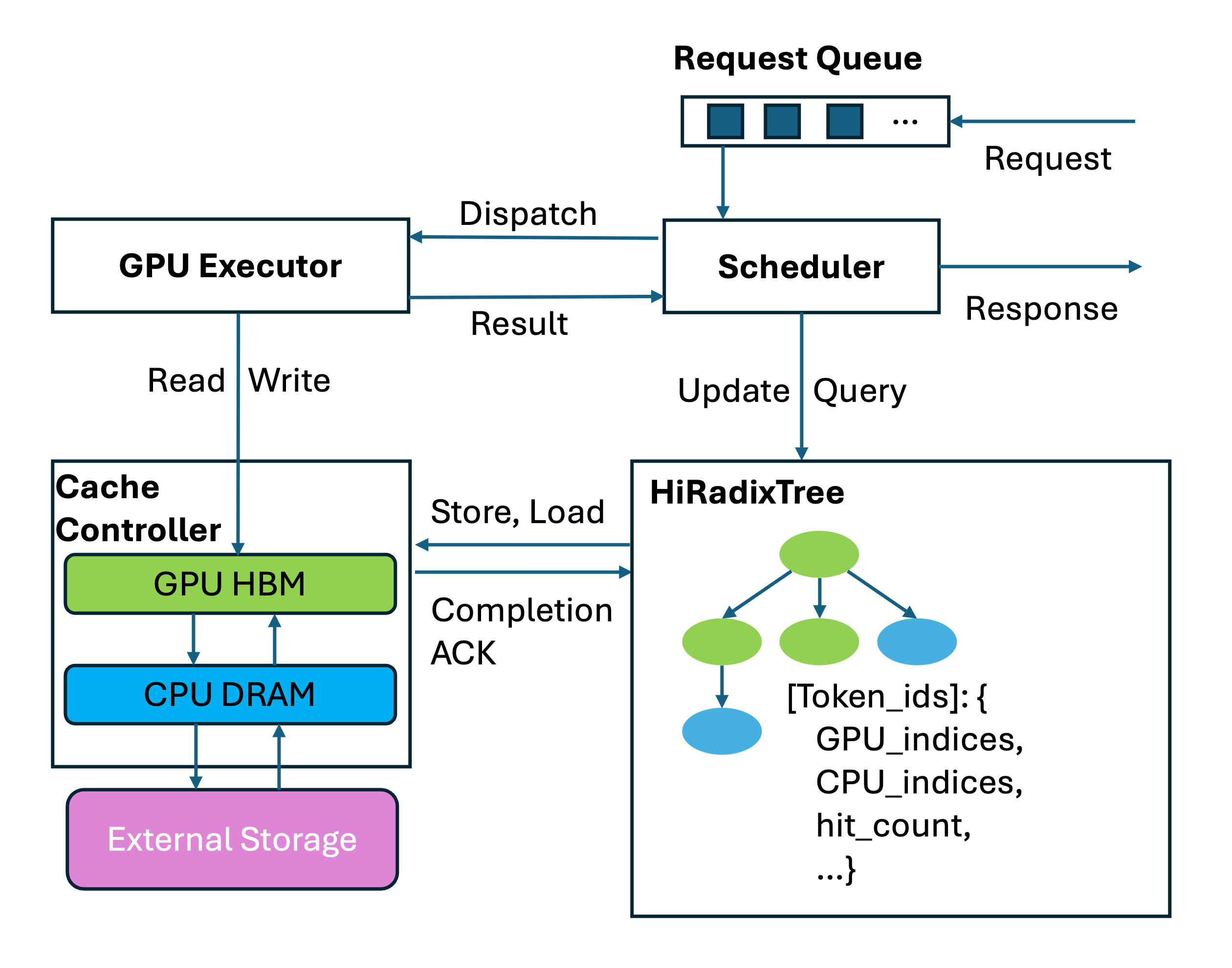
|
||||
|
||||
### Local Match
|
||||
|
||||
Local matching is the first step in HiCache's workflow, where incoming request tokens are matched against the HiRadixTree to locate cached KV data in local memory tiers (L1 GPU memory and L2 host memory).
|
||||
|
||||
The matching algorithm traverses the HiRadixTree from the root node, following child nodes that match the token sequence prefix. At each node, the incoming token sequence is compared with the node’s stored token sequence. When `page_size > 1`, matching is performed at the page granularity to optimize memory access patterns. If a match terminates within a node’s stored sequence, the node is automatically split to create an exact boundary, improving the efficiency of future matches.
|
||||
|
||||
The algorithm returns a continuous prefix of the request, with the first part residing in L1 and the latter part in L2.
|
||||
|
||||
Since the process only requires traversing the local HiRadixTree and does not involve any actual data copying, local matching is extremely fast.
|
||||
|
||||
### Prefetch from L3
|
||||
|
||||
Data prefetching is one of HiCache’s core optimization techniques, designed to proactively load KV caches from L3 storage into local L2 memory, thereby reducing access latency during subsequent operations.
|
||||
|
||||
**Prefetch Trigger Conditions**:
|
||||
After local matching, for the parts not found in L1 or L2, the system queries L3 to retrieve metadata for the next continuous matching KV caches. If the length of hit cache in L3 exceeds a threshold (default: 256 tokens, configurable), a prefetch operation is triggered.
|
||||
|
||||
**Prefetch Strategies**: HiCache provides three different prefetch termination strategies to address different scenario needs:
|
||||
- **best_effort**: Terminates immediately when GPU can execute prefill computation, with no waiting time, suitable for scenarios extremely sensitive to latency.
|
||||
- **wait_complete**: Must wait for all prefetch operations to complete, suitable for scenarios requiring high cache hit rates.
|
||||
- **timeout**: Terminates after specified time or when complete, balancing latency and cache hit rate needs.
|
||||
|
||||
After prefetching stops, the data already fetched is used together with the local data for the prefill computation.
|
||||
|
||||
For **timeout** strategy, HiCache introduces two configuration parameters to support fine-grained control over prefetch timeout conditions:
|
||||
|
||||
* `prefetch_timeout_base`: the base timeout, representing overhead unrelated to the number of tokens (e.g., scheduling and synchronization).
|
||||
* `prefetch_timeout_per_ki_token`: the incremental timeout per thousand tokens.
|
||||
|
||||
The timeout is computed as:
|
||||
|
||||
```
|
||||
timeout = prefetch_timeout_base + prefetch_timeout_per_ki_token * num_token_to_fetch / 1024
|
||||
```
|
||||
|
||||
### Data Write-back
|
||||
|
||||
The write-back mechanism is responsible for moving frequently accessed KV caches from L1 to L2 and L3, enabling larger and longer-term storage as well as cache sharing across instances.
|
||||
|
||||
**Configurable Write-back Policies**: HiCache supports three write-back strategies:
|
||||
|
||||
* **write_through**: Every access is immediately written back to the next level. When bandwidth is sufficient, this strategy provides the strongest caching benefit.
|
||||
* **write_through_selective**: Data is written back only after the access frequency exceeds a threshold. This strategy backs up only hot data, reducing I/O overhead.
|
||||
* **write_back**: Data is written back to the next level only when it is evicted from the upper level. This strategy alleviates storage pressure and is suitable for scenarios where storage capacity is limited but memory utilization must be maximized.
|
||||
|
||||
**Cross-instance Sharing**: When data is written back from L2 to L3, only data not already present in L3 is transferred. KV caches stored in L3 can then be shared across all SGLang instances in the cluster (depending on the L3 backend implementation), significantly improving cache hit rates within the same memory budget.
|
||||
|
||||
### Multi-Rank Synchronization
|
||||
|
||||
During multi-GPU parallel computation, such as tensor parallelism (TP), HiCache must ensure consistent states across different ranks. Therefore, critical computation steps require the use of `all_reduce` for state synchronization.
|
||||
|
||||
For example, during prefetching, `all_reduce(op=min)` is used to ensure that all ranks obtain the same number of L3 hits, preventing inconsistent judgments about whether the prefetch threshold has been reached. Similarly, after prefetching completes or terminates, `all_reduce(op=min)` is again required to guarantee consensus among ranks on the prefix length of the successfully retrieved KV cache.
|
||||
|
||||
### Data Transfer Optimization
|
||||
|
||||
**Zero-Copy Data Transfers**: Both prefetching and write-back involve substantial data movement. Minimizing the number of data copies can significantly improve system performance. HiCache supports passing memory addresses and sizes directly when transferring data from L2 memory to an L3 backend.
|
||||
|
||||
**“Batch-Oriented” Data Organization**: The granularity of data reads and writes has a major impact on performance. To address this, HiCache L3 stores and transfers KV cache data at the granularity of **pages** and supports different data layouts beyond the existing `layer first` scheme, including `page first` and `page first direct`. Under the `page first` and `page first direct` layouts, all KV cache data belonging to the same page is placed in contiguous memory, allowing it to be passed as a single object to L3 using zero-copy transfers.
|
||||
|
||||
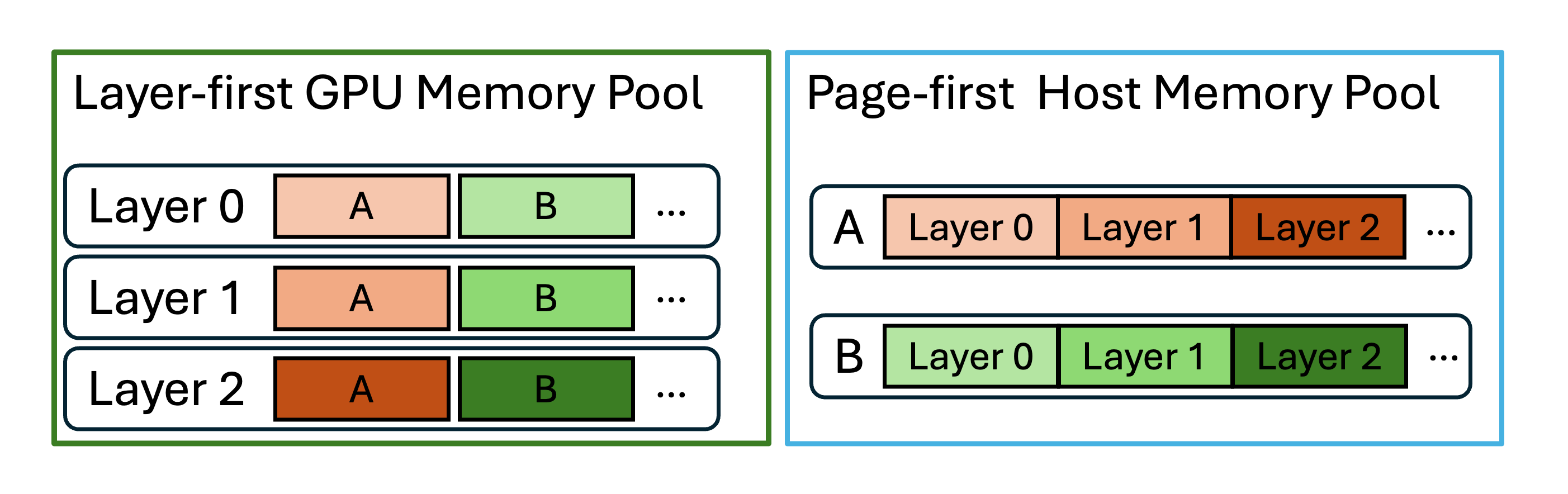
|
||||
|
||||
However, because GPU KV computation is naturally performed layer by layer, the GPU inherently operates in a `layer first` layout. When transferring `page first` data from L2 to the GPU, data must be transferred at the granularity of one token per layer. The `page first direct` layout mitigates this issue by grouping together all tokens of a given layer within a page, allowing transfers from L2 to GPU to be aggregated at the page-layer level.
|
||||
|
||||
**CPU-to-GPU Transfer Optimizations**: In HiCache, moving data from CPU memory to GPU is as performance-critical as prefetching data from L3 to L2. HiCache employs several optimizations for this process:
|
||||
|
||||
* **Compute-Transfer Overlap**: During the prefill phase, when transferring data from CPU to GPU, HiCache overlaps layers by concurrently loading the KV cache of layer N+1 while computing layer N. This effectively hides data transfer latency.
|
||||
* **GPU-assisted I/O Kernels**: On top of `cudaMemcpyAsync`, HiCache implements a set of GPU-assisted I/O kernels specifically optimized for KV cache transfers between CPU and GPU. Compared to the baseline approach, these kernels achieve up to 3x higher transfer speed.
|
||||
|
||||
**Write-back Optimization for MLA**: For MHA (Multi-Head Attention) models under multi-TP, each rank holds `1/tp_size` of a token’s KV data. In contrast, for MLA (Multi-Layer Attention) models, all ranks hold the complete and identical KV data for each token. HiCache includes a dedicated optimization for MLA: only one rank initiates the write-back operation, ensuring that data is not redundantly stored across ranks.
|
||||
|
||||
### Integration with PD-Disaggregation Deployment Mode
|
||||
|
||||
SGLang supports a PD (Prefill-Decode) disaggregation deployment mode through the Mooncake TransferEngine (for details, see [this doc](https://docs.sglang.ai/advanced_features/pd_disaggregation.html)). In the PD-disaggregation deployment mode, HiCache can be enabled on both the prefill nodes and decode nodes to optimize prefill performance. If enabled on decode nodes, the decode output will also be written back to L3.
|
||||
|
||||
### Unified Interfaces and Rich L3 Storage Backends
|
||||
|
||||
HiCache encapsulates all read, write, and query operations on L3 backends within the `class HiCacheStorage(ABC)`, exposing a set of simple and consistent interfaces. This design supports a wide range of L3 storage backends and allows users to select the one that best fits their specific use cases.
|
||||
|
||||
- **Mooncake**: Mooncake is a high-performance caching system for LLM inference that leverages RDMA and multi-NIC resources to enable zero-copy, ultra-fast data transfers. Try Mooncake [here](https://github.com/sgl-project/sglang/tree/main/python/sglang/srt/mem_cache/storage/mooncake_store).
|
||||
|
||||
- **DeepSeek 3FS (HF3FS)**: HF3FS is a Kubernetes-native distributed storage solution with operator-based deployment. Try HF3FS [here](https://github.com/sgl-project/sglang/tree/main/python/sglang/srt/mem_cache/storage/hf3fs).
|
||||
|
||||
- **NIXL**: NIXL provides a unified API for accessing various storage plugins, including but not limited to DeepSeek's 3FS, GPU Direct Storage (GDS) and Amazon S3-compatible object storage. Try NIXL [here](https://github.com/sgl-project/sglang/tree/main/python/sglang/srt/mem_cache/storage/nixl).
|
||||
|
||||
- **AIBrix KVCache**: AIBrix KVCache is a production-ready KVCache Offloading Framework, which enables efficient memory tiering and low-overhead cross-engine reuse. Try AIBrix KVCache [here](https://github.com/sgl-project/sglang/tree/main/python/sglang/srt/mem_cache/storage/aibrix_kvcache).
|
||||
|
||||
- **HiCacheFile**: A simple file-based storage backend for demonstration purposes.
|
||||
|
||||
Specifically, **LMCache**, an efficient KV cache layer for enterprise-scale LLM inference, provides an alternative solution to HiCache. Try LMCache [here](https://github.com/sgl-project/sglang/tree/main/python/sglang/srt/mem_cache/storage/lmcache).
|
||||
|
||||
## Related Parameters
|
||||
|
||||
- **`--enable-hierarchical-cache`**: Enable hierarchical cache functionality. This is required to use HiCache.
|
||||
|
||||
- **`--hicache-ratio HICACHE_RATIO`**: The ratio of the size of host KV cache memory pool to the size of device pool. For example, a value of 2 means the host memory pool is twice as large as the device memory pool. The minimum allowed value is 2.
|
||||
|
||||
- **`--hicache-size HICACHE_SIZE`**: The size of host KV cache memory pool in gigabytes. This parameter overrides `hicache-ratio` if set. For example, `--hicache-size 30` allocates 30GB for the host memory pool **for each rank**. If there are 8 ranks, then the total memory size is 240GB.
|
||||
|
||||
**Note**: `--hicache-ratio` and `--hicache-size` are two critical parameters. In general, a larger HiCache size leads to a higher cache hit rate, which improves prefill performance. However, the relationship between cache size and hit rate is not linear. Once most reusable KV data—especially hot tokens—are already cached, further increasing the size may yield only marginal performance gains. Users can set these parameters based on their workload characteristics and performance requirements.
|
||||
|
||||
- **`--page-size PAGE_SIZE`**: The number of tokens per page. This parameter determines the granularity of KV cache storage and retrieval. Larger page sizes reduce metadata overhead and improve I/O efficiency for storage backends, but may lower the cache hit rate when only part of a page matches the stored KV cache. For workloads with long common prefixes, larger pages can improve performance, while workloads with more diverse prefixes may benefit from smaller pages. See [Data Transfer Optimization](#data-transfer-optimization) for how page granularity affects I/O performance.
|
||||
|
||||
- **`--hicache-storage-prefetch-policy {best_effort,wait_complete,timeout}`**: Controls when prefetching from storage should stop. See [Prefetch from L3](#prefetch-from-l3) for details.
|
||||
- `best_effort`: Prefetch as much as possible without blocking
|
||||
- `wait_complete`: Wait for prefetch to complete before proceeding
|
||||
- `timeout`: Terminates after specified time or when complete (Recommended for production environments, as setting an appropriate timeout helps the system meet required SLOs)
|
||||
|
||||
- **`--hicache-write-policy {write_back,write_through,write_through_selective}`**: Controls how data is written from faster to slower memory tiers. See [Data Write-back](#data-write-back) for details.
|
||||
- `write_through`: Immediately writes data to all tiers (strongest caching benefits)
|
||||
- `write_through_selective`: Uses hit-count tracking to back up only frequently accessed data
|
||||
- `write_back`: Writes data back to slower tiers only when eviction is needed (reduces I/O load)
|
||||
|
||||
- **`--hicache-io-backend {direct,kernel}`**: Choose the I/O backend for KV cache transfer between CPU and GPU. See [Data Transfer Optimization](#data-transfer-optimization) for details.
|
||||
- `direct`: Standard CUDA memory copy operations
|
||||
- `kernel`: GPU-assisted I/O kernels (recommended for better performance)
|
||||
|
||||
- **`--hicache-mem-layout {layer_first,page_first,page_first_direct}`**: Memory layout for the host memory pool. See [Data Transfer Optimization](#data-transfer-optimization) for details.
|
||||
- `layer_first`: Compatible with GPU computation kernels (default for GPU memory)
|
||||
- `page_first`: Optimized for I/O efficiency
|
||||
- `page_first_direct`: Groups all tokens of a given layer within a page, allowing transfers from L2 to GPU to be aggregated at the page-layer level
|
||||
|
||||
- **`--hicache-storage-backend {file,mooncake,hf3fs,nixl,aibrix,dynamic}`**: Choose the storage backend for the L3 tier. Built-in backends: file, mooncake, hf3fs, nixl, aibrix. For dynamic backend, use --hicache-storage-backend-extra-config to specify: `backend_name` (custom name), `module_path` (Python module path), `class_name` (backend class name). See [Unified Interfaces and Rich L3 Storage Backends](#unified-interfaces-and-rich-l3-storage-backends) for available backends.
|
||||
|
||||
- **`--enable-lmcache`**: Using LMCache as an alternative hierarchical cache solution.
|
||||
|
||||
- **`--hicache-storage-backend-extra-config HICACHE_STORAGE_BACKEND_EXTRA_CONFIG`**: JSON string containing extra configuration for the storage backend, e.g., `--hicache-storage-backend-extra-config '{"prefetch_threshold":512, "prefetch_timeout_base": 0.5, "prefetch_timeout_per_ki_token": 0.25}' `
|
||||
@@ -23,7 +23,7 @@ The case of a server being too conservative can happen when users send many requ
|
||||
|
||||
On the other hand, if you see `token usage` very high and you frequently see warnings like
|
||||
`KV cache pool is full. Retract requests. #retracted_reqs: 1, #new_token_ratio: 0.9998 -> 1.0000`, you can increase `--schedule-conservativeness` to a value like 1.3.
|
||||
If you see `KV cache pool is full. Retract requests.` occasionally but not frequently (~1 time per minute), it is okay.
|
||||
If you see `KV cache pool is full. Retract requests.` occasionally but not frequently, it is okay.
|
||||
|
||||
### Tune `--mem-fraction-static` to increase KV cache pool capacity
|
||||
SGLang allocates memory as follows:
|
||||
|
||||
@@ -35,16 +35,12 @@
|
||||
"\n",
|
||||
"* `max_loaded_loras`: If specified, it limits the maximum number of LoRA adapters loaded in CPU memory at a time. The value must be greater than or equal to `max-loras-per-batch`.\n",
|
||||
"\n",
|
||||
"* `lora_eviction_policy`: LoRA adapter eviction policy when GPU memory pool is full. `lru`: Least Recently Used (default, better cache efficiency). `fifo`: First-In-First-Out.\n",
|
||||
"\n",
|
||||
"* `lora_backend`: The backend of running GEMM kernels for Lora modules. Currently we support Triton LoRA backend (`triton`) and Chunked SGMV backend (`csgmv`). In the future, faster backend built upon Cutlass or Cuda kernels will be added.\n",
|
||||
"* `lora_backend`: The backend of running GEMM kernels for Lora modules. Currently we only support Triton LoRA backend. In the future, faster backend built upon Cutlass or Cuda kernels will be added.\n",
|
||||
"\n",
|
||||
"* `max_lora_rank`: The maximum LoRA rank that should be supported. If not specified, it will be automatically inferred from the adapters provided in `--lora-paths`. This argument is needed when you expect to dynamically load adapters of larger LoRA rank after server startup.\n",
|
||||
"\n",
|
||||
"* `lora_target_modules`: The union set of all target modules where LoRA should be applied (e.g., `q_proj`, `k_proj`, `gate_proj`). If not specified, it will be automatically inferred from the adapters provided in `--lora-paths`. This argument is needed when you expect to dynamically load adapters of different target modules after server startup. You can also set it to `all` to enable LoRA for all supported modules. However, enabling LoRA on additional modules introduces a minor performance overhead. If your application is performance-sensitive, we recommend only specifying the modules for which you plan to load adapters.\n",
|
||||
"\n",
|
||||
"* `--max-lora-chunk-size`: Maximum chunk size for the ChunkedSGMV LoRA backend. Only used when --lora-backend is 'csgmv'. Choosing a larger value might improve performance. Please tune this value based on your hardware and workload as needed. Defaults to 16.\n",
|
||||
"\n",
|
||||
"* `tp_size`: LoRA serving along with Tensor Parallelism is supported by SGLang. `tp_size` controls the number of GPUs for tensor parallelism. More details on the tensor sharding strategy can be found in [S-Lora](https://arxiv.org/pdf/2311.03285) paper.\n",
|
||||
"\n",
|
||||
"From client side, the user needs to provide a list of strings as input batch, and a list of adaptor names that each input sequence corresponds to."
|
||||
@@ -59,17 +55,6 @@
|
||||
"### Serving Single Adaptor"
|
||||
]
|
||||
},
|
||||
{
|
||||
"cell_type": "markdown",
|
||||
"metadata": {},
|
||||
"source": [
|
||||
"**Note:** SGLang supports LoRA adapters through two APIs:\n",
|
||||
"\n",
|
||||
"1. **OpenAI-Compatible API** (`/v1/chat/completions`, `/v1/completions`): Use the `model:adapter-name` syntax. See [OpenAI API with LoRA](../basic_usage/openai_api_completions.ipynb#Using-LoRA-Adapters) for examples.\n",
|
||||
"\n",
|
||||
"2. **Native API** (`/generate`): Pass `lora_path` in the request body (shown below)."
|
||||
]
|
||||
},
|
||||
{
|
||||
"cell_type": "code",
|
||||
"execution_count": null,
|
||||
@@ -94,8 +79,7 @@
|
||||
"python3 -m sglang.launch_server --model-path meta-llama/Meta-Llama-3.1-8B-Instruct \\\n",
|
||||
" --enable-lora \\\n",
|
||||
" --lora-paths lora0=algoprog/fact-generation-llama-3.1-8b-instruct-lora \\\n",
|
||||
" --max-loras-per-batch 1 \\\n",
|
||||
" --log-level warning \\\n",
|
||||
" --max-loras-per-batch 1 --lora-backend triton \\\n",
|
||||
"\"\"\"\n",
|
||||
")\n",
|
||||
"\n",
|
||||
@@ -154,8 +138,7 @@
|
||||
" --enable-lora \\\n",
|
||||
" --lora-paths lora0=algoprog/fact-generation-llama-3.1-8b-instruct-lora \\\n",
|
||||
" lora1=Nutanix/Meta-Llama-3.1-8B-Instruct_lora_4_alpha_16 \\\n",
|
||||
" --max-loras-per-batch 2 \\\n",
|
||||
" --log-level warning \\\n",
|
||||
" --max-loras-per-batch 2 --lora-backend triton \\\n",
|
||||
"\"\"\"\n",
|
||||
")\n",
|
||||
"\n",
|
||||
@@ -229,10 +212,9 @@
|
||||
" python3 -m sglang.launch_server --model-path meta-llama/Meta-Llama-3.1-8B-Instruct \\\n",
|
||||
" --enable-lora \\\n",
|
||||
" --cuda-graph-max-bs 2 \\\n",
|
||||
" --max-loras-per-batch 2 \\\n",
|
||||
" --max-loras-per-batch 2 --lora-backend triton \\\n",
|
||||
" --max-lora-rank 256\n",
|
||||
" --lora-target-modules all\n",
|
||||
" --log-level warning\n",
|
||||
" \"\"\"\n",
|
||||
")\n",
|
||||
"\n",
|
||||
@@ -390,15 +372,6 @@
|
||||
"print(f\"Output from lora1 (updated): \\n{response.json()[1]['text']}\\n\")"
|
||||
]
|
||||
},
|
||||
{
|
||||
"cell_type": "markdown",
|
||||
"metadata": {},
|
||||
"source": [
|
||||
"### OpenAI-compatible API usage\n",
|
||||
"\n",
|
||||
"You can use LoRA adapters via the OpenAI-compatible APIs by specifying the adapter in the `model` field using the `base-model:adapter-name` syntax (for example, `qwen/qwen2.5-0.5b-instruct:adapter_a`). For more details and examples, see the “Using LoRA Adapters” section in the OpenAI API documentation: [openai_api_completions.ipynb](../basic_usage/openai_api_completions.ipynb).\n"
|
||||
]
|
||||
},
|
||||
{
|
||||
"cell_type": "code",
|
||||
"execution_count": null,
|
||||
@@ -437,14 +410,13 @@
|
||||
" python3 -m sglang.launch_server --model-path meta-llama/Meta-Llama-3.1-8B-Instruct \\\n",
|
||||
" --enable-lora \\\n",
|
||||
" --cuda-graph-max-bs 8 \\\n",
|
||||
" --max-loras-per-batch 3 \\\n",
|
||||
" --max-loras-per-batch 3 --lora-backend triton \\\n",
|
||||
" --max-lora-rank 256 \\\n",
|
||||
" --lora-target-modules all \\\n",
|
||||
" --lora-paths \\\n",
|
||||
" {\"lora_name\":\"lora0\",\"lora_path\":\"Nutanix/Meta-Llama-3.1-8B-Instruct_lora_4_alpha_16\",\"pinned\":true} \\\n",
|
||||
" {\"lora_name\":\"lora1\",\"lora_path\":\"algoprog/fact-generation-llama-3.1-8b-instruct-lora\"} \\\n",
|
||||
" lora2=philschmid/code-llama-3-1-8b-text-to-sql-lora\n",
|
||||
" --log-level warning\n",
|
||||
" \"\"\"\n",
|
||||
")\n",
|
||||
"\n",
|
||||
@@ -525,48 +497,6 @@
|
||||
"terminate_process(server_process)"
|
||||
]
|
||||
},
|
||||
{
|
||||
"cell_type": "markdown",
|
||||
"metadata": {},
|
||||
"source": [
|
||||
"## Choosing LoRA Backend\n",
|
||||
"\n",
|
||||
"SGLang supports two LoRA backends that you can choose from using the `--lora-backend` argument:\n",
|
||||
"\n",
|
||||
"- `triton`: Default basic Triton-based backend.\n",
|
||||
"- `csgmv`: Chunked SGMV backend optimized for high concurrency scenarios.\n",
|
||||
"\n",
|
||||
"The `csgmv` backend was recently introduced to improve performance especially at high-concurrency scenarios. Our benchmark shows that it achieves 20% to 80% latency improvements over the basic triton backend.\n",
|
||||
"Currently it is at preview phase, we expect to make it our the default LoRA backend in future release. Before that, you can adopt it by manually setting the `--lora-backend` server config."
|
||||
]
|
||||
},
|
||||
{
|
||||
"cell_type": "code",
|
||||
"execution_count": null,
|
||||
"metadata": {},
|
||||
"outputs": [],
|
||||
"source": [
|
||||
"server_process, port = launch_server_cmd(\n",
|
||||
" \"\"\"\n",
|
||||
" python3 -m sglang.launch_server \\\n",
|
||||
" --model-path meta-llama/Meta-Llama-3.1-8B-Instruct \\\n",
|
||||
" --enable-lora \\\n",
|
||||
" --lora-backend csgmv \\\n",
|
||||
" --max-loras-per-batch 16 \\\n",
|
||||
" --lora-paths lora1=path/to/lora1 lora2=path/to/lora2\n",
|
||||
" \"\"\"\n",
|
||||
")"
|
||||
]
|
||||
},
|
||||
{
|
||||
"cell_type": "code",
|
||||
"execution_count": null,
|
||||
"metadata": {},
|
||||
"outputs": [],
|
||||
"source": [
|
||||
"terminate_process(server_process)"
|
||||
]
|
||||
},
|
||||
{
|
||||
"cell_type": "markdown",
|
||||
"metadata": {},
|
||||
|
||||
@@ -17,10 +17,6 @@ For the design details, please refer to [link](https://docs.google.com/document/
|
||||
|
||||
Currently, we support Mooncake and NIXL as the transfer engine.
|
||||
|
||||
## Profiling in PD Disaggregation Mode
|
||||
|
||||
When you need to profile prefill or decode workers in PD disaggregation mode, please refer to the [Profile In PD Disaggregation Mode](https://docs.sglang.ai/developer_guide/benchmark_and_profiling.html#profile-in-pd-disaggregation-mode) section in the Benchmark and Profiling guide. Due to torch profiler limitations, prefill and decode workers must be profiled separately using dedicated command-line options.
|
||||
|
||||
## Router Integration
|
||||
|
||||
For deploying PD disaggregation at scale with load balancing and fault tolerance, SGLang provides a router. The router can distribute requests between prefill and decode instances using various routing policies. For detailed information on setting up routing with PD disaggregation, including configuration options and deployment patterns, see the [SGLang Router documentation](router.md#mode-3-prefill-decode-disaggregation).
|
||||
@@ -38,102 +34,27 @@ uv pip install mooncake-transfer-engine
|
||||
### Llama Single Node
|
||||
|
||||
```bash
|
||||
python -m sglang.launch_server \
|
||||
--model-path meta-llama/Llama-3.1-8B-Instruct \
|
||||
--disaggregation-mode prefill \
|
||||
--port 30000 \
|
||||
--disaggregation-ib-device mlx5_roce0
|
||||
python -m sglang.launch_server \
|
||||
--model-path meta-llama/Llama-3.1-8B-Instruct \
|
||||
--disaggregation-mode decode \
|
||||
--port 30001 \
|
||||
--base-gpu-id 1 \
|
||||
--disaggregation-ib-device mlx5_roce0
|
||||
python -m sglang_router.launch_router --pd-disaggregation --prefill http://127.0.0.1:30000 --decode http://127.0.0.1:30001 --host 0.0.0.0 --port 8000
|
||||
$ python -m sglang.launch_server --model-path meta-llama/Llama-3.1-8B-Instruct --disaggregation-mode prefill --disaggregation-ib-device mlx5_roce0
|
||||
$ python -m sglang.launch_server --model-path meta-llama/Llama-3.1-8B-Instruct --disaggregation-mode decode --port 30001 --base-gpu-id 1 --disaggregation-ib-device mlx5_roce0
|
||||
$ python -m sglang.srt.disaggregation.mini_lb --prefill http://127.0.0.1:30000 --decode http://127.0.0.1:30001 --host 0.0.0.0 --port 8000
|
||||
```
|
||||
|
||||
### DeepSeek Multi-Node
|
||||
|
||||
```bash
|
||||
# prefill 0
|
||||
python -m sglang.launch_server \
|
||||
--model-path deepseek-ai/DeepSeek-V3-0324 \
|
||||
--disaggregation-ib-device ${device_name} \
|
||||
--disaggregation-mode prefill \
|
||||
--host ${local_ip} \
|
||||
--port 30000 \
|
||||
--trust-remote-code \
|
||||
--dist-init-addr ${prefill_master_ip}:5000 \
|
||||
--nnodes 2 \
|
||||
--node-rank 0 \
|
||||
--tp-size 16 \
|
||||
--dp-size 8 \
|
||||
--enable-dp-attention \
|
||||
--moe-a2a-backend deepep \
|
||||
--mem-fraction-static 0.8
|
||||
$ python -m sglang.launch_server --model-path deepseek-ai/DeepSeek-V3-0324 --disaggregation-ib-device ${device_name} --disaggregation-mode prefill --host ${local_ip} --port 30000 --trust-remote-code --dist-init-addr ${prefill_master_ip}:5000 --nnodes 2 --node-rank 0 --tp-size 16 --dp-size 8 --enable-dp-attention --moe-a2a-backend deepep --mem-fraction-static 0.8
|
||||
# prefill 1
|
||||
python -m sglang.launch_server \
|
||||
--model-path deepseek-ai/DeepSeek-V3-0324 \
|
||||
--disaggregation-ib-device ${device_name} \
|
||||
--disaggregation-mode prefill \
|
||||
--host ${local_ip} \
|
||||
--port 30000 \
|
||||
--trust-remote-code \
|
||||
--dist-init-addr ${prefill_master_ip}:5000 \
|
||||
--nnodes 2 \
|
||||
--node-rank 1 \
|
||||
--tp-size 16 \
|
||||
--dp-size 8 \
|
||||
--enable-dp-attention \
|
||||
--moe-a2a-backend deepep \
|
||||
--mem-fraction-static 0.8
|
||||
$ python -m sglang.launch_server --model-path deepseek-ai/DeepSeek-V3-0324 --disaggregation-ib-device ${device_name} --disaggregation-mode prefill --host ${local_ip} --port 30000 --trust-remote-code --dist-init-addr ${prefill_master_ip}:5000 --nnodes 2 --node-rank 1 --tp-size 16 --dp-size 8 --enable-dp-attention --moe-a2a-backend deepep --mem-fraction-static 0.8
|
||||
# decode 0
|
||||
python -m sglang.launch_server \
|
||||
--model-path deepseek-ai/DeepSeek-V3-0324 \
|
||||
--disaggregation-ib-device ${device_name} \
|
||||
--disaggregation-mode decode \
|
||||
--host ${local_ip} \
|
||||
--port 30001 \
|
||||
--trust-remote-code \
|
||||
--dist-init-addr ${decode_master_ip}:5000 \
|
||||
--nnodes 2 \
|
||||
--node-rank 0 \
|
||||
--tp-size 16 \
|
||||
--dp-size 8 \
|
||||
--enable-dp-attention \
|
||||
--moe-a2a-backend deepep \
|
||||
--mem-fraction-static 0.8 \
|
||||
--max-running-requests 128
|
||||
$ python -m sglang.launch_server --model-path deepseek-ai/DeepSeek-V3-0324 --disaggregation-ib-device ${device_name} --disaggregation-mode decode --host ${local_ip} --port 30001 --trust-remote-code --dist-init-addr ${decode_master_ip}:5000 --nnodes 2 --node-rank 0 --tp-size 16 --dp-size 8 --enable-dp-attention --moe-a2a-backend deepep --mem-fraction-static 0.8 --max-running-requests 128
|
||||
# decode 1
|
||||
python -m sglang.launch_server \
|
||||
--model-path deepseek-ai/DeepSeek-V3-0324 \
|
||||
--disaggregation-ib-device ${device_name} \
|
||||
--disaggregation-mode decode \
|
||||
--host ${local_ip} \
|
||||
--port 30001 \
|
||||
--trust-remote-code \
|
||||
--dist-init-addr ${decode_master_ip}:5000 \
|
||||
--nnodes 2 \
|
||||
--node-rank 1 \
|
||||
--tp-size 16 \
|
||||
--dp-size 8 \
|
||||
--enable-dp-attention \
|
||||
--moe-a2a-backend deepep \
|
||||
--mem-fraction-static 0.8 \
|
||||
--max-running-requests 128
|
||||
$ python -m sglang.launch_server --model-path deepseek-ai/DeepSeek-V3-0324 --disaggregation-ib-device ${device_name} --disaggregation-mode decode --host ${local_ip} --port 30001 --trust-remote-code --dist-init-addr ${decode_master_ip}:5000 --nnodes 2 --node-rank 1 --tp-size 16 --dp-size 8 --enable-dp-attention --moe-a2a-backend deepep --mem-fraction-static 0.8 --max-running-requests 128
|
||||
```
|
||||
### Advanced Configuration
|
||||
|
||||
PD Disaggregation with Mooncake supports the following environment variables for fine-grained control over system behavior.
|
||||
|
||||
#### NVLink Transport Configuration
|
||||
To enable NVLink transport for KV cache transfers with the mooncake backend (recommended for NVL72 deployments), set the following environment variables. Note that auxiliary data transfer will still use TCP as a temporary workaround.
|
||||
|
||||
```bash
|
||||
export SGLANG_MOONCAKE_CUSTOM_MEM_POOL=True
|
||||
export MC_FORCE_MNNVL=True
|
||||
```
|
||||
|
||||
#### Prefill Server Configuration
|
||||
| Variable | Description | Default |
|
||||
|:--------:|:-----------:|:--------:
|
||||
@@ -177,89 +98,22 @@ pip install . --config-settings=setup-args="-Ducx_path=/path/to/ucx"
|
||||
### Llama Single Node
|
||||
|
||||
```bash
|
||||
python -m sglang.launch_server \
|
||||
--model-path meta-llama/Llama-3.1-8B-Instruct \
|
||||
--disaggregation-mode prefill \
|
||||
--port 30000 \
|
||||
--disaggregation-transfer-backend nixl
|
||||
python -m sglang.launch_server \
|
||||
--model-path meta-llama/Llama-3.1-8B-Instruct \
|
||||
--disaggregation-mode decode \
|
||||
--port 30001 \
|
||||
--base-gpu-id 1 \
|
||||
--disaggregation-transfer-backend nixl
|
||||
python -m sglang_router.launch_router --pd-disaggregation --prefill http://127.0.0.1:30000 --decode http://127.0.0.1:30001 --host 0.0.0.0 --port 8000
|
||||
$ python -m sglang.launch_server --model-path meta-llama/Llama-3.1-8B-Instruct --disaggregation-mode prefill --disaggregation-transfer-backend nixl
|
||||
$ python -m sglang.launch_server --model-path meta-llama/Llama-3.1-8B-Instruct --disaggregation-mode decode --port 30001 --base-gpu-id 1 --disaggregation-transfer-backend nixl
|
||||
$ python -m sglang.srt.disaggregation.mini_lb --prefill http://127.0.0.1:30000 --decode http://127.0.0.1:30001 --host 0.0.0.0 --port 8000
|
||||
```
|
||||
|
||||
### DeepSeek Multi-Node
|
||||
|
||||
```bash
|
||||
# prefill 0
|
||||
python -m sglang.launch_server \
|
||||
--model-path deepseek-ai/DeepSeek-V3-0324 \
|
||||
--disaggregation-transfer-backend nixl \
|
||||
--disaggregation-mode prefill \
|
||||
--host ${local_ip} \
|
||||
--port 30000 \
|
||||
--trust-remote-code \
|
||||
--dist-init-addr ${prefill_master_ip}:5000 \
|
||||
--nnodes 2 \
|
||||
--node-rank 0 \
|
||||
--tp-size 16 \
|
||||
--dp-size 8 \
|
||||
--enable-dp-attention \
|
||||
--moe-a2a-backend deepep \
|
||||
--mem-fraction-static 0.8
|
||||
$ python -m sglang.launch_server --model-path deepseek-ai/DeepSeek-V3-0324 --disaggregation-transfer-backend nixl --disaggregation-mode prefill --host ${local_ip} --port 30000 --trust-remote-code --dist-init-addr ${prefill_master_ip}:5000 --nnodes 2 --node-rank 0 --tp-size 16 --dp-size 8 --enable-dp-attention --moe-a2a-backend deepep --mem-fraction-static 0.8
|
||||
# prefill 1
|
||||
python -m sglang.launch_server \
|
||||
--model-path deepseek-ai/DeepSeek-V3-0324 \
|
||||
--disaggregation-transfer-backend nixl \
|
||||
--disaggregation-mode prefill \
|
||||
--host ${local_ip} \
|
||||
--port 30000 \
|
||||
--trust-remote-code \
|
||||
--dist-init-addr ${prefill_master_ip}:5000 \
|
||||
--nnodes 2 \
|
||||
--node-rank 1 \
|
||||
--tp-size 16 \
|
||||
--dp-size 8 \
|
||||
--enable-dp-attention \
|
||||
--moe-a2a-backend deepep \
|
||||
--mem-fraction-static 0.8
|
||||
$ python -m sglang.launch_server --model-path deepseek-ai/DeepSeek-V3-0324 --disaggregation-transfer-backend nixl --disaggregation-mode prefill --host ${local_ip} --port 30000 --trust-remote-code --dist-init-addr ${prefill_master_ip}:5000 --nnodes 2 --node-rank 1 --tp-size 16 --dp-size 8 --enable-dp-attention --moe-a2a-backend deepep --mem-fraction-static 0.8
|
||||
# decode 0
|
||||
python -m sglang.launch_server \
|
||||
--model-path deepseek-ai/DeepSeek-V3-0324 \
|
||||
--disaggregation-transfer-backend nixl \
|
||||
--disaggregation-mode decode \
|
||||
--host ${local_ip} \
|
||||
--port 30001 \
|
||||
--trust-remote-code \
|
||||
--dist-init-addr ${decode_master_ip}:5000 \
|
||||
--nnodes 2 \
|
||||
--node-rank 0 \
|
||||
--tp-size 16 \
|
||||
--dp-size 8 \
|
||||
--enable-dp-attention \
|
||||
--moe-a2a-backend deepep \
|
||||
--mem-fraction-static 0.8 \
|
||||
--max-running-requests 128
|
||||
$ python -m sglang.launch_server --model-path deepseek-ai/DeepSeek-V3-0324 --disaggregation-transfer-backend nixl --disaggregation-mode decode --host ${local_ip} --port 30001 --trust-remote-code --dist-init-addr ${decode_master_ip}:5000 --nnodes 2 --node-rank 0 --tp-size 16 --dp-size 8 --enable-dp-attention --moe-a2a-backend deepep --mem-fraction-static 0.8 --max-running-requests 128
|
||||
# decode 1
|
||||
python -m sglang.launch_server \
|
||||
--model-path deepseek-ai/DeepSeek-V3-0324 \
|
||||
--disaggregation-transfer-backend nixl \
|
||||
--disaggregation-mode decode \
|
||||
--host ${local_ip} \
|
||||
--port 30001 \
|
||||
--trust-remote-code \
|
||||
--dist-init-addr ${decode_master_ip}:5000 \
|
||||
--nnodes 2 \
|
||||
--node-rank 1 \
|
||||
--tp-size 16 \
|
||||
--dp-size 8 \
|
||||
--enable-dp-attention \
|
||||
--moe-a2a-backend deepep \
|
||||
--mem-fraction-static 0.8 \
|
||||
--max-running-requests 128
|
||||
$ python -m sglang.launch_server --model-path deepseek-ai/DeepSeek-V3-0324 --disaggregation-transfer-backend nixl --disaggregation-mode decode --host ${local_ip} --port 30001 --trust-remote-code --dist-init-addr ${decode_master_ip}:5000 --nnodes 2 --node-rank 1 --tp-size 16 --dp-size 8 --enable-dp-attention --moe-a2a-backend deepep --mem-fraction-static 0.8 --max-running-requests 128
|
||||
```
|
||||
|
||||
## ASCEND
|
||||
@@ -281,45 +135,16 @@ export ENABLE_ASCEND_TRANSFER_WITH_MOONCAKE=true
|
||||
### Llama Single Node
|
||||
|
||||
```bash
|
||||
python -m sglang.launch_server \
|
||||
--model-path meta-llama/Llama-3.1-8B-Instruct \
|
||||
--disaggregation-mode prefill \
|
||||
--port 30000 \
|
||||
--disaggregation-transfer-backend ascend
|
||||
python -m sglang.launch_server \
|
||||
--model-path meta-llama/Llama-3.1-8B-Instruct \
|
||||
--disaggregation-mode decode \
|
||||
--port 30001 \
|
||||
--base-gpu-id 1 \
|
||||
--disaggregation-transfer-backend ascend
|
||||
python -m sglang_router.launch_router --pd-disaggregation --prefill http://127.0.0.1:30000 --decode http://127.0.0.1:30001 --host 0.0.0.0 --port 8000
|
||||
$ python -m sglang.launch_server --model-path meta-llama/Llama-3.1-8B-Instruct --disaggregation-mode prefill --disaggregation-transfer-backend ascend
|
||||
$ python -m sglang.launch_server --model-path meta-llama/Llama-3.1-8B-Instruct --disaggregation-mode decode --port 30001 --base-gpu-id 1 --disaggregation-transfer-backend ascend
|
||||
$ python -m sglang.srt.disaggregation.mini_lb --prefill http://127.0.0.1:30000 --decode http://127.0.0.1:30001 --host 0.0.0.0 --port 8000
|
||||
```
|
||||
|
||||
### DeepSeek Multi-Node
|
||||
|
||||
```bash
|
||||
# prefill 0
|
||||
python -m sglang.launch_server \
|
||||
--model-path deepseek-ai/DeepSeek-V3-0324 \
|
||||
--disaggregation-transfer-backend ascend \
|
||||
--disaggregation-mode prefill \
|
||||
--host ${local_ip} \
|
||||
--port 30000 \
|
||||
--trust-remote-code \
|
||||
--dist-init-addr ${prefill_master_ip}:5000 \
|
||||
--nnodes 1 \
|
||||
--node-rank 0 \
|
||||
--tp-size 16
|
||||
$ python -m sglang.launch_server --model-path deepseek-ai/DeepSeek-V3-0324 --disaggregation-transfer-backend ascend --disaggregation-mode prefill --host ${local_ip} --port 30000 --trust-remote-code --dist-init-addr ${prefill_master_ip}:5000 --nnodes 1 --node-rank 0 --tp-size 16
|
||||
# decode 0
|
||||
python -m sglang.launch_server \
|
||||
--model-path deepseek-ai/DeepSeek-V3-0324 \
|
||||
--disaggregation-transfer-backend ascend \
|
||||
--disaggregation-mode decode \
|
||||
--host ${local_ip} \
|
||||
--port 30001 \
|
||||
--trust-remote-code \
|
||||
--dist-init-addr ${decode_master_ip}:5000 \
|
||||
--nnodes 1 \
|
||||
--node-rank 0 \
|
||||
--tp-size 16
|
||||
$ python -m sglang.launch_server --model-path deepseek-ai/DeepSeek-V3-0324 --disaggregation-transfer-backend ascend --disaggregation-mode decode --host ${local_ip} --port 30001 --trust-remote-code --dist-init-addr ${decode_master_ip}:5000 --nnodes 1 --node-rank 0 --tp-size 16
|
||||
```
|
||||
Loaded 100 of 1703 files, more files were not shown because too many files have changed in this diff.
Show more
Reference in new issue
Block a user