
257 lines
6.3 KiB
Markdown
257 lines
6.3 KiB
Markdown
---
|
||
language:
|
||
- en
|
||
license: other
|
||
license_name: qwen-research
|
||
base_model: Qwen/Qwen2.5-8B
|
||
tags:
|
||
- qwen
|
||
- lora
|
||
- merged
|
||
- math
|
||
- reasoning
|
||
- tool-integrated-reasoning
|
||
- aimo
|
||
- safetensors
|
||
datasets:
|
||
- jeannkouagou/aimo3-tool-integrated-reasoning
|
||
pipeline_tag: text-generation
|
||
library_name: transformers
|
||
---
|
||
|
||
# Qwen3-8B AIMO3 Tool-Integrated Reasoning
|
||
|
||
## Model Summary
|
||
|
||
A LoRA fine-tuned version of Qwen-8B trained for **tool-integrated reasoning** on the AIMO3 competition dataset (generated by GPT-OSS-120B). The LoRA adapters have been **merged** into the base model and saved in SafeTensors format for straightforward deployment.
|
||
|
||
| Property | Details |
|
||
|---|---|
|
||
| Base Model | Qwen-8B |
|
||
| Fine-tuning Method | LoRA (merged) |
|
||
| Format | SafeTensors (BF16) |
|
||
| Parameters | ~8B |
|
||
| Disk Size | ~16GB |
|
||
| Max Context | 8192 tokens |
|
||
|
||
---
|
||
|
||
## Model Details
|
||
|
||
### LoRA Configuration
|
||
|
||
| Hyperparameter | Value |
|
||
|---|---|
|
||
| Rank (r) | 16 |
|
||
| Alpha | 32 |
|
||
| Dropout | 0.05 |
|
||
| Bias | none |
|
||
| Target Modules | `q_proj`, `k_proj`, `v_proj`, `o_proj`, `gate_proj`, `up_proj`, `down_proj` |
|
||
|
||
### Training Hyperparameters
|
||
|
||
| Hyperparameter | Value |
|
||
|---|---|
|
||
| Precision | BFloat16 (no quantization) |
|
||
| Epochs | 2 |
|
||
| Steps | 8750 (~1 epoch) |
|
||
| Per-device Batch Size | 2 |
|
||
| Gradient Accumulation Steps | 8 (effective batch: 16) |
|
||
| Learning Rate | 2e-4 |
|
||
| LR Scheduler | Cosine with warmup |
|
||
| Warmup Ratio | 0.03 |
|
||
| Weight Decay | 0.01 |
|
||
| Max Gradient Norm | 1.0 |
|
||
| Max Sequence Length | 8192 |
|
||
| Optimizer | AdamW (Fused) |
|
||
|
||
### Hardware & Infrastructure
|
||
|
||
- **Platform**: Kaggle
|
||
- **GPU**: Single NVIDIA H100 (80GB)
|
||
- **Attention**: Flash Attention 2
|
||
- **Optimizations**: Gradient checkpointing, TF32, fused optimizer
|
||
|
||
---
|
||
|
||
## Training Data
|
||
|
||
- **Dataset**: [AIMO3 Tool-Integrated Reasoning Dataset](https://www.kaggle.com/datasets/jeannkouagou/aimo3-tool-integrated-reasoning) (synthesized by GPT-OSS-120B)
|
||
- **Split**: 97.5% train / 2.5% validation
|
||
- **Format**: CSV with problem–solution pairs
|
||
|
||
**Supported column names:**
|
||
- Input: `problem`, `question`, `input`, `prompt`
|
||
- Output: `solution`, `answer`, `output`, `response`, `completion`
|
||
|
||
### Instruction Format
|
||
|
||
Training uses a ChatML-style format:
|
||
```
|
||
<|im_start|>user
|
||
{prompt}<|im_end|>
|
||
<|im_start|>assistant
|
||
{response}<|im_end|>
|
||
```
|
||
|
||
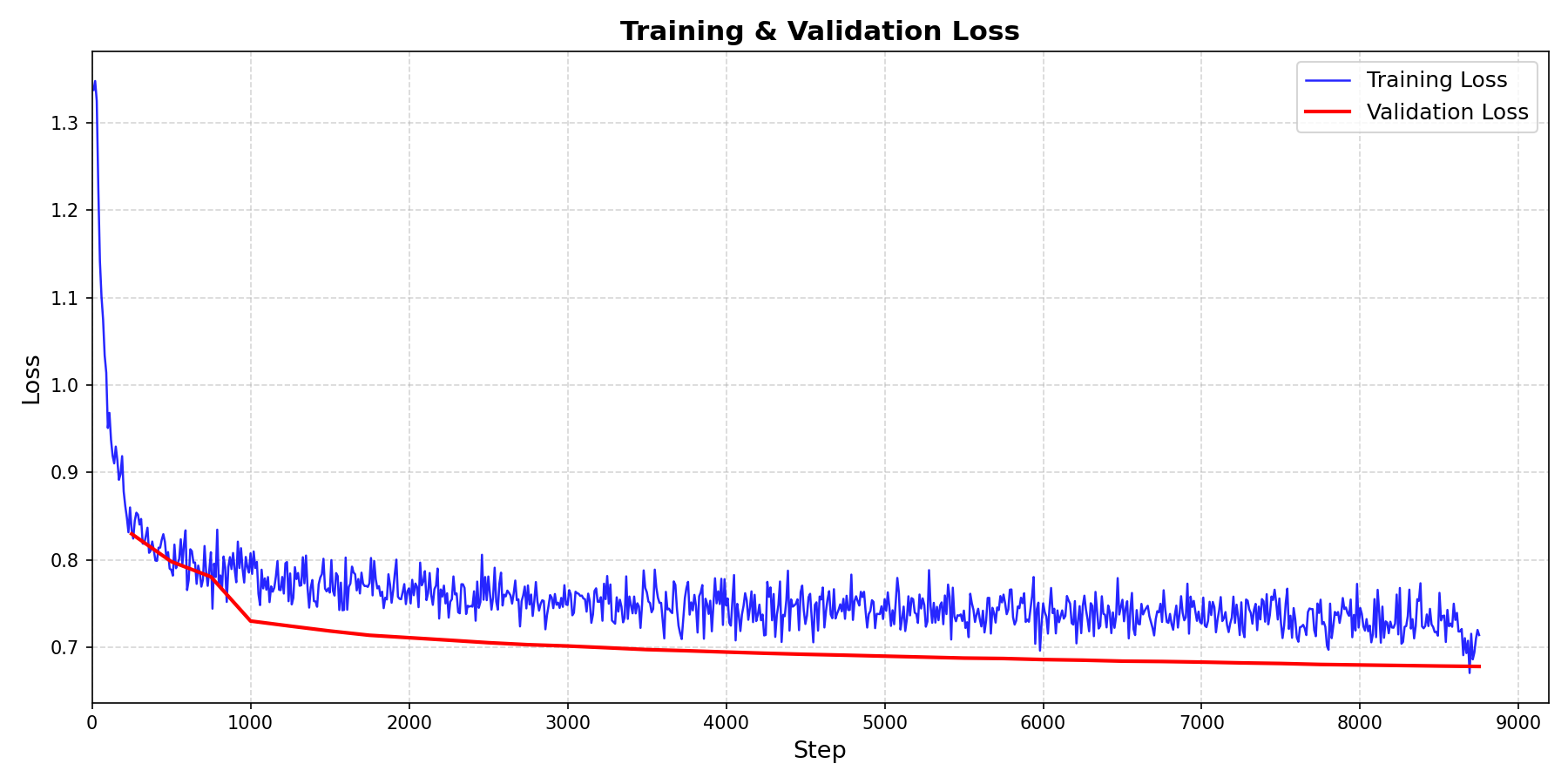
### Training Loss
|
||
|
||
The model is trained for 8750 steps (~ 1 epoch) before stopping. Below are the train and validation loss curves for the entire training session.
|
||
|
||
|
||
|
||
---
|
||
|
||
## Usage
|
||
|
||
### Load the Model
|
||
|
||
Since the LoRA adapters are already merged, PEFT is **not required**:
|
||
```python
|
||
from transformers import AutoModelForCausalLM, AutoTokenizer
|
||
import torch
|
||
|
||
model = AutoModelForCausalLM.from_pretrained(
|
||
"tensorhydra/qwen-8b-aimo3-reasoning",
|
||
trust_remote_code=True,
|
||
torch_dtype=torch.bfloat16,
|
||
device_map="auto"
|
||
)
|
||
|
||
tokenizer = AutoTokenizer.from_pretrained(
|
||
"tensorhydra/qwen-8b-aimo3-reasoning",
|
||
trust_remote_code=True
|
||
)
|
||
```
|
||
|
||
### Inference
|
||
```python
|
||
prompt = "Solve this problem: What is 2 + 2?"
|
||
|
||
formatted_prompt = f"user\n{prompt}\nassistant\n"
|
||
|
||
inputs = tokenizer(formatted_prompt, return_tensors="pt").to(model.device)
|
||
outputs = model.generate(
|
||
**inputs,
|
||
max_new_tokens=512,
|
||
temperature=0.7,
|
||
top_p=0.9,
|
||
do_sample=True
|
||
)
|
||
|
||
response = tokenizer.decode(outputs[0], skip_special_tokens=False)
|
||
print(response)
|
||
```
|
||
|
||
### Batch Inference
|
||
```python
|
||
prompts = [
|
||
"Solve: 15 + 27 = ?",
|
||
"What is the derivative of x^2?",
|
||
"Calculate the area of a circle with radius 5"
|
||
]
|
||
|
||
formatted_prompts = [
|
||
f"user\n{p}\nassistant\n"
|
||
for p in prompts
|
||
]
|
||
|
||
inputs = tokenizer(formatted_prompts, return_tensors="pt", padding=True).to(model.device)
|
||
outputs = model.generate(**inputs, max_new_tokens=512, temperature=0.7, do_sample=True)
|
||
|
||
for response in tokenizer.batch_decode(outputs, skip_special_tokens=False):
|
||
print(response)
|
||
print("-" * 80)
|
||
```
|
||
|
||
### Quantized Inference (Lower VRAM)
|
||
```python
|
||
# 8-bit (~8GB VRAM)
|
||
model = AutoModelForCausalLM.from_pretrained(
|
||
"tensorhydra/qwen-8b-aimo3-reasoning",
|
||
load_in_8bit=True,
|
||
device_map="auto"
|
||
)
|
||
|
||
# 4-bit (~4GB VRAM)
|
||
model = AutoModelForCausalLM.from_pretrained(
|
||
"tensorhydra/qwen-8b-aimo3-reasoning",
|
||
load_in_4bit=True,
|
||
device_map="auto"
|
||
)
|
||
```
|
||
|
||
---
|
||
|
||
## Memory Requirements
|
||
|
||
| Mode | VRAM |
|
||
|---|---|
|
||
| BF16 (full) | ~16GB |
|
||
| 8-bit quantized | ~8GB |
|
||
| 4-bit quantized | ~4GB |
|
||
|
||
---
|
||
|
||
## Repository Structure
|
||
```
|
||
model/
|
||
├── config.json
|
||
├── generation_config.json
|
||
├── model.safetensors.index.json
|
||
├── model-00001-of-0000X.safetensors
|
||
├── ...
|
||
├── tokenizer_config.json
|
||
├── tokenizer.json
|
||
└── special_tokens_map.json
|
||
```
|
||
|
||
---
|
||
|
||
## Intended Use
|
||
|
||
- Mathematical reasoning and problem solving
|
||
- Tool-integrated step-by-step reasoning
|
||
- Educational and research applications
|
||
- Production deployment (merged model, no PEFT dependency)
|
||
|
||
## Limitations
|
||
|
||
- Fine-tuned on a narrow reasoning domain; may not generalize well to other tasks
|
||
- Hard context limit of 8192 tokens
|
||
- Performance is bounded by the quality and distribution of the synthetic training data
|
||
- Full merged model requires ~16GB storage (vs. ~100–200MB for LoRA adapters alone)
|
||
|
||
---
|
||
|
||
## Links
|
||
|
||
- **Dataset**: [jeannkouagou/aimo3-tool-integrated-reasoning](https://www.kaggle.com/datasets/jeannkouagou/aimo3-tool-integrated-reasoning)
|
||
- **Fine-tuning Notebook**: [tensorhydra/qwen3-8b-aimo3-finetune](https://www.kaggle.com/code/tensorhydra/qwen3-8b-aimo3-finetune)
|
||
|
||
---
|
||
|
||
## Citation
|
||
```bibtex
|
||
@misc{qwen-lora-aimo3,
|
||
title = {Qwen-8B LoRA Fine-tuned for Tool-Integrated Reasoning},
|
||
author = {tensorhydra},
|
||
year = {2025},
|
||
howpublished = {Kaggle Model Hub},
|
||
note = {Merged LoRA model in SafeTensors format}
|
||
}
|
||
```
|
||
|
||
---
|
||
|
||
## Acknowledgements
|
||
|
||
- **Base model**: [Qwen-8B](https://huggingface.co/Qwen) by Alibaba Cloud
|
||
- **Training frameworks**: Hugging Face Transformers & PEFT
|
||
- **Dataset synthesis**: GPT-OSS-120B
|
||
- **Serialization**: SafeTensors
|
||
- **Training platform**: Kaggle (H100 GPU)
|
||
|
||
## License
|
||
|
||
This model inherits the license of the base Qwen-8B model. Please refer to the [Qwen license terms](https://huggingface.co/Qwen/Qwen2.5-8B/blob/main/LICENSE) before use. |