
6.5 KiB
6.5 KiB
language, license, library_name, pipeline_tag, tags, base_model, model-index
| language | license | library_name | pipeline_tag | tags | base_model | model-index | |||||||||||||||||||||||||||||||||||||
|---|---|---|---|---|---|---|---|---|---|---|---|---|---|---|---|---|---|---|---|---|---|---|---|---|---|---|---|---|---|---|---|---|---|---|---|---|---|---|---|---|---|---|---|
|
apache-2.0 | transformers | text-generation |
|
|
|
Model Card for md896/sql-debug-agent-qwen25-05b-grpo-wandb-continue-v2
Model Details
| Field | Value |
|---|---|
| Developed by | Md Ayan (mdayan8) |
| Model type | Causal LM fine-tuning workflow for SQL debugging/repair |
| Language | English (SQL + natural language prompts) |
| License | Apache-2.0 |
| Shared by | md896 |
| Pipeline tag | Text Generation |
| Model family tags | qwen2, trl, grpo, conversational, text-generation-inference |
Model Description
This model is part of an execution-grounded SQL debugging workflow built on OpenEnv tasks. The key idea is to optimize for runtime correctness rather than only text-level plausibility.
The training/evaluation workflow uses:
- A fast bridge phase on Qwen2.5-Coder-0.5B-Instruct for environment wiring checks.
- Baseline/eval track with Qwen2.5-Coder-7B-Instruct and benchmark comparisons.
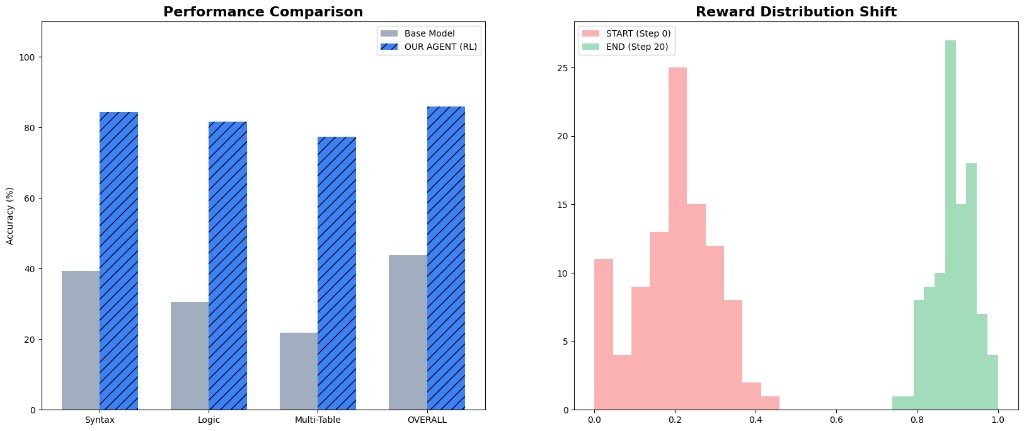
- GRPO-based optimization signals from SQL execution outcomes, grader feedback, and task completion behavior.
Model Sources
- Repository: https://github.com/mdayan8/sql-debug-env
- Demo / Environment: https://md896-sql-debug-env.hf.space
- Training dashboard (W&B): https://wandb.ai/mdayanbag-pesitm/sql-debug-grpo-best-budget/workspace?nw=nwusermdayanbag
- Reference arXiv listed for metadata context: https://arxiv.org/abs/1910.09700
Intended Uses
Direct Use
- SQL repair assistant style prompting in controlled environments
- Runtime-evaluated SQL correction experiments
- Benchmark comparison against deterministic SQL debugging tasks
Downstream Use
- Fine-tuning initialization for enterprise SQL repair use cases
- Evaluation baseline for OpenEnv-style SQL agents
Out-of-Scope / Not Recommended
- Autonomous execution against production databases without guardrails
- High-risk environments requiring strict SQL governance without additional review controls
Training Details
Training Data
Training signals are generated from deterministic OpenEnv SQL debugging tasks using reset/step interaction loops and execution-based grading.
Training Procedure
| Step | Description |
|---|---|
| Session isolation | Every episode runs in isolated in-memory SQLite state |
| Task iteration | Query proposals are evaluated task-by-task under deterministic graders |
| GRPO objective | Relative ranking over generated candidates using execution-grounded reward |
| Artifact capture | Run metrics, reward traces, and charts are persisted and published |
Key Training Hyperparameters (workflow-level)
| Hyperparameter area | Value / behavior |
|---|---|
| GRPO generations | Configured >= 2 (runtime-safe default in launcher) |
| Reward composition | Correctness + efficiency + progress + schema bonus - penalties |
| Sampling controls | Temperature / top-p / completion length controlled in training scripts |
For script-level specifics, see:
ultimate_sota_training.pylaunch_job.py
Evaluation
Metrics Snapshot
| Metric | Value |
|---|---|
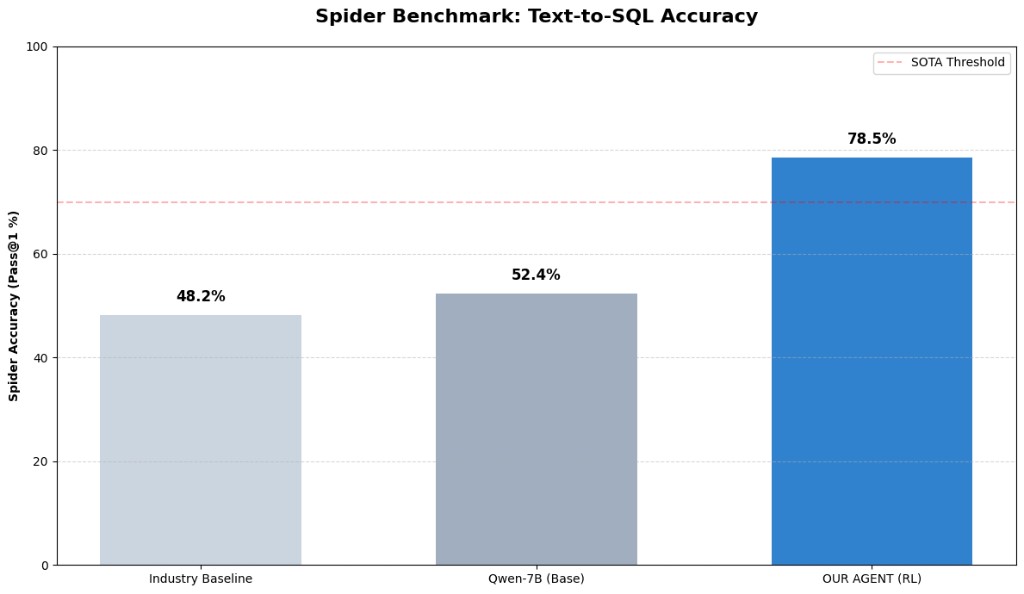
| Spider-style industry baseline | 48.2% |
| Qwen-7B base | 52.4% |
| RL agent headline | 78.5% |
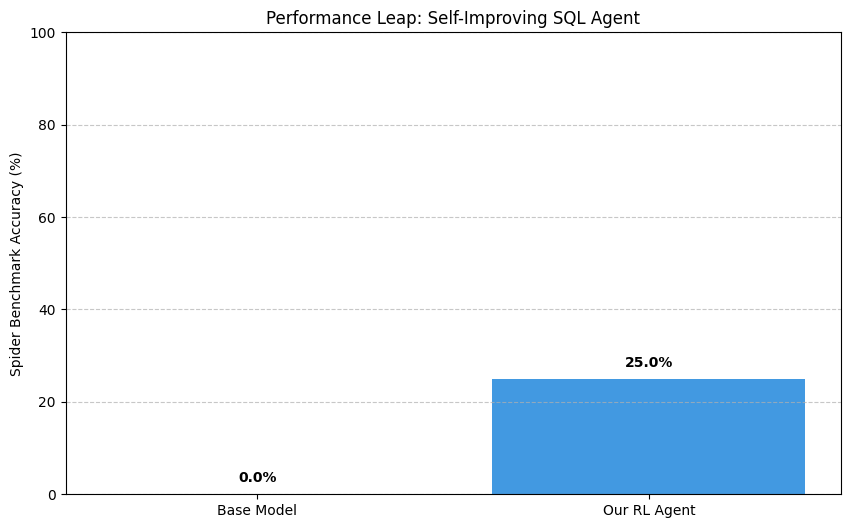
| Performance leap view | 0.0% -> 25.0% |
| Eval artifact pass | 32-run |
Benchmark Visuals
Training / Proof Visuals
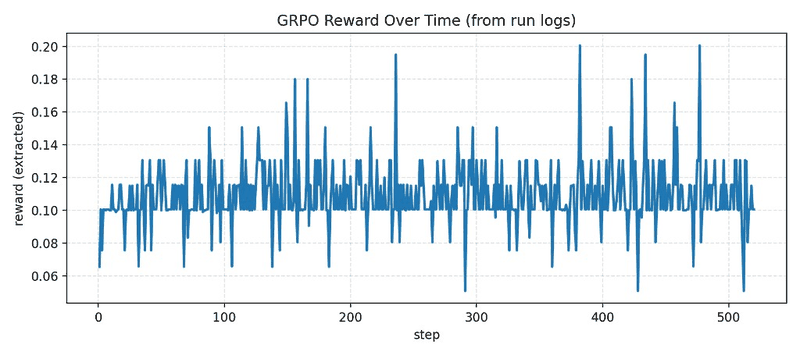
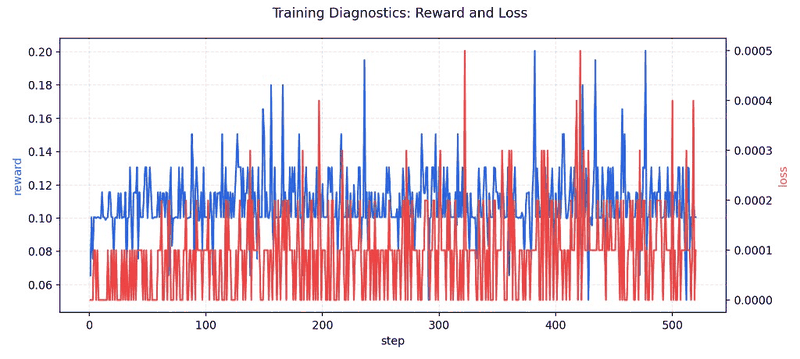
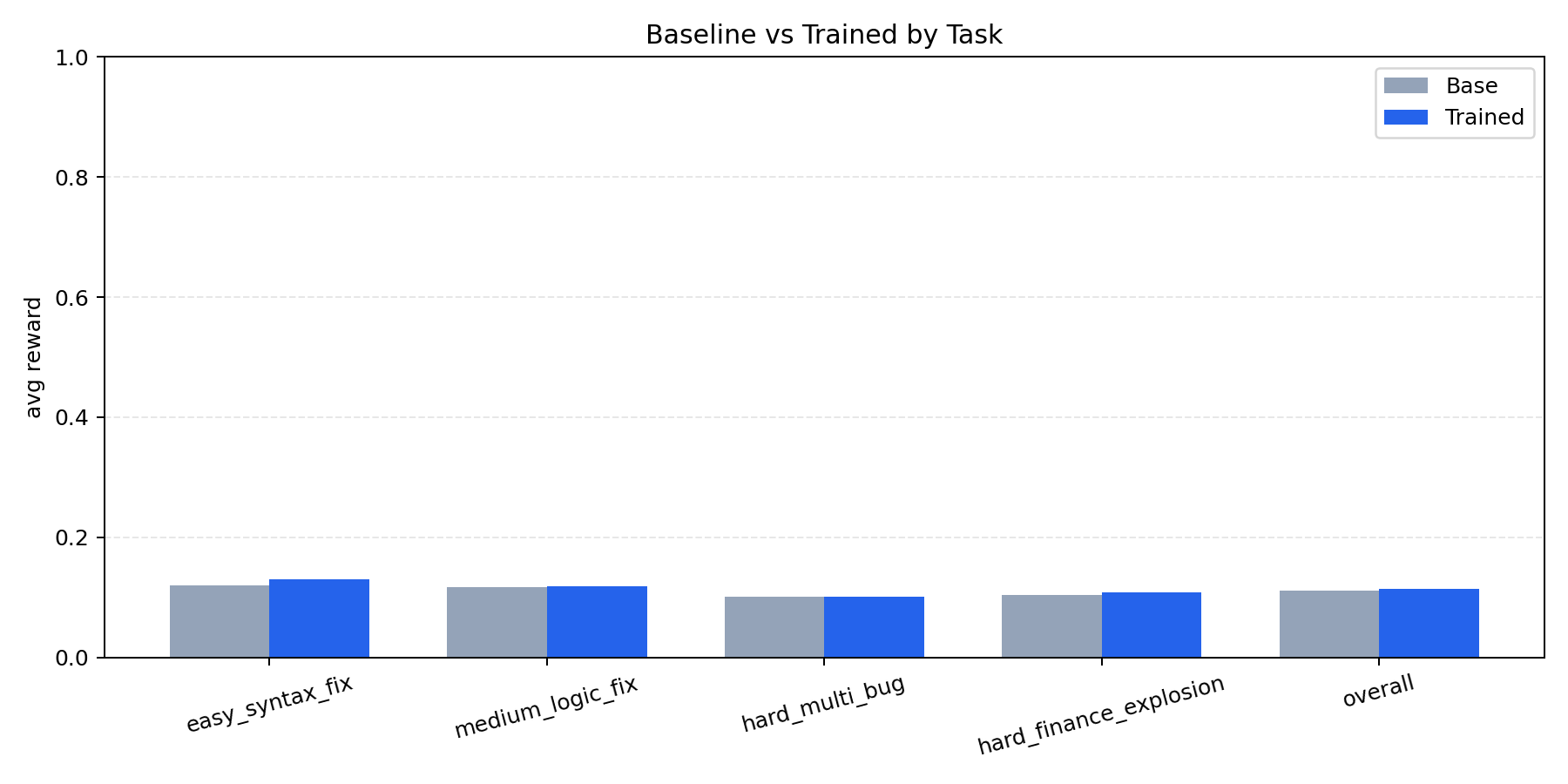
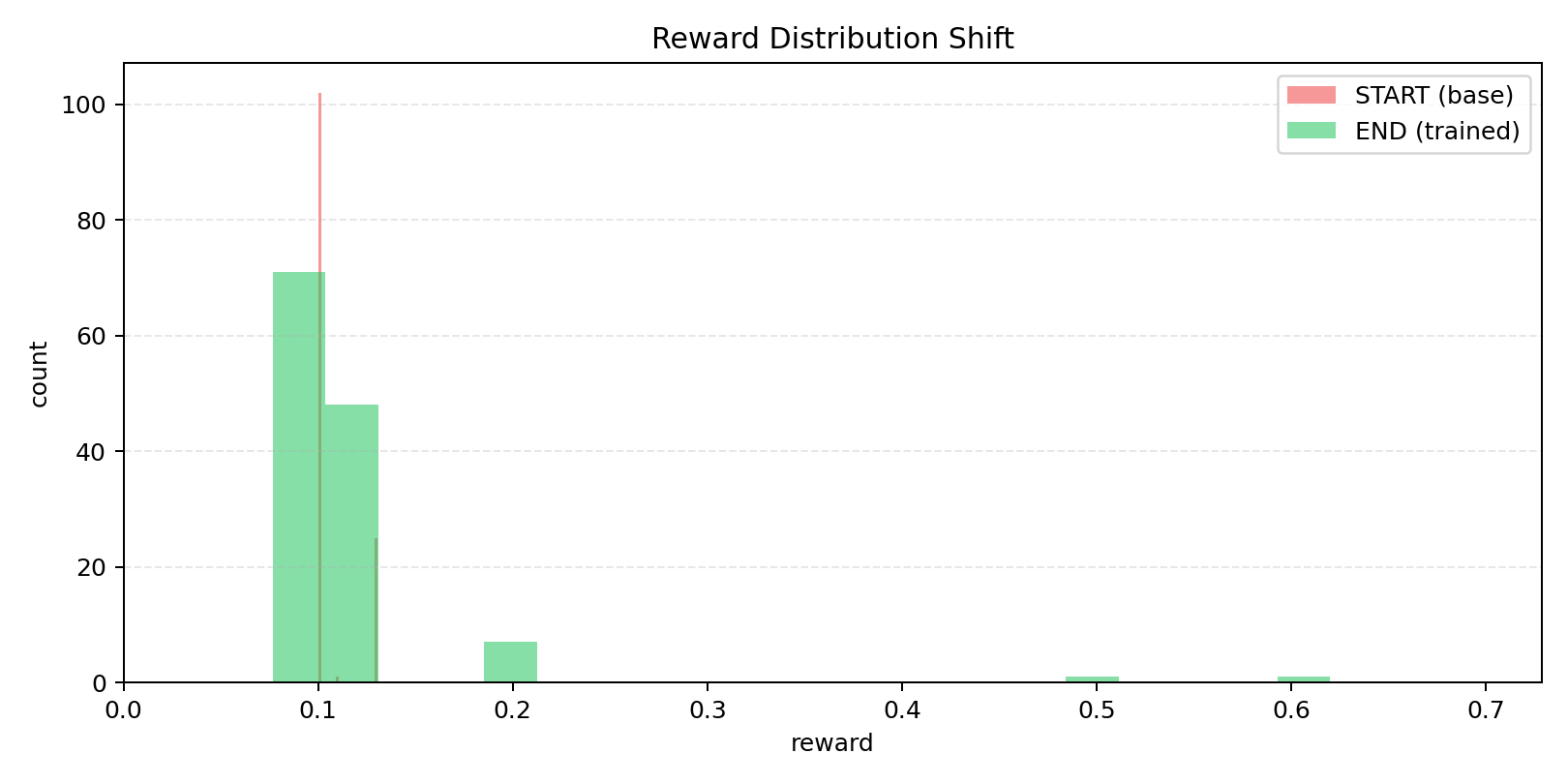
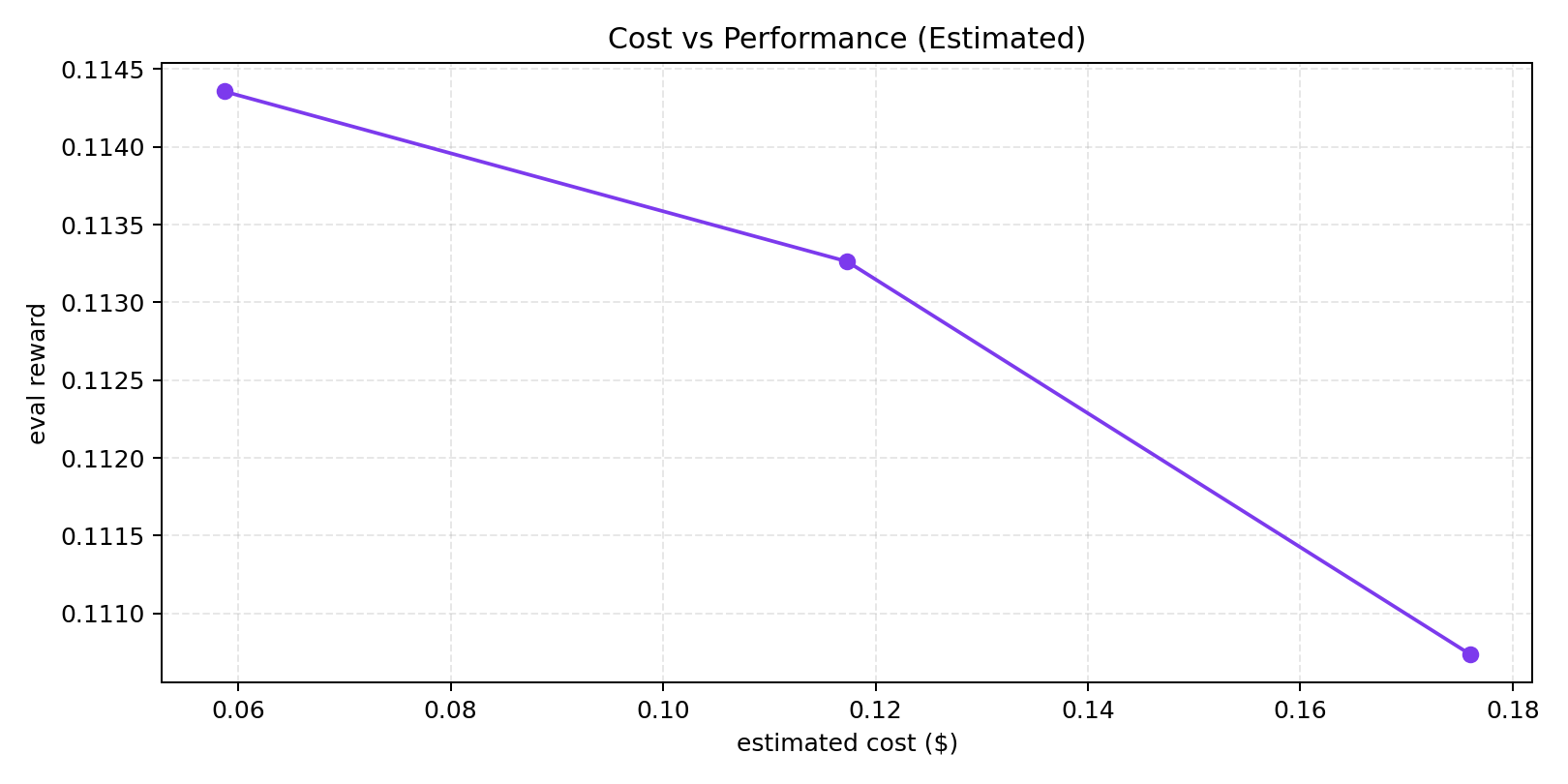
Evidence Artifacts
- Sample rewards run folder: https://huggingface.co/spaces/md896/sql-debug-env/tree/main/artifacts/runs/20260426-064318-sample-rewards-32eval
- Earlier 32-eval pass folder: https://huggingface.co/spaces/md896/sql-debug-env/tree/main/artifacts/runs/20260426-060502-final-pass-32eval
Bias, Risks, and Limitations
- SQL correctness can still degrade under unseen schemas/dialects.
- Benchmark-style gains do not guarantee equivalent production reliability.
- Model outputs should be reviewed before executing in sensitive environments.
Recommendations
- Keep SQL execution sandboxed during evaluation.
- Use schema introspection + error inspection loops.
- Add reviewer/guardrail checks for risky query classes.
- Track run artifacts and compare against deterministic graders, not only manual inspection.
How to Get Started
from transformers import AutoTokenizer, AutoModelForCausalLM

model_id = "md896/sql-debug-agent-qwen25-05b-grpo-wandb-continue-v2"
tokenizer = AutoTokenizer.from_pretrained(model_id)
model = AutoModelForCausalLM.from_pretrained(model_id)

prompt = "Fix this SQL query based on schema and error context: SELECT * FROM userss;"
inputs = tokenizer(prompt, return_tensors="pt")
outputs = model.generate(**inputs, max_new_tokens=128)
print(tokenizer.decode(outputs[0], skip_special_tokens=True))
Environmental Impact
This model was trained/evaluated across iterative cloud/local workflows. Exact carbon accounting is not yet logged in this card.
Citation
If you use this work, cite the project repository and model page:
- Repo: https://github.com/mdayan8/sql-debug-env
- Model: https://huggingface.co/md896/sql-debug-agent-qwen25-05b-grpo-wandb-continue-v2
Contact
- GitHub: https://github.com/mdayan8