
98 lines
4.1 KiB
Markdown
98 lines
4.1 KiB
Markdown
---
|
|
datasets:
|
|
- BatsResearch/ctga-v1
|
|
language:
|
|
- en
|
|
library_name: transformers
|
|
pipeline_tag: text2text-generation
|
|
tags:
|
|
- data generation
|
|
license: apache-2.0
|
|
---
|
|
|
|
# Bonito-v1 GGUF
|
|
|
|
You can find the original model at [BatsResearch/bonito-v1](https://huggingface.co/BatsResearch/bonito-v1)
|
|
|
|
## Variations
|
|
|
|
| Name | Quant method | Bits |
|
|
| ---- | ---- | ---- |
|
|
| [bonito-v1_iq4_nl.gguf](https://huggingface.co/alexandreteles/bonito-v1-gguf/blob/main/bonito-v1_iq4_nl.gguf) | IQ4_NL | 4 | 4.16 GB|
|
|
| [bonito-v1_q4_k_m.gguf](https://huggingface.co/alexandreteles/bonito-v1-gguf/blob/main/bonito-v1_q4_k_m.gguf) | Q4_K_M | 4 | 4.37 GB|
|
|
| [bonito-v1_q5_k_2.gguf](https://huggingface.co/alexandreteles/bonito-v1-gguf/blob/main/bonito-v1_q5_k_s.gguf) | Q5_K_S | 5 | 5.00 GB|
|
|
| [bonito-v1_q5_k_m.gguf](https://huggingface.co/alexandreteles/bonito-v1-gguf/blob/main/bonito-v1_q5_k_m.gguf) | Q5_K_M | 5 | 5.13 GB|
|
|
| [bonito-v1_q6_k.gguf](https://huggingface.co/alexandreteles/bonito-v1-gguf/blob/main/bonito-v1_q6_k.gguf) | Q6_K | 6 | 5.94 GB|
|
|
| [bonito-v1_q8_0.gguf](https://huggingface.co/alexandreteles/bonito-v1-gguf/blob/main/bonito-v1_q8_0.gguf) | Q8_0 | 8 | 7.70 GB|
|
|
| [bonito-v1_f16.gguf](https://huggingface.co/alexandreteles/bonito-v1-gguf/blob/main/bonito-v1_f16.gguf) | FP16 | 16 | 14.5 GB|
|
|
|
|
## Model Card for bonito
|
|
|
|
<!-- Provide a quick summary of what the model is/does. -->
|
|
|
|
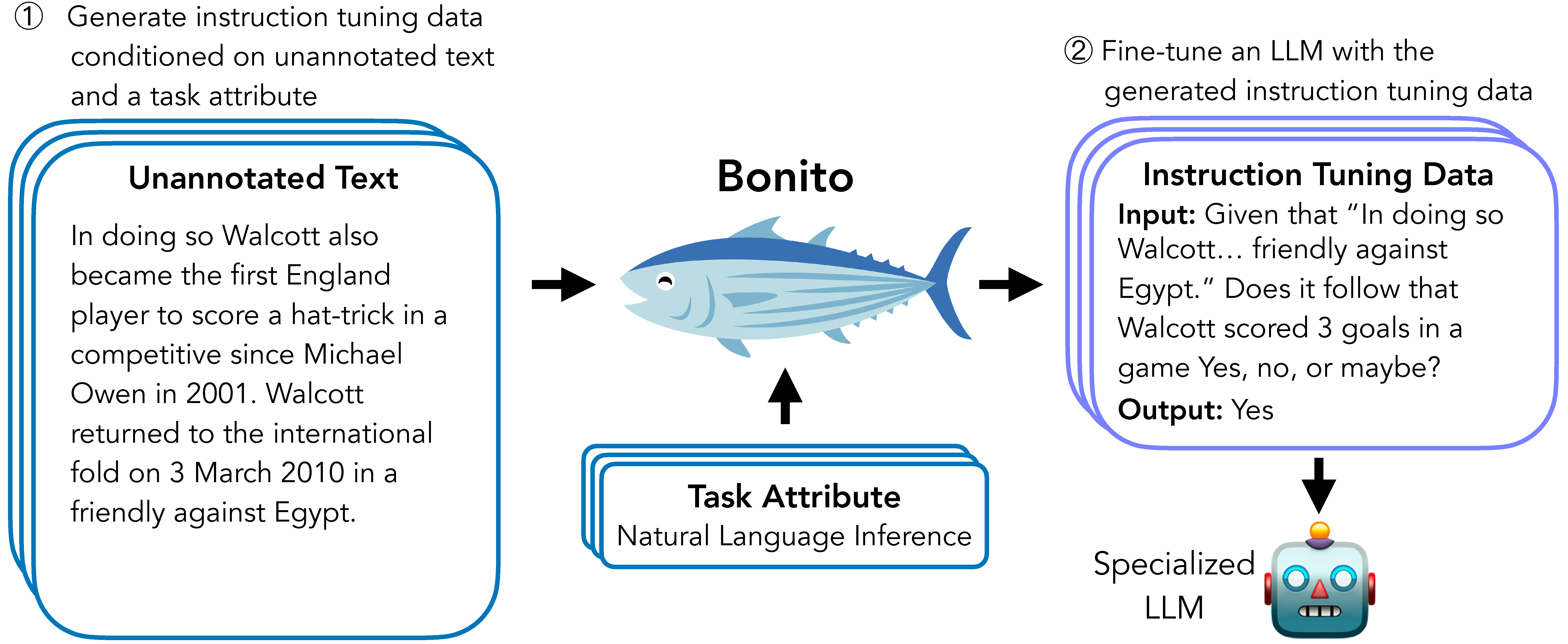
Bonito is an open-source model for conditional task generation: the task of converting unannotated text into task-specific training datasets for instruction tuning.
|
|
|
|
|
|
|
|
## Model Details
|
|
|
|
### Model Description
|
|
|
|
<!-- Provide a longer summary of what this model is. -->
|
|
|
|
Bonito can be used to create synthetic instruction tuning datasets to adapt large language models on users' specialized, private data.
|
|
In our [paper](https://github.com/BatsResearch/bonito), we show that Bonito can be used to adapt both pretrained and instruction tuned models to tasks without any annotations.
|
|
|
|
- **Developed by:** Nihal V. Nayak, Yiyang Nan, Avi Trost, and Stephen H. Bach
|
|
- **Model type:** MistralForCausalLM
|
|
- **Language(s) (NLP):** English
|
|
- **License:** TBD
|
|
- **Finetuned from model:** `mistralai/Mistral-7B-v0.1`
|
|
|
|
### Model Sources
|
|
|
|
<!-- Provide the basic links for the model. -->
|
|
|
|
- **Repository:** [https://github.com/BatsResearch/bonito](https://github.com/BatsResearch/bonito)
|
|
- **Paper:** Arxiv link
|
|
|
|
## Uses
|
|
|
|
<!-- Address questions around how the model is intended to be used, including the foreseeable users of the model and those affected by the model. -->
|
|
|
|
### Direct Use
|
|
|
|
<!-- This section is for the model use without fine-tuning or plugging into a larger ecosystem/app. -->
|
|
To easily generate synthetic instruction tuning datasets, we recommend using the [bonito](https://github.com/BatsResearch/bonito) package built using the `transformers` and the `vllm` libraries.
|
|
|
|
```python
|
|
from bonito import Bonito, SamplingParams
|
|
from datasets import load_dataset
|
|
|
|
# Initialize the Bonito model
|
|
bonito = Bonito()
|
|
|
|
# load dataaset with unannotated text
|
|
unannotated_text = load_dataset(
|
|
"BatsResearch/bonito-experiment",
|
|
"unannotated_contract_nli"
|
|
)["train"].select(range(10))
|
|
|
|
# Generate synthetic instruction tuning dataset
|
|
sampling_params = SamplingParams(max_tokens=256, top_p=0.95, temperature=0.5, n=1)
|
|
synthetic_dataset = bonito.generate_tasks(
|
|
unannotated_text,
|
|
context_col="input",
|
|
task_type="nli",
|
|
sampling_params=sampling_params
|
|
)
|
|
```
|
|
|
|
|
|
### Out-of-Scope Use
|
|
|
|
<!-- This section addresses misuse, malicious use, and uses that the model will not work well for. -->
|
|
|
|
Our model is trained to generate the following task types: summarization, sentiment analysis, multiple-choice question answering, extractive question answering, topic classification, natural language inference, question generation, text generation, question answering without choices, paraphrase identification, sentence completion, yes-no question answering, word sense disambiguation, paraphrase generation, textual entailment, and
|
|
coreference resolution.
|
|
The model might not produce accurate synthetic tasks beyond these task types. |