
472 lines
18 KiB
Markdown
472 lines
18 KiB
Markdown
<div align="center">
|
||
<img src="https://raw.githubusercontent.com/sgl-project/sglang/main/assets/logo.png" alt="logo" width="400"></img>
|
||
|
||
[](https://pypi.org/project/sglang)
|
||

|
||
[](https://github.com/sgl-project/sglang/tree/main/LICENSE)
|
||
[](https://github.com/sgl-project/sglang/issues)
|
||
[](https://github.com/sgl-project/sglang/issues)
|
||
|
||
</div>
|
||
|
||
--------------------------------------------------------------------------------
|
||
|
||
| [**Blog**](https://lmsys.org/blog/2024-07-25-sglang-llama3/) | [**Paper**](https://arxiv.org/abs/2312.07104) | [**Slack**](https://join.slack.com/t/sgl-fru7574/shared_invite/zt-2ngly9muu-t37XiH87qvD~6rVBTkTEHw) |
|
||
|
||
SGLang is a fast serving framework for large language models and vision language models.
|
||
It makes your interaction with models faster and more controllable by co-designing the backend runtime and frontend language.
|
||
|
||
The core features include:
|
||
- **Fast Backend Runtime**: Efficient serving with RadixAttention for prefix caching, jump-forward constrained decoding, continuous batching, token attention (paged attention), tensor parallelism, flashinfer kernels, and quantization (AWQ/FP8/GPTQ/Marlin).
|
||
- **Flexible Frontend Language**: Enables easy programming of LLM applications with chained generation calls, advanced prompting, control flow, multiple modalities, parallelism, and external interactions.
|
||
|
||
## News
|
||
- [2024/07] 🔥 Faster Llama3 Serving with SGLang Runtime (vs. TensorRT-LLM, vLLM) ([blog](https://lmsys.org/blog/2024-07-25-sglang-llama3/)).
|
||
- [2024/04] SGLang is used by the official **LLaVA-NeXT (video)** release ([blog](https://llava-vl.github.io/blog/2024-04-30-llava-next-video/)).
|
||
- [2024/02] SGLang enables **3x faster JSON decoding** with compressed finite state machine ([blog](https://lmsys.org/blog/2024-02-05-compressed-fsm/)).
|
||
|
||
<details>
|
||
<summary>More</summary>
|
||
|
||
- [2024/01] SGLang provides up to **5x faster inference** with RadixAttention ([blog](https://lmsys.org/blog/2024-01-17-sglang/)).
|
||
- [2024/01] SGLang powers the serving of the official **LLaVA v1.6** release demo ([usage](https://github.com/haotian-liu/LLaVA?tab=readme-ov-file#demo)).
|
||
|
||
</details>
|
||
|
||
## Contents
|
||
- [Install](#install)
|
||
- [Backend: SGLang Runtime (SRT)](#backend-sglang-runtime-srt)
|
||
- [Frontend: Structured Generation Language (SGLang)](#frontend-structured-generation-language-sglang)
|
||
- [Benchmark And Performance](#benchmark-and-performance)
|
||
- [Roadmap](#roadmap)
|
||
- [Citation And Acknowledgment](#citation-and-acknowledgment)
|
||
|
||
## Install
|
||
|
||
### Method 1: With pip
|
||
```
|
||
pip install --upgrade pip
|
||
pip install "sglang[all]"
|
||
|
||
# Install FlashInfer CUDA kernels
|
||
pip install flashinfer -i https://flashinfer.ai/whl/cu121/torch2.3/
|
||
```
|
||
|
||
### Method 2: From source
|
||
```
|
||
# Use the last release branch
|
||
git clone -b v0.2.10 https://github.com/sgl-project/sglang.git
|
||
cd sglang
|
||
|
||
pip install --upgrade pip
|
||
pip install -e "python[all]"
|
||
|
||
# Install FlashInfer CUDA kernels
|
||
pip install flashinfer -i https://flashinfer.ai/whl/cu121/torch2.3/
|
||
```
|
||
|
||
### Method 3: Using docker
|
||
The docker images are available on Docker Hub as [lmsysorg/sglang](https://hub.docker.com/r/lmsysorg/sglang/tags), built from [Dockerfile](docker).
|
||
Replace `<secret>` below with your huggingface hub [token](https://huggingface.co/docs/hub/en/security-tokens).
|
||
|
||
```bash
|
||
docker run --gpus all \
|
||
-p 30000:30000 \
|
||
-v ~/.cache/huggingface:/root/.cache/huggingface \
|
||
--env "HF_TOKEN=<secret>" \
|
||
--ipc=host \
|
||
lmsysorg/sglang:latest \
|
||
python3 -m sglang.launch_server --model-path meta-llama/Meta-Llama-3-8B-Instruct --host 0.0.0.0 --port 30000
|
||
```
|
||
|
||
### Common Notes
|
||
- If you cannot install FlashInfer, check out its [installation](https://docs.flashinfer.ai/installation.html#) page. If you still cannot install it, you can use the slower Triton kernels by adding `--disable-flashinfer` when launching the server.
|
||
- If you only need to use the OpenAI backend, you can avoid installing other dependencies by using `pip install "sglang[openai]"`.
|
||
|
||
## Backend: SGLang Runtime (SRT)
|
||
The SGLang Runtime (SRT) is an efficient serving engine.
|
||
|
||
### Quick Start
|
||
Launch a server
|
||
```
|
||
python -m sglang.launch_server --model-path meta-llama/Meta-Llama-3-8B-Instruct --port 30000
|
||
```
|
||
|
||
Send a request
|
||
```
|
||
curl http://localhost:30000/generate \
|
||
-H "Content-Type: application/json" \
|
||
-d '{
|
||
"text": "Once upon a time,",
|
||
"sampling_params": {
|
||
"max_new_tokens": 16,
|
||
"temperature": 0
|
||
}
|
||
}'
|
||
```
|
||
Learn more about the argument format [here](docs/en/sampling_params.md).
|
||
|
||
### OpenAI Compatible API
|
||
In addition, the server supports OpenAI-compatible APIs.
|
||
|
||
```python
|
||
import openai
|
||
client = openai.Client(
|
||
base_url="http://127.0.0.1:30000/v1", api_key="EMPTY")
|
||
|
||
# Text completion
|
||
response = client.completions.create(
|
||
model="default",
|
||
prompt="The capital of France is",
|
||
temperature=0,
|
||
max_tokens=32,
|
||
)
|
||
print(response)
|
||
|
||
# Chat completion
|
||
response = client.chat.completions.create(
|
||
model="default",
|
||
messages=[
|
||
{"role": "system", "content": "You are a helpful AI assistant"},
|
||
{"role": "user", "content": "List 3 countries and their capitals."},
|
||
],
|
||
temperature=0,
|
||
max_tokens=64,
|
||
)
|
||
print(response)
|
||
```
|
||
|
||
It supports streaming, vision, and most features of the Chat/Completions/Models endpoints specified by the [OpenAI API Reference](https://platform.openai.com/docs/api-reference/).
|
||
|
||
### Additional Server Arguments
|
||
- Add `--tp 2` to enable tensor parallelism. If it indicates `peer access is not supported between these two devices`, add `--enable-p2p-check` option.
|
||
```
|
||
python -m sglang.launch_server --model-path meta-llama/Meta-Llama-3-8B-Instruct --port 30000 --tp 2
|
||
```
|
||
- Add `--dp 2` to enable data parallelism. It can also be used together with tp. Data parallelism is better for throughput if there is enough memory.
|
||
```
|
||
python -m sglang.launch_server --model-path meta-llama/Meta-Llama-3-8B-Instruct --port 30000 --dp 2 --tp 2
|
||
```
|
||
- If you see out-of-memory errors during serving, please try to reduce the memory usage of the KV cache pool by setting a smaller value of `--mem-fraction-static`. The default value is `0.9`
|
||
```
|
||
python -m sglang.launch_server --model-path meta-llama/Meta-Llama-3-8B-Instruct --port 30000 --mem-fraction-static 0.7
|
||
```
|
||
- See [hyperparameter_tuning.md](docs/en/hyperparameter_tuning.md) on tuning hyperparameters for better performance.
|
||
- Add `--nnodes 2` to run tensor parallelism on multiple nodes. If you have two nodes with two GPUs on each node and want to run TP=4, let `sgl-dev-0` be the hostname of the first node and `50000` be an available port.
|
||
```
|
||
# Node 0
|
||
python -m sglang.launch_server --model-path meta-llama/Meta-Llama-3-8B-Instruct --tp 4 --nccl-init sgl-dev-0:50000 --nnodes 2 --node-rank 0
|
||
|
||
# Node 1
|
||
python -m sglang.launch_server --model-path meta-llama/Meta-Llama-3-8B-Instruct --tp 4 --nccl-init sgl-dev-0:50000 --nnodes 2 --node-rank 1
|
||
```
|
||
- If the model does not have a template in the Hugging Face tokenizer, you can specify a [custom chat template](docs/en/custom_chat_template.md).
|
||
- To enable fp8 quantization, you can add `--quantization fp8` on a fp16 checkpoint or directly load a fp8 checkpoint without specifying any arguments.
|
||
- To enable experimental torch.compile support, you can add `--enable-torch-compile`. It accelerates small models on small batch sizes.
|
||
|
||
### Run Llama 3.1 405B
|
||
|
||
```bash
|
||
## Run 405B (fp8) on a single node
|
||
python -m sglang.launch_server --model-path meta-llama/Meta-Llama-3.1-405B-Instruct-FP8 --tp 8
|
||
|
||
## Run 405B (fp16) on two nodes
|
||
# replace the `172.16.4.52:20000` with your own first node ip address and port, disable CUDA Graph temporarily
|
||
|
||
# on the first node
|
||
GLOO_SOCKET_IFNAME=eth0 python3 -m sglang.launch_server --model-path meta-llama/Meta-Llama-3.1-405B-Instruct --tp 16 --nccl-init-addr 172.16.4.52:20000 --nnodes 2 --node-rank 0 --disable-cuda-graph --mem-frac 0.75
|
||
|
||
# on the second
|
||
GLOO_SOCKET_IFNAME=eth0 python3 -m sglang.launch_server --model-path meta-llama/Meta-Llama-3.1-405B-Instruct --tp 16 --nccl-init-addr 172.16.4.52:20000 --nnodes 2 --node-rank 1 --disable-cuda-graph --mem-frac 0.75
|
||
```
|
||
|
||
### Supported Models
|
||
|
||
- Llama / Llama 2 / Llama 3 / Llama 3.1
|
||
- Mistral / Mixtral
|
||
- Gemma / Gemma 2
|
||
- Qwen / Qwen 2 / Qwen 2 MoE
|
||
- DeepSeek / DeepSeek 2
|
||
- LLaVA 1.5 / 1.6
|
||
- `python -m sglang.launch_server --model-path liuhaotian/llava-v1.5-7b --tokenizer-path llava-hf/llava-1.5-7b-hf --chat-template vicuna_v1.1 --port 30000`
|
||
- `python -m sglang.launch_server --model-path liuhaotian/llava-v1.6-vicuna-7b --tokenizer-path llava-hf/llava-1.5-7b-hf --chat-template vicuna_v1.1 --port 30000`
|
||
- `python -m sglang.launch_server --model-path liuhaotian/llava-v1.6-34b --tokenizer-path liuhaotian/llava-v1.6-34b-tokenizer --port 30000`
|
||
- LLaVA-NeXT-Video
|
||
- see [examples/usage/llava_video](examples/usage/llava_video)
|
||
- Yi-VL
|
||
- see [srt_example_yi_vl.py](examples/quick_start/srt_example_yi_vl.py).
|
||
- StableLM
|
||
- Command-R
|
||
- DBRX
|
||
- Grok
|
||
- ChatGLM
|
||
- InternLM 2
|
||
- Mistral NeMo
|
||
|
||
Instructions for supporting a new model are [here](https://github.com/sgl-project/sglang/blob/main/docs/en/model_support.md).
|
||
|
||
### Benchmark Performance
|
||
|
||
- Benchmark a single static batch by running the following command without launching a server. The arguments are the same as for `launch_server.py`. Note that this is not a dynamic batching server, so it may run out of memory for a batch size that a real server can handle. A real server truncates the prefill into several batches, while this unit test does not. For accurate large batch testing, consider using `sglang.bench_serving`.
|
||
```
|
||
python -m sglang.bench_latency --model-path meta-llama/Meta-Llama-3-8B-Instruct --batch 32 --input-len 256 --output-len 32
|
||
```
|
||
- Benchmark online serving. Launch a server first and run the following command.
|
||
```
|
||
python3 -m sglang.bench_serving --backend sglang --num-prompt 10
|
||
```
|
||
|
||
## Frontend: Structured Generation Language (SGLang)
|
||
The frontend language can be used with local models or API models.
|
||
|
||
### Quick Start
|
||
The example below shows how to use sglang to answer a mulit-turn question.
|
||
|
||
#### Using Local Models
|
||
First, launch a server with
|
||
```
|
||
python -m sglang.launch_server --model-path meta-llama/Meta-Llama-3-8B-Instruct --port 30000
|
||
```
|
||
|
||
Then, connect to the server and answer a multi-turn question.
|
||
|
||
```python
|
||
from sglang import function, system, user, assistant, gen, set_default_backend, RuntimeEndpoint
|
||
|
||
@function
|
||
def multi_turn_question(s, question_1, question_2):
|
||
s += system("You are a helpful assistant.")
|
||
s += user(question_1)
|
||
s += assistant(gen("answer_1", max_tokens=256))
|
||
s += user(question_2)
|
||
s += assistant(gen("answer_2", max_tokens=256))
|
||
|
||
set_default_backend(RuntimeEndpoint("http://localhost:30000"))
|
||
|
||
state = multi_turn_question.run(
|
||
question_1="What is the capital of the United States?",
|
||
question_2="List two local attractions.",
|
||
)
|
||
|
||
for m in state.messages():
|
||
print(m["role"], ":", m["content"])
|
||
|
||
print(state["answer_1"])
|
||
```
|
||
|
||
#### Using OpenAI Models
|
||
Set the OpenAI API Key
|
||
```
|
||
export OPENAI_API_KEY=sk-******
|
||
```
|
||
|
||
Then, answer a multi-turn question.
|
||
```python
|
||
from sglang import function, system, user, assistant, gen, set_default_backend, OpenAI
|
||
|
||
@function
|
||
def multi_turn_question(s, question_1, question_2):
|
||
s += system("You are a helpful assistant.")
|
||
s += user(question_1)
|
||
s += assistant(gen("answer_1", max_tokens=256))
|
||
s += user(question_2)
|
||
s += assistant(gen("answer_2", max_tokens=256))
|
||
|
||
set_default_backend(OpenAI("gpt-3.5-turbo"))
|
||
|
||
state = multi_turn_question.run(
|
||
question_1="What is the capital of the United States?",
|
||
question_2="List two local attractions.",
|
||
)
|
||
|
||
for m in state.messages():
|
||
print(m["role"], ":", m["content"])
|
||
|
||
print(state["answer_1"])
|
||
```
|
||
|
||
#### More Examples
|
||
|
||
Anthropic and VertexAI (Gemini) models are also supported.
|
||
You can find more examples at [examples/quick_start](examples/quick_start).
|
||
|
||
### Language Feature
|
||
To begin with, import sglang.
|
||
```python
|
||
import sglang as sgl
|
||
```
|
||
|
||
`sglang` provides some simple primitives such as `gen`, `select`, `fork`, `image`.
|
||
You can implement your prompt flow in a function decorated by `sgl.function`.
|
||
You can then invoke the function with `run` or `run_batch`.
|
||
The system will manage the state, chat template, parallelism and batching for you.
|
||
|
||
The complete code for the examples below can be found at [readme_examples.py](examples/usage/readme_examples.py)
|
||
|
||
#### Control Flow
|
||
You can use any Python code within the function body, including control flow, nested function calls, and external libraries.
|
||
|
||
```python
|
||
@sgl.function
|
||
def tool_use(s, question):
|
||
s += "To answer this question: " + question + ". "
|
||
s += "I need to use a " + sgl.gen("tool", choices=["calculator", "search engine"]) + ". "
|
||
|
||
if s["tool"] == "calculator":
|
||
s += "The math expression is" + sgl.gen("expression")
|
||
elif s["tool"] == "search engine":
|
||
s += "The key word to search is" + sgl.gen("word")
|
||
```
|
||
|
||
#### Parallelism
|
||
Use `fork` to launch parallel prompts.
|
||
Because `sgl.gen` is non-blocking, the for loop below issues two generation calls in parallel.
|
||
|
||
```python
|
||
@sgl.function
|
||
def tip_suggestion(s):
|
||
s += (
|
||
"Here are two tips for staying healthy: "
|
||
"1. Balanced Diet. 2. Regular Exercise.\n\n"
|
||
)
|
||
|
||
forks = s.fork(2)
|
||
for i, f in enumerate(forks):
|
||
f += f"Now, expand tip {i+1} into a paragraph:\n"
|
||
f += sgl.gen(f"detailed_tip", max_tokens=256, stop="\n\n")
|
||
|
||
s += "Tip 1:" + forks[0]["detailed_tip"] + "\n"
|
||
s += "Tip 2:" + forks[1]["detailed_tip"] + "\n"
|
||
s += "In summary" + sgl.gen("summary")
|
||
```
|
||
|
||
#### Multi Modality
|
||
Use `sgl.image` to pass an image as input.
|
||
|
||
```python
|
||
@sgl.function
|
||
def image_qa(s, image_file, question):
|
||
s += sgl.user(sgl.image(image_file) + question)
|
||
s += sgl.assistant(sgl.gen("answer", max_tokens=256)
|
||
```
|
||
|
||
See also [srt_example_llava.py](examples/quick_start/srt_example_llava.py).
|
||
|
||
#### Constrained Decoding
|
||
Use `regex` to specify a regular expression as a decoding constraint.
|
||
This is only supported for local models.
|
||
|
||
```python
|
||
@sgl.function
|
||
def regular_expression_gen(s):
|
||
s += "Q: What is the IP address of the Google DNS servers?\n"
|
||
s += "A: " + sgl.gen(
|
||
"answer",
|
||
temperature=0,
|
||
regex=r"((25[0-5]|2[0-4]\d|[01]?\d\d?).){3}(25[0-5]|2[0-4]\d|[01]?\d\d?)",
|
||
)
|
||
```
|
||
|
||
#### JSON Decoding
|
||
Use `regex` to specify a JSON schema with a regular expression.
|
||
|
||
```python
|
||
character_regex = (
|
||
r"""\{\n"""
|
||
+ r""" "name": "[\w\d\s]{1,16}",\n"""
|
||
+ r""" "house": "(Gryffindor|Slytherin|Ravenclaw|Hufflepuff)",\n"""
|
||
+ r""" "blood status": "(Pure-blood|Half-blood|Muggle-born)",\n"""
|
||
+ r""" "occupation": "(student|teacher|auror|ministry of magic|death eater|order of the phoenix)",\n"""
|
||
+ r""" "wand": \{\n"""
|
||
+ r""" "wood": "[\w\d\s]{1,16}",\n"""
|
||
+ r""" "core": "[\w\d\s]{1,16}",\n"""
|
||
+ r""" "length": [0-9]{1,2}\.[0-9]{0,2}\n"""
|
||
+ r""" \},\n"""
|
||
+ r""" "alive": "(Alive|Deceased)",\n"""
|
||
+ r""" "patronus": "[\w\d\s]{1,16}",\n"""
|
||
+ r""" "bogart": "[\w\d\s]{1,16}"\n"""
|
||
+ r"""\}"""
|
||
)
|
||
|
||
@sgl.function
|
||
def character_gen(s, name):
|
||
s += name + " is a character in Harry Potter. Please fill in the following information about this character.\n"
|
||
s += sgl.gen("json_output", max_tokens=256, regex=character_regex)
|
||
```
|
||
|
||
See also [json_decode.py](examples/usage/json_decode.py) for an additional example on specifying formats with Pydantic models.
|
||
|
||
#### Batching
|
||
Use `run_batch` to run a batch of requests with continuous batching.
|
||
|
||
```python
|
||
@sgl.function
|
||
def text_qa(s, question):
|
||
s += "Q: " + question + "\n"
|
||
s += "A:" + sgl.gen("answer", stop="\n")
|
||
|
||
states = text_qa.run_batch(
|
||
[
|
||
{"question": "What is the capital of the United Kingdom?"},
|
||
{"question": "What is the capital of France?"},
|
||
{"question": "What is the capital of Japan?"},
|
||
],
|
||
progress_bar=True
|
||
)
|
||
```
|
||
|
||
#### Streaming
|
||
Add `stream=True` to enable streaming.
|
||
|
||
```python
|
||
@sgl.function
|
||
def text_qa(s, question):
|
||
s += "Q: " + question + "\n"
|
||
s += "A:" + sgl.gen("answer", stop="\n")
|
||
|
||
state = text_qa.run(
|
||
question="What is the capital of France?",
|
||
temperature=0.1,
|
||
stream=True
|
||
)
|
||
|
||
for out in state.text_iter():
|
||
print(out, end="", flush=True)
|
||
```
|
||
|
||
#### Roles
|
||
|
||
Use `sgl.system`, `sgl.user` and `sgl.assistant` to set roles when using Chat models. You can also define more complex role prompts using begin and end tokens.
|
||
|
||
```python
|
||
@sgl.function
|
||
def chat_example(s):
|
||
s += sgl.system("You are a helpful assistant.")
|
||
# Same as: s += s.system("You are a helpful assistant.")
|
||
|
||
with s.user():
|
||
s += "Question: What is the capital of France?"
|
||
|
||
s += sgl.assistant_begin()
|
||
s += "Answer: " + sgl.gen(max_tokens=100, stop="\n")
|
||
s += sgl.assistant_end()
|
||
```
|
||
|
||
#### Tips and Implementation Details
|
||
- The `choices` argument in `sgl.gen` is implemented by computing the [token-length normalized log probabilities](https://blog.eleuther.ai/multiple-choice-normalization/) of all choices and selecting the one with the highest probability.
|
||
- The `regex` argument in `sgl.gen` is implemented through autoregressive decoding with logit bias masking, according to the constraints set by the regex. It is compatible with `temperature=0` and `temperature != 0`.
|
||
|
||
|
||
## Benchmark And Performance
|
||
|
||
|
||
|
||
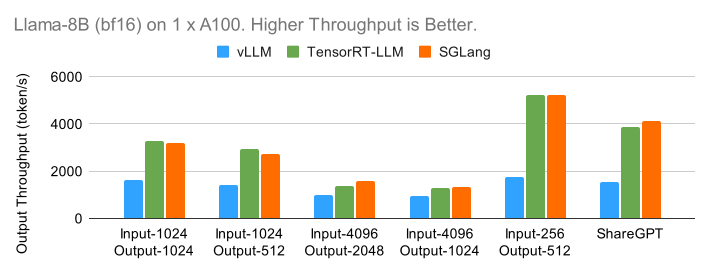
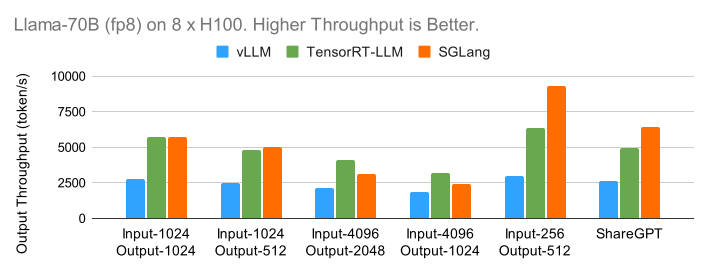
Learn more at this [blog](https://lmsys.org/blog/2024-07-25-sglang-llama3/).
|
||
|
||
## Roadmap
|
||
[Development Roadmap (2024 Q3)](https://github.com/sgl-project/sglang/issues/634)
|
||
|
||
## Citation And Acknowledgment
|
||
Please cite our paper, [SGLang: Efficient Execution of Structured Language Model Programs](https://arxiv.org/abs/2312.07104), if you find the project useful.
|
||
We also learned from the design and reused code from the following projects: [Guidance](https://github.com/guidance-ai/guidance), [vLLM](https://github.com/vllm-project/vllm), [LightLLM](https://github.com/ModelTC/lightllm), [FlashInfer](https://github.com/flashinfer-ai/flashinfer), [Outlines](https://github.com/outlines-dev/outlines), and [LMQL](https://github.com/eth-sri/lmql).
|