191 lines
7.6 KiB
Markdown
191 lines
7.6 KiB
Markdown

|
---
|
|||
|
|
license: apache-2.0
|
|||
|
|
language:
|
|||
|
|
- nb
|
|||
|
|
- nn
|
|||
|
|
- 'no'
|
|||
|
|
- se
|
|||
|
|
- sv
|
|||
|
|
- da
|
|||
|
|
- en
|
|||
|
|
- is
|
|||
|
|
- fo
|
|||
|
|
base_model:
|
|||
|
|
- norallm/normistral-11b-warm
|
|||
|
|
library_name: transformers
|
|||
|
|
pipeline_tag: text-generation
|
|||
|
|
tags:
|
|||
|
|
- norwegian
|
|||
|
|
- sami
|
|||
|
|
- bokmaal
|
|||
|
|
- nynorsk
|
|||
|
|
---
|
|||
|
|
|
|||
|
|

|
|||
|
|
|
|||
|
|
|
|||
|
|
**NorMistral-11b-long** is a length-extended version of [NorMistral-11b-warm](https://huggingface.co/norallm/normistral-11b-warm). It has been extended to 32,768 context length by continual training on additional 50 billion subword tokens – using a mix of Scandinavian, Sámi, English and code data (four repetitions of open Norwegian texts). The model follows our earlier paper [Small Languages, Big Models: A Study of Continual Training on Languages of Norway](https://arxiv.org/abs/2412.06484) by Samuel et al. 2025, and forms part of the NORA.LLM family developed by [the Language Technology Group at the University of Oslo (LTG)](https://huggingface.co/ltg).
|
|||
|
|
|
|||
|
|
*Disclaimer: This model is pretrained on raw (mostly web-based) textual data. It is not finetuned to follow instructions, and it can generate harmful completions after inappropriate user prompts. It is primarily intended for research purposes.*
|
|||
|
|
|
|||
|
|
|
|||
|
|
## License
|
|||
|
|
|
|||
|
|
We release the model under Apache 2.0 license to indicate that we do not impose any additional constraints on the model weights.
|
|||
|
|
However, we do not own the data in the training collection.
|
|||
|
|
|
|||
|
|
|
|||
|
|
## Pretraining corpus
|
|||
|
|
|
|||
|
|
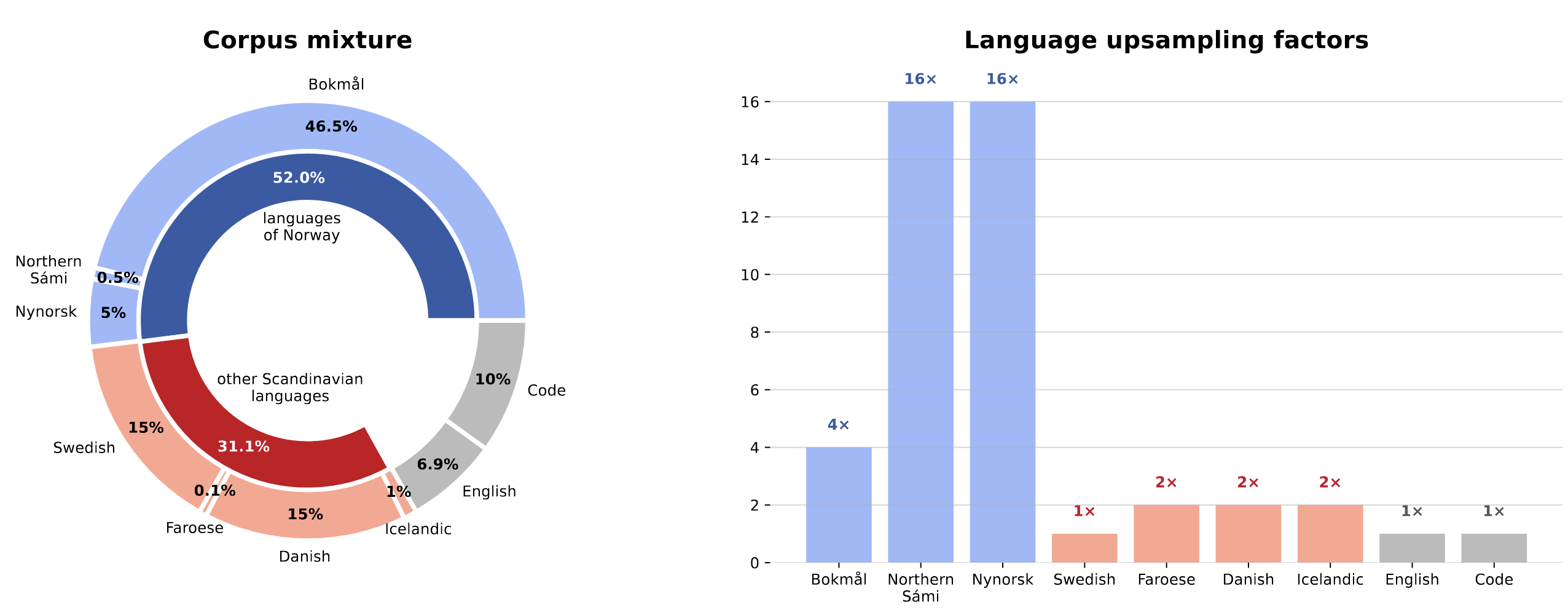
The model is pretrained on a combination of publicly available data and a custom web crawl for Sámi. The total training corpus consists of 250 billion tokens from the following sources:
|
|||
|
|
|
|||
|
|
1. Norwegian text (Bokmål and Nynorsk); this collection was created by the National Library of Norway and it's a prerelease of an update of NCC (codenamed "Mímir core"). It consists of: a) the public part of [Norwegian Colossal Corpus (NCC)](https://huggingface.co/datasets/NbAiLab/NCC) with permissible licenses (i.e. it doesn't include newspaper texts with the CC BY-NC 2.0 license); b) Bokmål and Nynorsk [CulturaX](https://huggingface.co/datasets/uonlp/CulturaX), and c) Bokmål and Nynorsk [HPLT corpus v1.2](https://hplt-project.org/datasets/v1.2).
|
|||
|
|
|
|||
|
|
2. Northern Sámi texts are sourced from a) [Glot500](https://huggingface.co/datasets/cis-lmu/Glot500); b) [the SIKOR North Saami free corpus](https://repo.clarino.uib.no/xmlui/handle/11509/100); and c) a custom web crawl (seeded from Sámi Wikipedia external links) published separately as [`ltg/saami-web`](https://huggingface.co/datasets/ltg/saami-web).
|
|||
|
|
|
|||
|
|
3. Additional languages for knowledge/language transfer: a) Danish, Swedish, Icelandic, and Faroese from CulturaX and Glot500; b) high-quality English from [FineWeb-edu](https://huggingface.co/datasets/HuggingFaceFW/fineweb-edu); and c) programming code from [The Stack v2 (the high-quality subset)](https://huggingface.co/datasets/bigcode/the-stack-v2-train-smol-ids).
|
|||
|
|
|
|||
|
|
The corpus is carefully balanced through strategic upsampling to handle the resource disparity between languages. Following data-constrained scaling laws, the corpus data for target languages is repeated multiple times (up to 16x for low-resource languages) to reach the optimal training budget while avoiding overfitting:
|
|||
|
|
|
|||
|
|
|
|||
|
|
|
|||
|
|
|
|||
|
|
|
|||
|
|
## Tokenizer
|
|||
|
|
|
|||
|
|
This model uses a new tokenizer, specially trained on the target languages. Therefore it offers substantially faster inference than the original Mistral-Nemo-Base-2407 model. Here are the subword-to-word split ratios across different languages:
|
|||
|
|
|
|||
|
|
| Tokenizer | # tokens | Bokmål | Nynorsk | Sámi | Danish | Swedish |
|
|||
|
|
|:------------|:--------:|:--------:|:---------:|:-------:|:--------:|:---------:|
|
|||
|
|
| Mistral-Nemo-Base-2407 | 131072 | 1.79 | 1.87 | 2.63 | 1.82 | 2.00 |
|
|||
|
|
| NorMistral-11b-long | 51200 | 1.22 | 1.28 | 1.82 | 1.33 | 1.39 |
|
|||
|
|
|
|||
|
|
|
|||
|
|
## Model details
|
|||
|
|
|
|||
|
|
**Model Developers:** Language Technology Group at the University of Oslo in collaboration with NORA.LLM.
|
|||
|
|
|
|||
|
|
**Architecture:** NorMistral-11B uses the Mistral architecture based on an improved Llama design, featuring:
|
|||
|
|
- Pre-normalization with RMSNorm
|
|||
|
|
- SwiGLU activation function
|
|||
|
|
- Rotary positional embeddings
|
|||
|
|
- Grouped-query attention
|
|||
|
|
- 40 transformer layers
|
|||
|
|
- Hidden dimension: 5,120
|
|||
|
|
- Intermediate dimension: 14,336
|
|||
|
|
- 32 query heads and 8 key & value heads (dimension 128)
|
|||
|
|
- Vocabulary size: 51,200 tokens
|
|||
|
|
- Total parameters: 11.4 billion
|
|||
|
|
|
|||
|
|
**Training Details:**
|
|||
|
|
- Training tokens: 250 + 50 billion
|
|||
|
|
- Batch size: 128 × 32,768 tokens (# sequences × sequence length)
|
|||
|
|
- Training steps: 12,000
|
|||
|
|
|
|||
|
|
|
|||
|
|
**Base Model:** Initialized from NorMistral-11b-warm
|
|||
|
|
|
|||
|
|
**License:** Apache-2.0
|
|||
|
|
|
|||
|
|
|
|||
|
|
|
|||
|
|
## Example usage
|
|||
|
|
|
|||
|
|
### Basic Causal Language Model Usage
|
|||
|
|
|
|||
|
|
Here's how to use NorMistral-11B as a standard causal language model for translation:
|
|||
|
|
|
|||
|
|
```python
|
|||
|
|
from transformers import AutoTokenizer, AutoModelForCausalLM
|
|||
|
|
import torch
|
|||
|
|
|
|||
|
|
# Import the tokenizer and model
|
|||
|
|
tokenizer = AutoTokenizer.from_pretrained("norallm/normistral-11b-long")
|
|||
|
|
model = AutoModelForCausalLM.from_pretrained("norallm/normistral-11b-long").cuda().eval()
|
|||
|
|
|
|||
|
|
# Define zero-shot translation prompt template
|
|||
|
|
prompt = """Engelsk: {0}
|
|||
|
|
Bokmål:"""
|
|||
|
|
|
|||
|
|
# Define tokens that should end the generation (any token with a newline)
|
|||
|
|
eos_token_ids = [
|
|||
|
|
token_id
|
|||
|
|
for token_id in range(tokenizer.vocab_size)
|
|||
|
|
if '\n' in tokenizer.decode([token_id])
|
|||
|
|
]
|
|||
|
|
|
|||
|
|
# Generation function
|
|||
|
|
@torch.no_grad()
|
|||
|
|
def generate(text):
|
|||
|
|
text = prompt.format(text)
|
|||
|
|
input_ids = tokenizer(text, return_tensors='pt').input_ids.cuda()
|
|||
|
|
prediction = model.generate(
|
|||
|
|
input_ids,
|
|||
|
|
max_new_tokens=64,
|
|||
|
|
do_sample=False,
|
|||
|
|
eos_token_id=eos_token_ids
|
|||
|
|
)
|
|||
|
|
return tokenizer.decode(prediction[0, input_ids.size(1):]).strip()
|
|||
|
|
|
|||
|
|
# Example usage
|
|||
|
|
generate("I'm excited to try this new Norwegian language model!")
|
|||
|
|
# > Expected output: 'Jeg er spent på å prøve denne nye norske språkmodellen!'
|
|||
|
|
```
|
|||
|
|
|
|||
|
|
### Memory-Efficient Loading
|
|||
|
|
|
|||
|
|
For systems with limited VRAM, you can load the model in 8-bit or 4-bit quantization:
|
|||
|
|
|
|||
|
|
```python
|
|||
|
|
import torch
|
|||
|
|
from transformers import AutoTokenizer, AutoModelForCausalLM
|
|||
|
|
|
|||
|
|
tokenizer = AutoTokenizer.from_pretrained("norallm/normistral-11b-long")
|
|||
|
|
|
|||
|
|
# Load in 8-bit mode (requires ~12GB VRAM)
|
|||
|
|
model = AutoModelForCausalLM.from_pretrained(
|
|||
|
|
"norallm/normistral-11b-long",
|
|||
|
|
device_map='auto',
|
|||
|
|
load_in_8bit=True,
|
|||
|
|
torch_dtype=torch.bfloat16
|
|||
|
|
)
|
|||
|
|
|
|||
|
|
# Or load in 4-bit mode (requires ~8GB VRAM)
|
|||
|
|
model = AutoModelForCausalLM.from_pretrained(
|
|||
|
|
"norallm/normistral-11b-long",
|
|||
|
|
device_map='auto',
|
|||
|
|
load_in_4bit=True,
|
|||
|
|
torch_dtype=torch.bfloat16
|
|||
|
|
)
|
|||
|
|
```
|
|||
|
|
|
|||
|
|
|
|||
|
|
## Citation
|
|||
|
|
|
|||
|
|
```bibtex
|
|||
|
|
@inproceedings{samuel-etal-2025-small,
|
|||
|
|
title = "Small Languages, Big Models: {A} Study of Continual Training on Languages of {Norway}",
|
|||
|
|
author = "Samuel, David and
|
|||
|
|
Mikhailov, Vladislav and
|
|||
|
|
Velldal, Erik and
|
|||
|
|
{\O}vrelid, Lilja and
|
|||
|
|
Charpentier, Lucas Georges Gabriel and
|
|||
|
|
Kutuzov, Andrey and
|
|||
|
|
Oepen, Stephan",
|
|||
|
|
editor = "Johansson, Richard and
|
|||
|
|
Stymne, Sara",
|
|||
|
|
booktitle = "Proceedings of the Joint 25th Nordic Conference on Computational Linguistics and 11th Baltic Conference on Human Language Technologies (NoDaLiDa/Baltic-HLT 2025)",
|
|||
|
|
month = mar,
|
|||
|
|
year = "2025",
|
|||
|
|
address = "Tallinn, Estonia",
|
|||
|
|
publisher = "University of Tartu Library",
|
|||
|
|
url = "https://aclanthology.org/2025.nodalida-1.61/",
|
|||
|
|
pages = "573--608",
|
|||
|
|
ISBN = "978-9908-53-109-0",
|
|||
|
|
}
|
|||
|
|
```
|
|||
|
|
|
|||
|
|
## Contact
|
|||
|
|
|
|||
|
|
Please write [a community message](https://huggingface.co/norallm/normistral-11b-long/discussions) or contact David Samuel (davisamu@ifi.uio.no) if you have any questions about this model.
|