--- license: apache-2.0 language: - en tags: - markdown - document-structure - heading-prediction - pdf-to-markdown - fine-tuned base_model: Qwen/Qwen3-0.6B datasets: - joelbarmettler/md-reheader-dataset metrics: - accuracy - exact_match pipeline_tag: text-generation library_name: transformers ---

md-reheader

Restore heading hierarchy in markdown documents with a fine-tuned 0.6B LLM.

PyPI Python 3.12+ Apache 2.0 HuggingFace Model HuggingFace Dataset GitHub stars

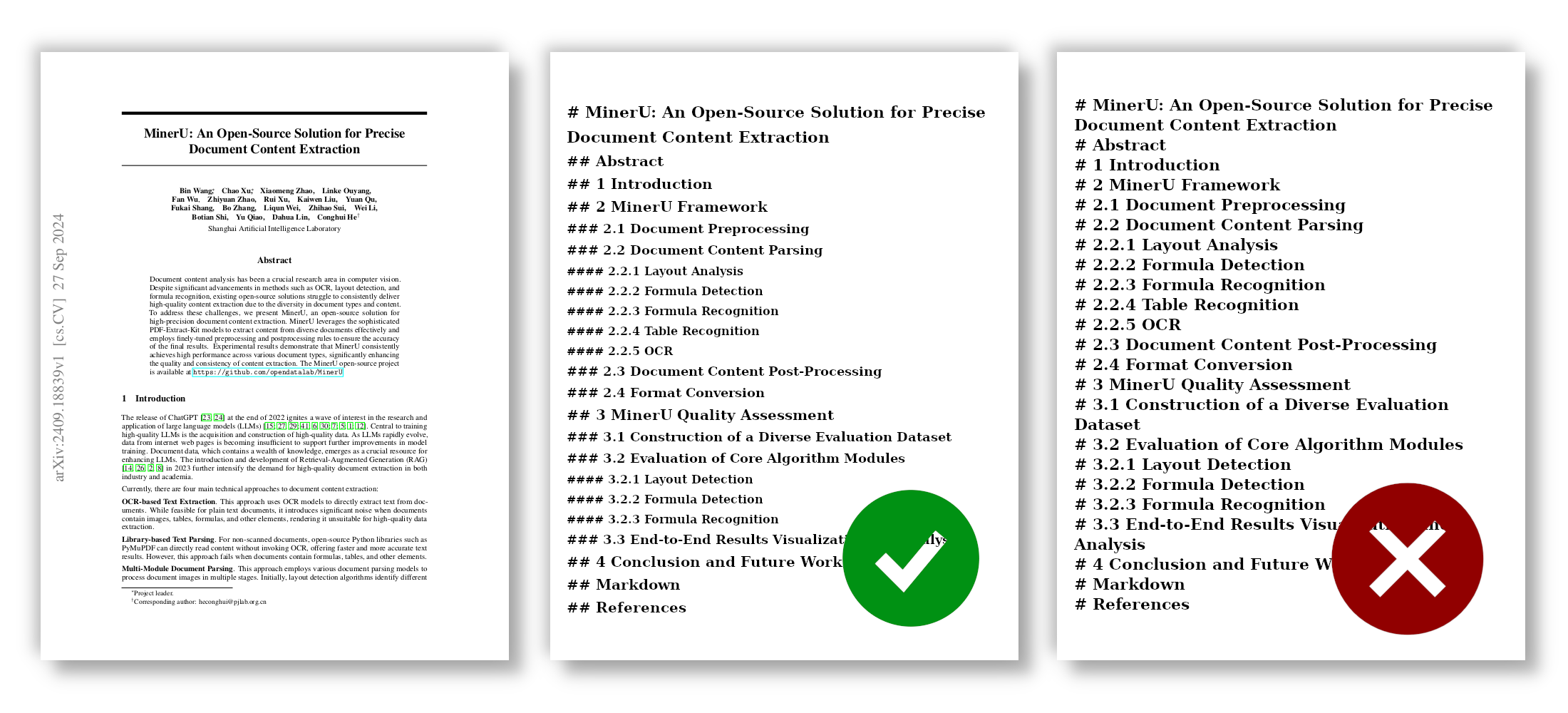
--- ## The problem PDF-to-markdown tools like [MinerU](https://github.com/opendatalab/MinerU), [Docling](https://github.com/DS4SD/docling), and [Marker](https://github.com/VikParuchuri/marker) do great text extraction — then collapse your document structure. Every heading becomes `#` or `##`. TOCs break. RAG chunking breaks. Navigation breaks. **md-reheader** fixes it. A 0.6B-parameter Qwen3 fine-tune reads the document and predicts the correct H1–H6 level for every heading in a single forward pass.

Source PDF → md-reheader → hierarchy restored vs. flat PDF-parser output

--- ## Quick start ### CLI ```bash pip install md-reheader rehead --input flat.md --output fixed.md ``` Auto-detects CUDA. Use `--cpu` or `--gpu` to override. Omit `--output` to stream to stdout (pipe-friendly). ```bash rehead -i flat.md | tee fixed.md # pipe rehead -i flat.md --gpu -o out/fixed.md # creates nested dirs rehead --help # all flags ``` ### Python API ```python from md_reheader.inference.predict import load_model, reheader_document model, tokenizer = load_model("joelbarmettler/md-reheader") flat = open("document.md").read() fixed = reheader_document(flat, model, tokenizer) ``` The package handles preprocessing (flattening + body stripping) and postprocessing (applying predicted levels back to the original document) automatically. ### Direct `transformers` usage ```python import torch from transformers import AutoModelForCausalLM, AutoTokenizer tokenizer = AutoTokenizer.from_pretrained("joelbarmettler/md-reheader") model = AutoModelForCausalLM.from_pretrained( "joelbarmettler/md-reheader", dtype=torch.bfloat16, device_map="auto", ) messages = [ {"role": "system", "content": "You are a markdown document structure expert. Given a markdown document with incorrect or flattened heading levels, output each heading with its correct markdown prefix (# for level 1, ## for level 2, etc.), one per line."}, {"role": "user", "content": "# Introduction\n\nSome text...\n\n# Background\n\nMore text...\n\n# Methods"}, ] input_text = tokenizer.apply_chat_template( messages, tokenize=False, add_generation_prompt=True, enable_thinking=False, ) inputs = tokenizer(input_text, return_tensors="pt").to(model.device) with torch.no_grad(): outputs = model.generate(**inputs, max_new_tokens=4096, do_sample=False) generated = outputs[0][inputs["input_ids"].shape[1]:] print(tokenizer.decode(generated, skip_special_tokens=True)) # # Introduction # ## Background # ## Methods ``` > **Important:** pass `enable_thinking=False` to `apply_chat_template`. Without it, the model enters a repetition loop because training used the non-thinking chat format. --- ### Self-host with vLLM md-reheader exposes the standard OpenAI-compatible chat endpoint when served with [vLLM](https://github.com/vllm-project/vllm) — higher throughput than raw `transformers`, and drop-in client compatibility. ```bash pip install vllm vllm serve joelbarmettler/md-reheader --dtype bfloat16 --max-model-len 8192 ``` On <10 GB cards (e.g. RTX 2000/3060), add `--enforce-eager --gpu-memory-utilization 0.70` to skip CUDA-graph allocations that otherwise OOM. ### Remote inference (vLLM or any OpenAI-compatible endpoint) Once a server is running, use md-reheader as a thin client — no local weights needed. **CLI:** ```bash rehead -i flat.md -o fixed.md --endpoint http://localhost:8000/v1 # With auth: rehead -i flat.md -o fixed.md --endpoint https://api.example.com/v1 --api-key sk-xxx # or set MD_REHEADER_API_KEY in the environment ``` **Python:** ```python from md_reheader.inference.remote import reheader_document_remote fixed = reheader_document_remote( open("flat.md").read(), endpoint="http://localhost:8000/v1", model="joelbarmettler/md-reheader", api_key=None, # or a bearer token ) ``` The remote client preprocesses locally (flatten + strip), sends a chat completion to the server with `chat_template_kwargs={"enable_thinking": false}` to match training, and applies predicted levels back to the original document. Identical output to local inference. ## How it works ``` flat markdown ──► flatten headings to # ──► strip body to 128+128 tokens │ ▼ restored markdown ◄── apply predicted levels ◄── Qwen3-0.6B (fine-tuned) ``` 1. Extract headings with [markdown-it-py](https://github.com/executablebooks/markdown-it-py) (correctly skips code blocks). 2. Flatten every heading to `# ` — the model ignores input levels. 3. Strip each section's body to its first 128 + last 128 tokens — preserves structural cues, kills the context bloat. 4. Qwen3-0.6B predicts the correct `#` prefix per heading. 5. Levels get mapped back to the original document. --- ## Evaluation Benchmarked on 7,321 held-out documents from GitHub markdown and Wikipedia. | Metric | All-H1 baseline | Heuristic | **md-reheader** | |-------------------------|:---------------:|:---------:|:---------------:| | Exact match | 0.0% | 14.5% | **56.1%** | | Per-heading accuracy | 13.1% | 49.1% | **80.6%** | | Hierarchy preservation | 61.3% | 68.6% | **91.0%** | | Mean absolute error | 1.38 | 0.62 | **0.22** | ### Per-level accuracy | | H1 | H2 | H3 | H4 | H5 | H6 | |----------|:---:|:---:|:---:|:---:|:---:|:---:| | Accuracy | 77% | 85% | 78% | 68% | 45% | 50% | H1–H3 land in the 77–85% band; H5/H6 drop but still beat baselines. Most deep-level errors are off-by-one — the relative structure survives. ### By document depth | Max depth | Exact match | Per-heading accuracy | Hierarchy | |-----------|:-----------:|:--------------------:|:---------:| | Depth 2 | 83% | 91% | 95% | | Depth 3 | 54% | 82% | 90% | | Depth 4 | 32% | 70% | 88% | | Depth 5-6 | 33% | 65% | 89% | ### By source | Source | Exact match | Per-heading accuracy | |-------------------|:-----------:|:--------------------:| | GitHub markdown | 49.5% | 74.0% | | Wikipedia | 71.3% | 95.5% | --- ## Speed | Document size | RTX 4090 (BF16) | CPU (fp32) | |---------------|:---------------:|:----------:| | < 1k tokens | 0.4s | 5s | | 1k–2k tokens | 0.8s | 10s | | 2k–4k tokens | 1.4s | ~20s | | 4k–8k tokens | 3.4s | ~60s | Documents longer than ~8k tokens (after stripping) are truncated from the tail. --- ## Training | Item | Value | |-------------------|------------------------------------------------------------| | Base model | [Qwen/Qwen3-0.6B](https://huggingface.co/Qwen/Qwen3-0.6B) (text-only) | | Framework | [Axolotl](https://github.com/axolotl-ai-cloud/axolotl) | | Training data | ~197k markdown docs (GitHub + Wikipedia, depth 4+ oversampled 2–8×) | | Hardware | 2× RTX 4090, DDP, BF16 | | Sequence length | 8,192 tokens with sample packing | | Learning rate | 5e-5, cosine schedule | | Epochs | 2 (epoch-1 checkpoint — epoch 2 overfits) | | Effective batch | 24 | ### Input format during training 1. All headings flattened to `# `. 2. Body text per section truncated to first 128 + last 128 tokens. 3. Document truncated to 8k tokens. 4. Assistant output: one heading per line with its correct `#` prefix. --- ## Limitations - **Deep nesting (H5/H6):** accuracy drops to 45–50%. Relative structure is preserved but absolute depth gets compressed by 1–2 levels. - **Ambiguous structure:** heading levels are subjective. The model learns common conventions; it can't resolve genuine ambiguity. - **Long documents:** >8k tokens (after stripping) get truncated. Headings past the cutoff retain their input levels. - **English-centric:** trained primarily on English content. --- ## Author Built by [Joel Barmettler](https://joelbarmettler.xyz/). ## Citation ```bibtex @software{barmettler2026mdreheader, author = {Barmettler, Joel}, title = {md-reheader: Restoring Heading Hierarchy in Markdown Documents}, year = {2026}, url = {https://github.com/joelbarmettlerUZH/md-reheader} } ```