# Netloader Guide
This guide provides instructions for using **Netloader** as a weight-loader plugin for acceleration in **vLLM Ascend**.
---
## Overview
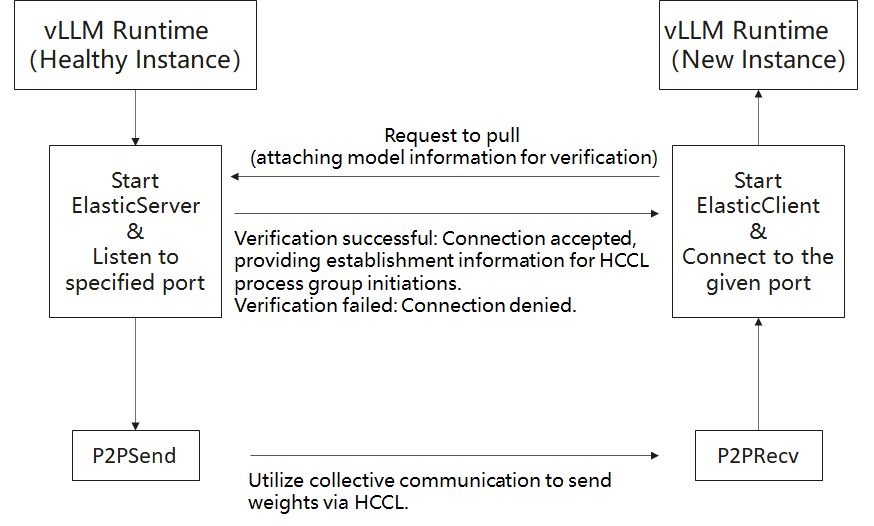
Netloader leverages high-bandwidth peer-to-peer (P2P) transfers between NPU cards to load model weights. It is implemented as a plugin (via the `register_model_loader` API added in vLLM 0.10). The workflow is:
1. A **server** preloads a model.
2. A new **client** instance requests weight transfer.
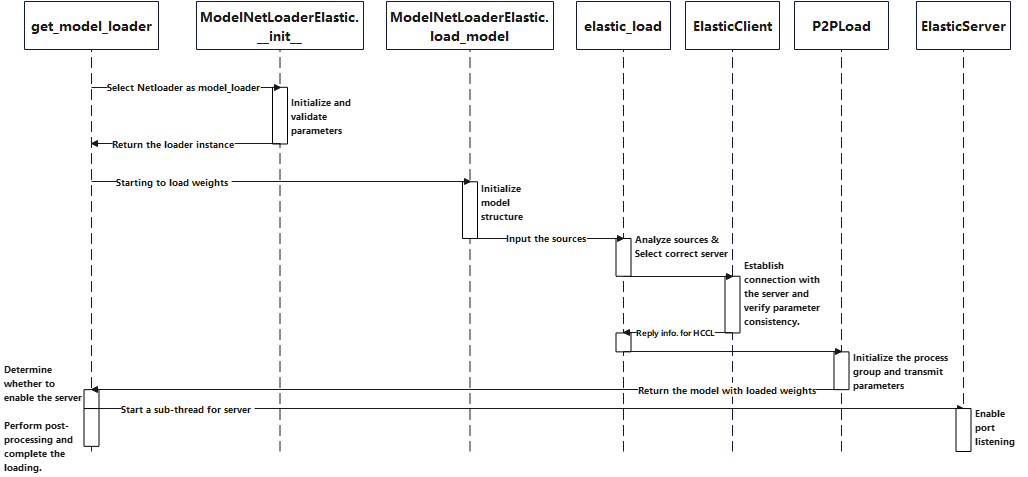
3. After validating that the model and partitioning match, the client uses HCCL collective communication (send/recv) to receive weights in the same order as stored in the model.
The server runs alongside normal inference tasks via sub-threads and via `stateless_init_torch_distributed_process_group` in vLLM. The client thus takes over weight initialization without needing to load from storage.
### Flowchart
### Timing Diagram
### Application Scenarios
- **Reduce startup latency**: By reusing already loaded weights and transferring them directly between NPU cards, Netloader cuts down model loading time vs conventional remote/local pull strategies.
- **Relieve network & storage load**: Avoid repeated downloads of weight files from remote repositories, thus reducing pressure on central storage and network traffic.
- **Improve resource utilization & lower cost**: Faster loading allows less reliance on standby compute nodes; resources can be scaled up/down more flexibly.
- **Enhance business continuity & high availability**: In failure recovery, new instances can quickly take over without long downtime, improving system reliability and user experience.
---
## Usage
To enable Netloader, pass `--load-format=netloader` and provide configuration via `--model-loader-extra-config` (as a JSON string). Below are the supported configuration fields:
| Field Name | Type | Description | Allowed Values / Notes |
|--------------------|---------|------------------------------------------------------------------------------------------------------|--------------------------------------------------------------------------------------------------------------|
| **SOURCE** | List | Weighted data sources. Each item is a map with `device_id` and `sources`, specifying the rank and its endpoints (IP:port).
Example: `{"SOURCE": [{"device_id": 0, "sources": ["10.170.22.152:19374"]}, {"device_id": 1, "sources": ["10.170.22.152:11228"]}]}`
If omitted or empty, fallback to default loader. The SOURCE here is second priority. | A list of objects with keys `device_id: int` and `sources: List[str]` |
| **MODEL** | String | The model name, used to verify consistency between client and server. | Defaults to the `--model` argument if not specified. |
| **LISTEN_PORT** | Integer | Base port for the server listener. | The actual port = `LISTEN_PORT + RANK`. If omitted, a random valid port is chosen. Valid range: 1024–65535. If out of range, that server instance won’t open a listener. |
| **INT8_CACHE** | String | Behavior for handling int8 parameters in quantized models. | One of `["hbm", "dram", "no"]`.
- `hbm`: copy original int8 parameters to high-bandwidth memory (HBM) (may cost a lot of HBM).
- `dram`: copy to DRAM.
- `no`: no special handling (may lead to divergence or unpredictable behavior). Default: `"no"`. |
| **INT8_CACHE_NAME** | List | Names of parameters to which `INT8_CACHE` is applied (i.e. filtering). | Default: `None` (means no filtering—all parameters). |
| **OUTPUT_PREFIX** | String | Prefix for writing per-rank listener address/port files in server mode. | If set, each rank writes to `{OUTPUT_PREFIX}{RANK}.txt` (text), content = `IP:Port`. |
| **CONFIG_FILE** | String | Path to a JSON file specifying the above configuration. | If provided, the SOURCE inside this file has **first priority** (overrides SOURCE in other configs). |
---
## Example Commands & Placeholders
> Replace parts in `` `<...>` `` before running.
### Server
```shell
VLLM_SLEEP_WHEN_IDLE=1 vllm serve `` \
--tensor-parallel-size 1 \
--served-model-name `` \
--enforce-eager \
--port `` \
--load-format netloader
```
### Client
```shell
export NETLOADER_CONFIG='{"SOURCE":[{"device_id":0, "sources": ["``:``"]}]}'
VLLM_SLEEP_WHEN_IDLE=1 ASCEND_RT_VISIBLE_DEVICES=`` \
vllm serve `` \
--tensor-parallel-size 1 \
--served-model-name `` \
--enforce-eager \
--port `` \
--load-format netloader \
--model-loader-extra-config="${NETLOADER_CONFIG}"
```
#### Placeholder Descriptions
- ``: Path to the model file
- ``: Model name (must match between server & client)
- ``: Base listening port on server
- `` + ``: IP and port of the Netloader server (from server log)
- ``: Client device ID (must differ from server’s)
- ``: Port on which client listens
After startup, you can test consistency by issuing inference requests with temperature = 0 and comparing outputs.
---
## Note & Caveats
- If Netloader is used, **each worker process** must bind a listening port. That port may be user-specified or assigned randomly. If user-specified, ensure it is available.
- Netloader requires extra HBM memory to establish HCCL connections (i.e. `HCCL_BUFFERSIZE`, default ~200 MB). Users should reserve sufficient capacity (e.g. via `--gpu-memory-utilization`).
- It is recommended to set `VLLM_SLEEP_WHEN_IDLE=1` to mitigate unstable or slow connections/transmissions. Related info: [vLLM Issue #16660](https://github.com/vllm-project/vllm/issues/16660), [vLLM PR #16226](https://github.com/vllm-project/vllm/pull/16226).